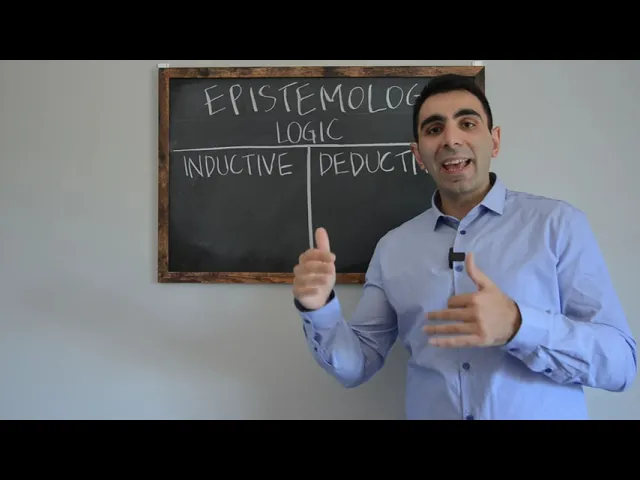
hello everyone welcome to our lecture on epistemology um if you remember from our very first lecture on world view epistemology composed one of the three parts of world view it was really the concept of knowledge i wish we can go through multiple aspects of epistemology but this class just does not give us the room so all we're going to talk about regarding epistemology is the concept of logic humans reason or do logic in two and only two ways they do inductive reasoning and they do deductive reasoning uh inductive reasoning is what a detective does so
if you come to a dead body and you see my knife in his back you see my shoes there you take dna and you see my blood there what conclusion do you draw that i murdered him congratulations you've just done inductive reasoning some of you when this lecture started did inductive reasoning going oh he's wearing the same shirt so he's recorded all these lectures on the same day that's right you've just done inductive reasoning you've taken data points and you've used those data points to create a hypothesis in the explanation of those data points that's
inductive reasoning so you can think of it going from data points to explanation or hypothesis the other form of reasoning is deductive reasoning for example if a then b if b density a therefore some of your minds jump right to c you've just done deductive reasoning you go from premises to conclusions the distinction between inductive reasoning and deductive reasoning is inductive reasoning its conclusions or hypotheses or explanations are never certain never ever ever you would need all the data in the world to have a sure conclusion which no human being has deductive reasoning on the
other hand if you're actually doing the right premises that conclusions are a hundred percent certain now there's deductive fallacies that a lot of people do pretending to do deductive reasoning and they're wrong but as long as the premises are true the conclusion 100 follows so inductive reasoning data points hypothesis you're never 100 sure deductive reasoning premises all cows have four legs right it is a cow that's your second premise therefore it it has four legs you've just done deductive reasoning as long as you're 100 sure the premises are right and you didn't do an error
in deductive reasoning the conclusion is certain all right i have to give you a quick history lesson that goes along with this there is an invisible line that separates all of europe it's like somewhere south of paris below the line everyone eats fish and drinks wine above the line everyone eats beef and drinks beer that's an invisible line that breaks europe into north and south in the 1300s southern europe went through a movement called the renaissance northern europe later about 100 years 150 years later goes through a movement called the reformation when it goes through
the reformation that movement opens the door for another movement a hundred years after the reformation that movement is called the enlightenment and the enlightenment once again splits europe into two well not all of you're up again but just the northern part splits northern europe into two there's the island great britain where there's england scotland wells ireland and then there's the continent so mostly germany is what your mind thinks of but other places like northern france denmark those kind of countries that splits and the way it splits is based on the types of reasoning on the
island they believed all human knowledge must begin with inductive reasoning and that brings forth the scientific revolution and all that on the continent they believe all reasoning must begin with deductive reasoning on the island they're called empiricists because they begin with empirical data on the continent they're called rationalists until next time



![Chris Langan - The Interview THEY Didn't Want You To See - CTMU [Full Version; Timestamps]](https://img.youtube.com/vi/9miVG2xT5jY/maxresdefault.jpg)