What if CERN has stumbled upon something so earth-shattering that it rewrites everything we thought we knew? Nestled in the heart of groundbreaking research since the 1950s, this legendary center has always flirted with the edges of scientific understanding. What does this startling discovery mean for us?
Let’s as we dig into this alarming revelation. Exposing the Secrets of the Universe One of CERN's most famous projects is the Large Hadron Collider, the world's largest particle accelerator. It stretches over 27 kilometers in a circle and cost over four and a half billion dollars.
Many argue this was money well spent because the LHC has led to some of the biggest discoveries in recent years, like finding the Higgs boson and other unknown particles. This huge machine can speed up various particles around its loop until they are almost at the speed of light, completing over 11,000 laps per second. This is possible thanks to extremely powerful electromagnets that create a magnetic field inside the accelerator, which is over a thousand times stronger than the Earth's natural magnetic field.
Some people were worried that generating such a strong magnetic field might affect local electronics and even the Earth's magnetic field. When these particles reach their maximum speed, which is 99. 999991% of the speed of light, they are made to collide with each other in powerful crashes that release huge amounts of energy and various particles.
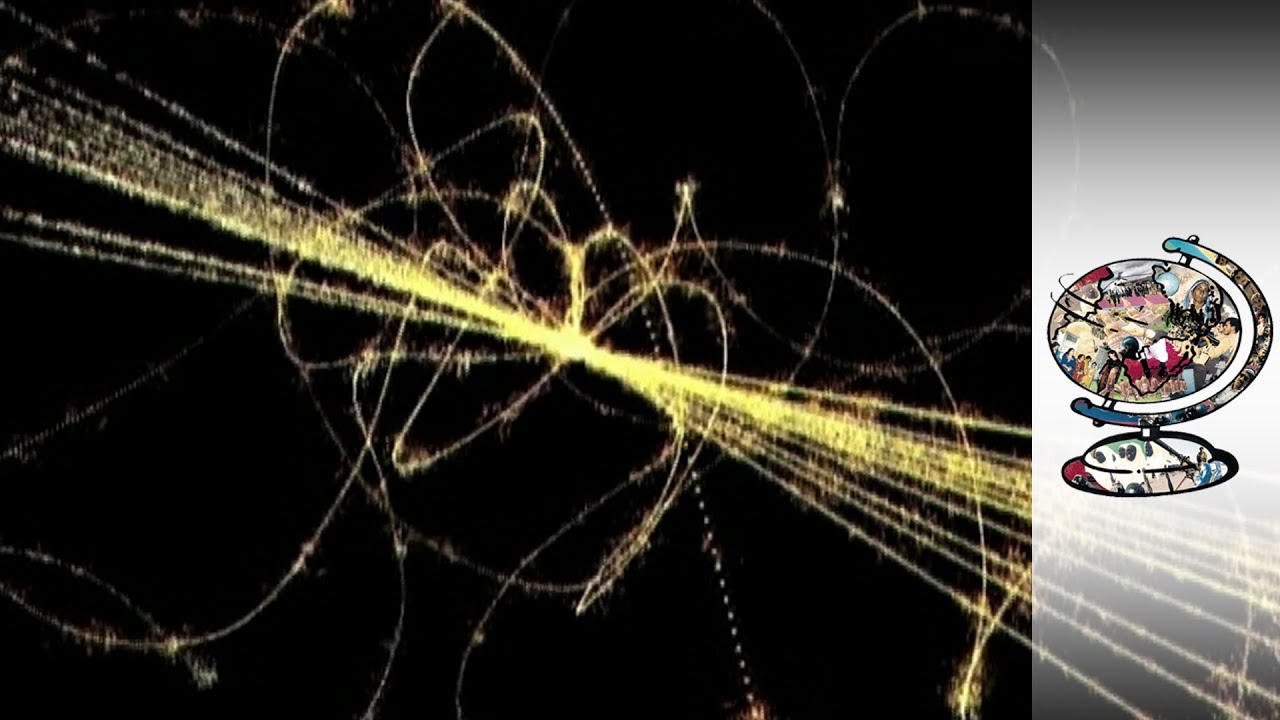
These particle collisions create showers of particles that scatter in all directions, existing only for tiny fractions of a second before disappearing. By using different types of particles, researchers can discover new particles in these bursts. Super-sensitive detectors are placed around the collision sites to capture all the information from each collision.
The amount of data collected from these experiments is enormous and greatly adds to our understanding of the fundamental parts of the universe. This research at CERN keeps pushing the boundaries of human knowledge, challenging our understanding of the physical world, and driving the development of new technologies and theories. But the real surprise is just how much we still have to learn about our universe.
The Large Hadron Collider is a bustling place where scientists from all over the world collect huge amounts of data from tiny particle collisions. Each year, these experiments produce over 15 petabytes of raw data, which scientists then carefully analyze. In 2017, the LHC achieved a major milestone by storing over 200 petabytes of data in its tape libraries.
To put this in perspective, one petabyte equals about 250,000 movies. Scientists are always looking for anything unusual in the data. Recently, they noticed something odd with a type of particle called the beauty quark.
Quarks are the basic building blocks of everything and come in different types, or flavors. The beauty quark, based on the Standard Model—a framework describing the behavior of basic particles—should decay into lighter particles called leptons, either an electron or a muon, due to the weak force. But the LHC data showed something strange: beauty quarks were decaying into muons 70 times more often than into electrons.
Normally, this should happen equally often, about 50-50. This unexpected ratio suggests there might be a new type of particle involved, leading some scientists to think there could be new physics beyond the Standard Model. Discovering a new particle could change our understanding of physics and answer many unresolved questions.
The Standard Model is very precise but only explains three of the four fundamental forces: electromagnetic, strong, and weak forces. It doesn't include gravity or explain dark matter, which makes up most of the universe. This anomaly with the beauty quark might lead to groundbreaking discoveries, hinting at physics we don't yet understand and potentially changing how we see the universe's basic workings.
The search for this new particle and the forces it might reveal continues to excite scientists, holding the promise of deeper insights into the mysteries of the cosmos. New findings at the LHC challenge what we know about particles. New Lethal Forces with the LHC The anomaly suggests that our current understanding might be incomplete, pushing scientists to explore new ideas.
In a recent experiment, the Large Hadron Collider found data that didn't match the usual rules of particle physics. While it's normal for results to sometimes be different, this case got a lot of attention from scientists. They are now looking closely at this strange result to see what it means.
The excitement is about a possible new particle called Z Prime. This particle might be a new kind of force, but very weak, which is why we haven't noticed it before. Scientists think this force might interact differently with electrons and muons compared to other known forces.
If they confirm this new force, it could change a lot. For years, physicists have been looking for clues to help understand big mysteries of the universe, like dark matter or the true role of the Higgs boson. Some even think this new force might help unify all the fundamental forces of nature, which is a major goal in physics.
If Z Prime is real, it could open new doors in physics, giving us insights to solve some of the biggest questions about the universe. CERN's ongoing research might just lead us to a major breakthrough in our understanding of everything around us. At the Large Hadron Collider (LHC), a fascinating experiment speeds up particles to an incredible 91 times the speed of light.
These particles are sent in opposite directions and then crash into each other with great force. This collision isn’t just a cool science trick; it creates a huge amount of energy and forms many new particles. When these particles collide, they scatter in all directions, but they only last for a very short time—most disappear almost instantly.
Right where these experiments happen, there are very sensitive detectors. These detectors are placed carefully around the collision points and their job is to catch every detail from these quick interactions. The amount of data collected is enormous.
Each year, the LHC gathers over 15 petabytes of raw data. To handle and study this huge amount of information, researchers spend countless hours going through it carefully. By 2017, the LHC had stored over 200 petabytes of data in its large tape libraries.
To put this in perspective, one petabyte can hold about 250,000 movies. You might wonder why they collect so much data. Among the many discoveries, one interesting find is about the behavior of a specific type of quark called the beauty quark.
Quarks are the building blocks of matter and come in different types, each with unique properties. These types can change quickly, turning into other particles almost immediately. The beauty quark, which changes in just a trillionth of a second, recently showed some surprising behaviors that didn’t match what scientists expected.
According to current theories, when beauty quarks change, they should turn into lighter particles called leptons—specifically, electrons or muons—in equal amounts. The LHC found that beauty quarks were changing into muons 70% of the time, much more often than into electrons. This strange finding suggests there might be an unknown particle affecting these changes, hinting at new physics we haven’t discovered yet.
This could mean a new particle that carries a force we don’t know about, possibly changing our understanding and expanding the standard model, which is the main framework of particle physics. The standard model explains particle physics very accurately, but it’s not perfect. These unusual quark changes raise big questions that challenge the model’s completeness.
Could we be on the verge of discovering new fundamental forces or particles? The ongoing research at the LHC is not only exploring the depths of particle physics but also holds the potential to change our understanding of the universe’s basic forces and structures. Now, let's see how these discoveries might change our main physics theory.
The Quest for the Elusive Z-prime Particle The Standard Model of particle physics describes three fundamental forces: electromagnetic, strong, and weak forces. However, it doesn't explain gravity or dark matter, which makes up most of the universe's matter. Recently, scientists found something unusual in their experiments that didn't match their predictions.
While unexpected results are common given the large amounts of data from the Large Hadron Collider (LHC), this finding caught researchers' attention and led to further investigation. Scientists think this anomaly might suggest a new fundamental force and the existence of a new particle, possibly called Z-prime. This particle could be a force carrier but is thought to be very weak, which is why it hasn’t been noticed before.
Some believe Z-prime might interact differently with electrons and muons compared to known particles, but how it fits with other particles in the Standard Model is still unclear. Discovering a new force-carrying particle would be a huge breakthrough in physics. It could help answer big questions about the universe, like the mysteries of dark matter and the Higgs boson.
Some scientists hope this could even lead to unifying the fundamental forces, a goal that has been pursued for over a century. Elon Musk praised CERN for their work on the Large Hadron Collider, the world's largest and most powerful particle collider, built between 1998 and 2008. This massive project involved over 10,000 scientists and hundreds of institutions from over 100 countries.
The collider is located in a 27-kilometer tunnel on the French-Swiss border near Geneva, about 175 meters underground. Since it began operating, the LHC has set energy records, with the first collision reaching 3. 5 teraelectron volts per beam—almost four times the previous world record.
Later improvements allowed it to reach 6. 5 teraelectron volts per beam. Musk noted that the LHC can accelerate not just proton beams, which are mainly used, but also lead ion beams.
Every year, for about a month, the LHC tests collisions between protons and lead ions to examine various theories in particle physics. These ongoing tests are crucial for understanding the basic components and forces of our universe. And this isn't where the excitement ends.
In physics, the Higgs boson, often called the Higgs, grabs the attention of scientists everywhere. This tiny particle is linked to the Higgs field and represents the energy that comes from that field, much like the waves you see on the ocean. The Higgs boson is unique among particles because it doesn't have the same properties as other basic particles or the ones that carry forces like electromagnetism or nuclear interactions.
Scientists have been on a mission to understand the Higgs boson, focusing their efforts at the Large Hadron Collider, the world's largest particle accelerator, located at CERN. Here, particles crash into each other at high speeds, creating and revealing rare particles like the Higgs. On July 4, 2012, scientists celebrated a major achievement when they discovered the Higgs boson.
They detected it mainly through two ways: its decay into a pair of photons and its decay into a pair of Z bosons, which are particles involved in weak interactions. But this wasn’t the end of the story. The discovery of the Higgs boson opened up new questions in particle physics.
The LHC's experiments, especially by the Atlas and CMS teams, have been digging deeper into the Higgs boson’s properties. This research will get a big boost with the High Luminosity upgrade of the LHC, planned for 2029. This upgrade will increase the number of particle collisions, making it easier to spot rare events that current theories might not fully explain.
Next, we look at how these insights affect ongoing experiments at CERN. CERN's Quest for 15 Million Higgs Bosons CERN expects that after the upgrade, they could produce 15 million Higgs bosons each year, up from 3 million in 2017. This increase could help find different types of Higgs bosons.
Some theories suggest there might be up to five types, with some appearing less often than others. Even before these upgrades, scientists had found good evidence for a type called the magnetic Higgs boson. But the journey doesn't stop there.
Researchers hope that studying the Higgs boson will reveal more secrets of the universe. Every experiment adds a piece to the puzzle, potentially leading to breakthroughs in understanding the basic forces and particles that make up everything. The excitement among scientists is growing as they stand on the brink of new discoveries, promising a future filled with scientific advancements and a better grasp of the world around us.
The Higgs field became a crucial idea just after the universe began, shaping the basic structure of space and time. This field is why matter acts the way it does and why particles have mass. Without the Higgs field and the Higgs boson, the universe would have no atoms, no stars, and no life.
The term God particle got attached to the Higgs boson after its discovery, mainly due to the media. This dramatic name comes from physicist Leon Lederman, who originally called it the goddamn particle because it was so hard to find. In the 1990s, when Lederman wrote a book about it, he wanted to call it The Goddamn Particle, but the publishers changed it to The God Particle to avoid controversy.
This name sparked many debates about the link between science and religion. The importance of the Higgs boson and its field is huge—without them, particles wouldn't have mass. Without mass, there'd be no galaxies, stars, planets, or life.
This is why the nickname, even if dramatic, highlights its importance. Scientists are still studying the Higgs boson to understand the early universe and how it stays stable over time. The Higgs field is special because it gives a baseline energy to the vacuum of space, which is crucial for the universe to exist.
Scientists think that by understanding this field's energy, they can explain why the electromagnetic force has an infinite range, while the weak force doesn't. They're also trying to see how Higgs bosons interact by creating pairs of these particles. Even though the Higgs boson gives mass to other particles, its own mass is still a mystery.
The theory doesn’t fully explain why its mass isn’t unstable due to quantum fluctuations, which could disrupt the vacuum of space. Although this wouldn't happen for a very long time, scientists keep searching for more particles like the Higgs boson. Finding these could help us understand the fundamental forces in the universe and possibly reveal new physics beyond what we know now.
The complexity of the Higgs boson goes even further. Scientists are also trying to figure out how the Higgs field fits into the larger picture of the universe’s evolution and stability. The need for new physical theories to keep the Higgs boson's mass stable has been a big reason for gathering more data.
Also, using higher-energy colliders is encouraged when possible. Even after ten years, this idea keeps hundreds of scientists around the world busy with this work. The Higgs boson, first suggested in 1964 and finally found in 2012, has puzzled science lovers for a long time.
People wonder why it took so long to discover it. This particle is quite large and naturally unstable, making it hard to detect. To create it, researchers had to use a high-energy collider to focus a lot of energy in a tiny space.
Once made, Higgs particles quickly break down in many ways, and only a few of these breakdowns can be seen clearly among other background activities. With new science comes big questions and wild theories about CERN’s work. The Quest to Uncover the Higgs Boson's Secrets Scientists built some of the biggest and most advanced detectors to find these particles.
They looked at hundreds of billions of proton collisions to spot the Higgs boson's unique signature. But this wasn't the worst part. Some people still question whether the projects and discoveries at CERN will lead to major scientific advances or, as some fear, to terrible outcomes.
Conspiracy theorists, in particular, have shared several scary ideas about CERN's work. One popular theory is that CERN's work with high-speed subatomic particles might accidentally bring about doomsday scenarios, like opening a gateway to a dangerous realm. On the other hand, CERN has explained that its work on making antimatter is meant to help us understand matter and mass better.
Antimatter is made of subatomic particles that have opposite charges to those in matter. Theories about the Big Bang suggest that antimatter was created at the same time as the universe and should be as common as matter, even though it's rare. But this wasn't the only strange idea.
Another theory is the Mandela Effect, where some believe CERN's experiments might shift our reality, possibly moving our world into another dimension and causing widespread memory mix-ups among people. Lastly, there has been talk about alleged human sacrifices at CERN, stirred by a video released in 2016 showing a staged ritual on its grounds. CERN later confirmed this video as a hoax.
The video showed hooded figures supposedly taking part in a fake ritual, which caused a lot of online buzz. However, CERN's spokesperson dismissed it as a misguided joke. These theories, while mostly rejected by scientists, continue to spark intense debate and curiosity about the extent and impact of CERN's experiments.
But this wasn't the final word on the matter. The intrigue surrounding CERN's work keeps people talking and wondering what might come next. It's still not clear if the police started an investigation after a particularly tricky situation.
It's not surprising that CERN, often at the center of unusual theories, caught public attention again on July 5th, 2022. After three years of upgrades and maintenance, as operations started again, the online world buzzed with various theories. While science lovers might find these suggestions upsetting, it's clear that CERN's goals don't include creating portals to other worlds, whether they be infernal, futuristic, or something else.
Are we prepared for the potential consequences of uncovering the unknown in particle physics? Leave your thoughts in the comments below! Like and subscribe for more!