[Music] in this video lecture we're going to discuss if the given preposition or compound propositions are equivalent to tautology or contradiction using a truth table so just a review on how to create a truth table we determine the number of rows based on the number of variables and the number of combination is based on on the formula two raised to n okay so in this example we have three variables so two raised to n we have eight so we have eight rows here eight combinations and to help us a bit to have a better truth
table or to get all combination of true or false of our variables we may use this pattern so from right to left this is the first variable second variable and third variable for the first variable the pattern will be repeat repeat the value once then change the value so false one time then change true one time change false one time change true and then up to the last row and for the second variable repeat twice the value then change so let's start with false so repeat false twice then change value to true repeat it twice
one two then change to false and then repeat twice again okay and for the third variable the pattern will be four times four the value before we change it so four times false then change to true then four times again for true before we change it to false and in case if we have a fourth variable so the pattern will be eight times of the value before we change so for example eight of false then change to true then eight times of true before we change the false okay so that's the pattern to ensure that
we're going to get all combination of true or false of our okay so now let's move on with determining if the given propositions are contradiction tautology or equivalent so let's start with this example so we're going to determine if the given equation is a tautology if this statement is correct so we have not p and 2 p or q implies to q so in this example we have two variables p q therefore we have four rows four combinations of true false and don't forget we're going to follow the hierarchy of operations where in the first
on the hierarchy is not followed by and followed by or then implication and last by conditional but in case if there is a predefined grouping it will be the first or whatever inside the will be evaluated first okay so this is the truth table for this equation for rows and then evaluate first not p and this is the column for the result of not b p or q result of p or q column and then we all know that this will be undead for the premise of this implication and this is the result column for
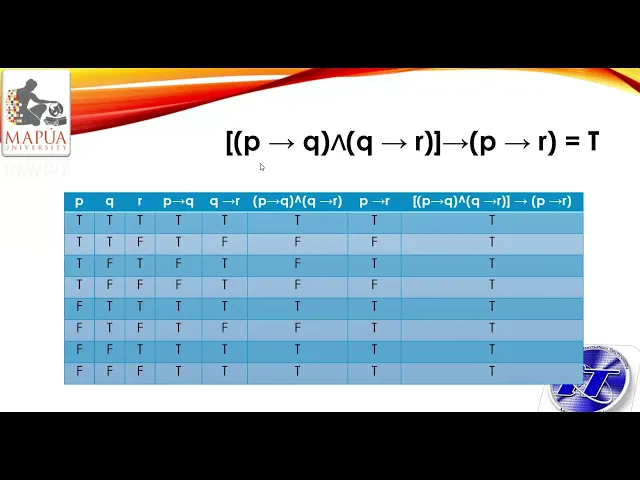
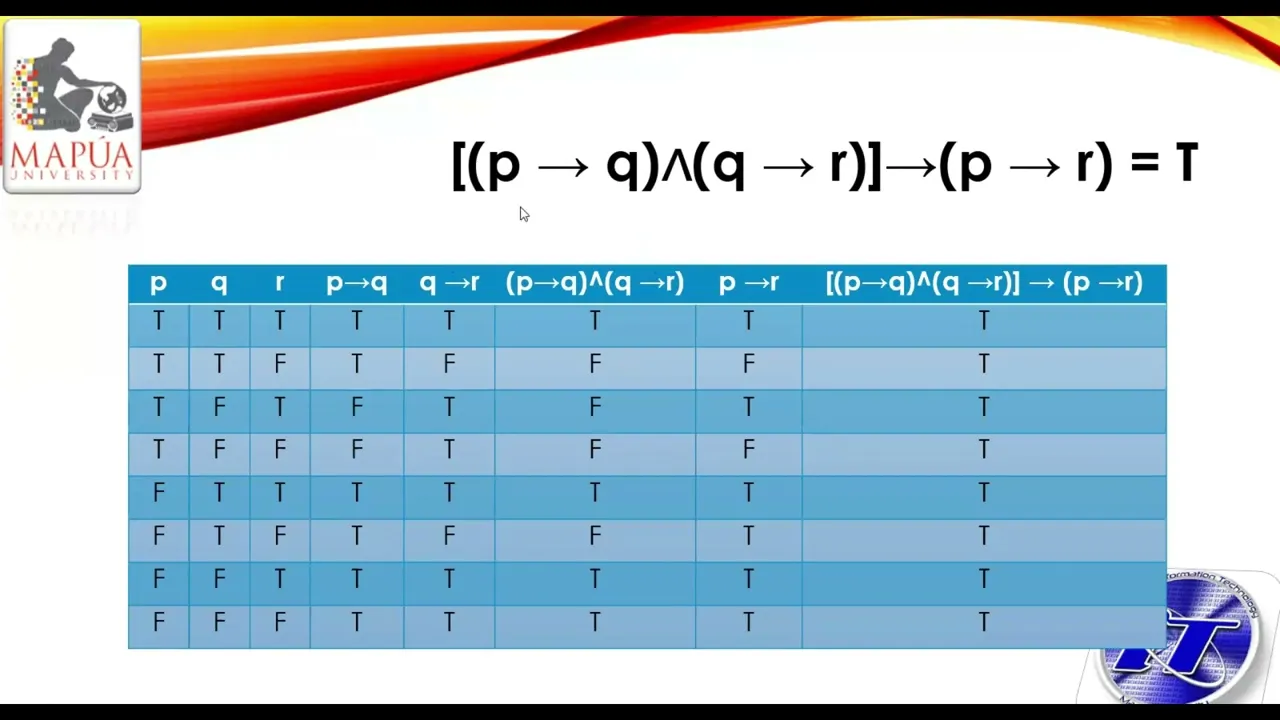
that okay remis implies to consequence which is q and this is the result column and as you can see here all values of p eq will yield a true statement therefore this statement is tautology therefore this equation is valid okay now let's move on with the second example we have p implies q and the token implies r this two term will be the antecedent for this implication and p implies r is our conclusion for this implication again and we're going to determine if the given equation is a tautology so how many variables do we have
we have three p q r so we have three variables three rows and we're going to evaluate first p implies q so we have this column k implies r this column and then and these two this will be the result column for that and for the conclusion p implies r this will be our column um column result and for the evaluation of implication this implication this is the antecedent this is the conclusion and this is the column result and as you can see in this column result every values of p q r will yield to
a true statement therefore this whole statement is a tautology and this statement is valid okay now next example p and 2p implies q implies q and this is a tautology we have two variables so it means four rows so for a combination of true false and we're going to evaluate first the p implies q since it's inside this paranthesis okay and this is the result column and the result of this will be added to p and this is the result of that and then this column is the antecedent for q for this implication function and
this is the column result and as you can see here every value of pq will yield a true statement therefore this equation is a tautology therefore this is valid this statement is valid last example p or q and the top implies r and the token implies r implies r these three terms will be our antecedent for this implication function and how many variables do we have eqr okay and again we're going to determine if this statement is a tautology so eight three variables eight rows p or q column p implies our column q implies our
column and then under this three and this is the result for the antecedent okay and then implies 2r and this is the result for the whole equation and same as with the previous slides all values of pqr will yield to a true statement therefore this equation is a tautology therefore the whole this statement is valid okay so that's all for this video lecture one example on the next video lecture thank you for listening see you next time thank you [Music] you