[Music] let us continue in discussing logic and preposition but for this video our focus is on the application of propositional logic first let us review the different logical operators that we have discussed so we have not and or sore conditional by conditional in not true will become false false will become true for and the statement would be false if one proposition and the statement is false while for or as long as there is a proposition which is true the statement will be true for sore at least one of the preposition is true but not both
in a statement while for conditional the statement will be false if the premise is true while the con while the conclusion is false while for biconditional bots both sides should have the same value true true false false and also we discuss the hierarchy of operators so like in algebra we have mdas we have hierarchy in logical operators so the highest is negation followed by and followed by or then implication and last by conditional and in case we if we have parentheses paranthesis means it's a predefined grouping so anything inside of the parentheses should be evaluated
first before you evaluate and that evaluate the other logical operators okay so let's have an example so we have p or q and not r implies s by conditional t so when we evaluate this statement without uh initially without any parenthesis okay so we should start with the negation so we need to evaluate first not r and then the result of not r will be ended to q and the result of the and will be or to p and the result of this part of the equation will be the premise of the implication okay where
in s is sure is our consequence and then the result of this implication is by condition to so that's how we evaluate this equation again president of a hierarchy of operators not and or implication end my conditional okay so now let's discuss the application of propositional logic so the applications are translating english to propositional logic second system specification third boolean searching and fourth logical puzzle but for this video lecture we're going to focus on translating english to propositional logic or vice versa so let's answer this or the value of um let's answer the following question
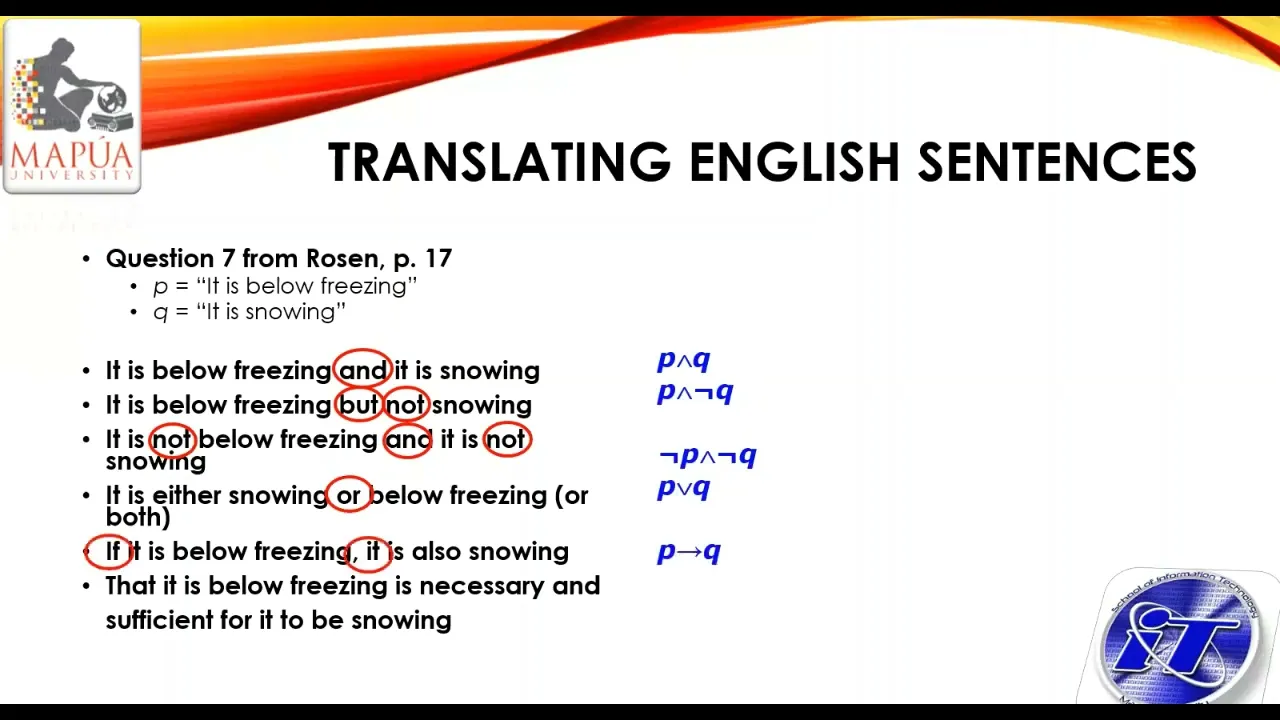
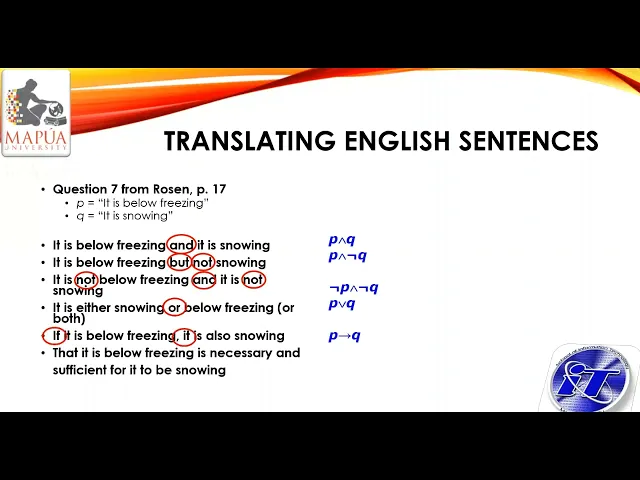
okay so we are requested to convert the given sentence into its equivalent equation and this question is from rasan this is question number seven from page 17. so we have p let p it is below freezing let q it is snowing so let's convert first the first sentence it is below freezing and it is knowing so we need to define first how many propositions do we have we have two below freezing and it's snowing and the operator is ant so therefore this is p and q second bullet it is below freezing but not snowing so
we have two operators but not but it's synonymous to end the only difference is the mood and positive positive negative negative by but for bad it will be positive to negative mood okay so the result will be p and not q okay for the third bullet it is not below freezing and it is not snowing so we have three operators first not second and and the third is another nut so the result will be not p and not q bullet it is either snowing or below freezing or both so this is an ordinary war or
inclusive or so the result will be p or q fifth bullet if it is below freezing comma it is also snowing this is an implication statement below before comma it's our premise after a comma it's our consequence so therefore the equation will be p implies q glass that is below freezing is necessary and sufficient for it to be snowing okay so if we're going to look for the um another way of writing or reading by conditional necessary and sufficient is one of the variants biconditional so therefore this is equivalent to p by conditional q okay
let's have another example i have neither given nor received help on this exam we have two propositions here given and helped on the exam first given second health okay and are operation operations are neither nor neither nor means negation of okay it means the whole sentence will be negated okay so let p is given let q is help so the result will be not of p or q okay so that's the equivalent of neither nor neither means the whole sentence will be negated okay and nor it means the operation is or okay negated or for
neither nor okay and last example you can access the internet from campus only if you are a computer science major or you are not a freshman in this example we have three prepositions one is about accessing the internet second being a computer science major and third being not a freshman okay and aside from that we also have three operators first is only if second or and last not and don't forget if we have only if at the middle of the sentence okay anything after only if is our consequence before only if it's our premise okay
so therefore accessing the internet is our premise being computer science or being not a freshman is our consequence okay so let a you can access the internet c your computer science major and f your refreshment so the result or the equivalent equation will be a implies 2 c or not f okay and as you can see the parenthesis is 4 is after the um implication sign okay because it means that these two is our consequence of the implication okay so that's it for this video lecture more example on the next video lecture thank you for
listening and goodbye [Music] you



![I Replaced ALL my ADOBE APPS with these [free or cheaper] Alternatives!](https://img.youtube.com/vi/5EfqHg49kMk/maxresdefault.jpg)