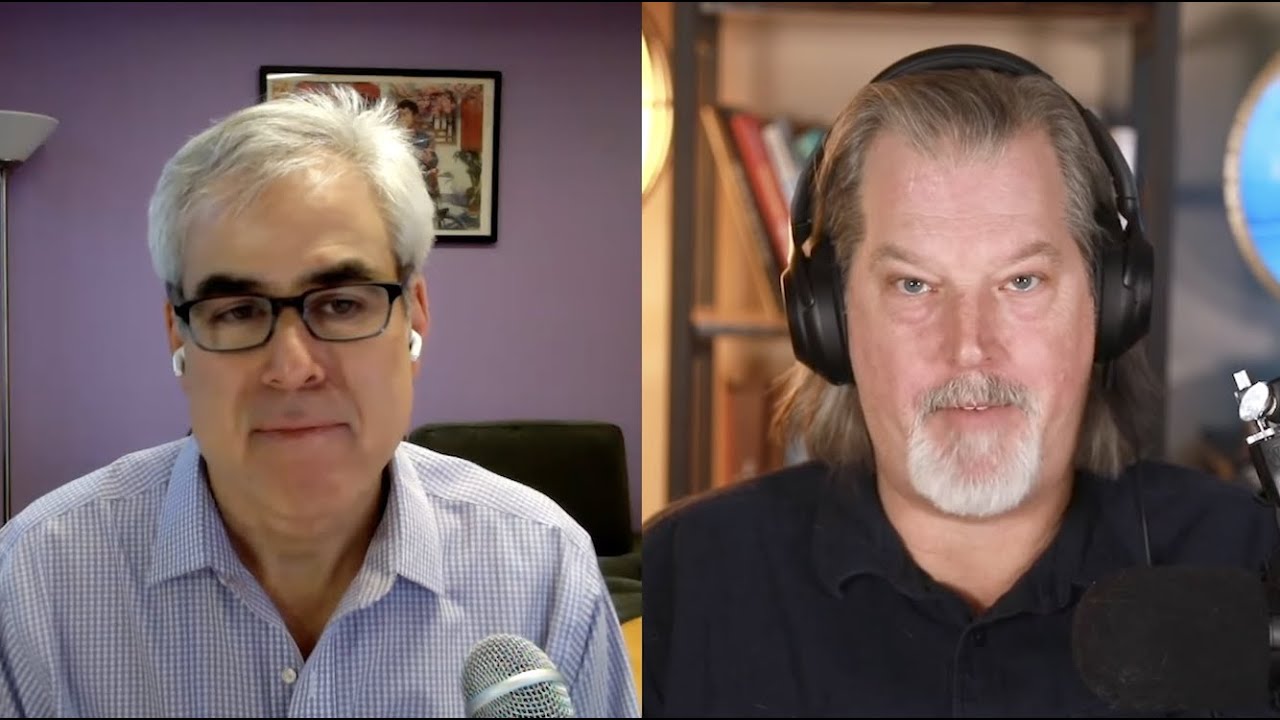
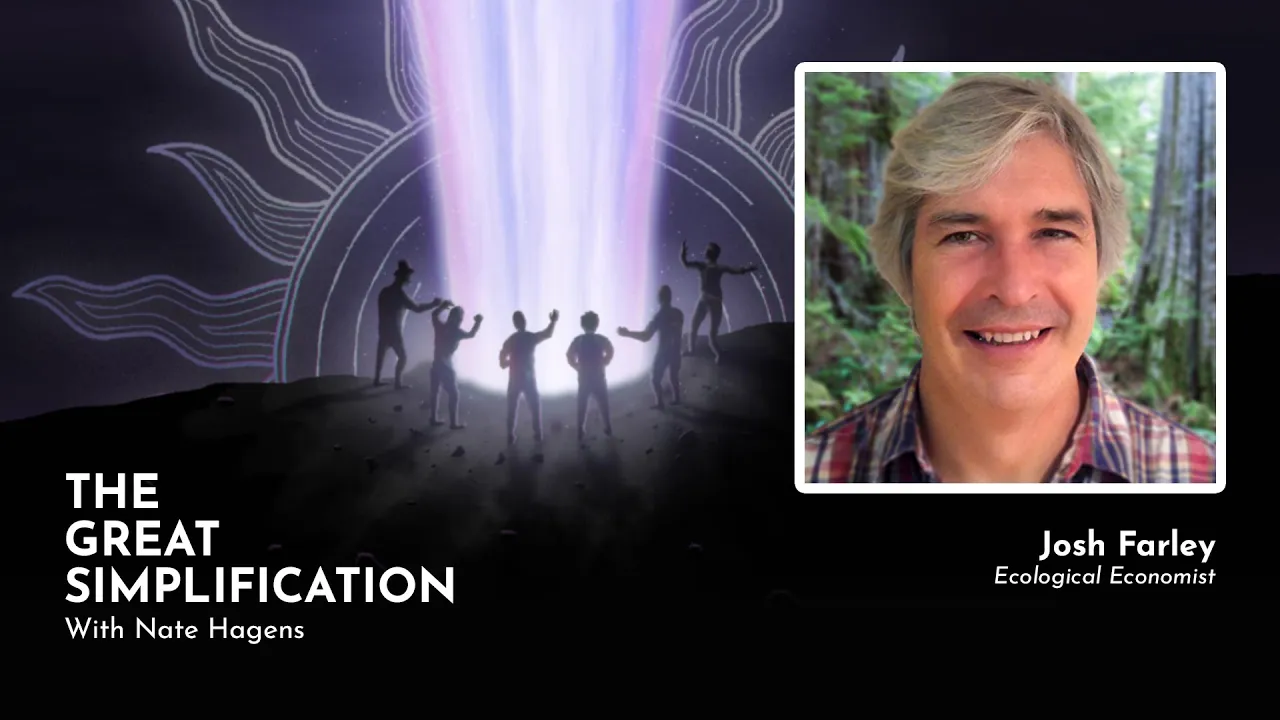
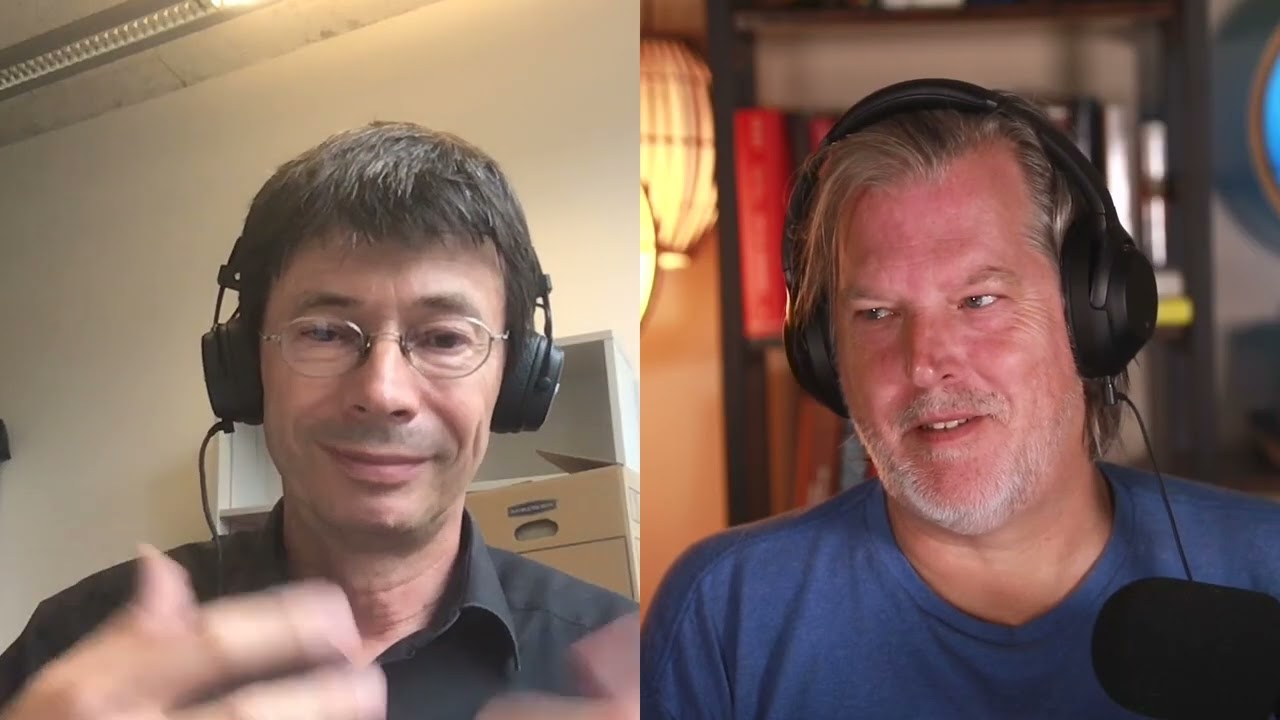
[Music] you're listening to the great simplification with nate higgins that's me on this show we try to explore and simplify what's happening with energy the economy the environment and our society together with scientists experts and leaders this show is about understanding the bird's eye view of how everything Fits together where we go from here and what we can do about it as a society and as individuals today we're going to be talking with josh farley josh is a professor of ecological economics he's the president of the international society for ecological economics he teaches in the
school of community development and applied economics at the University of vermont he also happens to be my chair of my phd committee 15 years ago and he is one of my best friends uh we have followed parallel paths to agree that humanity is currently functioning as a mindless energy hungry super organism connecting finance energy ecology human behavior And we talk a lot about these things from different lenses today we're going to talk about human behavior and particularly about cooperation and the evolution of cooperation and the fact that today our culture focuses on competition but the
cooperation coordination aspects of who we are as evolved hominids is very deep within us So hope you enjoy this conversation with josh farley [Music] so so maybe you could start off by you are an ecological economist what was your path that brought you to that discipline and the way that you're thinking on how all these things interconnect over time can you unpack that a little bit yeah i'll try to be brief because it was a kind of a long Path that we started out in the sciences and then um did a degree travel around latin
america hitchhiked around saw the problems with poverty the problems with the environment and when i came back i decided i wanted to you know make some contribution and did a degree in international development at columbia and my favorite professor suggested i go on in economics when i did the international development i realized how much harm you can do if you don't know Enough i figured i'd get more knowledge so i did degree in economics but within my first semester i realized that this the underlying science was very poor quality and the underlying ethics were even
worse so within my first semester i was ready to quit the degree but i got a fellowship to go spend the year in brazil down there i discovered ecological economics and kind of i'm self-taught in that field never had a Course in it and but i wrote to herman daly and as a grad student said i want to be an ecological economist how do i do this and he said finish your degree and call yourself one so that's what i did how have you uh over the years over the last 18 years since we met
can you describe the parallel path on synthesizing everything that i call the super organism can you maybe give i mean my listeners are are familiar with my Paper and the way that i describe it but maybe you could describe the way that you think of it which is overlapping but slightly different yeah i mean the whole big picture you know the whole biophysical basis of the economy i had developed that in grad school realizing that we are part of a finite planet and clearly uh endless growth especially exponential growth is impossible with any finite system
and that based on my own moral views Which we can talk about later because i think moral views are actually fundamental to the social sciences but i really you know pursued i was very interested in the socially just sustainability transition how do we create a sustainable world yeah that meets everybody's needs in a fair way and once you look at that problem you figure out what's required to achieve it and some of the things i did medicare in economics and in Economics we learn about markets and capitalism where everything is based on private property rights
and individual choice and the problems i cared about private property rights are impossible there's no private property rights to the atmosphere no private property rights to clean air or clean water and individual choice uh when the individual gets the benefits The society gets the cost individual choice is suicidal or at the very least very dangerous and so the big thing was understanding how a system works is radically different than understanding how to change it and what i identify just to be super brief to wrap up is i saw the problems we face are what they
call social dilemmas the individuals acting selfishly lead to the terrible Outcomes for society you need to cooperate but whenever no matter what everybody else does the individual is better off acting selfishly society is better off and everybody cooperates that's a social dilemma so i saw that problem and i thought well what kind of system do we have to develop to address those problems and that's what attracted me to this human behavior the evolution of cooperation Things that i think you and i were both discovering about the same time and so that's that's kind of a
brief synopsis but all the other things that you focus on the energy the information the new technologies the material flows i consider those the fundaments of ecological economics so intellectually we had a simultaneous super organism and Okay so human behavior you know 20 years ago 30 years ago there was something called the standard social science model uh that has kind of been discontinued now in the psychology classrooms where basically we were taught back then that humans are born as a blank slate and that culture and education dumped everything into our our brains but more and
more it's been recognized And accepted uh that we come born with prepared learning we are biological organisms that are a product of all of our great grand sisters way back to before we were even homo sapiens talk about why studying human behavior is critical and how what you learn from anthropology and evolutionary psychology is in stark contrast to what economics teaches students So economics starts with this conventional view which they call homo economicus that people are perfectly rational perfectly self-interested and insatiable and and actually you know right away if you analyze that critically as any
individual you will see that their model of you know being perfectly rational and self-interested applies only to sociopaths or psychopaths and Perhaps to some economist and one of the things that was very interesting though is when i started doing my phd almost ever in economics almost everybody shared my views that that was a pretty twisted view of human nature however by the end of the phd many people had actually adopted that way of thinking and there's a lot of research showing that studying economics does change the way people think and way they Behave and the
way they put their their interests ahead of others so very interestingly knowing that how we're enculturated in a system can change our attitudes and behaviors towards others also reveals that there is a door to changing our attitudes and behaviors in a way that make us better adapted to solving these social dilemmas which it's widely agreed Upon across many disciplines can only be solved through cooperation there are no competitive self-interested solutions to these social dilemmas like climate change or pollution back up a second there so cultural evolution works in the field of economics itself that pro-social
curious young people take classes in economics and some of them choose to major in economics and that ends up Changing their empathy and pro-social concern absolutely there's this isn't just like there's a lot of research and economics and all the sciences that's not widely replicated sensational results get published this is a result that is widely widely widely replicated and is actually self-evident to people who hang out around economist and economics departments but there's articles saying like um you know Why are economists different with the why in parentheses that you know we know that economists do
become and all these empirical studies show they become more self-interested and not only that but lots of empirical work showing that participating in a market economy or framing problems within through the lens of a market economy gets people to behave more in that self-interested fashion which is really antithetical to the Problems we face but i you know what i don't buy is that there's one way humans behave there are certain challenges we face that are best solved through self-interested behavior other challenges that can only be solved through collective action and cooperation we're very plastic we're
very malleable throughout our evolutionary history we face many many different challenges that require Different ways to solve we have the genetic plasticity to behave differently but we've also developed cultures that um have you know that essentially confront challenges in different ways and what has struck me is that we have the secret of our success is the name of a book that talks about cultural evolution but our ability to cooperate at larger and larger scales has given us this incredible Adaptive fitness if you'd imagine a lone human confronting any challenge in the primitive world you know
we'd get killed by a saber-toothed tiger or you know die from the cold but you bring and so we're really frail weak and not very smart individuals but you bring us together as a group and suddenly we are extremely powerful and extremely intelligent you think about you know some primitive hunter-gatherer making a bow and arrow The knowledge required to make that bow and arrow is contained is held by many many many different people so there's a story of like the inuit tribe that got a pandemic came and it knocked out enough individuals who knew how
to make compound bows they lost one of their most valuable technologies until they gained it back from another tribe just as evidence that knowledge is collective and you need a certain number of people to actually have a certain Level of technology that's actually a really scary insight or at least where my mind went with that because we're alive at a time where we live in a just-in-time inventory system that is a product of a six continent supply chain so that inuit example may apply uh to us on various goods in the future or technologies or
stories etc if you expand on that inuit example because i believe okay there's you know an example Of the compound bow in the kayak needed a certain population size to develop but we're dependent on technologies that require immense population size and immense storage of knowledge to do anything and in fact to the point where you take you know widely recognized one of the most brilliant people who ever lived is einstein could einstein make a sandwich on his own and i'm taking the big picture making a sandwich would he know how to grow bread How to
grow wheat to make bread so he had to know how to mill wheat grow wheat uh do the metallurgy to make the metal to you know make your plows and on and on and on and even the most simple activities feeding ourselves doing anything requires this you know a collective knowledge contained by many many people and cooperation across the board there is no human who can survive as an individual Independent of culture so this gets to the super organism dynamic that i write about and thank you josh for pushing me to write that paper because
i wouldn't have written that without you constantly pestering me but it's a product of the cooperation built on top of energy surplus because complexity of the things that you're talking about the plows and the things to make the wheat and everything Requires energy more complexity requires more energy so this explosion of coordination how does coordination different than cooperation by the way so again i would look at this coordinated activity is getting people to work together towards a common end kind of two paths to doing that are cooperation or coercion you can force people to do
something or you can get them to do it willingly because you're also doing Something for them cooperation depends on reciprocity you know you scratch my back i scratch yours but even the coercion so if you're going to coerce people to do something for you that requires cooperation on the part of the court coercers so what is capitalism then where everyone is getting the reciprocity is they're getting a paycheck right yep yeah so i mean so capitalism it's Weird it's you know it's based on this idea that everybody acts in their competitive self-interest and as you
you and i both know when did cooper when did uh capitalism appear it appeared at the same time as fossil fuels you know you're looking at 18th century england as adam smith was writing the wealth of nations james watt was perfecting the steam engine that could pump water out of the coal mines to be able to mine coal and these two things went Hand in hand so there's no capitalist system without a fossil fuel economy and here it's just kind of conjecture but fossil fuels they can easily be privately owned and you know so you
can have private property rights and when i use fossil fuels you can't if i burn a barrel oil you can't burn it we're competing for access to that same oil so the benefits are really they're private and they're Rival i get it you don't um the unfortunate thing is the costs of course of fossil fuels are collective but is the cost didn't matter as we were developing capitalism because we were so you know we had so little impact on the global atmosphere so i actually think that one of the things that contributed to the rise
of the capitalism was our energy source which is absolutely essential for everything we do was a neat fit with a market economy Until the collective costs of fossil fuels became overwhelming well but there's two costs right there's the cost of extracting it and then there's the cost that's not included in our environment uh in our decisions which is the environmental externalities and it's still not included and if it was included it was fully included there would not be an industry on the planet that would be profitable well they obviously would have a totally different Suite
of industries on the planet so we would have had developed other ways to do things but i think you're probably right and especially you know now if you're looking at fully including the costs you know mainstream economics is all about marginal analysis small changes human impacts and the ecosystems are not marginal they are you know they are system changing and so actually even the basic tools of mainstream analysis no Longer makes sense so right now the cost of additional fossil fuel use are kind of immeasurable if we believe what the scientists are saying about climate
change but had we always been paying attention to those costs we would not they would not have reached this level of being immeasurable but they would still be collective and and markets work when only when all the costs and all the benefits are borne by The decision maker and that means that we suffer the consequences of our actions but now we see that the consequences of our decisions affect everybody so one thing you could do is change from the individual decision maker who externalizes all those costs to the collective decision maker that actually experiences all
those costs what's an example of a collective decision maker in this sense government so we have all Sorts of things that if you allow individuals to behave for their own self-interest it undermines social welfare and profound ways so we all agree to behave in certain ways you know i'd be better off if i could speed anytime i wanted if i could um you know if i didn't have to clean up after myself if i could you know there's all sorts of things i'd be better off as an individual you know if i was allowed to
do it but the government stops me from Doing those things and those are actually frivolous examples of speeding and but you know like the huge waste emissions and pollution government just doesn't allow that i can't dump pcbs or dioxins in the lake anymore well just as an aside i don't want to get into the deep maximum power principle and and energy on on this conversation because i want to focus on evolution of human cooperation but Regarding speeding if we were to reduce the speed limit by 20 miles an hour just that act alone would be
a greater impact on our emissions than going and driving all electric cars we use so much more energy just going 70 instead of 50 and yet people choose to go 70 they don't want to go 50. and we've tried to reduce the speed limit because time is money in our Economic system we want to get to where we go are going faster so we can spend time on twitter and facebook and and whatever else but um so so getting back to what we were talking about before let me understand these two trends so since the
dawn of agriculture 10 or 12 000 years ago human cultures have been gradually But inexorably outsourcing what we do to the cloud and to the collective because of so much complexity and formulas and recipes and knowledge that we pass on to each other now on the internet and to each generation like you said the inuit so in one sense we have become this massive collective But in another sense in a cultural sense the united states and to a lesser stan australia and europe the stories we tell are about individualism rugged individualism and this is the
way that humans are and so we've got those two mega trends going on uh can you comment on that so one thing is i actually think it's a little bit false to put the origins of this uh Intense collective behavior at dawn of the agricultural age i actually think that humans as a species are defined by our collective nature and if you think about you know on the plains of africa when we evolved we evolved this frail you know little creatures compared to everything else our source of power our secret was our ability to collaborate
as a group and to have collective knowledge which is enabled through language So i would actually argue that our collective knowledge quite possibly predates language i mean even you know these skills to nap and arrowhead things that had to be passed on that were collective and cumulative so i i think that humans have always been a super organism at the level of the individual group and have become dramatically more so and the You know this idea that knowledge and culture is collective and cumulative the larger your population the more complex a society you can have
i also do believe though that there has been tremendous variation across human groups and we've experimented with a lot of different ways you know authoritarian coercion versus fairly hierarchical flat cooperation systems i think there's evidence that we have more Plasticity than we're often given credit for so i don't really see this inevitable trend towards certain types of hierarchical behaviors i see that we are very capable of experimenting and trying out different things and that what has worked in the past is unlikely to work in our wildly changing future and that's what we have to focus
on let's take a big step back and look At something that is becoming less controversial but has had some epic changes in the science over the last 40 years is the concept of multi-level selection and uh which embedded in there is the fact that each of us as part of our genome uh are competitive or cooperative depending on the circumstances but could You explain multi-level selection and why it's important to understand that given what we face today sure and this goes back to darwin i mean his the ascent of man you know he actually recognized
that groups of humans that were more cooperative and collaborative were likely to leave more offspring than groups of humans in which the individuals were selfish and competitive So he proposed that we would select at the group level for people who cooperate and are altruistic but at the same time there is this there's also selection and there's selection at the individual level the the fittest individual is likely to have more offspring and often you can increase your own individual fitness by not helping or cooperating with others so if you're you know one of the classic examples
let's Say you're on a desert island and there's one really cooperative altruistic person and one really selfish competitive person who's going to do better so the cooperative person is going to help out the other person and get nothing in exchange making the other person more fit and so a lot of people said well in any population those individuals who are the most selfish will out compete the more cooperative ones until they displace Them but what happens in reality is you had these populations dotted across the plains of africa and those populations that had the most
selfish individuals were the most likely to die out and you know they couldn't sell oh why is that well so let's say that you had to defend yourself or let's say that it takes uh you know 20 individuals to take down a mammoth or whatever the Equivalent might have been in the plains of africa and as every individual you know your best option would be to not participate in that hunt and try to get some of the food afterwards because it's dangerous to go hunting so the group in which all the individuals cooperated to take
down the big animal we're gonna have more food And they would and and also the scary bit is that humans while we are very cooperative within a group we're often very hostile to other groups and i don't know to what extent you know i'm not an expert in anthropology but i read like jared diamond's the world before yesterday and he points out that a lot of these early tribes you know if you saw somebody who wasn't part of your group Uh you know you would run or kill and so the larger your group the more
protected you are against other groups the larger your group the more you can defend yourself against other animals and capture other animals and maybe even manage even in pre-agricultural times people manage natural resources in a way that helped to be done collectively and so there's a whole bunch of problems that we can Solve as a group but we can't solve as individuals and if you have a lot of different groups those groups who you know can't solve these problems are not going to reproduce the key punch line of multi-level selection is that within a group
the individual who is most selfish is likely to get benefits from the other group members without giving anything Back and is going to be more fit but the group that is more cooperative will out-compete other groups and apparently a handful of times in evolutionary history selection at the group level was more powerful than selection at the individual level doesn't mean that you know selfishness can't be an adaptive strategy in some situations that selfish individuals do get certain advantages within a group but their group is more likely to go Extinct and the group with the more
cooperative individuals will pass on you know their culture and quite possibly there is a genetic element to cooperation that you know there are genetic predispositions to cooperate and so the group with the more cooperative individuals passes on both its genes and its culture because humans are profoundly affected by both so it really explains a lot about The memetic tribes that we see in our culture today that everyone kind of conforms to their own facebook flavor you know whether it's far right or far left or in between or the various tribes we are intensely tribal and
defend people within our group and ostracize people outside of our group And what you're saying is that because of evolution both of these dynamics of competition and selfishness and cooperation within our group were both conserved evolutionarily we experience both of those depending on the environmental circumstance we find ourselves in and cooperation within our group often against other groups so all that competition and conflict can Still take place between groups in fact there's you know some thinkers believe that war with other groups actually bonded if you're at war with another group and you think about this
you know you hear about war movies like band of brothers where people who are in conflict against another group they will make any sacrifice for each other and you know in competition with the other group so in some ways the two go Together the intense cooperation and intense competition it's a problem though that we have executed our cooperative algorithms towards a cultural objective of monetary profits linked to energy linked to hydrocarbon energy linked to environmental destruction so we are cooperating towards profits As families as small businesses as corporations as nation states and what happens when
there's a phase shift away from the ability to generate profits linked to this what will soon be declining energy surplus then that causes a phase shift in who's in the in group and who's in the out group uh as evidenced as what's going on in Ukraine and russia is one one of many examples do you have any thoughts on that yeah so i actually have a lot of thoughts on this and i'm not surprised in my view what we face now is so first of all to give a little basis about this allegiance to groups
i strongly believe there is no human alive today that can survive as an individual apart from their inherited cultural knowledge there's a handful of individuals who Could perhaps survive but i doubt it without cultural artifacts like clothing maybe in some benign population so the deal is that as a human if you're not part of a group you're dead meaning the most rational important thing you can do as a human is to be part of a group and when groups identify themselves when you're saying there's a group there's a non-group meaning you have to identify As
the group and you need signifiers you need things to show you're part of that group and very often the crazier your belief that's shared by your group the more you believe crazy stuff that your group believes the more you have shown that you are part of that group and so we have this huge tendency to conform to our group beliefs but what we face now is challenges that require cooperation At a much larger scale so climate change being the painfully obvious one we need to cooperate at the scale of the problem climate change of course
is just a symptom of our overshoot of our using too many resources to meet this you know the profit and consumption goals that have been determined by our society is the correct things to pursue we need to change obviously change away from that focus and there was certainly a time When we were developing you know account our modern economy where more consumption was critically important for our adaptive fitness we've left that behind we now have to really figure out new ways of developing cooperation at the scale of the problem and the other one of these
that i think you know you said there's like a phase change i think the big phase change is we're shifting from reliance on Fossil fuels that can be individually owned and there's individual choice over use to so there's competition for them to alternative energy where you know no matter how much sunshine i capture on my home or the united states captures it doesn't leave less for china or australia or other places so we're not competing for access to this new form of energy and to get that new form of energy what We really need is
better knowledge we need to figure out how do we produce good solar good alternative energy without the cobalt without the you know rare earth without these things that are environmentally harmful and knowledge improves through use so putting this in the context of competitive self-interest if i developed a clean decentralized cheap alternative to Fossil fuels that does not require rare earths as an individual if i put a patent on it i could i'd be a billionaire i'd be super rich but if i did that then maybe people in india and china and sub-saharan africa couldn't afford
it they'd continue to burn coal and where i might be super rich my kids are going to be super screwed because we're going to get runaway climate change and so we're in a world where you know When i control and use the oil that's to my benefit but if i control and limit access to alternative energy technologies that's to my detriment so i really think we're flipping to a wildly new paradigm for an economy where competitive self-interest has become increasingly suicidal and it's not just things like oil have a collective cost things like an alternative
vaccine a vaccine for kovid have collective benefits And we bring together all our knowledge to create this covet vaccine and i wrote in a book chapter in 2015 that if we developed if we had a pandemic developed a vaccine and left it in the hands of the private sector they would patent it sell it at the highest price the market would bear and we would then have new variants evolving that even attacked those who had previously been vaccinated i'm very disappointed as an accurate Description of what's happening today well let me push back on on
that solar example a little bit because i agree with you on the decentralized and the knowledge and the non-rival the non-rival nature of the sun and the wind but we still would be competing for the ability to afford everyone having that certain lifestyle And not only that but that would be the energy for our homes and our businesses but our cultural objective would still be gdp and so that would have to change as well right that would have to change wildly so i'm not one of these people who believe we can replace fossil fuels with
alternative energies you know you talked before about Riding 20 miles an hour slower and would be better than um having electric cars i'm in favor of riding 45 miles an hour slower on a bicycle and you know in my view poor people walk middle income people ride bikes and take trains rich people fly and drive cars are we don't have a big enough planet for 7.8 billion people to be rich i'm in favor of secure sufficiency you know ironclad certainty you are going to meet Your basic needs you know every day of your life but
basic needs some people have more luxuries than others but the basic needs being met i think is really what we have to strive for and searching for meaning i actually think we're sacrificing our well-being when we work you know 60 80 hours a week at jobs we don't like to get more money to buy crap we don't even have time to use and that is kind of the um You know focus of our society right now well who was it in in the 1930s um keynes or gaul breath i can't remember kane who said a
hundred years from now we are going to be so rich that we only have to work 10 hours a week yep yep and he was right we are so rich and we're working more and this is the dynamic of the super organism because we've outsourced uh our decisions to the market which is Based on growth and so via downward causation everyone is running around like little ants and not not such a bad metaphor because we're stuck in this system so building on what you just said there are no technological solutions to a collective action problem
and what we face now is a collective action problem so what is In informed by uh knowledge about our human phenotype and the the plasticity that is in all of us the cultural uh uh shiftability of cooperation and competition what is the mechanism to solve these social dilemmas even if it's a long shot um given how cooperative we are i mean The super organism has to shrivel up uh somehow you know that's that's another conversation but what do you think how could we uh solve these social dilemmas yeah so one of the things is um
you know there's and these are games but they're games that have kind of been replicated in real life they play these games for example you know i could give a group of 100 people i say i'll give you all 50 bucks Everybody who returns the money to the common pool i'll double it and you'll each get 100. and even here i'm using monetary terms because that's our culture but you know i give everybody some good allow them to whatever is return of the common pool is doubled everybody comes out twice as good but each individual
realizes that if everybody else returns their money to the common pool um it'll be doubled and redistributed equally I'll get almost 100 out of that pool plus i'll have my 50 bucks so if everybody else pitches in i'm better off i keep my money if nobody else pitches in i'd be an idiot to pitch in and so if you play a game like that the first round will be some cooperative people who pitch everything in some selfish people who keep it all but if you keep playing round after round after round which real life is
Round after round after round of these interactions with people you find that in that setting the generous people are going to say i'm not a sucker i don't want to be the one who gives up everything so they'll gradually cut back their donations to the mean but that drives down the mean since they were the ones who are elevating the mean to begin with you end up with nobody cooperating and everybody worse off you can have a simple step in there which is Allow people to see what other people contributed and punish them for lack
of contribution and a lot of these games punishment is just like a mona you know i put in a dollar they'll lose three dollars but in real life punishment is if you're selfish i don't want you to date my daughter i don't want you to go near my fam you know i'm not i don't want to be your friend and ostracism can be incredibly powerful so what you're What you're getting at scientifically is the difference between reciprocity and strong reciprocity reciprocity being you share and cooperate and punish others when bad behavior ensues strong reciprocity is
when you punish people who don't punish others and it's it's this web of a social contract based on on norms yep and that strongest private city because you took it another step which Is absolutely true you know an example i gave when you allow people to punish the defectors and then you play that game over and over and over you converge on much greater cooperation strong reciprocities you're saying i punish you know so let's say we play this game and both of us donate and we you then punish the person who didn't donate and i
don't i'm free riding on you you punish that person which makes them more cooperative But if i freeride you allow somebody to punish the non-punisher then you very quickly can emerge at cooperation and and this is why our ancestors pre-agriculture not only were egalitarian in terms of consumption but aggressively egalitarian because of strong reciprocity if someone was hogging too much of the antelope there were there were social forces against that and that that Happens today and like the kalahari bushmen one of the first things a child knows is no they slap their hand away this
is a share we share this and i'm a terrible hunter i don't deserve to do this self-deprecation is a part of their culture in contrast our culture united states circa 2022 is still tell stories about how an individual can can conquer the world and when you lectured my class a few years ago you Brought up the example of the iphone would you like to describe that briefly yeah and again this is this is not just the iphone this is technology in general but in this case the iphone this comes from mariana masuka's work and she
has shown you know we we have this idea in the united states as the lone individual inventor who is you know it was apple who developed iphone therefore they're entitled to private property rights to it and if you look at the technology in The iphone you actually see that most of it was developed by the us government so the miniaturization the touch screens the internet the almost every technology in that phone was not developed by apple but rather by the government but this actually brings up a bigger issue is we still have this bizarre idea
that it's the lone inventor that's responsible but look at any big technological breakthrough so a recent One is you know crispr cast 9 the ability to edit jeans kind of like cutting and pasting and that technology was developed by a team in japan a team in france a team in california all at approximately the same time you know when isaac newton developed calculus libnitz developed calculus at the same time when darwin developed the theory of evolution wallace did at the Same time meaning that the way science really seems to progress is we have this collective
effort generating more and more knowledge and you at that point any knowledge just past the current frontier is very likely to be developed by somebody and it relies on the collective efforts of billions of people over thousands of years i mean that's all how our science works And then we have this bizarre story we tell ourselves no it was you know jobs the genius um you know or uh um when no he just happened to be the guy um you know if he hadn't developed that stuff somebody else would have a few months later and
mark zuckerberg if he hadn't done facebook somebody else would have a few months later how can we use this knowledge to potentially short-circuit what what's coming in coming decades Into a more benign path this is kind of interesting because i think for most of human history within the group we had very strong norms for sharing and cooperation and you look at almost any religious text it talked how about how evil it was to take more for yourself you know a camel will go through the eye of a needle easier than a rich man will go
to heaven and we've somehow changed our culture to say that self-interest and competitive Behavior is the ideal so really we are the anomalous age we have to go back to what we had for a long time and part of it is also this idea that satisfaction in life comes from consuming more stuff and which is just fantasy satisfaction in life comes from having more friends and more interaction with people a friend of mine just gave me the book flow i don't want To pretend to try to pronounce the guy's last name very complicated i think
czech last name but in it he says that one of the things that gives you the most satisfaction in life is flow when things are just going you know it's this combination of difficulty and skill that merges to give you this fantastic feeling and one of the greatest producers of flow is cooperating with your friends to overcome or with cooperating to overcome A common challenge so as i tell my students you know you can have so many opportunities for a rich and meaningful life because we're going to need to cooperate like hell to overcome all
these challenges and i do believe that makes us happier and just feel better i totally agree with you not only intellectually but practically and experientially and i miss hanging out With you and our group in in vermont because you're you're really walking what you teach uh in the fact that you have so many parties at your house and you invite all your neighbors and everyone comes and brings a dish or drinks or whatever and you bike to work and you teach your students about dumpster diving which is the modern equivalent of hunter hunting and gathering
and Seriously the i mean after basic needs are met the best things in life are free the problem is is that we've built all our expectations on fossil surplus continuing at this scale and that's not going to manifest so i agree with you that social capital and cooperation and friends is going to be one of the biggest great things in our future but it's going to be coupled with Those people that want to hang on to and avoid loss aversion with our our current you know 200 to our 101 exosomatic surplus just as an aside
one of the projects we're working on is is an organization called how are we.org and we've interviewed eventually we want to interview hundreds of thousands of people but so far we're about at a thousand in wisconsin And there's a battery of questions on what well-being means to people and you prioritize all these categories and out of the thousand people only two people categorize luxury items and uh things of convenience as as very important almost everyone doesn't really care about living a luxury lifestyle so this is where we get back to the human behavior Thing of
comparing ourselves to others based on the cultural metrics of our current lifetime we don't need all this stuff to be happy part of the reasons we think we need all this stuff is we're looking around and we're getting this marketing and advertising that you suck but if you buy this extra little toy or gadget or xbox or whatever you're going to be cool so i'm just wondering how much of our Problems go away when energy surplus goes away but coupled with that is also do with as energy surplus goes away so does some of our
technology our complexity our interconnectedness and our food supply so there's that what do you think josh so this is going to get me off on a little one of my pet interests is uh you know the relationship between Abundance and cooperation and this is just kind of anecdotal but i'm very very interested in slime molds which is a little into you know it's a little uh amoeba-like organism that in conditions of abundance they all go around hunting on their own and but when things get scarce that individual hunting strategy no longer works and they come
together in what's called a slug mass and they can send out little pseudopods looking for Food sources and they're so efficient at this they've taken like a topographical map of spain and put food on the map in a proportion to the population of different cities and you put one of these slug masses there and it will recreate the transportation infrastructure of spain as this more efficient way of getting food through cooperation and that is only that cooperative mechanism is induced Entirely by resource scarcity leading to this kind of perhaps polyana-ish view that as resources become
scarce we really come to depend on each other much more and cooperate much more and it's interesting that if you look at you were talking about um you know early cultures and most of them that i know of they you know you individuals never starved either the group starved or nobody starved you had much more Egalitarian distribution i would say though that you know you talked about um there were some uh early groups with resource abundance who didn't develop i mean like you know the northwest um indians in america had slaves and hierarchies pre-agriculture so
i think that plasticity is intense in humans we can evolve different paths but i think that the conditions we face dictate What cultural approaches are likely to be most successful and i think it's painfully obvious the conditions we face now do require cooperation at a global scale and massive reduction in consumption economists say that we are inherently insatiable but the last i looked at this with got the data was like early 2000s we spent the equivalent of the gdp of canada on advertising convincing people that they're insatiable if we were Insatiable you wouldn't need to
spend that much to convince us we are getting rid of advertising can be an enormous play an enormous role in reducing our expectations of you know how much we should consume and how much we should work it's interesting i don't have a tv i gave my tv away in 1999. five years before i met you i have a screen which i watched netflix things and green bay packer games and things like That but very infrequently and when i do i'm just shocked at the stupidness of current advertising and it just makes me really squeamish because
i've had 20 years without that advertising and now uh contrary to when you and i met but now all the big ad agencies have evolutionary psychologists phd's on staff to you know really hone in on what what we need to trigger these people to buy Stuff yeah absolutely and i mean the people are so who is adopting these ideas revolutionary psychology is the the market sector and you know because the government we still have this myth of libertarianism you know the government should intervene in our lives where's the private sector and i actually think that
social media plays one of the biggest roles in shaping our behaviors and attitudes you know the whole goal of social media Of course is to get people to see more ads and as it turns out the way you get people to see more ads is staying online longer is sending them highly polarizing information so at a time we need reduced consumption and greater cooperation the biggest players in the market economy are focused on polarizing people as a means to get them To see more ads and buy more stuff and i i really wonder what future
generations how are they going to look at these people if they're going to look at them as the equivalent of adolf hitler or something you know when they know the problems we face and how they're using these brilliant technologies and amazing knowledge of you know human psychology well the the polarization and the groups on Facebook are just a perfect demonstration of our tribal minds in in the modern era because people do feel they're cooperating because they're supporting their group yeah but q and on or or whatever it is and so this is like almost predictable
that if you have the technology and the artificial intelligence that that would be the result in addition to advertising what if what if we got rid of social media how would That change our cooperative competitive uh structure in our brains just hypothetically i don't think we should get rid of social media i think we should choose the goals for which social media is used right now the goal is to increase consumerism if and so i'm actually a huge advocate of a knowledge commons where all knowledge is is free and i actually think it should be
the role of universities to start such a knowledge Commons and they should be the ones we should have these social media like a public utility it's free there's no advertising and the the algorithms instead of triggering people to be polarized or to buy more you know stay on and buy more stuff the algorithms be uh you know created to get people to actually buy less stuff to maybe see the commonalities we share across different Groups so the social media is an amazing tool i can use a hammer to bash somebody's head in which makes it
a terrible tool or a hammer to build houses to shelter the homeless which makes it a great tool social media is an amazing tool we just using it for the wrong ends because the algorithms are optimizing the wrong thing they're optimized for clicks which leads to profits but you could change the algorithms towards Pro-social ends but this gets back to the super organism is all at universities the university that you're in is a miniature super organism it needs funding and more students to pay for the deputy dean of academic affairs and you know the sports
and and everything else so to make decisions that are for a collective action result are economically against the interest of These entities so do you have any insight on how the things that you would like to see in the next 50 years could come about and so one of the things i would like to say about universities i am at a land-grant university the idea behind land-grant universities was if you read adam smith you know he says patents are horrible they're the antithesis of free markets we created patents to give an incentive For inventors to
hand over their knowledge the patent office so that after the 14 years of the patent it would be publicly available and you know patents were designed to make knowledge publicly available once our government had enough of a tax base enough of resource base we created land-grant universities where the government would essentially directly pay Academics to develop not only to develop the ideas but to go out there and educate the farmers do extension that was the original goal so this so that's the path we need to be on now i see the future right now at
my university we interviewed um because i did a course on this knowledge commons with my students they interviewed the university we spent 500 000 a year trying to get Intellectual property rights from which we make on average four hundred thousand dollars in revenue in other words we're spending a hundred thousand dollars of student and taxpayer money to deny the public access to the knowledge we produced for the common good oh my god so i really do see and we also the university pays me to write journal articles which i then publish in journals that the
University has to buy the university can't afford to buy the journal i publish it most now because the price is too high so they pay me to create the content and can't afford access to it meaning though that for universities it would actually be in their financial interest to stop it with the intellectual property rights and to you know the the most important Input into any new technology or new idea is an old technology and an old idea and universities i really think we need to transnational cooperation so there's no national interest it's a another
sector of the economy that represents the knowledge commons it creates the knowledge we need right now the market is going to generate knowledge that makes profits we Need to generate knowledge it protects ecosystems that provides public goods we need to generate knowledge that protects things that can't generate a profit and we have no good mechanism for doing that so let's expand on that but let's throw in two other aspects of human behavior that uh are are fighting in in opposing directions from what you're envisioning number one is we are optimal foraging Creatures it's why we
like to invest a little and get a lot uh it's why in that ultimatum game where you cooperate and then share money and you share a little or donate a little or are selfish a little but you're still trying to maximize a return on something we don't like to give stuff away so to what extent is more or growth embedded in who we are as a biological species and then the second Part is the the climate and future generations and other species and all those things are in the future and as biological organisms we have
steep discount rates and prefer the present moment over next week and next week over two weeks from now and two weeks from now over 10 years from now and so emotionally the future isn't real to us so how how do you merge those two Constraints with your hope for a good collective action and and future response like you were describing i'm actually not so convinced we always do want more we want enough the optimal foragers when you look at hunter-gatherer bands they didn't like try to get more and more and more they tried to get
enough as quickly and easily as possible because they couldn't store it if you killed five mastodons instead of one it would rot And or is it because they couldn't store or also because there's more fun things in life although speaking actually i think hunting and gathering could probably be really fun oh well you and i do it with mushrooms and other things yeah for sure it's it's it's rock leaf mushroom and it's like a big dopamine fest finding mushrooms near burlington is is not too mentally dissimilar than slot Machines in vegas it's a lot healthier
i totally agree you know i think this idea of insatiability and even you know when i first studied international development it was interesting reading about early development workers going to like africa helping them develop more productive farming systems what was their response great i get to work less and this is when we did have the means to store and so it wasn't just a storage thing they realized that if you wanted To get the people to work get to produce more you had to go in and create new watch you had to say hey wait
a minute if you're produce more you get a tv you get a radio you got to create these wants and it's really hard to separate um you know i actually see myself in academia people work really really hard long hours i tell my students actually that you know quality of life is super important And that's why a lot of them like to work with me but uh you know really my job the job of most professors advising phd students is to select those people who work 80 or 90 hours a week sacrificing everything else for
their job and their career and their promotions when i actually think that's exactly the wrong way to be doing things it does take a process of enculturation and indoctrination to make people work that hard to buy stuff could we have A grass tops from the bottom up cultural revolution where people started to recognize that and maybe it started a little bit with kovid of course a lot of people that work from home and use zoom are kind of privileged to be able to do that but are we reaching a point in our culture where all
this gadgets and technology and material consumption is is truly being Recognized as a dead end path not only for climate and environmental reasons but just for personal fulfillment reasons but we're the richest culture in the history of the world and we're miserable i'm not sure i could swear on this but this is what i'm going to talk about is um after the 2008 crash hermann daly sent me a picture of some guy standing outside one of the wall street uh you know skyscrapers holding up a sign that Said jump you and the idea was that
here are the people who had been solely focused on getting wealth for themselves screw everybody else don't care about everybody else and there is a social reaction to ostracize them well it's a strong reciprocity that that is a conserved from our tribal times yep and i and i do think that that will be a big part of the path forward that i already see Like um you know with a lot of the students on university campuses and stuff you know there's this huge social pressure to absolutely accept anybody's gender preferences or sexual preferences and to
you know not discriminate against race and everything and this was a sea chain what i see is a sea change towards the way people Treat others and you would be ostracized if you said negative things against my daughter she's 14. she comes home and tells me she's not sure if she can be friends with somebody who you know discriminates against gays or a race you wouldn't be friends with the racist i mean and already this ostracization is taking place on this issue of you know discrimination and privilege and i don't think it's a big step
to recognize these people who Are consuming too much are the ones that you know once we get that same movement to where you're ashamed to be seen consuming that much or behaving in that way where do you draw the boundary there because the average american are the people on the earth that are consuming too much and and again there's a big difference between median and mean on that obviously yeah and so and this is super super difficult you know at the University of vermont we have all these you know kind of ecologically aware students but
when i tell them they got to write these policy briefs to explain how to solve a problem and they'll say oh we'll write about how we can get everybody in electric cars and i'll say is that sustainable for the planet and they'll say oh but you know we gotta have our cars i mean there's certain things that just are non-negotiable we're extremely plastic this is the huge Thing i do not know how to shape cultures i mean clearly the media is phenomenally powerful social media i look at fox news which has so shaped the dialogue
around like democracy and covid incredibly powerful they understand pretty damn well how to you know uh how to change people's minds i think that you know the social media they're doing these experiments all the time they really Know what you know they did the one to get more people to vote they actually you know did one where they could get people to be happier or more depressed by changing their feed they've done thousands of experiments we don't know about they probably have a lot of the answers that i don't have so some of the things
i think are the most harmful are like you know social media and you know this uh corporate corporate Manipulation of our data but it's the wrong ends so in my view it's all a question of you know tools or tools you have to evaluate them according to the desirable ends to date our desirable end has been you know i mean recent history has been ever more consumption we now realize that's insane not everyone realizes that's insane people in yours and my tribe do but i think that is still the cultural goal Yep and even people
who know better still you know as i was telling my students i was supposed to i was supposed to fly down to brazil to see family because i promised my wife would see her family i love her family and i was willing you know i was looking at the individual benefits to me were immense the costs of the world were huge somebody who knows all these things i was going to fly there except my daughter got they were walking out the Door got a call from department of health so what given the breadth of and
depth of knowledge that you have about the human predicament what are you most worried about in coming decades and what gives you the most hope great question you know i'm definitely most worried about business as usual i'm one of these people who tends to be Fairly hopeful by nature um and you probably have some of this too that you know if the really gets bad hits the fan i don't think humans you know civilization is gonna profoundly be altered but humans prior to modern technologies you know populated the world we're very adaptive we'll survive there
will be pockets of people that will survive for sure you Know i'm afraid of the [Music] huge die-off and loss of biodiversity and loss of human populations and cultures but i think over time all that comes back i'm very much um you know uh you talked about how we discount the future in the long future you know Nature will rebound from whatever we do probably pockets of humans will survive and but i i look at the short future i'm trying to think to be honest there's so many things that have me worried right now well
you're i mean of of all the people in my network you're among the smartest and wisest but you're also coupled with a super gregarious positive personality which is why you're such a popular teacher So you know i've been talking about these risks since i met you and you kind of nate you're kind of overly gloomy i think that x y and z but now reality has kind of caught up to this story but you're such an optimistic human i just wondered you know what is it that you really worry about and what is it that
gives you hope yeah And in some ways they're the same like right now what i see is you know there's this talk about um you know our conflict with russia and our conflict with china and this threat of war and so that is this um you know competitive anti-cooperation approach that gives me the most fear but at the same time i think the solution to those problems would be biden going to putin and to China and you know iran and saying look we got this global climate change problem that's much more serious if we pool
our intellectual forces you have brilliant scientists you know so i actually do look at cooperation is something that when you do something nice to somebody they have an instinctual obligation to do something nice to you it's reciprocity they've done these studies to show that if somebody you don't like gives you Something you don't like you still want to reciprocate and be nice to that well that was the whole model of the hare krishnas in the 70s and 80s they would come and bring you a flower and then a minute later they would ask for a
dollar and you felt compelled to donate yeah and so what i see is the solution so these all these crises we face now if we had a real leader who could come and recognize the big challenges and you Know and i think i think these are like uh dinosaurs all you know all the big countries they're ruled by or you know the leaders are people who are stuck in the last you know they're self-selected for sociopathic type of people to get at that level aren't they there there is a yeah the one thing that should
disqualify you from being president is wanting to be president right exactly but like could we get someone like you as president Because you would have the intellectual ideas and the personality and the charisma to do these things but you would never make it up in the polls because you're not telling people what they want to hear yeah but i think that increasingly it's obvious that if we pool the only way we're going to be able to solve these global challenges is to pool our resources and i think that cooperation is a positive feedback loop and
this is one of the reasons why i'm What's what what i'm actually trying to push for now what i what i think that i could possibly contribute to is we're writing with my students we're writing an article about how knowledge improves through use and how a knowledge commons a transnational knowledge commons we could start sharing knowledge even it was just about coveter about green technologies just painfully obvious that sharing Knowledge increases its value as we start to do that we develop more trust in the other people with whom we're working and as we develop more
trust it allows us to cooperate at a larger scale which therefore helps develop more trust which helps develop cooperate at an even larger scale so that cooperation you know and they seem to lab whatever you might think of them he makes this point that we've already passed a lot of critical Ecological boundaries you know resilience bouncing back to where we were might no longer be possible we do need to think about the next system what's going to replace it and so he talks about anti-fragile systems that grow stronger as you hammer on them and i
do think that cooperation is fundamentally anti-fragile the more you use it the stronger it gets and the more likely you are to use it again and even In your own lives it's like lifting weights tears down the muscles and then they grow back stronger so is doing cooperative altruistic things in your neighborhood etc right yep my neighbors like uh you know i got up the other morning and we'd had snow my neighbor had shoveled my driveway and the first thing i'm thinking is okay what am i going to do for him now and in the
summer he didn't eat out of my garden but you know in the winter i get it so Next time i'm going to get up before him and shovel their driveways it's a very healthy dynamic that our culture you know 50 60 100 years ago we were like that and now we're so rich yep quote unquote that we just order stuff from amazon and and don't need our neighbors i totally agree with you that we're going to need our neighbors again one huge difference just to add to this is if you order stuff from amazon and
You get an amazing deal you pay very little you get a lot you think i scored if my neighbor does something for me that's more than i did for him i don't think i scored i think oh man i better reciprocate so within that kind of reciprocity cooperative economy every economic interaction deepens your social ties within a market economy you know i go pay for something rest no rest process every you know my Money exactly measures how much i was supposed to rush reciprocate there's no social ties i'm not writing thank you notes to the
store when i go buy groceries even if i got a good you know i got a great deal i'm not going to write a thank you note i mean it's a wildly different relationship the economic system de-emphasizes or constrains cooperation yep absolutely because so in my view actually this is the power of money that you know humans Evolve their intelligence and minds to understand cooperation reciprocity you had to track all the people in your group if i help them will they help me or will they help my brother tit for tat and then we had
uh we had many iterations we would know that we would see those people next week next month next year but it's very cognitively demanding to keep track of All that reciprocity along comes money you did something for me i immediately reciprocate by giving you money so my view is that actually money kind of captured our evolved capacity for tracking reciprocity and hijacked it is you talk about a supernormal stimulus it's the most powerful supernormal stimulus there is money we've parsed all of our ancestral rich tapestry of of of traits into this one unit Absolutely let
me just ask you this see you're very fluent in these things and you teach a lot of these things to your students as i know because i come in and do uh closing lectures to your class what do you generally give as your advice to these 19 20 23 year old humans that are suddenly you know they're aware of climate and polarization and social media risk but the larger limits to growth uh resource Depletion they get a little more of it from your class what do you recommend to them how do you send them out
into the world after graduating university what sort of advice do you give your students and how would you change that or is it the same advice you'd give on this this podcast to the listeners yeah i mean i think it's about the same and what i tell them actually is that these challenges we face the ecological and social challenges are actually far more Difficult to overcome than we commonly see so like the stern review said you know if we spend one percent of gdp we could you know reduce the chance of catastrophic climate change i
think he's raised it to two percent of gdp which when you think about it if gdp is growing at three percent per year he's saying we could address climate change if we accept our living standards from eight months ago there's no freaking way you know it's going to take a huge Amount of resources and it's going to be huge changes in our levels of consumption in our lifestyles but i also say that most of you know many of these things in our culture that you know get us to consume more and work crazy hours to
consume more actually are not you know that we're sacrificing our welfare and the alter of excess consumption and actually moving towards a more sustainable society where we slash our consumption and i'm not talking electric Cars for everybody i'm talking electric bikes for everybody once you start going down that path you will realize that you know work less consume less have do the other things that make your life rich and fulfilling so i actually think that yeah we're gonna have to slash consumption by way more than most world leaders uh dare tell us but that the
impacts of that are gonna be way you know in i think for the first bit it's actually Going to be positive and even in my own life my most fulfilling and rewarding times were not when i was consuming the most but really when i was when i was working with my friends to solve some problem or to overcome you know hard work and but you do it you know building the house with a family doing these things and it makes you feel really good and so i just tell my students that you know the things
they think make them Feel good it's because they've been indoctrinated from birth with all these advertisements and everything else but the things that really are likely to make them feel good we can still have an abundance even as we're dramatically slashing our levels of consumption and material i won't say material welfare just material throughput a couple of my top 20 best experiences of my life were in your living room actually so yeah exactly that's what i teach my Students as well and i think the super organism is is firmly in the driver's seat and so
we're not going to as a culture voluntarily choose to consume less until we're forced to but as young people to have that mindset that you just described doesn't necessarily save the planet but it's going to make people more flexible more resilient when we are going to have to consume have a smaller material throughput so Any other closing words josh and i guess just you know getting back to some of these things that you know the super organism what makes us a super organism is the messages we constantly receive together that makes us believe certain ways
and if those are controlled for the for-profit motive advertising and social media for profit shape our super organism in this you know ever expanding consumption way if we change the goals towards which we use those technologies To focus on you know finding meaning through other things i think that would be a huge part of changing the super organism so we're we're like so many ants with the little pheromones that were running around little emojis on growth and memes and things like that but we need to change the pheromones towards different messages yep excellent josh thank
you so much my friend i do miss hanging out in burlington and hopefully we will uh see Each other in person instead of on zoom thank you for your time today and uh we will talk soon my friend eagley i definitely value the friendship and uh appreciate the chance to share ideas if you enjoyed or learned from this episode of the great simplification please subscribe to us on your favorite podcast platform and visit thegreatsimplification.com for more information on future releases


![FOX and Friends Weekend 10/20/24 [8AM] FULL HD | FOX BREAKING NEWS TRUMP October 20, 2024](https://img.youtube.com/vi/SDwC4fuaAuY/maxresdefault.jpg)