You're standing in line at Starbucks and the guy in front of you is wearing a Rolex driving a Tesla. You saw him pull up in and he just ordered a $12 latte without even glancing at the price. He looks successful.
He looks wealthy. But statistically speaking, there's a 75% chance his bank account balance is under $15,000. that Rolex financed the Tesla leased the confidence funded by credit cards and a salary that disappears before it hits his account.
This is the illusion that keeps 3/4 of people trapped in financial mediocrity for their entire lives. My name is Nick and what I'm about to show you is why most people will earn over a million dollars in their lifetime and still never accumulate even a h 100,000 in actual wealth. Let's start with some numbers that should honestly terrify you.
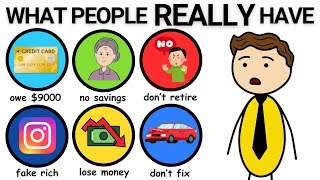
The average American at age 30 has about $7,000 in liquid savings. By 40, maybe $45,000 in retirement accounts. Even at 50, most people have less than $60,000 they can actually touch.
These are people with careers, with decent salaries, with retirement accounts they opened once and forgot about. They're earning money. They're just not keeping any of it.
And the gap between what they earn and what they own is where the real story lives. Here's what nobody tells you. When you graduate, get that first real job and start seeing actual paychecks.
Income and wealth are not the same thing. They're not even cousins. Income is what shows up in your bank account every 2 weeks.
Wealth is what stays there and grows while you sleep. You can make six figures and be broke. You can make 50,000 and be building real financial security.
The difference has almost nothing to do with the number on your paycheck and everything to do with what happens after that number arrives. Most people treat a raise like a permission slip to upgrade their life. You go from making 45,000 to 60,000 and suddenly that studio apartment feels too small.
You deserve a one-bedroom now, maybe a nicer part of town. the used Honda Civic that got you through your 20s starts looking embarrassing next to your co-worker's new SUV, you're making more money. So, shouldn't your life reflect that?
This is called lifestyle creep, and it's the silent assassin of wealthb buildinging. Every dollar of that $15,000 raise gets absorbed into higher rent, a car payment, better restaurants, a gym membership you'll use twice, and subscriptions you'll forget exist. A year later, you're making 60,000 and you somehow feel exactly as broke as you did at 45.
The math here is brutal. If you were saving 10% of 45,000, that's 4,500 a year. Bump up to 60,000 and keep that same 10%.
You're now saving 6,000. Except you don't because the onebedroom costs an extra 600 a month. The car payment is 400.
You're eating out three times a week instead of once. your actual savings rate drops to maybe 5% and suddenly you're saving less than you were before the raise. You got a promotion and went backwards.
This happens to almost everyone and most people never even notice it's happening. But lifestyle creep is just the opening act. The real trap, the one that keeps people stuck forever, is what I call payments mentality.
Walk into any car dealership and ask how much a car costs. They won't tell you 35,000. They'll tell you it's only $499 a month only as if that word makes it affordable.
Financing has rewired how people think about cost. Instead of asking can I afford this thing, uh people ask can I afford this monthly payment and the answer is almost always yes because dealerships and credit card companies have gotten very good at making the math feel small. Here's what that actually means.
Um, you finance a $35,000 car at 6% interest over six years. You'll pay over $41,000 total. Uh, you just gave away $6,000 for the privilege of not waiting.
And that car, the thing you're paying interest on, is losing value the entire time you own it. 3 years in, it's worth maybe 20,000, but you still owe 18. You're underwater on a depreciating asset and your monthly payment feels so normal you don't even think about it anymore.
It's just part of life now. Rent, utilities, car payment, phone payment, credit card minimums. Your income is spoken for before you even see it.
This is why 75% of people never reach 100,000 in invested assets. They're not buying assets. They're renting their lifestyle on credit and calling it success.
An asset is something that puts money in your pocket or grows in value. Stocks, index funds, real estate, a business. A liability is something that takes money out of your pocket.
Cars, clothes, gadgets, subscription services. Most people own a ton of liabilities and zero assets. They have a closet full of sneakers and an investment account with $1,200 in it that hasn't been touched since their first employer autoenrolled them.
Um, and then there's the investing delay. This one kills me because the math is so obvious once you see it, but most people never run the numbers. Let's say you're 25 years old.
You invest $5,000 a year into an index fund averaging 8% annual returns. By 65, you'll have over $1. 4 million.
Now, let's say you wait until you're 35 to start. Same 5,000 a year, same 8%. you'll end up with around 650,000.
You delayed 10 years and cut your retirement in half. That's not a rounding error. That's the difference between comfortable and stressed for the last 30 years of your life.
People tell themselves they'll start investing later, once they pay off the car, once they get the next raise, once life calms down, but life never calms down and later never comes. What actually happens is they wake up at 42, realize they have $19,000 to their name, and panic. Suddenly, they're trying to catch up by dumping money into risky investments or side hustles they don't understand.
They're trying to compress 20 years of compounding into 5 years of hustle. It doesn't work. You can't outearn bad math.
But here's the thing nobody talks about, and it's the reason this whole script exists. There's a specific number where everything changes. A threshold where the game shifts from agonizingly hard to surprisingly easy.
That number is $100,000. And getting there is the single most important financial milestone most people will never hit. Charlie Mer once said, "The first h 100,000 is a but you got to do it.
" coming from a billionaire. That sounds almost insulting, but he's right. And the reason why is buried in a mathematical reality that most people never experience because they quit before they get there.
At $100,000 invested, assuming an 8% average annual return, you're earning roughly $8,000 a year in growth without lifting a finger. That's almost 700 bucks a month your money is making while you sleep. Now compare that to someone with 10,000 invested.
They're earning $800 a year, $66 a month. The difference between those two scenarios isn't just the dollar amount. It's psychological momentum.
When your investments are generating real noticeable monthly income, something shifts in your brain. You stop seeing investing as this abstract future thing and start seeing it as a machine that's actually working. You start protecting it, feeding it, prioritizing it because now it feels real.
But here's where it gets wild. That 100,000 doesn't just earn 8,000 in year 1 and stop. In year two, you've got 108,000 working for you.
That generates 8,640. Year three, you're at 116,640, earning over 9,300. By year five, you're past 146,000, earning nearly 12 grand a year without adding a single extra dollar.
You went from zero to a h 100,000 through pure discipline and sacrifice. But you go from 100,000 to 200,000 significantly faster because compounding is finally doing heavy lifting. The boulder you were pushing uphill for years suddenly crests the peak and starts rolling on its own.
Let me show you why this matters in a way that'll actually make you angry if you've been delaying. Let's say you're 30 years old right now. You commit to saving and investing $1,000 a month.
At 8% annual returns, you'll hit a $100,000 in about 6 and 1/2 years. You'll be 36. Not bad.
But here's the kicker. Yes. But once you hit that 100,000, if you keep putting in that same,000 a month, you'll hit 200,000 in just four more years.
You'll be 40. Then 300,000 by age 43, 400,000 by 46, half a million by 48. The time between milestones shrinks because your money is compounding on a larger and larger base.
The first 100,000 took you 6 and 1/2 years of grinding. The next 400,000 took you 12 years, but the acceleration is obvious. You're not working harder.
Your money is now. Let's say you're 30 and you delay 5 years. You're going to start at 35.
Same thousand a month, same returns. You hit a 100,000 at 412. You've already lost 5 years of compounding on that base.
By the time the first person is at half a million at 48, you're at 310,000. You didn't just lose 5 years, you lost $190,000 in growth. That's the cost of waiting.
That's the invisible tax nobody warns you about. So, why do most people never get there? It's not income.
Plenty of six-figure earners have under 50 grand in net worth. The issue is behavior. Specifically, it's the inability to delay gratification long enough to let the math work.
We live in a culture that's actively hostile to accumulation. Every advertisement, every algorithm, every influencer is designed to make you feel like you're missing out if you're not spending. Your phone is a dopamine slot machine that constantly reminds you of things you don't own.
And the worst part, the spending often feels justified. You worked hard. You deserve it.
That's the lie. Hard work doesn't entitle you to spend everything you earn. Hard work is supposed to build something.
But if you're spending it all, you're just running in place with nicer shoes. And then there's the optimization trap. People spend months researching the perfect investment strategy.
Should I buy this ETF or that one? Should I use a Roth or traditional? What about real estate?
What about crypto? Meanwhile, they have $1,700 in their savings account and they're financing a couch. None of that research matters if you're not actually accumulating capital.
The best investment strategy in the world is worthless if you have nothing to invest. You don't need to be a genius. You need to be consistent.
Index funds, automate it, increase contributions every time you get a raise. That's it. Boring wins.
Here's the part where I'm going to tell you something you probably don't want to hear. If you're serious about hitting a h 100,000 in the next 5 to seven years, you're going to have to live like you're broke, even when you're not. That means saying no a lot.
No to the vacation everyone else is taking. No to the new car because yours works fine. No to eating out four times a week.
No to buying the thing just because it's on sale. Every dollar you don't spend is a soldier you're sending to fight for your future. And in the beginning, it feels like you're sacrificing everything.
Your friends are posting trips to Tulum. You're meal prepping chicken and rice for the fourth week in a row. They're upgrading to the new iPhone.
You're holding on to your cracked screen like it's a badge of honor. It sucks. I'm not going to lie to you and say it's fun.
But um here's what nobody tells you about that grind. It doesn't last forever. Once you hit a 100,000, once you see that compounding start to snowball, the game changes.
You're not white knuckling it anymore. You've built the foundation. Now you can afford to relax a little because your money is doing the heavy lifting.
The people who skip the grind, they're still stuck at step one, wondering why they feel broke on 75 grand a year. You'll be 10 years in watching your net worth climb by 50,000 in a single year, and you'll realize the sacrifice was worth every boring, repetitive, unglamorous moment. The first 100,000 isn't just a number.
It's proof you can delay gratification, ignore the noise, and build something real. And once you prove that to yourself, the next 100,000 is inevitable. So what does this actually look like in practice?
Because theory is useless if you can't execute. Let me give you the brutal, unsexy truth about how you actually get to $100,000 when you're starting from nearly nothing. First, you need to accept that for the next 3 to 5 years, you're going to be the weird one.
Your co-workers will think you're cheap. Your family will ask why you never go on vacation. Your friends will stop inviting you out because you always say no.
And you have to be okay with that. Because here's what they don't see. Um, while they're financing experiences, they can't afford to impress people they don't like, you're building an asset base that will eventually buy you a decade of freedom.
They're renting their lifestyle. You're buying yours. The math doesn't care about their opinions.
Step one is ruthlessly simple. Track every single dollar for 30 days. Not to budget yet, just to see where the money actually goes.
Most people have no idea. They think they spend 200 a month eating out. The bank statement says 600.
They think their car costs 350 a month. Insurance, gas, maintenance, registration brings it to 700. You can't fix what you can't measure.
Spend one month just observing your financial behavior like a scientist. No judgment, just data. Step two is where it gets uncomfortable.
You're going to find at least $500 a month of pure waste. Subscriptions you forgot about. Convenience spending that adds no value.
Impulse purchases that seemed important at the time. Cut all of it. Not most of it.
All of it. This isn't forever. This is war.
You're in the accumulation phase. And accumulation requires aggression. You can add some of it back later when you have the foundation.
Right now, you don't. Step three is the one that separates people who make it from people who stay stuck forever. Automate your savings and investments before you see the money.
The day your paycheck hits, money moves automatically. 500 into a high yield savings account for emergencies. 500 into an index fund.
Whatever's left is what you live on. not the other way around. Most people try to save what's left over at the end of the month.
There's never anything left over. You have to pay yourself first and you have to make it automatic. So, discipline isn't required every single month.
Now, here's the part that's going to test you. Um, life will try to sabotage this plan immediately. Your car will break down.
Your laptop will die. Uh, someone will get married in another state. These aren't emergencies.
These are predictable expenses that you failed to plan for. That's what the emergency fund is for. That's why you built the buffer.
You don't pause investing every time something costs money. You handle it and keep moving. The people who stop and restart investing 10 times never build momentum.
Consistency beats intensity every single time. Let's talk about income for a second because I know someone's thinking, Nick, 500 a month is impossible on my salary. Maybe, but probably not.
The average American household brings in about 75,000 a year. After taxes, that's roughly 55,000 or 4600 a month. If you genuinely cannot find $1,000 a month to save and invest out of 4,600, your lifestyle is the problem, not your income.
And I get it. Rent is expensive. Child care is expensive.
Life is expensive. But expensive is also relative. People making 40,000 feel broke.
People making 140,000 also feel broke. The difference is choices, not circumstances. If your income genuinely is too low, then step four is increasing your earning power.
Not through side hustles that pay $12 an hour through skill acquisition that makes you more valuable. Learn a highinccome skill. Get a certification.
switch industries, negotiate better. The goal isn't to work three jobs. The goal is to make your primary income high enough that saving a thousand a month doesn't require three jobs.
This might take a year. It might take three, but it's worth it because time is the ingredient you can't buy back later. Here's what nobody warns you about.
The psychological battle gets harder before it gets easier. At 10,000 saved, it feels pointless. At 25,000, you're exhausted and wondering if it's worth it.
At 50,000, you start seeing progress, but you're also burnt out from years of saying no to everything. This is the danger zone. This is where most people crack and blow it all on something stupid because they need a release.
Don't push through because at 70,000 something magical starts happening. The gains get bigger. A 7% return on 70,000 is $4,900 that you didn't work for.
You're starting to see the compounding effect in real time, not just on a spreadsheet, and then you cross a $100,000. The number that took you 5 years to reach the first time, it'll take you 3 years to reach again, then 2 years, then 18 months. The acceleration is real and it's intoxicating.
Suddenly, you're not grinding anymore. You're managing. You're optimizing.
You're watching your money make more in a year than some people save in a decade. That's the other side. That's what you're building toward.
But you only get there if you survive the boring middle. The years where nothing feels like it's happening. The years where your friends are living their best lives on Instagram and you're eating leftovers for the fourth night in a row.
the years where you question if you're doing it right because society tells you that spending money is how you prove you've made it. You haven't made it by spending. You've made it when you no longer have to.
The first 100,000 isn't about the money. It's about proving to yourself that you can delay gratification long enough to win a game that most people lose by default. Once you prove that, everything else is just execution.
You've broken the pattern. You've escaped the trap. and the next h 100,000 that's just momentum.
So here's what it comes down to. 75% of people will never reach a h 100,000 in liquid wealth because they're playing a game they don't understand with rules they never learned. They think wealth is about income.
It's not. They think it's about finding the perfect investment. It's not.
They think it's about timing the market or catching the next big thing. It's not. Wealth is about the gap between what you earn and what you spend, multiplied by time and protected from your own worst impulses.
The guy with the Rolex at Starbucks, he's not winning. He's performing. And the performance cost him everything he'll never have.
Meanwhile, the person driving the 10-year-old Toyota with a brokerage account nobody knows about is quietly building the kind of freedom that doesn't need to be photographed. You don't need to be smart to reach a h 100,000. You need to be stubborn.
Stubborn enough to say no when everyone else is saying yes. Stubborn enough to keep investing when it feels like nothing's happening. Stubborn enough to ignore the noise and trust the math.
Because the math doesn't lie. It doesn't care about your feelings. It doesn't care if you're tired of being disciplined.
It just compounds slowly and silently until one day you wake up and realize you're not trapped anymore. That's the real prize, not the number in the account. The fact that you proved you could do it.
And once you've done it once, you'll do it again and again until the question isn't whether you'll be okay financially. Uh the question is what you're going to do with all the time you bought back.