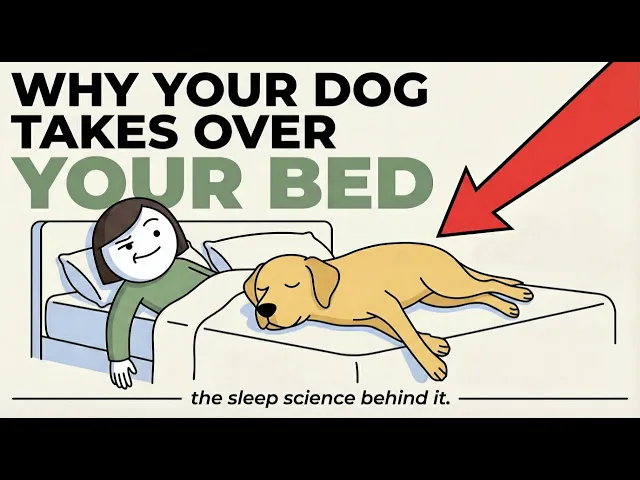
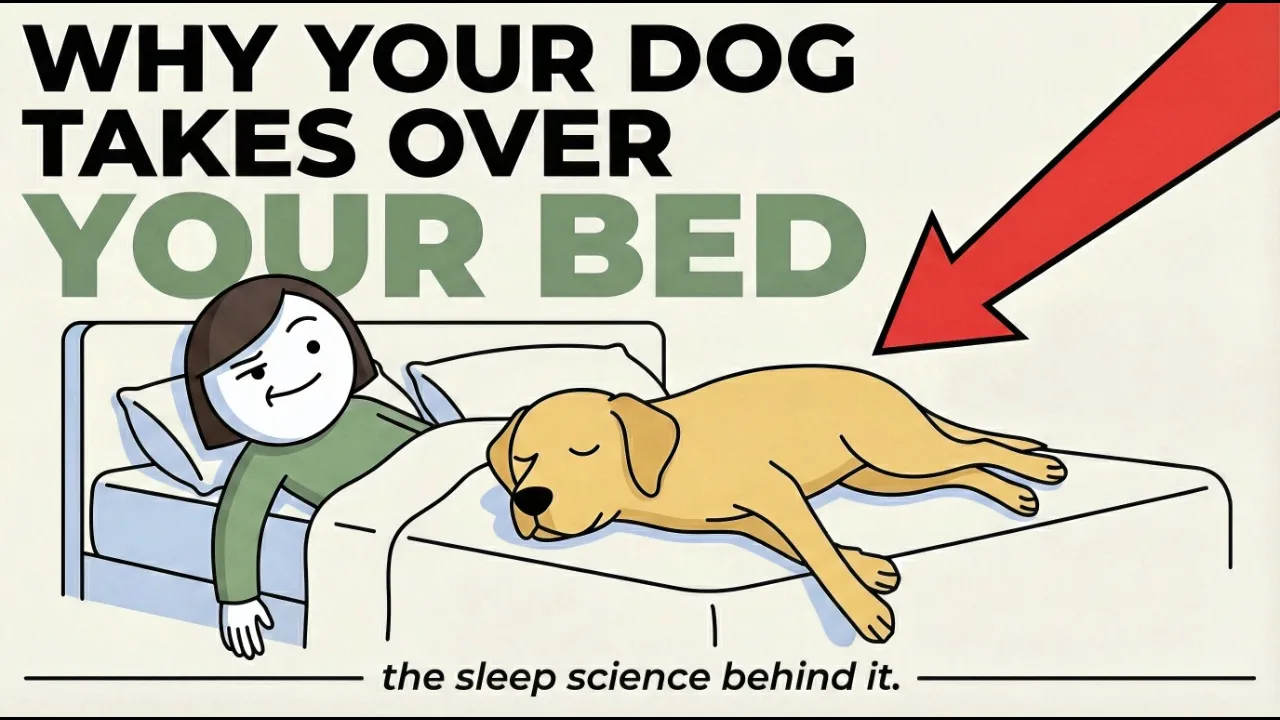
It's two in the morning. Your dog has a perfectly good bed of their own somewhere in the house. And yet, here they are, circling your mattress, settling against your leg, taking up exactly 80% of the space, and leaving you the rest.
Most people assume it's about warmth, maybe habit, maybe they're just a little clingy. But behavioral neuroscience tells a completely different story. What your dog is doing right now, every single night, is one of the most complex expressions of trust, attachment, and evolutionary biology that exists between two species on this planet.
And most owners have no idea. Let's start with the warmth theory, because it sounds reasonable. Dogs get cold, you're warm.
Simple. But here's the problem. Your dog has access to sunny spots, radiators, a couch, and probably a pile of your laundry on the floor.
If warmth was all they wanted, they have options. So why do they keep choosing you? Because sleep is the most vulnerable state any animal can be in.
Every instinct in your dog's brain, instincts inherited from thousands of years of predator-prey dynamics, screams at them to find somewhere hidden and safe. When they're unconscious. And instead, they walk past every quiet corner in your home, and climb next to a human 15 times their size.
That's not about temperature. Researchers at Eötvös Loránd University in Budapest adapted the same attachment test psychologists used to study human infants, Ainsworth's strange situation procedure, and applied it to dogs. The result?
Dogs form attachment bonds with their owners that are functionally identical to the bond an infant forms with its mother. The same proximity-seeking. The same distress when separated.
The same calm when reunited. The same relief when back together. 61% of dogs tested were classified as securely attached.
Almost exactly the same proportion found in human toddlers. When your dog chooses to sleep beside you, they are performing the single most fundamental behavior in attachment psychology. Seeking closeness to their safe person at the moment of greatest vulnerability.
They're not being clingy. They're telling you you're the safest thing in their world. But here's where it gets really interesting.
Because this isn't just psychology. It's chemistry. In 2015, a team of researchers at Azabu University in Japan published a study in the journal Science, one of the most prestigious scientific journals on the planet.
They measured oxytocin levels in 30 dog-owner pairs during interaction. Oxytocin, if you haven't heard the name, is the neurochemical your brain releases when you feel bonded to someone, the same molecule that floods a mother's brain when she holds her newborn for the first time. And what they found was extraordinary.
When a dog gazes at their owner and the owner gazes back, both of them experience a surge in oxytocin simultaneously, across species. The dog's oxytocin goes up. The owner's oxytocin goes up, which makes the dog want to gaze more, which releases more oxytocin, which makes the owner feel more bonded, which makes them gaze back.
It's a loop. A self-reinforcing neurochemical loop that no other animal on earth shares with humans. They tested the same interaction with wolves raised by humans.
The loop didn't activate at all. This co-evolved specifically between dogs and humans over thousands of years of living together. And physical contact amplifies it.
Researchers found that just 10 minutes of petting your dog produces measurable drops in cortisol, that's your stress hormone, in both of you. Now think about what happens over eight hours of sleeping pressed together. Here's a question almost nobody thinks to ask.
When did dogs and humans start sleeping next to each other? The answer is basically from the beginning. Dogs are the only animal domesticated before agriculture, before farming, before cities.
Before writing, roughly 15,000 years ago, wolves began approaching human camps, drawn by food scraps, fire, warmth. The friendliest wolves, the ones least likely to flee, they survived better. They passed on those traits.
Generations later, they weren't wolves anymore. In Germany, archaeologists found a burial site dated to 14,000 years ago. Two humans interred together, and two dogs beside them.
But the detail that changes everything is this. One of the dogs had survived severe canine distemper, a disease that kills within three months. The dog had been in intensive care for over five weeks.
Someone had nursed that dog through its illness 14,000 years ago. These weren't just working animals. They were family.
And that's not accidental. Geneticists have discovered that domestic dogs carry unique genetic insertions in a region of chromosome 6 associated with extreme friendliness and human-directed contact seeking. Wolves don't have them.
Dogs were literally shaped at a genetic level to want to be near us, to sleep near us, to bond with us. Your dog isn't doing something unusual when they climb into bed. They're doing something that's been selected for across 15 millennia.
Now, I want to tell you about a study that nobody talks about because the finding seems impossible at first. Researchers at the Mayo Clinic measured the sleep quality of 40 adults and their dogs over seven nights, using clinical-grade sleep trackers on both. The result?
Dogs objectively disrupted human sleep. Movement, repositioning, the occasional 3 a. m.
stretch that takes out your ankle. Objectively, the data was worse. And yet, almost every single participant reported feeling more comfortable, more secure, and more rested when their dog was in the room.
How is that possible? A researcher at Canisius College surveyed nearly a thousand women and found that dogs were rated as less disruptive than human bed partners. More comforting, more consistent.
Her follow-up study used motion trackers to find the cause. Owners were waking up briefly every time the dog moved, but they almost never remembered it in the morning. The physical interruptions were real, but the felt experience of safety was stronger than the disruption.
And this is where it gets deep. Because it turns out that the psychological benefit of sleeping beside a trusted companion, of having a warm, breathing presence that your nervous system recognizes as safe, might be more important to restorative sleep than uninterrupted darkness and silence. We spent most of human history sleeping in groups.
The isolated, solo bedroom is the exception, not the rule. Maybe your dog isn't ruining your sleep. Maybe they're restoring something more ancient than sleep hygiene.
A 2024 study out of the University of Jyväskylä in Finland monitored the heart rate variability of 30 dog-owner pairs across six different conditions. Heart rate variability, HRV, is one of the best measures of how your autonomic nervous system is functioning. High HRV means you're relaxed and regulated, low HRV means your stress response is activated.
And what they found was this. During every condition measured, dogs and their owners showed correlated HRV patterns. Their nervous systems were in sync.
When the owner was calm, the dog was calm. When the owner was stressed, the dog's autonomic state shifted. And the synchronization was strongest during rest.
They tested the same thing with dogs and unfamiliar humans. No synchronization at all. This only happens within bonded pairs.
What this means is that sleeping beside your dog isn't just a psychological comfort. It's a neurological event — two separate nervous systems from two different species co-regulating each other through the night. There's one last thing I need to tell you, and it might be the most important part of this video.
If your dog has been sleeping beside you for months or years and one day they stop, don't brush it off. Dogs are creatures of habit. When a deeply established behavior disappears overnight, there's always a reason.
Sometimes it's environmental — a new pet, a new person in the house, a shift in your schedule. Dogs are exquisitely sensitive to changes in their territory. Something that feels minor to you can feel seismic to them.
But sometimes it's physical. Veterinary researchers have found that changes in sleep location are one of the earliest behavioral signs of pain, appearing before limping, stiffness, or any obvious physical symptom. A dog who stops jumping onto the bed might not have suddenly decided they prefer the floor.
They might be hurting. And in older dogs, disrupted sleep patterns are the hallmark symptom of canine cognitive dysfunction — the dog equivalent of dementia. It affects an estimated 35% of dogs over 8 years old.
So if the nightly ritual changes, pay attention. Your dog doesn't have language. Behavior is the only way they can tell you something is wrong.
So the next time you wake up at 3am with exactly 6 inches of mattress and 80 pounds of dog pressed against your legs, remember what's actually happening. Your dog chose you. Not the couch, not the floor, not the warm patch by the radiator.
You. Because 15,000 years of evolution, a neurochemical loop that no other species shares with us, and an attachment system built to mirror the bond between parent and child, all pointed at one thing. Sleeping beside you is the safest place in their world.
And honestly, the science suggests it might be doing something for you too. If this changed how you see your dog, subscribe to this channel and drop a comment below. I want to know where your dog sleeps tonight.
And if you want to understand why your dog stares at you with those eyes — that's the next video. And the science behind it is even stranger than you'd expect. It's two in the morning.
Your dog has a perfectly good bed of their own somewhere in the house. And yet, here they are, circling your mattress, settling against your leg, taking up exactly 80% of the space, and leaving you the rest. Most people assume it's about warmth, maybe habit, maybe they're just a little clingy.
But behavioral neuroscience tells a completely different story. What your dog is doing right now, every single night, is one of the most complex expressions of trust, attachment, and evolutionary biology that exists between two species on this planet. And most owners have no idea.
Let's start with the warmth theory, because it sounds reasonable. Dogs get cold, you're warm. Simple.
But here's the problem. Your dog has access to sunny spots, radiators, a couch, and probably a pile of your laundry on the floor. If warmth was all they wanted, they have options.
So why do they keep choosing you? Because sleep is the most vulnerable state any animal can be in. Every instinct in your dog's brain, instincts inherited from thousands of years of predator-prey dynamics, screams at them to find somewhere hidden and safe.
When they're unconscious. And instead, they walk past every quiet corner in your home, and climb next to a human 15 times their size. That's not about temperature.
Researchers at Eötvös Loránd University in Budapest adapted the same attachment test psychologists used to study human infants, Ainsworth's strange situation procedure, and applied it to dogs. The result? Dogs form attachment bonds with their owners that are functionally identical to the bond an infant forms with its mother.
The same proximity-seeking. The same distress when separated. The same calm when reunited.
The same relief when back together. 61% of dogs tested were classified as securely attached. Almost exactly the same proportion found in human toddlers.
When your dog chooses to sleep beside you, they are performing the single most fundamental behavior in attachment psychology. Seeking closeness to their safe person at the moment of greatest vulnerability. They're not being clingy.
They're telling you you're the safest thing in their world. But here's where it gets really interesting. Because this isn't just psychology.
It's chemistry. In 2015, a team of researchers at Azabu University in Japan published a study in the journal Science, one of the most prestigious scientific journals on the planet. They measured oxytocin levels in 30 dog-owner pairs during interaction.
Oxytocin, if you haven't heard the name, is the neurochemical your brain releases when you feel bonded to someone, the same molecule that floods a mother's brain when she holds her newborn for the first time. And what they found was extraordinary. When a dog gazes at their owner and the owner gazes back, both of them experience a surge in oxytocin simultaneously, across species.
The dog's oxytocin goes up. The owner's oxytocin goes up, which makes the dog want to gaze more, which releases more oxytocin, which makes the owner feel more bonded, which makes them gaze back. It's a loop.
A self-reinforcing neurochemical loop that no other animal on earth shares with humans. They tested the same interaction with wolves raised by humans. The loop didn't activate at all.
This co-evolved specifically between dogs and humans over thousands of years of living together. And physical contact amplifies it. Researchers found that just 10 minutes of petting your dog produces measurable drops in cortisol, that's your stress hormone, in both of you.
Now think about what happens over eight hours of sleeping pressed together. Here's a question almost nobody thinks to ask. When did dogs and humans start sleeping next to each other?
The answer is basically from the beginning. Dogs are the only animal domesticated before agriculture, before farming, before cities. Before writing, roughly 15,000 years ago, wolves began approaching human camps, drawn by food scraps, fire, warmth.
The friendliest wolves, the ones least likely to flee, they survived better. They passed on those traits. Generations later, they weren't wolves anymore.
In Germany, archaeologists found a burial site dated to 14,000 years ago. Two humans interred together, and two dogs beside them. But the detail that changes everything is this.
One of the dogs had survived severe canine distemper, a disease that kills within three months. The dog had been in intensive care for over five weeks. Someone had nursed that dog through its illness 14,000 years ago.
These weren't just working animals. They were family. And that's not accidental.
Geneticists have discovered that domestic dogs carry unique genetic insertions in a region of chromosome 6 associated with extreme friendliness and human-directed contact seeking. Wolves don't have them. Dogs were literally shaped at a genetic level to want to be near us, to sleep near us, to bond with us.
Your dog isn't doing something unusual when they climb into bed. They're doing something that's been selected for across 15 millennia. Now, I want to tell you about a study that nobody talks about because the finding seems impossible at first.
Researchers at the Mayo Clinic measured the sleep quality of 40 adults and their dogs over seven nights, using clinical-grade sleep trackers on both. The result? Dogs objectively disrupted human sleep.
Movement, repositioning, the occasional 3 a. m. stretch that takes out your ankle.
Objectively, the data was worse. And yet, almost every single participant reported feeling more comfortable, more secure, and more rested when their dog was in the room. How is that possible?
A researcher at Canisius College surveyed nearly a thousand women and found that dogs were rated as less disruptive than human bed partners. More comforting, more consistent. Her follow-up study used motion trackers to find the cause.
Owners were waking up briefly every time the dog moved, but they almost never remembered it in the morning. The physical interruptions were real, but the felt experience of safety was stronger than the disruption. And this is where it gets deep.
Because it turns out that the psychological benefit of sleeping beside a trusted companion, of having a warm, breathing presence that your nervous system recognizes as safe, might be more important to restorative sleep than uninterrupted darkness and silence. We spent most of human history sleeping in groups. The isolated, solo bedroom is the exception, not the rule.
Maybe your dog isn't ruining your sleep. Maybe they're restoring something more ancient than sleep hygiene. A 2024 study out of the University of Jyväskylä in Finland monitored the heart rate variability of 30 dog-owner pairs across six different conditions.
Heart rate variability, HRV, is one of the best measures of how your autonomic nervous system is functioning. High HRV means you're relaxed and regulated, low HRV means your stress response is activated. And what they found was this.
During every condition measured, dogs and their owners showed correlated HRV patterns. Their nervous systems were in sync. When the owner was calm, the dog was calm.
When the owner was stressed, the dog's autonomic state shifted. And the synchronization was strongest during rest. They tested the same thing with dogs and unfamiliar humans.
No synchronization at all. This only happens within bonded pairs. What this means is that sleeping beside your dog isn't just a psychological comfort.
It's a neurological event — two separate nervous systems from two different species co-regulating each other through the night. There's one last thing I need to tell you, and it might be the most important part of this video. If your dog has been sleeping beside you for months or years and one day they stop, don't brush it off.
Dogs are creatures of habit. When a deeply established behavior disappears overnight, there's always a reason. Sometimes it's environmental — a new pet, a new person in the house, a shift in your schedule.
Dogs are exquisitely sensitive to changes in their territory. Something that feels minor to you can feel seismic to them. But sometimes it's physical.
Veterinary researchers have found that changes in sleep location are one of the earliest behavioral signs of pain, appearing before limping, stiffness, or any obvious physical symptom. A dog who stops jumping onto the bed might not have suddenly decided they prefer the floor. They might be hurting.
And in older dogs, disrupted sleep patterns are the hallmark symptom of canine cognitive dysfunction — the dog equivalent of dementia. It affects an estimated 35% of dogs over 8 years old. So if the nightly ritual changes, pay attention.
Your dog doesn't have language. Behavior is the only way they can tell you something is wrong. So the next time you wake up at 3am with exactly 6 inches of mattress and 80 pounds of dog pressed against your legs, remember what's actually happening.
Your dog chose you. Not the couch, not the floor, not the warm patch by the radiator. You.
Because 15,000 years of evolution, a neurochemical loop that no other species shares with us, and an attachment system built to mirror the bond between parent and child, all pointed at one thing. Sleeping beside you is the safest place in their world. And honestly, the science suggests it might be doing something for you too.
If this changed how you see your dog, subscribe to this channel and drop a comment below. I want to know where your dog sleeps tonight. And if you want to understand why your dog stares at you with those eyes — that's the next video.
And the science behind it is even stranger than you'd expect.