hello friends and welcome back to the channel uh for this uh video considering the situation i had my last one i made sure that my uh picture is much much smaller uh so that you can see the full of the slides so this lecture is about the big sleep and the day of the locust so again i'm going to go through some literary and historical background that will help you understand uh both works in context whether you decided to read the big sleep or you decided to read the day of the locust so picking up
uh with our california history both of these novels have to do specifically with los angeles and so uh zeroing in from kind of the uh the gold brush era from joaquin marietta that's had to do with sort of the larger state as a whole we're gonna put our magnifying glass if you will on los angeles history so los angeles as we know it was founded by 44 people in 1781 and by 1870 so over the next 100 years there were few thou fewer than 5 000 residents and la was largely known as a cattle herding
town by 1900 so this is 30 years later there were over 100 000 residents and by 1930 it was 1.25 million and as you can see here from this little map uh you know 1850 this is what los angeles looked like and as the years move by more and more land and territory is subsumed or consumed by los angeles so it had exponential growth uh within 60 years it went from 5000 to 1.25 million so that's a phenomenal growth uh in a very short amount of time so uh lots of this had to do with
19th century um it had to do with the railroads so los angeles uh became connected to the east coast by the railroads and then also um you know once sort of the gold rush was was over with you had the oil and gas industry and specialty agriculture um like citrus that kind of thing banking shipping and then tourism a lot of rich folks like california weather and so uh even before there was like uh even before there was hollywood and like uh sort of clits and glamour and disneyland and all that stuff um los angeles
was a tourist attraction simply for the good weather hollywood uh was a neighborhood developed in 1903 near los angeles and then it was merged with la uh in 1910. first movie studio was established in 1908. uh hollywood attracted the movie industries because of the good weather so you could film um you didn't have to shut down for the wintertime while it was snowing you could film year round as well as cal california's welcoming legal climate for avoiding motion picture patents from the thomas edison company so thomas edison held a lot of patents for motion picture
technology and if you filmed in california it was harder for thomas edison to sue you um edison was notoriously litigious so by the 20s and again this is just rapid rapid growth so in 1908 was our first uh movie studio in hollywood but by the 20s so like eight or 12 years later the movie industry was the fourth biggest industry in america so during the 30s which is thought of as gold the golden hollywood age the major movie studios monopolistically controlled the film industry producing over 600 movies per year they cranked out or as by
comparison um you know these days 600 movies a year is a lot uh these days the major studios will pump out like 300 ish so it's significantly fewer than they used to but they used to crank them out like nobody's business um also they could they owned the production they owned the movie theaters they owned everything um including the talent they signed long restrictive contact contracts with the studios so it was almost impossible for you to you know these days you know you'll have an actor who does a movie for disney and then they turn
around and they do a movie for universal and then they turn around and do a movie for sony back in the day it was like oh no sony owned your contract um occasionally they'd lend each other out but that's how it worked so the 20s and 30s also had a wildly unpredictable economy um no it's no shocker if you know anything about american history that the great depression um the stock market crash of 1929 happened and the great depression was all through the 30s basically continuing into world war ii um movie studios uh have lots
of money with this new technology it's probably more closely akin to how like the big tech companies like you know uh in 2008 barely anybody knew what facebook was but by 2018 10 years later it had a gajillion dollars and mark zuckerberg became one of the most powerful men in the world so like that's a little bit of an idea for you uh when it comes to uh when it comes to how quickly this industry uh catapulted and skyrocketed so similarly movie studios they had lots and lots of money and they were able to uh
to an extent weather some of the depression and the reason being was that just like uh during coven 19 lockdowns uh netflix made a ton of money because everybody was home watching tiger king all right and similarly uh even if people were broke a lot of times they could they could scrounge a nickel to go see gone with the wind for the 15th time uh so it it largely the movie studios actually didn't do that bad during the depression but there was a lot of highs and lows and highs and lows with the economy in
general because movie studios were so uh so new and then also they were often heavily in debt and financially unstable they'd spent a lot of money on a movie then the movie would flop and then they'd lose bunch of money and so it's there was a lot of the the finances and the economy of early hollywood was kind of a roller coaster even though there was a lot of rich rich and famous people sometimes they'd be rich and famous one day and then has been the next day all right uh so that's sort of the
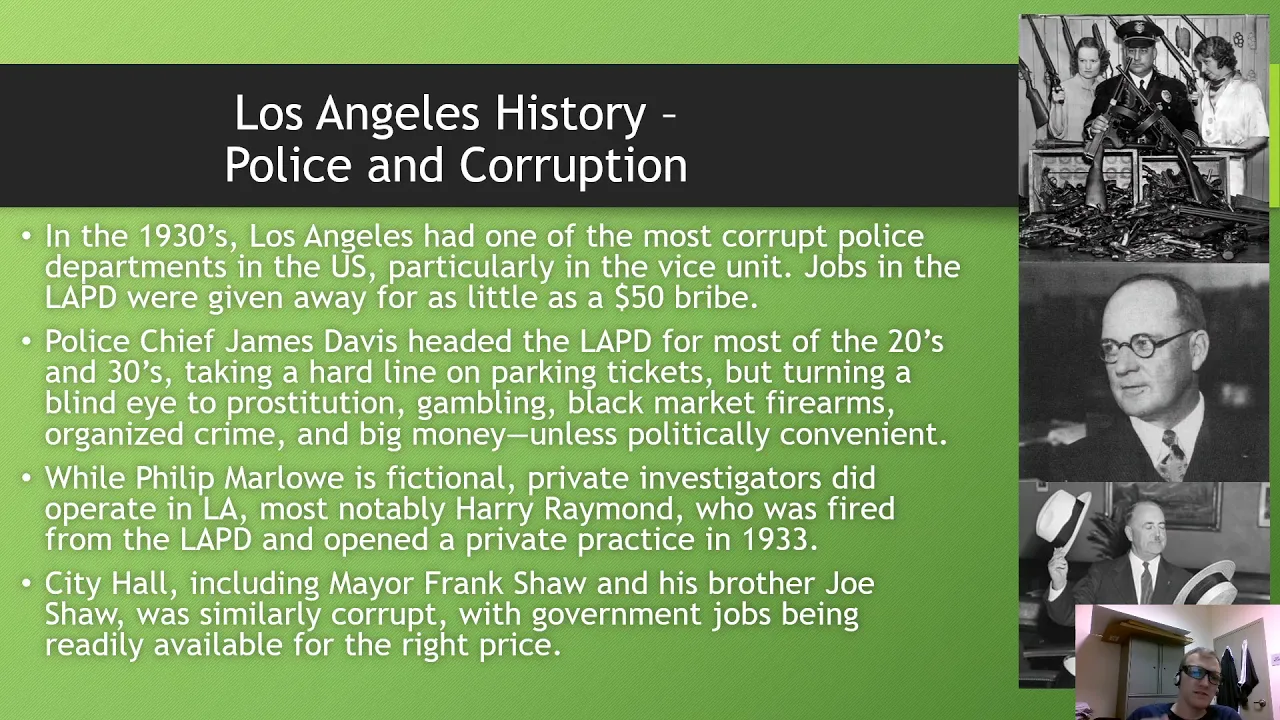
movie business next uh and we're gonna sort of in this uh lecture we're gonna come back and forth between sort of the chandler side of things on the west side of things so next thing about los angeles history is police and corruption so in the 1930s la had one of the most corrupt of police departments in the entire country particularly in the vice unit uh jobs in the lapd were given away for as little as a 50 bribe um granted 50 was a lot more in 1930 but still like you could buy a job on
the lapd for 50 bucks or you could plant one of your people in there for 50 bucks police chiefs james davis headed up the lapd for most of the 20s and the 30s taking a hard line on parking tickets so you know things where he could uh charge uh where he could sort of charge the little people money but turning a blind eye to prostitution gambling black market firearms organized crime and big money unless it was politically convenient for instance so this is a picture of davis uh when he did a big gun grab at
at one point uh during his career but that was after years of doing nothing about guns so again this was this uh police chief was more about politics and doing things uh that would benefit uh the people who were giving him kickbacks reason you don't do anything about prostitution gambling in black market firearms is because all the people who run all those operations kick you back some money and they pay you so you go away now while philip marlowe is fictional private invest investigators did operate in la the most famous of which was this guy
harry raymond harry raymond uh was he what used to work on the lapd in the vice squad uh but then he was fired and he opened private practice in the 19 in 1933. so city hall including mayor frank shaw and his brother joe shaw they were similarly corrupt um government jobs being readily available for the right price just like you could buy buy a job as a detective for 50 bucks you could buy a job in city hall it was just very corrupt uh from my research it seems that joe was was more of the
sort of corrupt mastermind uh behind his brothers behind his brother the mayor frank but still i mean if you have to debate which one was more corrupt i mean who cares uh what's interesting about sort of the lapd police and municipal corruption is how much of it makes raymond chandler's stories seem much less fantastical so for instance there is a guy named clifford clinton he was a restaurateur and he became sort of a political optimist and reformer he wanted to root out corruption in the lapd in city hall he hired harry raymond as a pii
to investigate corruption then after months of surveillance by the lapd's captain earl coynette clinton's basement was bombed uh though no one was hurt and then later harry raymond started his car trigger triggering a car bomb and you can see this is harry raymond's car after it exploded this is clifford clinton raymond miraculously survived here's a picture of clinton and raymond while raymond was recovering in the hospital um he suffered hundreds of wounds and broken bones and they even had to amputate his left leg so raymond then testified in court kynet was find found guilty of
attempted murder davis was fired and shaw was recalled from office this wasn't the end of the corruption in los angeles but this shaw davis era was was over and so because this shaw davis uh kinet this whole police uh city uh mayor corruption this was all the 1930s um the 20s and the 30s were all about this and so this is the los angeles that chandler lived in so when chandler's talking about how everybody everything's a grift and every end everybody's on the take well you know chandler published big sleep in 1939 this is exactly
what had just occurred in the city of los angeles for a while there was some reforms that were in there and um like like i said corruption's never really gone but this particularly bad series of corruptions kind of kind of peaked right when chandler started writing beyond that there's more los angeles history in the politics and the media if you thought fake news was bad now where do you see the 30s so political and media institutions of los angeles were also completely corrupt unlike the 2020s in the 1930s it was republicans that held tight control
of both the entertainment industry and the newspapers so um these days it's uh it's democrats who own most of the um most of the movie studios and most of the big media corporations that the the um newspapers and stuff like and some such most of them they they donate to democratic politicians and that kind of thing with the exception of like fox news um but in the 1930s it was republicans who owned it all so during the depression obviously poverty was rampant all california industries suffered the oil industry suffered the shipping industry suffered everything was
suffering and also waves of economic migrants including like the oakies like in grapes of wrath that exacerbated income inequality so there was more people than ever flooding to california and there was less uh pieces of the pie to go around um so essentially you were a movie executive or a movie star or a rich snowbird from out of town like in david locust or you were scraping by eating out of a dumpster and that's kind of the this this sort of two tiers of california at the time so socialist author upton sinclair uh this is
a if anybody saw the movie on netflix mank some of that is covered in here um upton sinclair is also famous for writing the the novel the jungle which is about um the meat packing industry and then he also wrote uh oil which was later um adapted into there will be blood starring daniel day lewis so upton sinclair is he's a famous writer and he ran for governor on a very similar it was called the epic campaign in poverty in california and he garnered large populist support with a plan to reduce unemployment this was sort
of similar to fdr's national plans with the new deal that involved uh it involved for instance uh ideas that were actually kind of radical but they were popular in the sense like he would say he wanted the government to seize unused properties unused farms and unused factories you wanted the government to take that on so that you could put the unemployed to work in them so these would have like there's debates now with whether or not that would have made the depression worse or actually fix the depression but the idea is that sort of the
poor and working classes would have been direct beneficiaries in the short term from the policies that upton sinclair uh put together uh movie studios republican party officials newspapers they coalesce to destroy abdo and sinclair um here's a picture this is william randolph hearst who owned basically half of the newspapers in the world uh and this is louis b meyer um who was one of the studio heads of uh mgm metro golden meyer which is still around in some shape or form so the leaders of several movie studios more or less intimidated their workers away from
voting for sinclair basically if you've worked for a movie studio which was like a lot of people in los angeles um and i'm not talking about you know clark gable here i'm talking about you know the guy who holds the boom mic uh the extras the you know the all of the little people who me who made the movie um they were basically in no uncertain terms saying you can't vote for weapon sinclair you've got to vote for the republican guy even though even though the the workers themselves might have directly benefited from sinclair's policies
the studios were able to pull their weight to maintain the political status quo newspaper moguls like harry chandler this is no relation to raymond chandler and william randolph hearst also used their vast empires to influence california politics engaging in sensational yellow journalism and political hit jobs um like i mentioned the netflix movie mank which is about uh william randolph hearst and the writing of the movie citizen kane this covers it a little bit though it kind of overstates uh hearst's involvement when really the worst actors um against sinclair were harry chandler and um louise meyer
uh chandler and meyer teamed up and launched a fatal coordinated attack on sinclair's campaign and he got he got blown out even though he had a very strong um uh showing uh many and part of sort of the backdrop of this was that many people in the uh in the media industry and were of jewish immigrant roots and there was they were sort of arguing and sort of torn between the idea of that they were jewish immigrants and there was a rise of anti-semitism worldwide especially in the united states of europe and that fascism was
coming um in the 1930s we got hitler we got mussolini we got franco and this the european market was becoming increasingly taken over by fascism and many people uh saw that hitler uh and hitler's germany were good for business uh and so they might even though they might uh have you know been on the negative end of you know what hitler ended up becoming uh you know they thought it was promising like hey you know hitler's hitler's really doing good things for germany's economy and you know they watch movies in germany um so you have
guys like hit like hearst um who you know were sympathetic to hitler and like this for instance this is him and his mistress and like sort of like a hitler themed party again this is before hit before world war ii really kicked off um and you know this is kind of back in the time when uh when even the allies were saying yeah maybe hitler's not that bad but you know hindsight is 20 20. all right so that's some uh historical backdrop with the corrupt media the corrupt politics and this is just a very very
very corrupt los angeles in many ways again you thought that the cops and the politicians and the uh and the movie studios and the newspapers or the journalistic outlets you thought they were all corrupt now weak sauce compared to 1930s all right so this is the world that raymond chandler enters so chandler is born in chicago uh his alcoholic father abandoned the family when he was young he was raised and educated in europe and he served in world war one seeing trench combat in france um after the war he moved to los angeles where he
became involved with a married woman there's her picture there and she was 18 years older than him and um she divorced her husband and uh chandler supported both her and his mom uh they eventually got married after chandler's mom died his mom did not approve of um for sort of kind of understandable reasons uh he eventually got an executive job in the california foreign oil industry and he was doing that for a number of years uh but then he was fired during the depression partly due to his alcoholism so what's interesting you know he's born
in 198 sorry this should be 1888. um he's born in 1888 and yet he uh you know he didn't really become a writer until his 40s uh he was you know the vice president of an oil company but then after he got fired he um he turned to writing because at that time that time writing actually was a job where you can actually make a little bit of money um and like as sort of regularly submitting to magazines um so he was a lifelong alcoholic he struggled with balance of depression and suicidality all throughout his
life he attempted suicide a number of times he was broke he at one point he said that he went for five days living in a hotel uh where all he had to eat was soup but again great depression not surprising so he he turned to writing for the pulp magazine black mask and earned a modest success as a writer uh in addition to famous adaptations of the stories as he got more and more popular he also contributed to screenplays including double indemnity and chandler you know i would say rightly considered himself one of the great
american novelists uh but the reputation of detective genre led most literary critics to dismiss his work as pop fluff you know he never got the accolades and the attention uh he was sort of seen as oh well he's just sort of the thriller writer the mystery writer he's not really like a writer writer uh even though i think that he had some of the he made some of the most like uh important advances in uh 24 20th century writing fun fact um as you see here this is a short story he published in black mask
called killer in the rain and you see the girl in the kimono and you see the totem pole um this actually is a scene from what would later become the big sleep one of the things chandler did is he cannibalized a couple of his short stories and he sort of strung them together to make the plot of the big sleep so um that uh this at one point killer in the rain had this scene which later ended up being part of the uh big sleep so now you know uh after several successful movies and novels
chandler moved to la jolla near san diego um in 1954 died and chandler's alcoholism and depression reached its peak um you know he has he was sort of an off and on drinker but during his sort of most successful years uh professionally he was the alcoholism was you know less prominent and during the during the the worst years both his um both the quantity and quality of his work suffered after since he died he attempted suicide again um but he he called the cops while he was in the shower with a revolver threatening to kill
himself and then he was briefly institutionalized he continued to write until his death um he left some some posthumous work on you know unpublished that ended up getting published later after a trip to england his health took a turn for the worst and he died in 1959 of pneumonia exacerbated by years of heavy drinking and smoking he was not a healthy man and so that was raymond chandler now and there's nathaniel west so nathaniel west was born nathan weinstein in new york city his parents were jewish immigrants from eastern europe and they had sort of
already suffered the they had already suffered you know a lot of the horrors of the 20th century in eastern europe um with the rise of communism in uh in uh russia it's very complex very complicated not a fun time to be um in eastern europe and also not a fun time to be a jew um as you could as you could see into world war ii where the holocaust really ramped up nathaniel west died before you know the worst of the holocaust was sort of widely understood but it was not a safe time to be
jewish in europe and it was not a safe time to be anyone in eastern europe uh so his parents uh immigrated to new york city uh he was a terrible student but a voracious reader uh he would read read read read and so he's really smart and really well read but he also cheated his way through most of his education i feel like everybody knows a guy who's like that during the depression his family fell on hard times and he became a night manager at a hotel in new york city so he would work the
graveyard shift and he would meet all sorts of colorful characters many of which he would sort of incorporate later in the day of the locust while in new york west was part of an influential literary writers he more so than raymond chandler he was much more part of that kind of uh that kind of fraternity of writers so he would hang out with william carlos williams uh and uh chandler's detective fiction predecessor daschle hammett so he was much more in kind of the the the elite literary circles um who are the with these guys who
are really sort of moving forward uh what would become known as literary modernism around the time he also uh he also changed his name for he felt it was too jewish for success as a writer remember anti-semitism was not just a nazi germany thing it was an american thing too um so he became nathaniel west instead of nathan weinstein so desperate for cash he moved to hollywood in 1933 to pursue screenwriting um again you had movies where um where where writing actually could be sort of a trade rather than just something that only a few
people were able to do he lived in a hotel on hollywood boulevard where he met many other colorful characters in the film industry who he incorporated in today on the locust as well uh during his lifetime west novels never really achieved greater clan they didn't sell particularly well and he struggled financially um though he he his novels like achieved cult claim um so there were some people who really liked his novels and sort of like you know they were they were hipster novels in the sense that you know he's you might never have heard of
it but like the cool people knew it um in la uh west became good friends with f scott fitzgerald author of the great gatsby who was also working in the film industry too uh and but at that time you know in the 30s and 40s he was seen or in the 30s anyway he didn't survive to the 40s in the 30s he was seen as a has been um he was really big in the 20s but people are like oh that guy who wrote the great gatsby 10 years ago yeah um interestingly at the time
of their deaths both of them were working on uh biting critiques of the film industry at the same time in the last year of his life um might have been his happiest year of his life west got married to his wife eileen and he made some considerable money um selling a number of motion picture treatments you know he had made really decent money and it like it was finally turning around um but on december 21st f scott fitzgerald died of a heart attack and then on their way home from a hunting trip in mexico like
partly to go to um f scott fitzgerald's funeral west and eileen both died in a car crash and here you can see the newspaper clipping from that time so the they ended up both dying in their station wagon um west was like sort of a notoriously bad driver one thing that is if you must know the dog was in the car at the time of the of the car wreck but the dog was okay and now you know but west and his wife both died during his life uh west was not interested in contemporary american
real realist literature you know some of the most popular literature in america was sort of like the more realist the more naturalistic um literature he wasn't really into that he was much more into sort of the more experimental modernist literature surrealist art and then also catholic and jewish mysticism so he was kind of into all that symbolism and stuff like that much is made of west in his alleged politics basically saying okay well what was his politics especially considering the 1930s was you know fascism and then locust has sort of these anarchistic mob motifs um
so he was thinking all right well you know was he a socialist was he an anarchist you know was he an anti-fascist um you know from what we know of west he certainly was not a fan of hitler or franco or mussolini but he was relatively apolitical and he especially compared his contemporaries who um compared to his contemporaries who raised socialism daschle hammett and john dos pasos and john steinbeck they were all into socialism whereas west was a little bit like more he was critical of fascism but in sort of the more abstract human nature
sense wes saw the american dream the politics and the religion and the romance as sort of sickly and comically out of reach and that poverty was both financial and spiritual that he sort of saw financial poverty as sort of a reflection of this sort of spiritual rot of the american dream um he really started gaining literary prominence in 1957 with a re-issue of his books day the locust and miss lonely hearts which are now both considered to be satirical masterpieces so that's that's chandler that's west so now when it comes to the literary context this
is where we're going to get into the weeds here but stay with me um hopefully it'll it'll kind of work so but in the 80 years between where uh we move from sort of where joaquin marietta was we then moved to what is called modernist literature uh modernist literature is really from around the turn of the century to around world war ii where there's this big shift not just in english-speaking society but also um also in the literary style so this is a meme from the internet as most memes are where you can sort of
get the idea of different conflicts in literature so in the classical sense of literature you have um man versus nature man versus man and man versus god these are sort of the more common uh the more common uh motifs that you see in literature particularly in the 19th century lots of the realist and naturalist uh writings you know like where you will get into um folks like uh stephen crane or jack london you know he wrote like call the wild you get a lot of man versus man and you get a lot of man versus
nature um so when you get a front frontier narrative um like a western like joaquin marietta you get a lot of man versus man you get a lot of man versus nature you know you're on the rugged terrain nature you are you know it's a cops and robber story it's man versus man um so joaquin marietta was here the modern period where we move into chandler and west you get much more into here man you get more themes of man versus society man versus himself and man versus no god so this idea of you you
have this this individual alienated from society uh you have a uh individual who's much more internally focused and then you have these big existential questions of real of life you know if before it was okay well are you doing what god wants you to do and now it's maybe there is no god and maybe that's maybe that's the conflict that's a little bit of a primer for modernist literature um here are some other sort of big differences between the two um broad strokes differences i'm not gonna go through all this this is actually more for
british literature but it's still helpful to think about it so really the overall spirit of the victorian age which is sort of the literature in especially in britain um in the night through most of the 19th century was earnest it was preoccupied with man's relationship to god awareness of time concern with how best to live social issues concerned with finding one's place an increasingly complex social structure the overall spirit of the modern period is alienation it is preoccupied with man's crisis of meaning amid collapsing social institutions radical philosophy intense focus on finding inner meaning amid
a world full of contradictory and subjective reality disillusionment and fragmentation in search of truth is there a truth out there some other things to consider um from the move from the sort of the 19th century the 20th century um you have a lot of non-linear storytelling foreshadowing a lot more of sort of psychological points of view focus on subjective storytelling stream of consciousness first person questioning gender roles and sexual norms um cycles of time uh questioning ideas of patriotism and heroism there's a lot more alienation there's a lot more uh you know sort of everything
is meaningless and some of that is reflected in the philosophy so here's a quote by albert camus who um he sort of rose to prominence a little bit after chandler and west but the way he described it is the modern mind is in complete disarray knowledge has stretched itself to the point where neither the world nor our intelligence can find any foothold it is a fact that we are suffering from nihilism nihilism is sort of that that idea that nothing matters here's a quote from friedrich nietzsche who's an influential philosopher at the time god is
dead and we have killed him this idea that sort of nothing means anything so this modernist uh movement it spins out out of the 1890s it writers really rejected the idea that the artist was sort of this moral uh this kind of moral instructor to society i've said the word a bunch of times but alienation they felt and explored many feelings of alienation from the artist the public between individuals between institutions and individuals and a lot of them were underpinned by the the philosophies these radical philosophies of freud and young and nietzsche and marx sort
of questioning the ideas of god and country that had been so dominant for so long one thing that really did not help was world war one um you sort of can't talk about the modern period without talking about world war one um the particular politics are less important than the fact that it was just catastrophic to the west the world had never seen a more violent catastrophe in its existence for the first time airplane zeppelins tanks machine guns and chemical warfare including gas attacks were utilized to bring unprecedented destruction 40 million people were killed or
wounded with 9 to 11 million military personnel dying along with 8 million civilians and that's for i believe that's just for the uk about two million soldiers died of disease and six million went missing or presumed dead by the end of the war one in four men were serving the military in the uk and while many fathers and children were killed in war the vast majority of the dead were young unmarried men often as young as 16. again this is kind of this is adapted from a lecture i use for british lit so that's sort
of the you keep the uk stats but still you get this idea one in four people in europe was in the military uh adding insult to injury the outbreak of influenza called the spanish flu infected approximately 500 million people 25 percent of the global population killing three to five percent of the global population lots of comparisons from co of covet 19 back to the spanish flu the biggest difference between um the spanish flu and cova 19 is the at-risk population with spanish flu the at-risk population was young people whereas um with kova 19 it's it's
it's the most ass at risk of the elderly so not only did uh 50 to 100 million people die worldwide um you know to put that in perspective so far encode with covet 19 i think it's something like six million people have died worldwide um so that's that shows you a little bit of the um the magnitude of the spanish flu and its global impact um and then again it was young people too the aftermath of world war one entire generation of young men were dead several world powers including russia the ottoman empire germany were
in ruins and outlooks on the pre-world pre-war world were radically different so if you're wondering why is everybody having an existential crisis uh yeah that didn't help the fact that the world basically exploded uh the other thing uh two is just radical philosophy this is not an extensive list of the philosophers but you had guys like sigmund freud and carl jung really exploring psychology you had frederick nietzsche um who uh he was rejecting christianity advocated to use the people to use their own will to achieve their potential then you had karl marx who was who
was um looking at class warfare and advocating for the end of capitalism so even the financial structures you know people people basically people did not trust their own brains god or the government uh and that's part of feeling fueling all this um angst so that's sort of kind of the underpinnings specifically of the modernist period which both chandler and west are part of then there's also some specific things going on in detective fiction so detective fiction was more or less invented by edgar allan poe in the 1940s he uh with his stories like murders in
the rumor uh and his uh famous detective um detective dupont uh often this would involve a private investigator who solves crimes and mysteries arthur conan doyle created sherlock holmes who debuted in 1887 easily the most famous literary detective now there's also a difference between classical detective fiction and hardboiled detective fiction in classical detective fiction you get um characters are typically wealthy uh the scene of the crime is often a mansion or a country house or a similarly similarly high-class setting um if any of you have seen the movie knives out where it's you know a
bunch of rich people all get together and we try to figure out who done it that's your typical detective fiction in the classical sense uh you get detectives like um from agatha christie's murder on the orient express and so he comes in and he solves the crime and he gets everybody together and he uses his logic and he follows the clues and at the end you know the crime is wrapped up it's put in a bow there's equilibrium there's law and order there's upper class values and there is justice that is brought back to society
by the end of the novel that's classical detective fiction hard-boiled detective fiction not so much so american writer daschle hammett is credited with inventing the genre in the late 20s um and it largely proliferated in black mask the same one that that both hammett and chandler would write in so uh unlike classical detective fiction hard-boiled fiction uh has to do with this rather than sort of this upper-class rural or suburban setting you have this urban city everything is grimy and gross and it's always raining the characters are frequently lower in working class they've got slang
vernacular you know instead of the pinky out oh well i would never you know yeah and you get a lot more of this sort of the the street the street talk and the street slang there's also no sen no clear sense of justice right or wrong or moral clarity the bad guys often win and the good guys often aren't that good um like western adventure stories before them hard-boiled detectives stories they were marketed to the working class and they were cli serialized in magazines like black mask that were really cheap to buy so again if
you were broke during the depression you were able to pick up black mask for 15 cents and you would be entertained for a number of hours they were also filled with sex and violence because that's you know part of the sort of the seedy um the seediness of it all though not without not without any censorship but um they definitely were a lot more uh a lot more rough around the edges than some of the more kind of pinky out literature um the urban setting also appealed to increasingly urban american public you know when there
was much more of a sort of a frontier atmosphere the western was much more appealing then now you know moving in from the 18 you know the 19th century in the you know the 1850s and 60s and 70s and 80s where it was much more like of the open frontier you know people were heading west to the gold rush um so they were reading more westerns well now people lived in cities and it was much more industrialized and urban and so the the same people who read reading the westerns while the western genre didn't go
away the hard-boiled detective fiction proliferated because it spoke to the situation a lot of americans found themselves in hard-boiled detective stories also gave birth to the film noir genre with many many famous detective stories adapted to equally famous film versions raymond chandler's the big sleep um was adapted many of his novels were adapted but most famously hungry humphrey bogart uh played sam spade in the maltese falcon and also uh philip marlowe in the big sleep so while he didn't invent the genre chandler really um is considered the master of the genre and he's also the
most responsible for making los angeles a proper or a popular literary locale nobody was writing about los angeles before chandler started writing about los angeles um you know sam spade and the black uh maltese falcon for instance takes place in san francisco also california but not l.a chandler famously used the first person um he delved into the psychology of his detective um usually marlow but um wasn't his only character but definitely his most famous character um much more than other writers before him so for instance the maltese falcon is all third person uh and so
it's the detective did this and then he did that and then he did this and then he did that with marlow you get much more of the interior monologue what was he thinking why was he thinking it um you get that inner psychology uh chandler also humanized his villains um he sort of thought you know there are very few people who aren't a complete psychopath who are villains at heart um and by that means he he made the distinction to think you know these people will create villain it will commit villainous acts but deep down
inside you know you've got this this businessman who will whack a guy but he might really love his family um and so there's chandler really sort of saw both sides of the it wasn't just white hat black hat it was very much the bad guys often weren't that bad and the good guys often weren't that good um so that's kind of chandler's style uh beyond that though chandler also established clear rules for the hard-boiled detective in his landmark essay the simple earth murder he really decided like wrote the rulebook for who the hard-boiled detective is
who's now a trope but chandler's really the one who like wrote the book on it and so i'm gonna read the whole quote because it's a good one this is from his essay but this really describes marlowe and a lot of other characters too but down these mean streets a man must go who is not himself mean who is neither tarnished nor afraid he must be a complete man and a common man and yet an unusual man he must be to use a rather weathered phrase a man of honor by instinct by inevitability without thought
of it and certainly without saying it he must be the best man in his word and a good enough man for any world sorry the best man in his world and a good enough man for any world i don't care much about his private life he is neither a eunuch nor a seder i think he might seduce a duchess and i'm quite sure he would not spoil a virgin if he's a man of honor and one thing he's that in all things he's a relatively poor man or he would not be a detective at all
he's a common man or he could not go among common people he has a sense of character or he would not know his job he will take no man's money dishonestly and no man's insolence without a do and dispassionate revenge he is a lonely man and his pride is that you will treat him as a proud man would be very sorry you ever saw him he talks as the man of his age talks that is with rude wit a lively sense of grotesque disgust for the sham and a contempt for pettiness the story is this
man's adventure in sort of search of a hidden truth and it would be no adventure if it did not happen to a man fit for adventure he has a range of awareness that starves you but it belongs to him by right because it belongs to the world he lives in if there were enough like him the world would be a very safe place to live in without becoming too dull to be worth living so in this case what chandler is doing is he is he's describing the hero that he's already written at this point he's
written it for years but this is very much um you know this basically became the hard-boiled detective for years to come there's so many characters in literature in popular culture who are like this uh they are you know they are in the world but not of the world they are worldly but they are not consumed by sort of the griminess of the world and that's very much kind of where where chandler is looks like i have to pause okay i am now recording again this is a long video maybe i should make it worth two
points okay so uh so i've covered uh detective fiction now i wanted to cover a little bit of the literary um background for uh nathaniel west's work so uh toward the end of i should go full screen though toward the end of the 19th century uh society began to critique long-standing victorian attitudes um again victorian is more sort of the british side of things but the the ideas of sort of these these societal values that had been governing um uh governing uh sort of the the upper echelons of society these are values including sort of
god and country values including sort of um around gender norms and sexuality uh around sort of family structure around individuals duties to society these kinds of things some artists like oscar wilde lampooned victorian morals as pompous and self-important basically that you know that that art and literature were getting to the point where it was all these monkey muks basically saying well this is how you have to live your life um so the spirit of the of the 1890s was termed the thin decision or um the end of the end of the century uh it led
to art and literature marked by melancholy cynicism boredom and a critique of the late 19th century decadence a lot of people were looking at the sort of the moral hypocrisy of kind of the the the rich monkey monks sort of telling everybody else how to live um and what uh produced this was this idea of aestheticism uh which was an artistic movement that rejected moralistic or socio-political purposes for art more for kind of an art for art's sake purpose as wilde wrote all art is quite useless and nathaniel west cited such authors as wildest key
influences to his literary style so again that sort of goes to the idea where he was less overtly political and more sort of kind of just cynical in general uh the other thing that you can look at is that west uh and day the locust is a satire so satire is an english sorry it's not even english it's a literary genre that dates back to ancient times but in english some of the most famous satirists include jeffrey chaucer uh in his sort of body canterbury tales here's an image from some of that um where he
sort of trash talks every member of of society and he has a ton of heart jokes and makes fun of the church and he makes fun of knights and he makes them in all sorts of people um perhaps one of the most famous uh satires is jonathan swift's 1729 modest proposal where he ironically suggests that eating he suggests that people should eat children in order to solve problem poverty in ireland uh and then you have modern examples um from the last you know from the 21st century like tv shows like south park great modern example
of a um of a satire where they they take a variety of forms but often they're filled with intentionally offensive humor largely targeted at social values um you know it intentionally steps on third rails intentionally steps on political land mines to offend to challenge um exaggerated characters are designed to lampoon social classes um and there's also dark comedy and laced with irony you know how many times has kenny been killed well that's because it's a satire and it's a dark comedy and so people getting killed can be funny in the dark comedy sometimes satires have
a specific political point other times there are more broad social critiques designed if not explicitly reform society then to parody make fun of challenge and laugh at it you know sometimes you'll get like a specific satire like george orwell's animal farm which is critiquing communism or you will get more of a broad satire like nathaniel s um data locus which it satirizes hollywood but it's not like it it doesn't end with like a 12-step uh instructions for how to fix hollywood it's just sort of kind of laughing at the chaos watching the world burn um
similar to satire is also uh more from the artistic sphere but it had an influence on west as well which is cubist and surrealistic art so various artistic movements in europe in the early 20th century helped influence um the theater of the absurd um which is uh which was also sort of a a drama movement that kind of came a little bit after um after uh west after his death and you would get uh artists like pablo picasso and salvador dali who would be making um you know that these works of art were much less
about you know painting a beautiful picture of the mona lisa and much more in these sort of weird subjective interpretations of reality you know art became something that you could do completely different than just trying to paint a bowl of fruit um these avant-garde artistic movements much like the literary movements that com that accompanied them explored themes of alienation isolation fragmentation collage and juxtaposition contradiction and then explorations of human consciousness and unconsciousness as opposed to more realistic representations of art again we're not painting a beautiful woman here um you know or if we do paint
a beautiful woman it'll be this sort of disembodied beautiful woman and so on and so forth finally there's um another literary movement uh called absurdism uh and this is similar to where to sort of the niche that uh that west was riding in so it proliferated in the early 20th century and it goes part and parcel with all of these existential questions about god in world war one and all of the meaning that the existence you know snoopy here is having an existential crisis where am i going what am i doing what is the meaning
of life you know that's what it is um it's it's tied to the existential to the philosophies of existentialism and nihilism um soren kierkegaard is kind of like the perhaps the biggest um existential philosopher and friedrich nietzsche also um is involved in this uh they they were two famous philosophers that absurdists would cite and um get inspiration from famous examples of certain fiction include franz kafka whose novella the metamorphosis describes the sad life of a man who wakes up and here's a picture of it who wakes up one morning transformed into a giant cockroach with
absolutely no explanation to why he's just a cockroach and then his life is sad um so that's the the example of kind of some absurdism and you see some absurdism in day of the locust all over the place absurdism like satire often includes irony humor black comedy and challenges societal institutions um novelist and philosopher albert camus i mentioned him earlier but his fa essay the myth of sisyphus as you can see here you know this guy who's pushing a boulder up a mountain only to have it roll back down um he in the essay camus
discusses man's need to attribute meaning to life only for the universe to respond with silence so you know man says why why why and the universe says nothing back to that cartoon that i showed you at the beginning of this sort of literary context it's man versus no god and that's a little bit of the context for west with absurdism so conclusion finally long video uh both west and chandler uh they really shaped the literary scene of los angeles they put los angeles on the map if you will um both of them were working writers
who came from modest means and they wrote about people modest means similar to how ridge wrote about um you know wrote around poor and disenfranchised you know these were two broke guys in the in the great depression who wrote about broke people during the great depression um they really serve as a good time capsule to this monumental change in california history um los angeles had just gone from being a podunk cow town to being one of the biggest cities in the country and in the world both achieved modest material success um you know they they
they paid their bills but neither enjoyed literary respect during their lifetimes um now they're looked back with much more respect than they were when they were ever alive um they sort of described equal and opposite reactions to the corruption of depression era los angeles um chandler much more in sort of the criminal justice system and sort of the municipal system and then west in much more of sort of the business system um the there is plenty of corruption to go around but they both described it in equally interesting ways but very different ways and like
i said both writers helped put la on the map um and by extension southern california as a whole they advanced their respective genres and they shaped how california would be viewed in popular consciousness for years to come um so that's weston chandler that's los angeles during the great depression and i hope that this helped you understand a little bit more about the books or the the book that you're reading right now so take care and i'll see you in the next video













![Live Aid (Queen) Full Concert [1985, London, Wembley Stadium]](https://img.youtube.com/vi/PLIAp5nr0q0/maxresdefault.jpg)