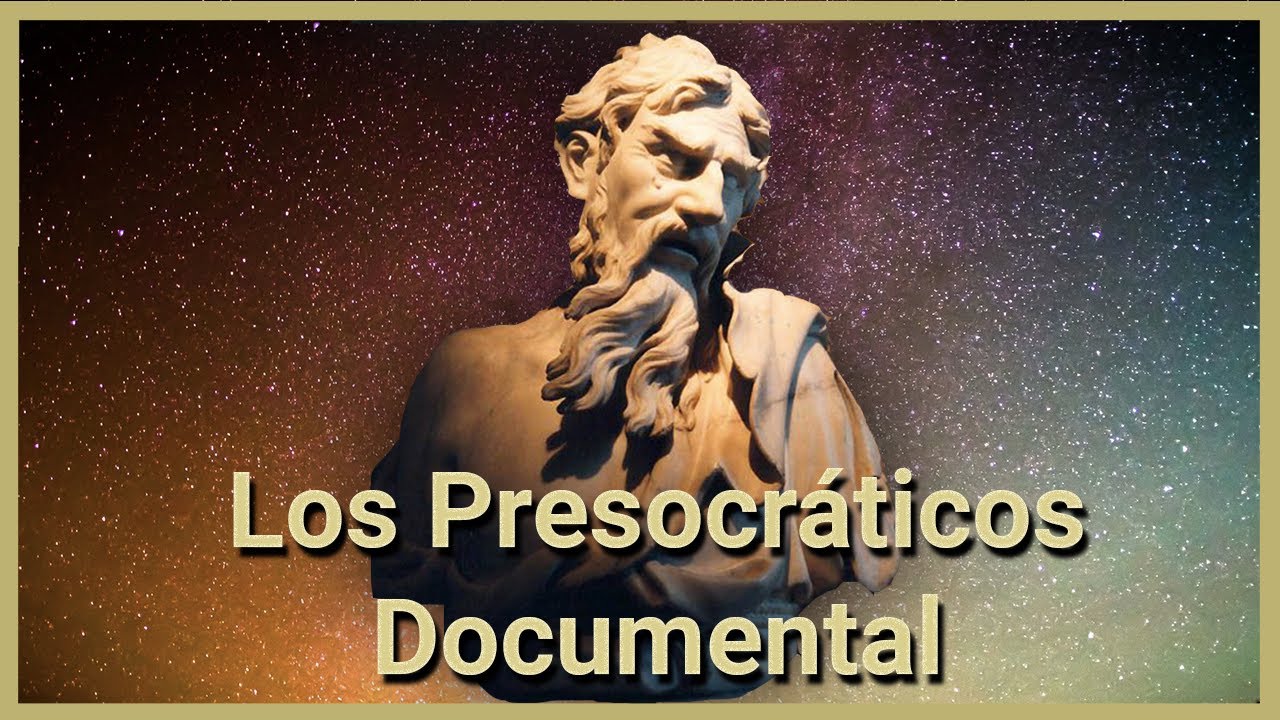
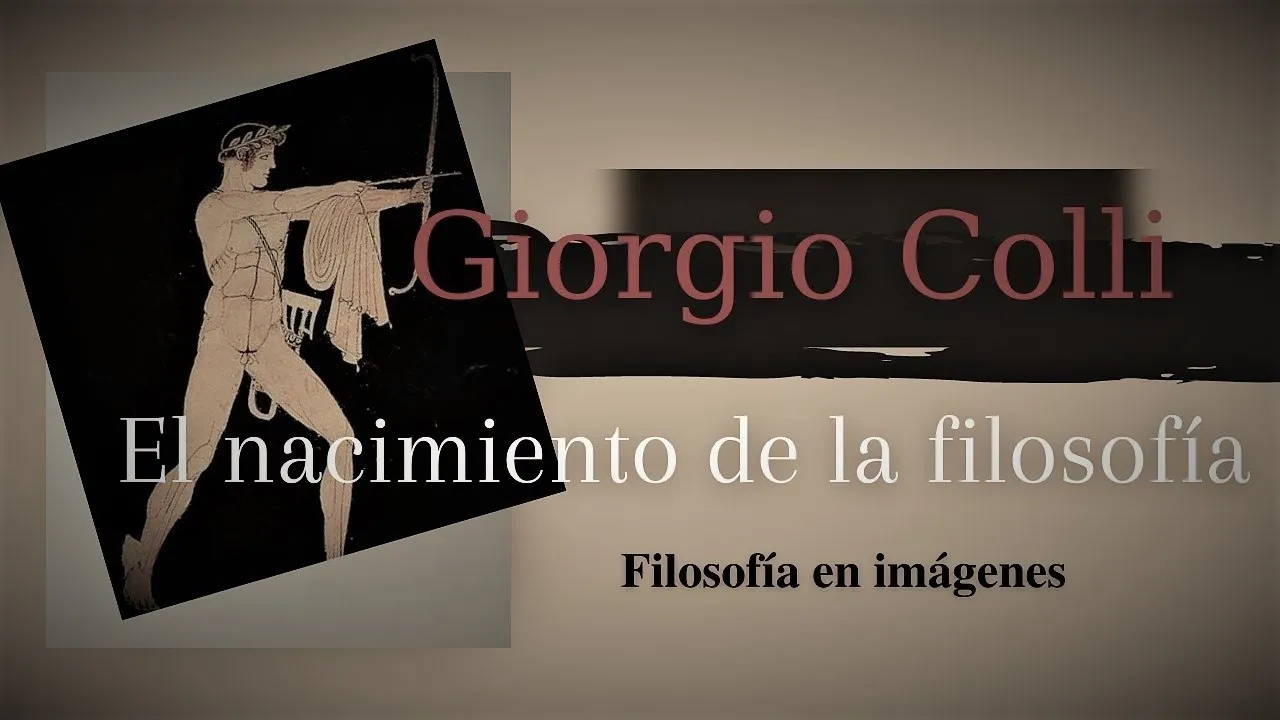
Well, this time we are meeting to investigate the central moments of Giorgio Colli's book The Birth of Philosophy. Giorgio Cooli was an Italian philosopher, philologist, and historian of philosophy, who lives in the twentieth century, specialist in the work of Nietzsche, translator of his complete works into Italian and French. Colli teaches ancient philosophy at the University of Pisa for 30 years, and the figure of Nietzsche was very influential in his philosophy, although he also allows himself to be discussed in some central aspects.
The book that brings us together is, then, The Birth of Philosophy, a fundamental theme, given that, as is known, philosophy has not always existed, it is not merely the "activity of thinking", it is a very specific task, with certain characteristics of its own, and its emergence, obviously, also has to do with history. As we know, there are many theories about it, like the ones we saw in Myth and Thought in Ancient Greece, by Jean Pierre Vernant. Colli deals once again with this crucial period in Greece, which was the transition from the 6th to the 5th century before Christ, and will be particularly interested in the evolution of what is called the "age of wisdom", giving way to the moment in which philosophers arise , and that peculiar activity called "philosophy".
But, we go by steps, going through the core of each chapter. In chapter I, entitled, we might say, almost provocatively, "Madness is the source of wisdom," Colli begins by saying that the origins of philosophy, and thus of all Western thought, are mysterious. According to scholarly tradition, he says, which would be the most widespread opinion, philosophy was born with thinkers like Thales and Anaximander.
However, Colli affirms that, in reality, the time of the origins of Greek philosophy is closer to us. Precisely Plato, he says, will call "philosophy", that is, "love of wisdom" to his own research, and to his educational activity, his "paideia", linked to a written expression, that is, to the literary form of dialogue. And here Colli highlights something central to his entire argument: Plato himself looks with reverence at the period that precedes him, as a world in which the so- called "wise men" had existed.
Furthermore, Colli maintains that "love of wisdom", strictly speaking, did not mean, for Plato, the aspiration to something never reached or unattainable. but, rather, the tendency to recover what had already been done and lived in the past. Once seated, no less, than that beginning, Colli continues his chapter I by explaining that the "age of wisdom" includes the so-called "Pre-Socratic era", but that its most remote origin escapes us.
Therefore, strictly speaking, this "age of wisdom" would already have its origins in the oldest tradition of poetry -as with Homer and Hesiod- and of Greek religion. It is here, then, where Colli introduces the figure of Nietzsche, and points out that, just as Nietzsche, in The Origin of Tragedy, proposed to hypothesize about said emergence, Colli himself will try to do the same, first of all, about the origin of wisdom. As is known, says Colli, Nietzsche starts from the images of two fundamental Greek gods: Dionysus and Apollo.
However, Colli understands that it is necessary to modify the characterization that Nietzsche made of these two gods. And fundamentally you have to give pre-eminence to Apollo, he says. Thus Colli conclusively confirms that if a god is to be attributed dominion over wisdom, it must be, he says, the one from Delphi, that is, Apollo.
Colli then goes on to explain that, in the oracle of Apollo at Delphi, the inclination of the Greeks towards knowledge is clearly manifested. For that archaic civilization, he says, the most characteristic of wisdom was, in particular, the knowledge of the future of man. Indeed, the Colli, involves the knowledge of the future and the manifestation and communication of such knowledge.
And that occurs, he says, through the word of God, through the oracle. Thus, the form, the order, the connection in which the words are presented, reveals that they are not human words, but divine words. But precisely this is due to the ambiguity of the oracle, how difficult it is to decipher, the uncertainty that surrounds it.
So the god knows the future and manifests it to man. But - and therein lies the key - he seems not to want man to understand him. There is an ingredient of perversity, of cruelty, in the image of Apollo, which is reflected in his way of communicating wisdom.
It is here that Colli mentions Heraclitus as a characteristic representative of this period of the sages, when he says: "The lord to whom the oracle that is in Delphi belongs, neither affirms nor hides, but indicates". So Colli allows himself to correct the interpretation that Nietzsche had already made of Apollo, by presenting him in a very one-sided way. It is that, in effect, according to Nietzsche, Apollo is the symbol of the world as "appearance".
So the work of Apollo would be, for Nietzsche, essentially the world of art, understood as a possible form, although unreal and illusory, of liberation from human pain. And, in turn, Nietzsche presents Dionysus, says Colli, as the god of "knowledge and truth", specifically understood as the intuition of that pain and radical anguish. For this reason, Colli affirms here that this is an unjustified interpretation of things, that Nietzsche would have taken specifically from Schopenhauer, but that does not coincide with other data from historical research in this regard.
As he sees it, as Collie sees it, on the contrary, Dionysus is connected, rather, with mystery, with mystical visions of bliss and purification. But that's not knowledge, says Colli. On the other hand, for him, as for other researchers, knowledge and wisdom are manifested through the word of Apollo and, in the case of the oracle, through the priestess the Pythia or Pythoness, who transmits her word to human beings in the oracle Thus, when outlining the concept of Apollonian, says Colli, Nietzsche would have had in mind only the "lord of the arts", the luminous god of solar splendor, authentic aspects of Apollo, but partial, unilateral.
On the contrary, other facets of the god broaden its significance and put it more in connection with the sphere of wisdom. The very etymology of Apollo, Colli reminds us, according to the Greeks suggests the meaning of "he who totally destroys", with his arrows and, generally, in a delayed manner, through illness. He is also known as "He who smites from afar" or "He who acts from afar".
Thus, to strengthen his argument, Colli claims that a decisive passage in Plato makes this clear to us. This is the speech on "mania", the way the Greeks called madness, which Plato puts into the mouth of Socrates in the Phaedrus. In that passage madness is opposed to self-control, and in an almost paradoxical inversion, for us moderns, madness is exalted as superior and divine.
According to Plato, then, it is the prophetic madness of Apollo, the main madness, that of the "mantic" or "art of divination". Apollo would not be, then, the god of measure, of harmony, but of exaltation, of madness. Nietzsche, on the other hand, considers that madness corresponds exclusively to Dionysus, and furthermore limits himself to defining it as "drunkenness".
This is how Colli reaches his second chapter, entitled "The Lady of the Labyrinth", in which this time he is going to put the accent on the figure of Dionysus. Five centuries before the cult of Apollo was installed in Delphi, he says, that is, around 1300 BC. C.
, the cult of Dionysus is introduced in the legendary Minoan-Mycenaean world, extended to the island of Crete. For this early Greek tradition, he says, Dionysus is the central character behind the famous "Myth of the Labyrinth. " Let us then briefly recall the myth to which Colli is constantly alluding in this chapter, but which he does not fully develop.
As is known, according to one of the oldest accounts in Greece, the king of Athens was required to annually deliver a tribute of fourteen youths, seven of each sex, to his counterpart King Minos of Crete. The fourteen young people were destined to be food for the Minotaur, a monster half man, half bull, who lived in the labyrinth, built by Daedalus, or a very skilled architect and sculptor. Theseus, son of the king of Athens volunteers to go to Crete as one of the fourteen youths of the annual tribute, with the intention of killing the Minotaur and freeing his homeland from the hateful tribute.
Thus, according to the myth, when he arrived in Crete, Theseus fell in love with Princess Ariadne, daughter of King Minos, and she provided him with the means so that, after killing the Minotaur, thanks to a ball of thread or wool, according to versions, he could find his way back into the labyrinth. Theseus then kills the Minotaur and returns victorious to Athens, taking Ariadne with him. But the ship stops at the island of Naxos and Ariadna falls asleep on the beach.
It is at this moment, precisely, that Athena orders Theseus to weigh anchor and continue, without delay, on his way to Athens. Theseus complies with the order and Ariadne wakes up disconsolate seeing how her lover's ship is moving away. Thus, a central element here is the labyrinth, whose archetype has a typically Greek symbolic importance, says Colli.
This author specifies, then, that the labyrinth had been built in the Cretan city of Knossos, in the service of Dionysus, with an inextricable complexity, a mixture of play and violence. As we said, it was the work of Daedalus, a brilliant Athenian, craftsman, artist, to whom tradition attributes the foundation of sculpture and technical wisdom. The geometric shape of the labyrinth, then, with its unfathomable complexity, created through a strange and perverse game of the intellect, alludes to a doom, to a mortal danger that awaits man, but, perhaps surprisingly, Colli points out that, as an archetype , as a primordial phenomenon , the labyrinth prefigures, in turn, the "logos", reason, since, he says, what else, if not the logos, is a product of man, in which man is lost and ruined ?
So, although Colli first emphasized the closeness between Apollo and Dinisos in terms of madness, mania, here he distinguishes them. And it would seem, in principle, that Apollo is subject to Dionysus, since the environment is one of crude animality. But marking the complexity of all this mythical framework, Colli tells us that Theseus defeats the Minotaur and overcomes the challenge of the labyrinth, thanks to the "logos thread", a logos that, in this case, would have a positive meaning.
And that seems to constitute, this time, a triumph of Apollo over Dionysus. The truth is that, both in the games of Apollo with the enigmas of the oracle, and in those of Dionysus with his labyrinth, what is always involved is a tragic challenge of the gods towards men, a mortal danger, of the that only the figures of the sage and the hero can be saved, says Colli. This is how Colli arrives at the third chapter, entitled "The god of divination".
In this chapter, the author highlights that, in the case of Apollo, his darkest side is that of being the one who sends the prophetic word with the prediction, many times, of a rocky future. But, on the other hand, it is the god that manifests itself in the magic of art. Colli then says that the double face of Apollo, the Greek myth represents it with two symbols that reflect these two attributes of the god: the bow, which designates his hostile action, and the lyre, which alludes to his benevolent action.
But as coming from the same god, they express an identical divine nature. Precisely, his word, the response of the oracle, rises from the darkness of the earth and manifests itself in the exaltation of the Pythia, in her unconnected madness. However, surprisingly, what comes out of that inner magma, of that ineffable possession?
Not confusing words, he says, not jumbled allusions, but precepts such as "Nothing in excess," or "Know thyself. " So the same god who shows man that the divine sphere is unlimited, unfathomable, capricious, senseless, lacking in need, haphazard, arrogant, when he gives directions in the human sphere, sounds like an imperative norm of moderation, of control , of limit, of rationality, of necessity And this is the idea that Colli continues to develop in the fourth chapter, entitled "The challenge of the enigma". Here the author recapitulates this disturbing conclusion, telling us that, then, the god Apollo, who imposes moderation on man, is, for his part, immoderate.
He exhorts him to control himself while he manifests himself through a "pathos", a passion, an exaltation, through uncontrolled emotions. So, says this author, with that very thing the god challenges man, provokes him, instigates him to disobey him. And so, such ambiguity turns the word of the oracle into an enigma, which clearly marks, says Colli, the difference between the human world and the divine world.
That is why, then, the enigma has a great importance in the archaic civilization of Greece. Colli will begin to develop, from here, all the evolution that will end up leading to what we are looking for in this book, in short, the birth of philosophy. But let's go back to the archaic era, says Colli, and then mentions an important evolution, which would have had the humanization of the enigma in the tradition he is analyzing.
First the god inspired a response in the form of an oracle and the prophet or prophets, the priests of the oracle, were simply interpreters of the divine word. All that belonged, still, completely to the religious sphere. Second, the god imposes a deadly enigma, such as the one offered by the sphinx to Oedipus, and it is that particular man who must solve it or else lose his life.
Third, two fortune tellers fight each other over a riddle. The god no longer intervenes, the religious background still remains, but a new element intervenes, the "agonism", the competition, which is still, in this case, a struggle for life and death. Fourth: one more step, the religious background falls and agonism, competition, the struggle of men for knowledge occupies the foreground .
But they are no longer fortune- tellers, they are wise men or, rather, says Colli, they are fighting to win the title of "wise man. " Colli thus arrives at the fifth chapter, which he calls "The pathos of the occult. " The chapter begins, then, mentioning an ancient story, attested by numerous sources that, for him, constitutes the fundamental document on the connection between wisdom and enigma.
It is about a source, he says, that talks about Homer, and tells that the oracle warned him to beware of the "riddle of young men". And that warning becomes concrete, for Homer, when, being on the shore of a beach, he questions some young fishermen about whether they had anything, if they brought anything. And they answer him as follows: "What we have taken, we have left, what we have not taken, we bring.
" But then, what was this enigma about? Tradition points out that the answer was simpler than it seemed. The fishermen, in fact, alluded to the lice on their clothes.
So, the resolution, says Colli, of the enigma, was as follows: "What we have taken, we have left, meant that the lice that they had found on their clothes, they took them out, and therefore they left them in the place. While " What we have not taken, we bring", meant that those who did not see or could not take were still carrying with them. However, the story tells that Homer, not being able to solve the riddle, died of grief.
He then says Colli that what is instantly astonishing in this type of story is the contrast between the futility, the banality, of the content of the enigma and the tragic outcome that occurs for not having solved it. But for the wise man the enigma is a deadly challenge . that, for this Greek culture, whoever stands out for the intellect must show himself invincible in the things of the intellect.
In this case, then, the formulation of the enigma is two pairs of contradictory determinations, says Colli, united to the inverse of what I could wait ass They are: "we have taken"- "we have not taken", versus "we have left" or "we bring". These pairs of determinations appear connected in the opposite way as expected. Because this would be: "What we have taken, we bring" and "What we have not taken, we have left.
" The sage who dominates reason should have managed to "untie" that knot. Heraclitus, for his part, confirms the perversity of the enigma, and the fact that a wise man should not be deceived. But, even more, according to Colli, Heraclitus makes of all his philosophy the task of solving the enigma of reality.
It is that, just as Homer was deceived by the enigma, Heraclitus considers that men are also deceived in terms of their consideration of everything they perceive in reality. Citing, then, the same structure that Homer could not resolve, Heraclitus says enigmatically: "The manifest things, which we have taken, we leave. " Then Colli is encouraged to speculate on what Heraclitus is meaning, and affirms that this phrase can mean, in him, that sensible apprehension actually consists of a series of sensations, but that it is we who transform them into something stable.
, as if it existed outside of us, permanently. That is why one could not "enter the same river twice" because we have innumerable instantaneous, partial, particular sensations of that supposed river, but it cannot be affirmed that "there is something stable" behind it. In reality, then, if we want to consider that "there is a river", strictly speaking, the only thing that we know, according to Heraclitus, is that it would be, each time, a new river, says Colli.
Then, "manifest things", which are series of sensations, "we let them fall" in the name of the stable. And for the second part of Homer's riddle, we would have: "the hidden things, which we have not seen or taken, we bring. " And then Colli says that, in Heraclitus, he would be alluding here to the "pathos of the occult.
" It would be unity, the idea that nature likes to hide, the soul, which is hidden, the confines of the soul. We do not see or take all of this, but we carry it within us. In this way, Heraclitus not only uses the enigma in the antithetical formulation of most of his fragments, but also maintains that the very world that surrounds us is an illusory fabric of opposites.
Reality itself would be, for him, a tissue of enigmas whose unity is the god. That is why Colli and ends this chapter quoting Heraclitus when he sentences: "The god is day - night, winter - summer, war - peace, satiety - hunger". In the sixth chapter, named by Colli "Mysticism and dialectics", the author asks himself the following question: if the origin of Greek wisdom is in mania, in madness, as we said at the beginning, how is it explained, then, the passage from that religious background to the elaboration of a truly abstract, rational, discursive thought, as is supposed to be typical of philosophy?
Colli affirms, then, that already in the mature phase of that era of the sages, we begin to find a formed, articulated reason, a non-elementary, non-basic logic, a high-level theoretical development. And Colli points out that what made all this possible was "dialectics", with the original meaning, in the Greeks, of "the art of discussion", of a real discussion, between two or more living persons, not created by a literary invention, like those of Plato. In this sense, the dialectic is one of the culminating phenomena of Greek culture, and one of the most original.
Where to find its origin? Colli points out that already the young Aristotle held that Zeno Elea was the inventor of dialectics. Although Colli says that it seems inevitable to admit, already in Parmenides, his predecessor, the same dialectical domain of the most abstract concepts, of the most universal categories.
But, would it not be possible, perhaps, to attribute to Parmenides himself, then, the invention of a theoretical baggage as imposing as the use of the so-called Aristotelian "first principles", such as "non-contradiction", or "excluded third", the introduction of categories that will remain forever linked to philosophical language? It would be more natural, even Colli says, to think of a dialectical tradition that goes back to a time before Parmenides, that originates precisely in that archaic era of Greece of which we have spoken. It is that this dialectic is born, precisely, in the field of agonism.
That is, the contest, the competition. When the religious background has receded, says Colli, and the cognitive drive no longer needs the spur of a god's defiance, when a struggle for wisdom between men no longer requires them to be diviners, then an exclusively human agonism appears. A man challenges another man to answer him in relation to any cognitive content.
And arguing about that answer, it will be seen which of the two has a more solid knowledge. The interrogator, says Colli, proposes a question in the form of an alternative, that is, presenting the two options of a contradiction. The questioned makes one of them his own, that is to say, he affirms with his answer that "that is the true one", he chooses.
That initial answer is called, then, "thesis of the discussion". The function of the interrogator will be to demonstrate, to deduce the proposition that contradicts that thesis, so that he achieves victory because, by proving that the proposition that contradicts that thesis is true, he demonstrates, at the same time, its falsity, that is, he refutes the opponent's claim. Thus, to achieve victory, the demonstration must be developed, but this is not announced unilaterally by the questioner, but is articulated through a long and complex series of questions whose answers constitute the particular links of the demonstration.
In dialectics, then, judges are not necessary to decide who is the winner. The victory of the questioner is a consequence of the discussion itself, since it is the questioned who first affirms the thesis and then contradicts himself and, therefore, refutes it. That means, for Colli, that the enigma, when humanized, gives rise to the dialectic that arises from this agonism.
The enigma was already a test, a challenge, to which the god exposed man. Now we speak of "problem", but that nucleus is still alive occupying a central position in the dialectical language. Consequently, mysticism and rationalism, says Colli, were not antithetical in Greece.
More than anything, they should be understood as two successive phases of a fundamental phenomenon. So the "perfect dialectician", who guides the interpretation, resembles Apollo, says Colli, who "wounds from afar". It is that this one, knowing that he is going to win, savors victory in advance.
There is a mediate cruelty, disguised, in front of a silent public that waits like the celebration of a sacrifice. Colli says then, to close this chapter, that it is very possible that the great sages have never been defeated in this way. In the seventh chapter, called "The destructive reason", Colli says that many generations of dialecticians elaborated in Greece a "system of reason", of the logos, as a purely oral concrete living phenomenon.
Obviously, the oral character of the discussion is essential in dialectics. Therefore, he affirms, a written discussion, translated into a literary work, like the ones we find in Plato, is a pale reflection, says Colli, of the original phenomenon, either because it lacks the slightest immediacy, of the presence of the interlocutors , of the inflection of their voices, of the allusion of their looks or because it describes a copy of that situation thought by a single man, for which it lacks the will of novelty, of the unforeseen that can arise only from the verbal encounter of two individuals of flesh and bone. In addition, Colli advances by recognizing that the result of the dialectic is always destructive, since what will be refuted is always the thesis contrary to the one chosen by the questioned.
Therefore, says this author, the consequences of this mechanism are devastating. Any judgment, any statement, on the truth of which man breeds, can be refuted. It follows that any doctrine, any scientific proposition, will be equally liable to destruction.
Parmenides already feared that the dialectical destruction would also affect the "hidden origin", from which the enigma and the dialectic derive. His formula "Being is" solves the enigma. It is the solution offered and imposed by a sage without the intervention of the hostility of a god.
In this attitude of Parmenides, says Colli, that there is benevolence towards men. Harder, on the other hand, is Heraclitus, who states his enigmas without solving them. Zeno of Elea, for his part, realized that the development of dialectics and reason could not be blocked.
To safeguard the divine womb, to summon men to it, Zeno thought, on the contrary, of radicalizing the dialectical impulse to the point of total nihilism, thus making it clear that the sensible world, our life, ultimately, is a mere appearance, a pure reflection of the true world, that of the gods. Thus, then, we arrive at the eighth chapter of Colli's book entitled, this time, "Agonism and rhetoric. " The author intends here to clarify a misunderstanding that, in his opinion, has always obscured the understanding of Greek rationality.
The sages of that archaic time - and this attitude was to last until Plato, he says - understood reason as a discourse on something else. A logos that, precisely, the only thing it did was say, express, something different from itself heterogeneous. Precisely, that original impulse of reason was forgotten, its allusive function ceased to be understood, the fact that it was up to it to express a "metaphysical distance" between the world of gods and men.
Subsequently, the building continued to be conserved following the rules of the primitive logos, which had been only a means, an agonistic weapon, a demonstrative symbol that, as authentic as it was, became, already in that transformation, a "spurious logos", says Colli . He points out, then, that after Parmenides and Zeno, the age of the sages is declining. And here Colli mentions Gorgias.
Gorgias does not offer us any remarkably new theoretical results. What, on the other hand, impresses him is the absence of any religious background. Gorgias does not worry about safeguarding anything, on the contrary, his famous formulation: "Nothing exists, if it existed it would not be knowable, and if it were knowable it would not be communicable", seems to question even the divine nature.
Gorgias, then, would have a central importance, being the sage who declares the end of the age of the wise, of those who had put the gods in communication with men. It is that, with the centralization of culture in Athens, says Colli, which occurred from the middle of the V century BC. C, would have manifested itself in Greece, the fatal tendency to break the isolation of dialectical language.
In the Athenian environment, the reserved atmosphere of the Eleatic dialogues, such as Parmenides and Zeno, is replaced by the framework of noisier, more frequented dialectical exchanges, says Colli. The word is now addressed to laymen, who do not discuss but merely listen. This is how rhetoric is born, which is also an essentially oral phenomenon, in which it is only one who comes forward to speak, while the others listen.
The agonistic character remains only in the sense that it is up to the listeners to judge it against what other speakers say. For Colli, then, in dialectics one still fights for "wisdom", while in rhetoric one fights for a wisdom "directed at power". What must be controlled, excited, placated, are simply the passions of men.
It is then that Colli introduces a factor to which he attributes a central importance in all this evolution. That is, the "writing intervention". Indeed, writing, in its literary use, spread after the middle of the sixth century BC.
C, and remains, above all, linked to the collective life of the city. That situation, Colli says then, in relation to writing, had a very prominent influence on the appearance of a new literary genre: philosophy. When literary language becomes public, writing, from the mnemonic instrument that it was, to help memory in the conservation of ideas, acquires more and more expressive autonomy, says Colli, and that is how he reaches the ninth chapter, last of his book, called "Philosophy as literature".
In it Colli warns that, through the cultural transformations of which we have spoken, through the intertwining of the rhetorical sphere with the dialectic and, above all, through the gradual generalization of writing in the literary sense, it was modified in parallel the structure of reason itself, of the logos. Plato invented "dialogue as literature" as a particular type of written dialectics and rhetoric that, for Colli, is characterized by the fact that it "presents in a narrative frame the contents of imaginary discussions to an undifferentiated public. " Plato himself calls this new literary genre by the name of "philosophy".
Thus, in the Athenian period that marks the passage from one era to another, the character of Socrates belongs more to the past than to the future, says Colli. Nietzsche considered Socrates as the initiator of the "Greek decadence". However, Socrates is a sage for his life, for his attitude towards knowledge.
El hecho de que no haya dejado nada escrito, no es algo excepcional conforme con "la rareza y anomalía de su personaje", como se ha pensado tradicionalmente, sino que, al contrario, es precisamente lo que podemos esperar de un "sabio griego". Por su parte Platón está dominado por el "demonio" (daimon) de su espíritu literario, y tampoco hay que olvidar su finalidad educativa, su paideia, y sus ambiciones políticas. Colli finaliza, entonces, su libro recordando una vez más lo que ha venido diciendo a lo largo de todas estas páginas: que la filosofía, este vástago que acaba de nacer, es "hija" de la era de la sabiduría, un período que, lejos de constituir el balbuceante antecesor de la era de la razón, se presenta como el momento más pleno de fuerza vital de toda la historia del pensamiento griego.
Un período que el propio Platón contempla con sincera veneración.