Hello to everybody! Have you ever wondered why musical notes are exactly 7? Where does this number 7 come from?
Indeed, the correct question would be: why has it been chosen to give a name only to 7 notes? In fact, looking more carefully, notes are more than 7, I will show that they are infinite, but we will get to this in due course. In modern music, it was then reduced to 12 the number of possible notes, but this is a simplification; nevertheless only 7 of these notes have their own name, while others have a name which is derived by these 7.
But let's proceed first things first: what distinguishes one note from another? Notes are distinguished through their pitch, which is linked to a precise physical quantity: the frequency. When every musical instrument produces a note, it generates a vibration, i.
e. a periodic acoustic wave. The number of periods in a second is called frequency; a sound with with higher frequency than another will be perceived as higher pitch note, and here we have the first important property of psyco-acoustics: a note with double frequency is perceived by our brain as the same note played with higher pitch.
For example when a man and a woman sing together the same melody, actually the notes produced by woman are all double frequency respect to the corresponding notes produced by man, but the feeling is that they are singing the same notes. From this property it results immediately a fundamental consequence for our path towards the seven notes: a note with frequency f and a note with frequency 2f will have the same name. We can then limit our space of enquiry in the set of frequencies ranging from a certain f1, chosen by us, to 2 f1, and out of this set things will be the same: from 1/2 f1 to f1 we will have the same notes, but lower pitch; from 2 f1 to 4 f1 we will have once again the same notes of our chosen set, but higher pitch.
All this stuff brings to another fundamental psyco-acoustic property: the difference between two notes, meaning as perceived distance, which is called "interval" in music, corresponds to the ratio of relevant frequencies. In fact the distance between two notes f1 and f2 must be the same we perceive between the corresponding notes 2 f1 and 2 f2, for this reason the distance is properly expressed by the ratio f2 / f1. Hence, it is useful to represent frequencies on a logarithmic scale, so that intervals with same value, that means frequencies with same ratio, are represented by segments of same length.
At this point we can make an arbitrary choice: we take the note at frequency f1 and we call it "C". This will be the first note of our sound alphabet. At the frequency of 2 f1 we will have then another "C", higher pitch than the previous one.
All the other notes of our scale will be inside this interval. Now, in order to increase our sound alphabet with other notes, let's ask ourselves: which other frequencies inside the interval between f1 and 2 f1 are good together with the frequency chosen for our first note "C"? Here help comes from physics and mathematics, in particular a study made by a French mathematician, Fourier, who lived between 18th and 19th century.
Fourier made a very important discovery: every periodical waveform with frequency f is equivalent to the merging of many sinusoidal waveforms of different amplitudes and frequencies equal to f, 2f, 3f, 4f, 5f and so on, so every note produced by a musical instrument or by human voice is the sum of many sinusoidal waveforms with frequencies which are integer multiple of the note frequency itself and amplitudes gradually decreasing; it is like every note of frequency f includes also the notes of frequencies 2f, 3f, 4f, 5f and so on. These notes at multiple frequencies are called harmonics. This result could be somehow expected for harmonics that are multiple equal to powers of 2, since we know that they represent perceptually the same note from which we started; if we consider other multiples instead, which are not powers of 2, we get some new notes that somehow have a relationship with the starting note; in particular, considering that starting from the sixth harmonic and above the amplitudes of sinusoidal waveforms are negligible for most of the instruments, we can truncate the Fourier series to the first 5 terms, and we will get 2 new notes: one corresponding to third harmonic (frequency 3f) and one corresponding to fifth harmonic (frequency 5f).
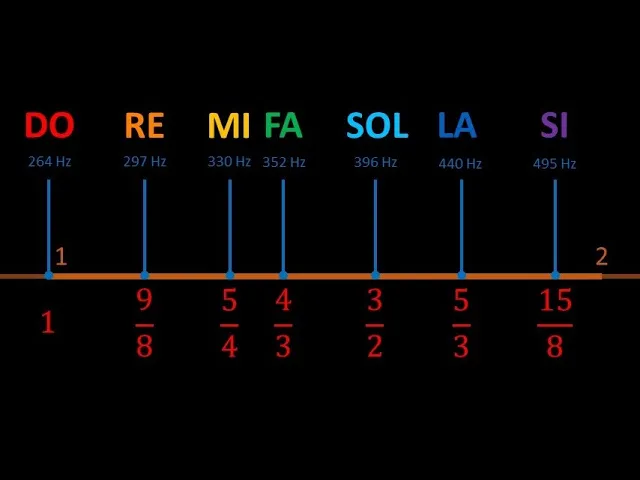
Starting from note f1 corresponding to "C" we get respectively: - 2 f1: another "C" - 3 f1: a new note, which we will call "G", that we can bring inside the interval between f1 and 2 f1 and it has a frequency of 3/2 f1; - 4 f1: another "C"; - 5 f1: a mew note, which we call "E", that we can bring inside the interval between f1 and 2 f1 and it has a frequency of 5/4 f1. For the sake of simplicity, from now on we can normalize all the frequencies respect to f1. We have got then, inside the interval of frequencies between 1 and 2, a scale of three notes which will be, in order: C, E, G This alphabet of 3 notes is already a scale and can be enough to compose some songs; and actually many songs from military worlds are made of these three notes.
Analyzing the intervals between the notes of our first scale we can notice: between C and E a distance of 5/4; between E and G a distance of 6/5, shorter than the previous one. The first interval will be called MAJOR interval, the second will be called MINOR interval. The chord made by the three notes played at the same time is pleasant for our ears and it is built as the union of a major interval followed by a minor interval: it will be called C MAJOR chord, and it is the basis on which we will build our scale; for this reason it is also called "tonic chord".
Now, if we want to extend our scale we can think to proceed with this alternation of major and minor intervals, adding a pair of other notes: let's build then another major interval above the minor interval E-G and let's build a minor interval below the major one C-E; We get two new notes: the first of frequency 5/4 above G, that is 15/8, which we will call B, and the second of frequency 6/5 below C, that is 5/6, which we will call A, that, brought inside the interval between 1 and 2 with a frequency doubling, becomes 5/3. The groups of 3 notes A-C-E and E-G-B hence created have an inverted structure respect to C-E-G, meaning that the minor interval comes before the major one; for this reason they are called MINOR chords: A MINOR - E MINOR Reordering the notes, we have got a scale of five notes: C, E, G, A, B. We can move forward with same process, adding a minor interval above the last major one, and a major interval below the last minor one, creating two new notes: D, at a frequency of 6/5 above B, that is 9/4; F, at a frequency 5/4 below A that is 2/3.
We get two new major chords: F major, G major. Bringing the 2 new notes inside the usual interval between 1 and 2 we get for D a frequency of 9/8, for F a frequency of 4/3. Reordering we obtain the seven notes scale: C, D, E, F, G, A, B.
Now you will tell me: why can't we move forward with this process, adding a new pair of notes, obtaining a nine notes scale? If we try to do this, adding a minor interval below F and a major interval above D we get the following: note N8, at a frequency of 5/9; note N9, at a frequency of 45/16. Note N8 would be at a frequency, brought inside the interval between 1 and 2, of 10/9 while note N9 would be at 45/32.
Note N8 has a frequency very similar, slightly lower, than note D, and the human ear tends to confuse it with D, for this reason it gives no added value to our seven notes scale we already have: actually this note will be called D, with a "-" sign to distinguish it from D previously found. By symmetry also note N9 will not have its own name, even because the interval of 45/32 is unpleasant for human ear, for this reason in the Middle Ages this interval was even called "diabolus in musica" (devil in music). Such note, being just higher than F note already found, although well dinstinct from it, will be called F as well, with a "#" symbol to distinguish it from F found previously.
Overlap of D just found with previous D closes the loop, and the seven notes are enough to create our scale. We now have our sound alphabet of seven notes: the 3 notes of tonal chord, plus symmetrically, two pairs of notes to continue the alternation of major and minor intervals, so pleasant for our ears, and create 2 minor chords and 2 major chords to go along with tonal chord to create the harmonic structure of our scale. The 7 notes scale we got is called MAJOR SCALE of C.
Notes D- and F# do not belong to this scale, but to other scales of different kind that we will analyze in upcoming episodes. In the next episodes we will treat: intervals and accidentals, minor scale, other tones scales, chords and harmonic schemes, representation of scales, intervals and chords in a bidimensional harmonic plane. Goodbye, I wish you a good continuation and hope to see you soon!