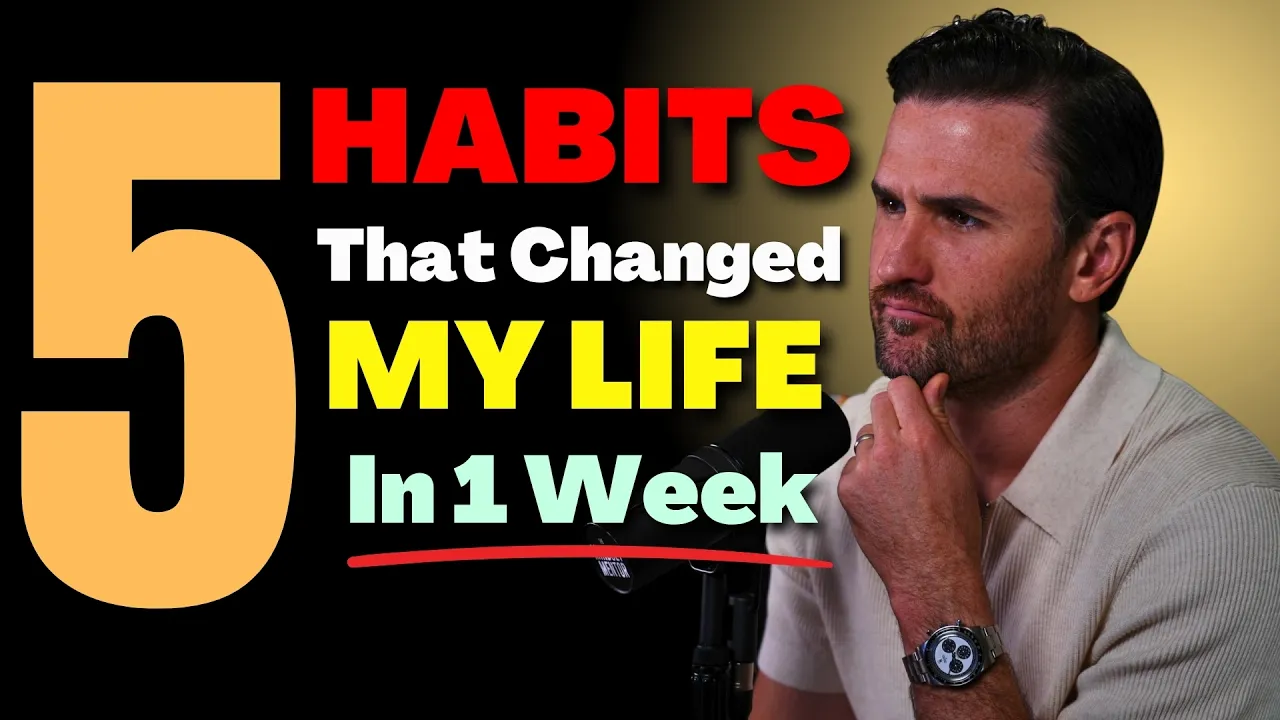
You don't need more motivation. You need habits that make your life better. You need systems to improve your life.
And so today, I want to give you the five habits that rebuilt me as a person. They built my focus, my peace, my self-respect, and also turned into success in the long term. I don't want to give you any fluffs or any hacks, just things that are going to work for you to show up on your worst days when you don't feel like taking action.
And if you want a life that feels bigger and lighter and better, then this episode is going to be for you. So, let's dive straight into it. Number one, one of the most important things that you can do is create your own morning mindset priming technique.
Your own morning mindset priming technique. Basically, here's the way you want to think about it. When you wake up in the morning, you have this interesting small window where your brain is really able to get into your subconscious, the stuff that you say, the stuff that you do.
And most people waste that time with scrolling on their phone, looking at their emails, watching Netflix, whatever they do in the morning, right? I want you to find a 10-minute window in your day where you prime your mind for how you want to feel, how you want to be, how you're going to show up, and who you're going to be throughout the day. Just a 10-minute window that is as soon as you possibly can when you wake up in the morning.
I want you to think about breath work, breathing in deeply. You can listen to breath work as you're doing it. Go on YouTube, type in breath work, follow something that's 10 minutes long.
You're going to get yourself into a prime state by breathing. And what you're going to do is you're going to focus on two things. Number one, your beliefs, who you are, who you think you are.
And I want you to speak into existence the type of person that you are, the type of person that you want to be. You know, I don't want you to say, "Oh, I'm uh becoming better. " I want you to say, "I am better.
" Don't say, you know, if you're working through health issues, don't say, "I want to be healthy. " Say, "I am healthy. " that you're going to change your beliefs and you're going to use these moments to speak into existence what it is that you want in your life.
If you do this over and over and over again, you will eventually start to change your beliefs about yourself, about the world, about other people. So that's the first thing is the beliefs that you have in your brain. And the second thing is the behaviors that you're going to take today.
I want you to see what you're going to do, how you're going to execute it, and I want you to see everything working exactly the way that you want it to. Reason why is because then when things actually happen in your day and you've got to go out and take action, you feel more confident because you unconsciously or maybe even consciously feel like you've done it before. Priming basically sets your emotional GPS of this is how I want to feel today and your your mental GPS of this is what I'm going to do today.
Most people wake up and they just go with the default. Not you. You're not going to do that.
You're not going to look at your phone for the first hour of waking up. You're not going to look at your inbox. You're not going to talk to anybody if you can.
The first 10 minutes, you just want to focus on breathing, focus on your beliefs, and focus on your behaviors. Talk to yourself the way that you need to in order to brainwash yourself into believing that you are the person that you need to be in order to create the life that you want. And visualize it.
It's only 10 minutes. Everybody listening to this right now can do it. So, it's basically today, this is how I'm going to show up.
This is the identity I'm going to show up with. This is the behaviors that I'm going to do. and I'm going to make sure I focus on that all day long.
I teach this because it works at a very, very deep level. And so, number one is you need to come up with your own morning priming technique. Hey, to the 65.
6% of you who watch my videos but are not subscribed, yes, we see it. And if you've ever learned anything from any of the videos I put out, please do me a favor, hit that subscribe button. It helps the channel grow and it helps me keep making more content to help you grow as well.
So with that, let's go back to the show. Number two, this is something that really changed my life and I've shared this before, but it is radical ownership. If you've listened to this podcast for a long time, one of the most, if not the most life-changing conversation I've ever had was with my very first mentor.
I was 19 years old. I was showing up late to calls. I wasn't hitting the assignments.
I wasn't being knew who I needed to be. I was giving him excuses. And he called me out and he said, "Rob, if if a business succeeds and all 10,000 people in this business have massive success, whose fault is it?
" I was like, "That would be the CEO's fault. " He said, "Okay, if the business fails, whose fault would that be? " I was like, "That would be the CEO's fault.
" He said, 'Okay, so if you get to the end of your life and you have everything that you want, the love, the happiness, success, joy, family, everything you've ever wanted, whose fault would that be? I was like, that would be my fault. He's like, okay, if you get to the end of your life and you don't bring out the love, the joy, the happiness, the success, you don't live up to your potential and it's not what you wanted to be, whose fault would that be?
I was like, I guess that would be my fault. He said, your problem is that you are not living like you're the CEO of your own life. You've got to stop blaming other people.
You've got to stop blaming other circumstances. Everything is your fault. From that moment on, it was like a like a switch just switched in my head and I was like, I got to take action.
It's me. I am the CEO of my own life. And if I'm the CEO of my own life, then I am the only one to blame for when something goes well.
I'm the only one to blame when something doesn't go well. Right? So, I changed my excuses.
I stopped acting the way that I used to. And now my brain was looking for instead of me being a victim, my brain was looking for for solutions to problems versus blaming and excuses and all of that stuff. It was like, no, I'm the one that's running the show.
I need to figure out what I need to do in order to get myself where I need to go. So every decision that I made from that moment forward was, hey, you know, there's a lot of things that I cannot control in my life. There are some things that I can control in my life.
What can I control? What I'm going to do is I'm going to focus on the thing that I can control. I'm going ignore everything else.
That's it. Very simple. And so, you need to start treating yourself like you're the CEO of your own life.
You need to have radical radical ownership. Anything that happens in your life is your fault. If you look through that lens, it doesn't make you a victim.
It puts you into a place of power. Puts you into a place of control. Okay?
So, that's number two. Number three is what I call the do it now rule. is to this is a strategy to kill all of the open loops that exist in your life.
Here's what it is. It's very simple. If I think of something that needs to be done and it takes less than 5 minutes, I'm just going to do it now.
No negotiations. And the reason why this works is because unfinished tasks in your brain create cognitive open loops that drain your energy. If you're somebody who overthinks, if you're somebody who's got way too much going on, you have ADHD, you have all of these things, you've got to start getting better at closing all of these open loops.
So, closing loops freeze working memory and returns your focus to the present moment. You will feel lighter because your brain isn't juggling 400 things at a time. So, this is how it would work, right?
I end up getting on my email real quick because I've got a few minutes and I see this email and I'm like, "Oh god, I don't want to reply to this email right now. Is it going to take less than five minutes? " Yes.
Okay, do it now. That simple. Okay, I've got to um I've got to schedule this calendar invite.
I've got to send it over to somebody. It's going to take less than 5 minutes. Yes, do it now.
You know, I didn't get all my push-ups in this morning. Is it going to take less than 5 minutes? Yes.
All right, do it now. I just finished lunch and there is one dish that I have in my hand. And I could leave it in the sink, but it's going to take less than 5 minutes.
Yes, do it now. It's quite simple. It's very, very simple.
There's no drama behind it. If it takes less than 5 minutes, just do it now. Now, there is a caveat to that.
If I'm in the middle of deep work in something that's very important, like if I'm in the middle of a a extremely in-depth work session of me planning something out, and I finish eating lunch and there's a dish sitting in front of me, I'm not going to get up and go wash the dish in that moment. It's like you've got to know the moment to do it. But if I'm walking in the kitchen, I have a dirty dish in my hand and it takes less than 5 minutes.
Do it now. This will help you become the type of person that follows through. A lot of people are like, "Oh, I get really good at starting something.
I get but I'm really bad at finishing something. " Okay. Well, the key to it is to start small.
Don't start big. Don't try to change the world and lift these heavy things. It's like no one thing.
If I want to get better at follow through, then I need to reply to that email. If I want to get better at follow-through, I need to wash that dish. If I want to get better at follow-through, I need to make my bed as soon as I get up in the morning.
If I want to get better at follow through, I need to just make sure whatever it is that's happening right in front of me that needs to be done, I'm just going to cross it off my list because if not, that thing lives in my brain the rest of the day. And so, very simple, I would recommend, and here's here's a task I'll give you real quick. Try this out today.
Set a 15 minute timer and I want you to hunt around your life and your day and find as many less than five minute tasks as you possibly can and then try to get all of them done, as many of them done as you possibly can in 15 minutes. So you might set a 15-minute timer. You notice, oh, you got to do this X Y Z.
You get seven things done in 15 minutes. And then you're like, okay, that wasn't as bad as I thought it was going to be. And then notice how much quieter your mind is.
the mental room that you just bought for yourself. So that's number three. Number four is I have set in my life very hard boundaries with technology.
I know so much about psychology and the way the brain works and neurology and I am completely weak to my phone if I'm not in control of it. I am and I know what's going on. That's the crazy part about it.
And so for me, I have very hard boundaries with technology. I have two separate phones. I know that people listening to this podcast might not be able to have two separate phones, but I have one work phone and I have one that's an actual phone that, you know, is like my my actual life phone.
And my work phone, to be honest with you, it's literally got uh text messages, phone calls, and uh photos. I think that's literally it. There's nothing like I don't have email on it because I do all of my email and everything everything on my computer.
I don't have Instagram, any of that stuff. This has actually become my favorite phone to leave the house with, believe it or not. Because when I leave the house, I've only got like my, you know, I walk away from my wife because she walks into a store, she can call me, she can text me, we can find each other.
I've Oh, there is maps as well. And then maps so I can know where I'm going to be going to someplace. But I have set really hard boundaries.
You know, my my phone is on airplane mode every single night at a specific time. I have like no phone zones. I have deep work.
When I sit down to do deep work, my phone, both of them are in a completely different room, right? If I have family time and I'm sitting down to have family time, it's after, you know, 7:00 p. m.
Absolutely no phone. All of my notifications are completely off on my computer and they're completely off my phone. The only way that my phone clicks on from being black is if I get a phone call.
Not a text message, not an email, nothing on Instagram, none of those things. If you do this, the fewer pings that you have, the pings that are happening in the background, the fewer cortisol spikes that you'll have throughout the day, right? Your attention, it's not like a buffet.
You need to protect your attention, protect your energy at all costs. If you protect it, everything in your life will improve. Your work, your your patience, your sleep, your relationships, everything will.
And so have these these like no tech zones. FA look at your computer and say, "How can I make my computer so it doesn't distract me as much? " Look at your phone.
Say, "How can I make sure it doesn't distract me as much? " When I'm going to get something done and I need to really work on something and it's important, I need to make sure that my notifications are off my computer and my phone is in a different room. You've got to have really hardcore boundaries with your phone, with your computer, with everything else that you have or it will ruin your day.
And if you do that long enough, it will ruin your life. Put a cap on social media. 30 minutes a day.
That's it. And after you're done with 30 minutes, you're done. You got to go on with your life.
Life is not right in front of your face looking at a screen. Life is everything that's happening outside of that. Set some hard boundaries.
It might be, "Hey, I'm offline from 8:00 p. m. to 8:00 a.
m. You know, if it's urgent, call twice so the does go through, but it's like, hey, I'm offline. " You just need to know that.
And so, and then you figure out what your tech-free windows are. dinners, 800 PM to 8 am, bedtime with the kids. You know, you're not anti- tech.
I'm not anti-tech. I'm just really, as I get older, I'm more prresent than anything else. Okay, that's number four.
And then number five, one of my favorite things to do is to speak my reality into existence. I use my words very clearly to aim at where I want my life to go. I speak above my current circumstances.
I don't say I want this. I say I have this. I know that what I want I am going to get.
Think about this. I can be afraid of something that hasn't happened yet in the future. Then I can be grateful for something that hasn't happened yet in the future as well.
So I can sit there and if I'm, you know, somebody who is going through some health things knowing that placebo effect exists and the noibo effect exists, which is placebo effect is you heal yourself with your mind. Noibo effect is that you make yourself sick with your mind. Then I'm going to sit there and I'm going to I'm going to thank God or the universe or whatever I believe in for my health.
I'm so grateful for my health. I'm speaking into existence what it is that I want. Language shapes your attention.
It shapes your emotion. It shapes your identity. It shapes your beliefs.
And then we act in line with what we believe and what we think about the world. And we continue to keep doing it. And you continue to keep taking action as a person you want to be.
if that's the way that you're speaking. So, you want to talk in line with the person that you're wanting to become. Don't ever stick to an identity.
Oh, well, I'm just the type of person that says XYZ. Oh, I've always been this way. You know, don't even say, "I have anxiety.
" Say, "I've had anxiety in the past. " Like, a lot of people will take a behavior or something that's happened to them and they'll make it their identity. They'll have anxious moments and they'll say, "I'm anxious.
" No, no, no. That's not the way that it works here. I'm not going to put something like I'm not going to make that a label on top of myself.
Okay? You have maybe you're you've been anxious in the past. I've been anxious.
I've had anxiety in the past. That's the way you're going to talk about it. Don't say I am anxious.
If you say I am anxious, you're making a behavior an identity. Right? So you got to think like what would future what would the perfect version of me say about this?
How would they speak to themsel? How would they show up? And then what you want to to do is replace your I ams.
Anything that starts with I am. You cannot finish that sentence with anything less than something that's empower that's empowering to you. If it's a negative label, I'm not good enough.
I'm not smart enough. I'm not good at math. Whatever.
I'm not lovable. I'm not good in relationships. Whatever it might be, I am blank.
You need to change those to a positive label. I've said this before in the past. I've had episodes on it before in the past.
There's a ancient Hebrew word that is abracadabra, which most people think that's when you pull a rabbit out of a hat. But abracadabra in Hebrew means as I speak I create. As I speak I create.
Whatever I speak out of my mouth I am creating in my reality. You got to ask yourself what are you speaking? What reality are you creating?
And if I think something that's speaking in my head. So I'm also got to pay attention to not only what I'm speaking but also what I'm thinking because that alone will change my reality. And so when I became really clear on speaking and getting all trying to get like I try to imagine all 40 trillion of my cells in my body believing the thing that I'm saying.
How can I wash all 40 trillion of my cells to believing and knowing that what I want in this world is possible. And so that's the five habits that really changed my life. So what I would recommend that you do take any of these that you like, put them into your day, try them for the week, and see if it changes your life as well.
Hey, thanks so much for watching this entire video. Based off of what you've been watching recently, YouTube thinks that you should watch this video next. It is perfectly crafted for you to watch.