I'm afraid I completely stopped believing in it when she started an affair with the detective. I mean, suppose someone murdered Charlotte. >> Oh, thank you very much. >> It's just an example, sweetie. What What I'm saying is I simply don't imagine for one minute that I'd end up having sex with the police officer investigating her case. >> Jess, why do you always say sex as if It's in inverted commas? >> Do I? >> Because it's a foreign word to you. Excuse me, ladies. Back to the book. Um, did anyone else have a problem with the
romantic subplot, >> Kate? Well, we've disagreed on this before. >> I don't think a test of whether a novel's any good is whether the reader would have behaved in the same way. >> Well, of course, Kate, you're the expert On human nature. >> I I really didn't mean it personally. >> Let's stick to the book, please. Well, come on, Kate. You can settle this for us. Have you ever shagged a murder suspect? >> Actually, I haven't, but I bet my pension it does happen. >> Charlotte, you're clutching one of your newspaper cutings. >> Yes, there
was a little bit in the Observer. Uh, Guilty Death by RP Bford Jones. I've read most of his others. There hasn't been one for years. This was the last. >> Why did he die? >> March, it says here. >> Murdered. >> Well, that's hardly very likely, is it? >> Well, I think we should see how Kate feels. She gets enough of that at work. >> The characterization was criminal, certainly. >> I've never read Beckford Jones, but There are people in the job who swear by him. I'd be happy to give it a go. >> Morning,
Rob, >> chief. >> Oh, uh, the assistant commissioner wants to see you. >> Which one? >> What do you mean which one? >> There are two. >> There are? >> Yeah. I think someone nodded off on his induction course, Rob. >> Well, this was Assistant Commissioner Briggs. >> Ah, the devil. Well, I know. Bad as it may be for my career, I can never quite laugh at his jokes. Not a problem from which he suffers. >> DCI Duncan te coffee. >> Can we try dry? Otherwise, I find you can spend the whole time peeing or
in meetings. >> I know what you mean. Kate, I'm going to throw the book at you. >> Really? What? Oh, I see an actual book actually thrown. Uh, A Guilty Death by RP Bford Jones. Oh, hey. I was just talking about this last night. >> Really? Not with Assistant Commissioner Williams. >> Uh, no. At the book club I go to at home. >> Oh, >> why would I be discussing crime fiction With the new AC, sir? He's hardly started, has he? >> Yesterday, I think. No, no, it's just as we work out the lines of
command, there might be a certain overlap of interest in cases. >> You're saying this book is a case? Book case sounds odd in that context, doesn't it? >> There may be something between the lines as it were. >> Oh. >> 3 weeks ago, a copy of the novel was sent to us here. We do get the odd book in the post. People claiming to have been lieled, TV shows wanting to check which hat a superintendent wears. But what made this one stick out like a copy of the Satanic Verses in Tehran >> was a note.
This book is a confession. >> Just that no signature. >> No, just that >> uh publicity stunt by the publishers. >> Well, we didn't spend as long at University as you, Kate, but that thought did occur. Of course, even by asking them if they did, we give them a perfect paragraph for one of those half-wit diarists tomorrow. Met investigate crime book and so on. So, for the moment, the key is low key. >> But what am I actually investigating, sir? Seems an odd one for the squad. >> Is it? Your little outfits are troubleshooters, aren't
they? >> Let me be clear about this. You want me to find out if this book is the clue to a crime? >> Ask a few questions. Yes. I'll give you two reasons why we're taking this seriously, Kate. One, there was, I don't know if you read about it, a case in Belgium, a best-selling novel about a bloke who chops up his misses. They spent years giving him prizes until someone thinks to dig up his back garden. Well, the rest of his collected Works will be prison diaries. >> But Beckford Jones is dead, sir. So
even if >> Yes, but without sounding like day one at Henden College, are you sure how he died? >> Ah, no, you're right. I'm not thinking it through like some people at my book group. >> The possibilities, I guess, are that Beckford killed himself because of whatever's in the book or was killed Because of it >> or that Beckford killed someone. Yes, those seem sensible lines of inquiry. Tell me, did your book club like it? We'll never know. There's a faction that only likes romances set in France. They turned it down. >> Oh, I fear
we won't have that option. The commissioner seems to have a feeling there's something here. Kate, I'm going to throw the book at you again. >> Oh, I'd better get a riot shield. Didn't he write dozens? >> Did he? This is the talking book version of the same one. I sent them out to get it. Never anyway job like this I'd be well read but I'm well listened. >> I think I'll start by doing it the old way. >> What version is this? Doesn't look like the one you get in shops. >> Sort of special paperback.
Apparently the publisher sends them out in advance. Bookshops critics and so on. >> Ah which actually might help because we know that some joker or hoaxer hasn't just bought one in water stes and posted it. >> Exactly. Buy yourself a real one on expenses obviously if you want a fancy cover. >> Uh, no. I'll start with this. Actually, it's quite funny. >> What is >> Don't they call this one the proof? >> The case that brought John Webster out of his long and satisfied retirement at first seemed quite innocuous, but long experience had taught him
that there are two kinds of terrible crime. There is the sort that immediately advertises its depravity. The pool or even lake of blood flowing from wounds which even to the most determinantly open-minded investigator could never possibly have been self-inflicted. And then there is the kind that initially seems to be innocent or at least unavoidable. what we consolingly call natural causes or suicide or accident, but is then exposed as homicide. The death that reluctantly returned Webster to a world in which he had hoped never to work again belonged to this second category. >> Chief, >> yeah,
sure. I'll just freeze this. >> Sorry, I spotted uh earlier a course on reducing workplace stress. >> Oh, that's fine. I was in the message tale. Did they come up with a solution? Well, as far as I could see, all the logic points to immediate sick leave or retirement, but uh they don't actually promote that. Drinking less and polarates is their answer. Uh did they tell you to listen to CDs in the office? >> What? Oh, no. This is This is what we're supposed to be working on next. >> Seriously? What's the crime? Audio piracy.
RP Beckford Jones, one of Britain's top crime writers. Final book published postumously. >> Right. How did he die? >> No cause of death was immediately available, says the New York Times. Abitery, >> which means either they didn't know or the family didn't want people to know. >> Exactly. >> But now we think he was killed. >> Oh, we don't think anything yet. An anonymous correspondent has convinced our crazed overlords that this novel is some kind of tip off. We have to find out if it leads to a crime. Oh, and another complication. RP Beckford Jones
was a pseudonym, and the obits can't seem to agree on who he really was. So, first, find your crime writer. That's where you start, I'm afraid. I want you to get everything you can on him. From the number of hits that come up on Google, there's plenty out there. While you do that, I'm going to read the book and see, I suppose, if there's anything suspicious about the suspense. >> Drew Kle was found dead in his bed. The kind of super wide double attributed to King >> left main and supported by Amanda Cle's tall, shy
wife, who became that Afternoon his tall, shy widow. She told the officers who responded to the call that returning home from work, she'd found her husband unexpectedly in bed, unable to be woken. >> At roundabout, take >> two separate plastic pots of painkillers, cheap supermarket paracetamol, and the pricier branded kind lay on a bedside table. Little monuments on the plinth of a paperback copy of a novel by PD James. Both Containers were almost empty. A patch of what looked like vomit, still damp, stained the thick white duvet that by the time the police arrived, had
been pulled to one side. Kle, unwell at work with pains in chest or head, had come home, swallowed pills, and tried to sleep it off. Cause of death, a coronary or aneurysm. >> Destination reached. >> But as would turn out to be the case with most guesses relating to the death Of Andrew Kle, this theory was soon proved false. O, you lost. The noise LEVEL IS RISING ABOVE PS3. PS3? I've convinced them it's an official council measurement above which their video games get confiscated. >> Well, mine okay today. >> Harry had a bit of daddy.
>> Oh, really? You should have let him call me on the mobile. >> What can you say that I can't? Nothing bad's going to happen to you and Daddy's looking down on you from wherever. >> Maybe sometimes it's good to have two people telling him those things. Increases the chances he might believe it. >> Thanks. >> It would sound cheap if I said I couldn't do without you. But >> if you think there's anything cheap about this, you haven't been reading my invoices properly. >> But I could pay someone else and they wouldn't give half
what you >> Enough. Now take your revolting brats home before I tell you what they're really like. Before I do, you can help me with something. RP Beckford Jones. >> Is this work or pleasure? >> Just tell me. >> Oh, what's happened to get the mess on his tail? >> Oh, you know, all this workplace welfare stuff I told you about. >> You're lying, aren't you? >> No. >> I know you have to sometimes. Anyway, Beckford, there must be about 20. They all have a and death in the title with a different do I mean
adverb adjective. A premature death was the first one which is set in a hospital. A tempting death where the murder is in a church. A little death where a kid gets killed. If you want to have a look at the bookshelves, they're all over there Between Julian Barnes and as Byot. >> And is there a policeman in them? >> Sort of. An ex copper, John Webster. He teaches criminology at a university, and he keeps being called back as a sort of consultant. >> Oh, here. I found them. A beautiful death. >> That's the one about
the fashion industry. >> On the jacket, there's no photo of the writer or anything about him. Is that Normal? >> I don't remember there being anything like that. >> And you seem to have them all. >> I think so. I've just ordered a new one online. >> As it happens, I have it in my bag. >> Show me. Oh, get you. You've got a proof. I actually bought one of these off eBay once. A lucky death. Can I have that one when you're finished with it? >> Hopefully. There's a small risk it might become evidence.
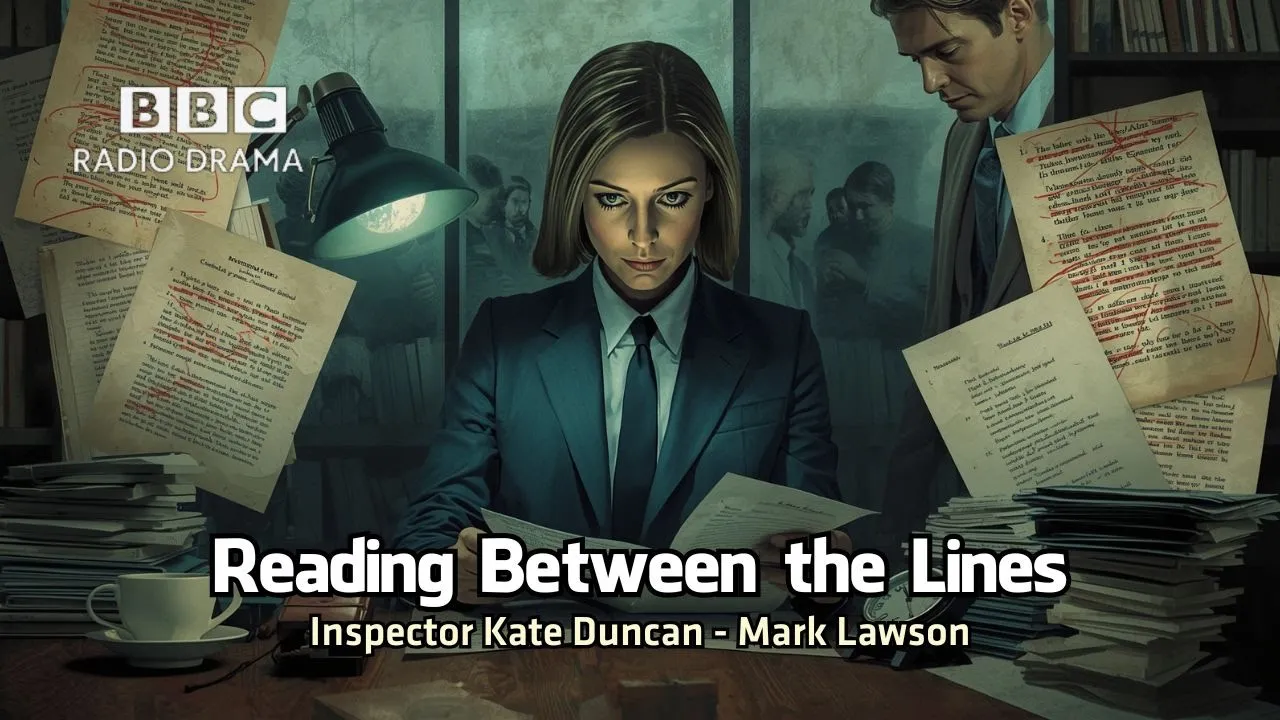
>> So, you were lying. >> Mhm. >> What the hell has happened? Is the book a murder weapon? >> There's a possibility the book contains a crime scene. All I have to do is work out which scene it >> theostumously published final book by the English crime writer RP Beckford Jones has been sent to the police with An anonymous note claiming that the novel is a confession to a murder. Detective Chief Inspector Kate Duncan has been asked to investigate. It was on the day before the funeral of Drew Kle that the results of the tissue
tests showed that he'd not died of natural causes. Initial toxicology reports revealed that his blood was heavily drugged. This encouraged the view because of the two almost empty tubs of painkillers beside The bed in which his body had been found that he'd succumbed to an overdose, accidental or deliberate. >> Oh, hi. Is that a guilty death you're listening to? >> Uh, yeah. Second time through. I've read half of it as well. And uh >> I've never found myself shouting at it like I do most detective stories. You obviously knew a copper ought to. And for
our purposes, if the book really is Some kind of confession, then what have we got? In the book, a guy dies. First, they think it's his ticker, then that he's killed himself until they realize it's murder. >> Don't spoil it. I might read it. >> Actually, I'd like you to. I've realized from this book group I'm in that no two readers see a book in the same way. So whoever sent the hardback to the yard, if they're serious, they're presumably trying to tell us that somewhere out There is a heart attack or possibly an overdose
that is really something else >> and which has something to do with Bedford Jones >> or a killing that he somehow knew about. Obviously, I've been hoping that the death in the book would be, I don't know, a body found in a clown's outfit in a convent. Something we could check against the case file. >> I hope you get further than the ones that interviewed him about his books. >> Don't say that, Rob. The archive search was going to be my good news, saving me all those conversations. >> I don't know. It's weird. These days,
you rarely get someone who's so Googlep proof. The name he wrote under wasn't his real one, and no one can agree. What was the books are copyrighted to a company called Rue Morg? You know the Iron Maiden song. >> Well, yes, and a book by Edgar Alan Poe Before that, father of detective fiction, >> right? >> So, that's probably >> I I've got a search out in the company. They'd have to list directors at the very least. But I tell you, this guy's mavity and then some. You should hear this. It's one of only two
interviews he ever gave. >> Okay. Radio 4 7 years ago. >> We'll be back in Ambridge tomorrow at 2 P.m. But now it's time for a special edition of Front Row. >> Hello. For some reason, power in English crime writing has always descended through the female line. Agatha Christie, Dorothy Elsa, PD James, Ruth Renzle. >> Bangs on a bit. >> But for whatever reason, the popular title bestowed by literary journalism on the leader of the genre has always been queen of crime. In the last two decades Though, English mystery fiction for the first time has
finally had a king. The bestselling novels of RP Beckford Jones, starting with a premature death in 1976 and stretching to a surprising death published this week, have been acclaimed for their psychological accuracy and almost impenetrable puzzles. And one mystery still remains unsolved after so many best-selling books. Who wrote them? >> Oh, great. >> In fact, you know, these books might Know who he is. He interviewed him. >> Wait. >> RP Beckford Jones has never appeared in public, but agreed to answer email questions. For the purposes of this broadcast, the responses are read by an actor.
I started by asking RP. >> It's going to be like looking for a smoke stain in a chimney. >> He or perhaps even they was so reluctant to be revealed. >> I've always read a lot of American Fiction and I was very struck by the division between the ones who were on the talk shows and the cover of Time magazine. Ma, Updike, and the ones that had never given an interview or been photographed. The second set seemed to me more sensible. The book is what matters. Who wrote it is irrelevant. >> Not to me, it's
not, sweetie. >> The next bit is probably the most interesting. >> Crime novels once told me that he Privately divided his writers between those who would otherwise have been detectives and those who would otherwise have been murderers. Which are you? I've certainly imagined what it might be like to kill someone and more particularly to have killed someone and to live with that degree of guilt. At one level, novels are laboratories for experimenting with other ways of living. >> Interesting. >> And whoever wrote the letter suggesting That his last book might have put the theory into
practice >> very intensely but safely within the imagination. >> Well, yes. Although I suppose if you actually had done something terrible, this kind of anonymity would be quite a good protection. A sort of personal witness protection scheme. >> What do you think, Chief? >> As I was going up the stair, I met a man who wasn't there. >> We're looking at a business where one of the things they do is inventing people. Beckford Jones could be just a character that someone was spinning. >> What I like about working with you, Rob, is that you're so
positive. If this one is probably worth hearing as well, much earlier 1989. >> This interview is a first for the South Bank show. On a previous occasion, the poet Philip Larkin declined to appear on camera and let us transmit only his Voice and his back. But RP Beckford Jones has gone further. The best-selling crime writer only agreed to respond to questions by post. In Kim Evans film, his answers are spoken by an actor filmed in shadow. Because we don't know who you are, we're inevitably wondering how close you've been to crime. Could you address that?
>> What can I tell you? >> I'm not a police officer. Although I've been greatly helped with my novels by Many cops, nor am I a criminal. Although again, my research has involved meeting people who've committed crimes. And then there is that truly mysterious asset, the imagination of the crime writer. Didn't President Kart of America once admit that he'd committed adultery many times in his heart? I've committed murder many times in mine. >> Well, that's about as close as we get to him. >> There's something a bit taunting about Him, her them, like those anonymous
phone calls from serial killers. But was it a sort of confession or just being cute to sell books? >> Yeah, this case is pretty wild, isn't it? We don't know what the crime was and we don't know who the suspect is. >> That's right. So now we do the interviewing. >> Hi, I'm Hillary Scotland MD here. >> DCI Kate Duncan. This is DS Rob Lorenzo. >> Hi. >> I think I bumped you by 10 minutes. We had one of our top authors in and uh well, we can't risk killing the goose or any of his
other recipes. >> Yeah, we saw him in reception. Oh, >> but please sit. So, uh, what's he writing next? Ah, well, we hope he'll be doing a humble pie cookbook. Special meals for people you've upset. But whatever he wants, really. He couldn't be much more profitable for us. >> Unless you put a swear box in front of him. >> Well, yes. One of the editors here said it's hard to get used to manuscripts of 100,000 words in which 30,000 of them are the same. You're here to talk about RPJ, though. Is that what you called
him >> on memos? Yes. In sales meetings. >> And to his face? >> Well, that hardly ever. >> I have a dreadful feeling you're going To tell me that you never met him. >> Well, no, of course not. >> He seems to have taken the idea of being a mystery novelist to extremes. >> Yeah, our religious division does the Bible. The office joke was always that there was more chance of meeting the author of that. >> And was it I don't mean to sound rude. just you had anybody in the company ever met him? >>
The legend at Fletcher and Hunt is that Either Fletcher or Hunt possibly had. But well, that was largely based on the rumor that there was someone at both of their funerals that none of the other staff recognized and people decided that was RPBJ, but it was too late to ask them. Did it say anything about why it was all so secret squirrel? Well, Bill Fletcher is supposed to have said once that it wasn't about who he was, but about what he knew. But isn't it tricky? Publishing books by someone you can't Talk to. Not terribly.
The agent sends you the writer's final version and you print it. Handling RPJ was just like that. Editorial queries went by post at first and and then email. There had been quite a gap before the last one, hadn't there? >> Absolutely. A Beautiful Death was 4 years ago. Because in this case, you're not taking them out to lunch to ask what they're pretending to be working on. We did Wonder if the writer had possibly died, but then the script of a guilty death was sent on. >> I haven't read it yet. DCI Duncan has. What
did you make of it? >> Well, to be honest, this is a difficult area in publishing. Frankly, if RPBJ had photocopied his dishwasher instruction manual, it would have been champagne all round. But our guilty death was different. It didn't read as fluently as the others. Of course. When we heard he Died, I figured it might be because of illness. Who told you that he died? Oh, it was the same point of contact for all our PBJ stuff. The agent Richard >> Richard Hunter Smith, pull up another chair, Detective Sergeant. I rarely have need of two,
the books being written individually on the whole. Those screenplays are often a team effort and situation comedy is almost always. >> When did you first meet RP? Well, the writer who used the pseudolim, RP Beckford Jones. >> Ah, your question puts me at a disadvantage. >> Oh, no. >> You never met him? >> I'm afraid I did not. At least not knowingly. >> But I actually find this quite hard to believe. Part of your job was to deal with the money. >> Indeed. Uh, a good 15% of the task. >> Well, so we can settle
this quite Easily. Who were the checks made out to? Well, I doubt that a mind as subtle as the one that wrote the Beckford Jones novels would have wanted his exposure to be as elementary as that. All monies forwarded from this office were made out to Rue Morg Limited. >> And where were the checks sent and how did you communicate with them? >> Well, the monies were sent by credit transfer to a dedicated account. The banking details were sent as were the Manuscripts from a P. box number. Laterally, electronic messages, although with opaque addresses. I
can give you all the details, I suppose. Although, I inevitably wonder what you're investigating. Is it a criminal offense to be anonymous? >> An allegation has been made. >> That's all we can say at the moment. >> Let me ask you, did anything about a guilty death surprise you? >> Its arrival, yes. The books always came Out of the blue. And on this occasion, it had been a longer stretch of blue than usual. >> And the novel itself, did it seem different in any way? >> Well, as I believe a number of reviewers commented, the
enclosed domestic setting was something of a departure. Of course, at one level, the audience for these books, even myself, were reading between the lines for clues to who the author was. Are these references to wives and Children autobiographical? And in that sense, one obviously wondered reading what turned out to be the final book if the writer had himself been one apex of a tragic love triangle. >> Really, >> that's interesting. >> Perhaps, although finally irrelevant. There should always be some mystery in where literature comes from, though not perhaps, I understand, to a detective. So, >>
who told you that Beckford Jones was dead? >> A typed announcement sent from the PO box number and electronic address. What? So there's actually no evidence that he's dead? >> Well, to be pedanic, there's no evidence that he ever lived, except for the books, which, as I have said, are enough for me. There was one question John Webster Dreaded being asked after sex. What are you thinking? Too often the honest answer would have been that he was thinking of something or someone that would have angered the woman with whom he'd apparently been so intimate. But
on this occasion he was thinking something so dangerous that he could not possibly voice it. As Webster lay in the fondly draped arms of Amanda Kle, he suddenly understood that she had murdered her husband. >> Wow. Sort of wish I hadn't known that before reading it. end of >> if it is autobiographical. Makes you wonder what the hell we're in. >> Oh, Lorenza. Yeah. Okay. Yeah. Thanks. We got the search back on R morg. There are two directors listed. John Richard Webster and Alice Susan Webster. >> John Webster. But he's a character in Bedford Jones's
books. Detective Chief Inspector Kate Duncan is investigating allegations that a guilty death, the posumously published final novel by celebrated mystery writer RP Beckford Jones, contained a confession to a real life crime. But so far, her investigation has failed even to reveal who the pseudonymous author was. >> Oh, Kate, >> assistant commissioner. >> Yeah, I thought to catch up on the book thing. >> Well, that wouldn't need a meeting. A shout across the corridor would do. >> Oh, have you found any evidence that the novel describes a crime? >> At the moment, we still haven't established
who wrote the book, >> but he was one of the best known writers. >> One of the best known pseudonyms. Publisher and agent swear they never got Closer to him than a letter box. We've chased the payments through a company called Rue Morg to someone called John Webster. >> But that's the name of >> the central character. Well, a 17th century playwright. and the detective in Beckford Jones's books. Yes. Seems the wrong way round from usual. The writer doesn't exist, but the hero does. >> And have you found this Webster? >> If We Webster is
Beckford Jones, then He's dead or pretending to be. We're checking the addresses we've got. >> Good. Well, I don't really see that you could be doing any more. >> Should I be doing anything, though, sir? At the moment, we've no crime and no criminal. >> No, keep going. I just have a feeling that there's something there. Oh, and uh by the way, has assistant commissioner Williams mentioned this investigation to You yet? >> No, I mean, what is there for? >> No, I'm just wary of doubling up, wasting police time, as it were. Better if you
deal directly with me on this. >> Preventing by her defensive posture from looking her in the eye, Webster addressed a curl of hair above the ear he could see. And you were alone when you found him. John, you know I was. And realizing he was dead, you vomited Over the body in shock. I told you over and over. It's embarrassing. But yes, Amanda, the thing about sick is, and this surprised me as well, I mean, it's it's not like leaving. >> Okay. It's nearly over. >> It's not really chief. What's happened? >> I mean the
audio book. >> Oh, do you want me to >> No, keep listening. >> The tests are back. And look, I'm afraid It wasn't you who threw up over Drew's body. It was someone else. She remained unable to face him, but her head sunk lower. I think I probably know who it was, Amanda. I can prove it with just another test. Well, why don't you just tell me? >> End of CD3. >> Can you leave it there for now? >> Oh, sure. So, how did it go with the deputy headmaster? >> He seemed remarkably untroubled by
the fact that we haven't found anyone or anything to investigate yet. He's also got this obsession with keeping this case, if case it is, away from Williams. >> Isn't it just a Willie measuring thing? Two of the Met's alpha males competing for the one top job. >> Yeah, maybe. >> Rob, I've been thinking. I have never known an investigation like this. The crazed overlords are telling us to keep Digging when we haven't even found a patch of soil to raise the spade over. I assume we haven't got a trace of John Webster yet. >> Um,
no. But the team are honor. while we wait. I had the idea that look, maybe we're getting too hung up on the fact that we're investigating in effect a book instead of 423 pages of fiction, four CDs of an audio Book. Maybe we should think of it as evidence, a cold case, a CPS file. Let's summarize what we've got and see if we can find a crime there. >> Well, I'm not sure I >> summarize the facts of the case for me. >> But I don't know how the story ends. I've got one more CD
to go. >> I know. I think that's probably useful. If it was a case file, we wouldn't have the ending. Tell me what you know. >> Okay. Um, can I have them? >> No. Without looking at the book, what you remember. >> Right. uh wife 40 something Amanda Kle calls the cops in the early evening says she came home to find a husband Drew same sort of age in bed asleep she thinks on the bedside cabinet there are more painkillers than you get at a boxing gym there's fresh vomit on the bedspread which wifey says
was hers when she clocked that he was a goner first everyone thinks hubby's taken an O Accidental or deliberate turns out that he was smothered probably with pillow on the wife's side of the bed. Analysis of a full tray from a Markx and Spencer's gourmet pub range sausage and three bean casserole reveal that someone has even been mixing painkillers into his meals. Analysis of the human spew found on the duvet reveals that it is not that of a mandicle. Um, that's as far as I got with the CDs. Oh, and a detective brought out of
Retirement to review the original investigation of the case. John Webster is shagging the widow when he realizes she must be a suspect. >> Good. The next sentence contains a plot spoiler. I'm afraid the sick turns out to belong to Amanda Kle's lover, William Fitcher. You can probably guess the rest. >> The lovers killed him so that they could be free to be together. >> Yeah. So, if the novel is a confession, Then Beckford Jones is admitting to having killed or helped to kill presumably someone's husband. >> Seems to be the most likely solution, doesn't it?
>> Lorenzo. >> Great. You've mailed it to me. Cool. Chief, we've got a trace on John Richard Webster. He's been paying utility bills at a place in the Cotles. The home of William Fitcher was Approached down a rough plummeting track, optimistically gouged at the end of a plowed field by the farmer who' built the house two centuries before. The swollen broken trunks of unkempt trees bowed over the hopeful road where they sometimes almost met the twisted bloated roots rising from the earth like the limbs of restless bodies buried there. suddenly gets a bit bothering heights
there. It's fidget that did it >> with a lover. Yeah. >> Plays and screenplays. It was conventional that the audience should have been introduced to all the potential murderers before one was singled out. >> Ignore her though. >> Destination reached if my map reading is right. >> Conventions. >> Apart from the road. >> Very late in the investigation. >> A pretty spectacular place of Interrogation. >> Someone's got a bit of money. Come on. Well, there's a light on. >> Yeah, London shoes aren't made for this mud. >> Someone's coming. >> Good afternoon. >> Uh, good
afternoon. >> I'm sorry if you're lost. I can only suggest turning around and going back. We can't be any help here. >> Uh, are you John Richard Webster? The name's familiar from stray envelopes and so on. I think he must have lived here once. >> Then can I ask who you are, sir? >> Well, clearly in the sense that you decide the questions, but the answers are in my control. >> DCI Duncan and DS Lorenzo, Metropolitan Police. I'm afraid we will need to speak to you. >> And what would be the subject of our discussion?
>> At the moment, it's a question of identity. >> Okay. I suppose this is a scene I have imagined. >> So >> you mentioned names on envelopes looking on the desk while you were making coffee you are John Richard Webster. >> Jack more than John in practice but yes. >> And I couldn't help noticing on the bookshelves you seem to be quite a fan Of crime fiction. >> I suppose so. >> A complete set of the novels of RP Beckford Jones. Well, not quite complete. There isn't a copy of A Guilty Death. >> No, that
one's on the desk over there. I've only recently read it. >> Read it? You wrote it, didn't you? >> What? Ho ho. I've been stupid, haven't I? You're not detectives. You're journalists again. >> Again? There have been some over the years. That was one reason for moving down here. >> As such a keen reader of mysteries, you'll know that there are ways of being sure. My warrant card. Well, it looks real, although I'm sure London is full of places over curry shops where they can be convincingly mocked up. >> I'm not the one who's pretending.
>> Are you a linguist, sir? In what connection? >> Well, I couldn't help noticing that you not only have the novels of RP Beckford Jones in English, but also well uh from here I can see uh Spanish, German, French, and uh Japanese. I guess that one. Unless you happen to be teaching yourself languages through cop novels, I'd reckon a collection like that is unlikely to be found outside the study of RP Beckford Jones himself. >> Look, I simply don't understand in what Circumstances my bookshelves come be under investigation. >> Mr. Webster, we can probably clear
this up quite quickly. A copy of a guilty death was sent to the police with a note suggesting that it described an actual crime. >> Is that right? And do you know who wrote the note? >> No, >> we didn't know until this afternoon who wrote the novel. >> And who did? >> Oh, come on, Mr. Webster. There are writers I really like, but I don't feel inclined to collect their books in 20 languages. >> Look, I can be absolutely clear about this. I did not write a guilty death. >> Mr. Webster, if you choose
to go on lying about having written the novel, we'll only become more suspicious about what's in it. >> The distinction was a precise one. I wrote the previous 16 books published under the name RP Beckford Jones. I did not write this one. >> Okay, that's good. >> And do you know who did write it? >> No, I knew nothing about it until I saw it on the Amazon site one day last year. >> Why didn't you come forward and say I didn't write it? >> Because distinguishing I from he or whoever would have entailed revealing
Who I was. The recluse is always vulnerable to impersonation. >> And that's why you didn't try to claim the royalties on a guilty death. >> Absolutely. A writer wants to be paid for his own work, but not for anyone else's. Also, it had the feel of a trap that by coming forward, I might be forced to expose myself. >> A trap? Who would want to trap you? >> Oh, I wasn't thinking of anyone specifically, a reader, a biographer. >> It seems a lot of trouble to go to for someone to fake a whole novel. Richard
Hunter Smith, the literary agent, received a message that Beckford Jones was dead. Did you write that? >> Yes, that was me. >> Why did you do that? >> Now that someone else was writing novels under the name, it seemed the quickest way of stopping them. At least they could only publish one. >> Although, it also meant that you could Never write another one yourself. >> No, I decided to retire Begford Jones four years ago. >> Why? This is what I don't quite get. But why were you so keen in the first place to publish books
without anyone knowing who you were? >> A fantasy of the anonymous celebrity. It excited me. I became obsessed with the fact that JD Salinger could be a famous writer and yet completely invisible. And then if you extended that to the idea of A crime writer who was just an alibi >> and yet you gave the hero your own name. >> Yes. A little in joke. Before I settled on detective fiction, I was going to write those fancy novels with trick endings. And is it true that you attended the funerals of your publishers? >> Oh yes.
>> A publisher is a kind of father or mother. I'm not the kind of man who would miss his parents' funerals, nor Were those my only incognito appearances. I sat quietly in discussions of the work of RP Beckford Jones at various literary festivals. At the Harriut Crimewitriting Festival in the bar late at night, I watched with fascination as a best-selling thriller writer talked a young publicity assistant into bed with the whispered confidence that he was secretly RP Beckford Jones. >> Can I ask you why you decided to stop Writing the novels? Um, four years ago,
you said. >> Yes, that was when I suffered a bereavement. My first reader, >> Alice Susan Webster. >> What? >> Two directors were listed for R. John Richard Webster. Alice Susan Webster. >> Yes, she was my wife. >> Do you I understand if this is painful. Do you mind my asking how she died? >> Well, there was an open verdict of the Inquest. She'd been depressed. I think I didn't realize quite what extent. >> You said that you've been reading a guilty death. >> Yes. Well, obviously I was curious. >> Do you think it's a
convincing imitation? >> It's like hearing your own voice played back on very faulty speakers. Something did strike me though. It was written by a writer, an accomplished one. >> And do you have any idea who that writer Was? >> If you were ever to find out, >> DCI Kate Duncan is investigating claims that a guilty death. Theostumously published novel by RP Beckford Jones contains a confession to a crime. A recluse called John Webster has admitted to publishing 16 novels under the pseudonym. Decades before his churchfearing mother had wanted him to be a priest and he
always felt something sacramental in the Ritual repetition of the long-spoken words that closed a case. Mander Kle he said I am arresting you in connection with the murder of Andrew Peter Kle on or about the 3rd of January 2004 >> at junction 7. The final words of a priest, however, were, "Go in peace." And there could be no peace for death haunted John Webster. He had brought two more guilty people to justice, but there would always be another one, and for Webster to bring Him to justice would be both the easiest and the hardest assignment
of his life. End of CD4. The guilty death by RP Beckford Jones was read by >> first time round I thought that was a disappointing ending. Inconclusive. But now, of course, I see that's the point. >> Oh, sure. Whoever wrote them. Those final lines are supposed to hang like a noose over John Webster's neck. >> Yeah, whoever wrote them. Half an hour ago. I thought we'd found our author, but now we're back. Well, not quite where we started. At least we know what a guilty death is supposed to be a confession, too. >> Someone is
trying to say that John Webster murdered his wife. Yeah, or at least a wife. Someone's wife. We'll need a search on the death of Alice Susan Webster. >> Right. >> And we better go back to where we started. >> Put Fletcher and Hunt in the satnav. >> Can you just tell us again the way that the manuscript of a guilty death arrived? >> The way they always did from his agent and the packaging, the way it looked and so on. There was nothing different about that. >> Well, I don't think so. But you know, even
in my time here, Scripts have become less distinctive. >> On that point, was there anything at all as a reader that made this book seem different from the other books by Bford Jones? >> Bloody hell. You think the final novel was a con, don't you? >> It's funny. When I saw that Howard Hughes movie, >> just tell us to your professional eye. Was there anything that >> Well, I told you when you were here Before, the grammar and spelling were quite dodgy, which was odd because Beckford Jones had always been a bit of a queen
for that. But I think he must have realized because he cleaned it all up when the author's revised. In fact, I wonder if he was a bit unhappy with the whole thing. He'd never done so much on galls. Gies are the big page proofs we send to authors. In places he practically rewrote the book, even changing characters names and So on. In a way, it was quite exciting. The biggest connection we'd ever had to him, but generally he just correct a few words. >> And given that you never met, how did Beckford Jones correct his
proofs? Like everything else, it all went through the agent. >> The manuscript, the galleys, would you have them here? >> Sorry, no. Uh, again, the agent. Can you tell me again, please? How did You receive the manuscript of a guilty death? >> Well, there's no mystery there. It arrived the way they always did, by post out of nowhere. >> And once the manuscript arrived, >> I sent it to Hillary Scotland at Fletcher and Hunt. A deal was rapidly agreed, as indeed it should have been. Given his sales, I was more or less sending them a
license to print money. And as I understand it, the next stage Was that you would return uh send the manuscript to the writer for correction. >> Mhm. Yes, that's it. Miss Scotland would list any questions she had and I would mail them to the author. >> And when we first spoke, I think you told me that you would use a series of addresses you were sent. >> Indeed. Just after the script arrived, we'd be emailed a PO box number for correspondence relating to that title. Actually, as I recall, with the guilty Death, that didn't happen.
So, we just used the details we had on file and the text came back corrected. So, uh >> Chief, this means >> later, Rob, the publisher said that there were very many more changes to this book than the previous ones. >> That's fair. Yes. >> She also said that the spelling and everything was sloppier than she'd have expected. >> Well, yes, there was evidence of a Certain slippage there. >> Didn't you wonder why that was? >> Well, of course I did. Uh, I wondered if Beckford Jones were unwell. The news of his death soon afterwards
rather confirmed this view. >> Would you still have the email that announced his death? >> Well, the teenagers who deal with these things for me say that the evidence exists forever. I can put you in touch with them. >> Good. Thanks. >> And Hillary Scotland said that you would have the manuscript and galley proofs. >> Ah, they also exist forever, although alas elsewhere. All of that material has now gone to the RP Beckford Jones manuscript collection at the University of East Anglia. The curator is Dr. Tony Parnell. >> Tony Parnell. >> Thank you for seeing
us so quickly. Is it always this chilly in here? >> Yeah, it is. I'm afraid. Detective Chief Inspector, dead texts are kept in a fridge. Unless you watch it, modern paper rots. for the same reason. If you could both put on these gloves. >> Um, presumably this is some kind of copyright dispute. H there's someone saying that they wrote the books and laying claim to the estate. >> Something like that. >> And what you do here is >> literary forensics, a relatively new Field. I started out in Marloian dubia. >> What on earth? >> I
know. I know. In the language business, we've invented our own texts that have been doubtfully attributed to Christopher Marlo. Are they? Aren't they? With the additional complication of the writer's identity. Was he Shakespeare? Was he a spy? >> But isn't it I don't mean to be rude. Isn't it just clever guesses? I mean, you call it forensics, but it's not like Ours. That stain leads to that perpetrator. >> Not as precisely. No. Sure. We're stuck with our blood and stuff, but can change our writing style. But there is a kind of literary DNA, linguistic fingerprints.
A writer has basic language habits wired deep into the brain. One of mine, you may not have noticed verbally, is that I'm more than happy to begin new sentences with the conjunction but. But I have colleagues Who were beaten by their English teachers into never doing so. In any block of text of a reasonable length, there will be numerous such clues of usage. But there I go again. You have to be careful. What I do is chase the changes. The central limitation of literary forensics is that a pseudonmous author can only be exposed if he
or she has also written something else. The Beckford Jones author though seems only to have published under that identity. The writer had clearly learned some linguistic lessons from Lare and Chandler, but otherwise he was his own man, whoever that is. You said that there are literary fingerprints. How do you Well, just for them, analyzing big blocks of electronic text. I find 10,000 words to be a useful unit. I build up a profile of language habits, even the use of function words. >> Sorry. uh the tiddlers and but of the I'd be surprised if the Beckford
Jones Author were not a relatively well-educated white male born between 70 and 75 years ago. >> That's interesting. Tell me once a language pattern is established would it vary much? >> It's a nice question. The whole science depends on differences in consistency. So across a huge range of works, Shakespeare is always Shakespeare. And to the annoyance of a number of hard Cases in cyerspace, Marlo is Marlo, not Shakespeare. And Beckford Jones is always Beckford Jones, except as it happens, which is probably the reason you come here in search of an imposter on one occasion. >>
The last book. >> Yes. Comparison of representative text establishes that there is almost no likelihood that the main writer of the guilty death was the RP Beckford Jones author. >> Right. And I don't suppose you'd be able to tell me who did write it. >> I operate in probabilities, not facts. But my study showed that the language habits of the writer of a guilty death have a 90% similarity with those shown in the novels of William Parkinson, writer of the Detective Inspector Buskam series. This is tremendous. Thank you. >> Have you told anyone this? >>
No, I emailed Richard Hunter Smith. >> Why him? >> Because he's Parkinson's agent as well. I eventually received a reply from the writer. It said, "I would love to say that I wrote a guilty death, but sadly can't." Interesting. A classic example of a non-denial denial. You want to sleep with my wife, don't you? Says man A. I can't say that I do, replies man B. meaning that it's true, but he didn't. >> Sure, of course. In the case of a guilty murder, we have something much more Curious going on. >> Go on. >> Although
the Beckford Jones author did not substantially write a guilty death, he does seem to have made significant autograph revisions to the manuscript and galley proofs. The inevitable conclusion is that the RP Beckford Jones author was forced to engage a collaborator, perhaps for reasons of illness, to assist with what proved to be the final Novel, but as I say, I only suggest probabilities. >> You have been very helpful. In case we need to check anything, >> I'm in Harriut from tomorrow, but here are my numbers. This is Bill Parkinson. For the next 3 days, I'll be
at the International Crime Writing Festival in Harriut, checking messages intermittently. For urgent professional inquiries, contact my agent, Richard Hunter Smith, of >> Chief Parkinson's gone to Harrigate. >> Right. Everyone seems to be heading there. I think we might be driving north tomorrow morning. >> DS Lorenza. Yeah, sure. Really? Oh, the plot thickens. Yeah. Can you put that on my desk? Cheers. Chief, our guys have dug out the death certificate on Webster's wife. >> Why do I have a feeling I've already Read it? >> Yeah. Alice Webster was found dead in bed. OD painkillers. As Webster
said, the coroner returned an open verdict. >> Continue until junction six. >> Right there. So, what do we have here? John Webster writes or claims to have written 16 books under the name of RP Beckford Jones. Four years ago, his wife dies and he stops publishing. Then, completely unbeknown to him, according to Webster, somebody else writes an Entire novel in the style of Beckford Jones. I think we need to speak to Parkinson tomorrow in Harriut, then visit Webster again in Gloucester on the way back down. And I can do a bit more research when I
pick up the kids tonight. >> You'd say if it gets too much, wouldn't you? >> Having them. >> As I've told you, A, you're my friend, and B, you pay me. So if A ever starts To go down, B can always go up. But not yet. >> Sh. RP Beckford Jones. >> You're still investigating him? >> What's going on? I can't say, but I think I'm finally getting somewhere. Have you finished the new one I gave you? >> Yeah, I have. >> You're making a face. Not one of his best. >> No. >> Hello, >>
Cades. Can you brief me on the book thing? >> Oh, assistant commissioner. Uh, it's difficult to speak here, but we now strongly believe that whoever sent us the book was right to be suspicious. >> Very good. I think I somehow always knew that. >> Sir, can I ask you something? >> The question of who sent us the book obviously becomes relevant. >> Oh, really? >> Was there any packaging or >> I certainly don't recall there being any on my desk? By the way, has uh assistant >> No, sir. I don't think Assistant Commissioner Williams even
knows who I am. >> Sorry. Work. You were telling me why you don't like the book. Yeah, you got to the end. >> Yes, twice. >> Well, I won't spoil it then, >> but I just thought it was so obvious that Joe White had done it. >> Joe White? >> Who's he? >> Hello, the murderer. >> What? No, the murderer? Well, with Arabella Drew is Tim Fitcher. >> Not in the novel I've read. >> Well, here, give me that. >> Oh, you said I could keep this. It's a proof. It might be valuable now that
Becker Johns is dead. I'm >> going to have to take it for the moment. Huh? >> You're right. It's like we've been reading completely different books. A Guilty Death was theostumously published final novel by the pseudonmous crime writer RP Beckford Jones. DCI Kate Duncan has discovered that the book seems to describe an actual murder. But though the reclusive author John Webster has admitted to publishing 16 books as Beckford Jones, he insists that the final one was written by someone else. Kate has discovered that many of those involved in the case are scheduled to appear at
the International Crime Writing Festival in Harriate. I can tell you that at Fletcher and Hunt, we're desperate to find the next RP Beckford Jones. >> Okay, a few more hands up, but we're going to have to stop there. Thank you to Hillary Scotland for that insight Into crime publishing. Coffee and tea are being served in the library now. Good morning. >> Once she goes through that door, every would be writer will grab her. Should we >> Miss Scotland? Yes. Oh, hi, Detective Inspector. Oh, I'm pleased to see you're such a fan of crime novels. Maybe
you should write one. >> Uh, no. We're here for work. Uh, a few more questions. This particular edition of A Guilty Death, how many people would Have had it? >> Uh, oh, that's a very early proof. Who gave you this? >> Oh, it came up when we were digging around. I was surprised by how different it was from the published version. >> Well, I think I told you he did a mega revive. >> Yes, sure. Just quickly, do you know a writer called William Parkinson? >> Oh, Bill. Yeah. Yeah. We we published him until about
4 years ago, but he got A better offer from Transworld. And anyway, he'd lost the editor he had with us. Uh, actually, she died, unfortunately. But to be honest, his books never sold like we'd hoped. >> Can you see him here now? Look, he's the one with the loud voice at the bar with the gaggle of cutie groupies around him. You know, he's probably auditioning for this year's festival bonk. >> This is probably the quietest place we'll find. How can I help you, >> Mr. Parkinson? Have you read the novels of RP Beckford Jones? >>
Oo, yes. I think anyone actively interested in crime fiction would have to. He's the governor. was the governor obviously. >> Did you read A Guilty Death? >> I've never sat down and read it from page one to whatever. >> 423 I think. >> Is it? But anyway, I certainly know all about the books. >> Are you familiar with the work of Dr. Tony Parnell? >> Ah, is that the nutty professor who reckons I wrote the Beckford Jones books? >> No. No, he only thinks you wrote the last one. Well, as my children say, whatever. >>
Did you write a guilty debt? >> As I told him, I'd love to have those sales. >> So, you didn't write it. >> Again, as I said to him, I really wish I could say yes, but I can't. >> Okay. I think that's as far as we're going to get at the moment. >> Are you planning to stay around >> for a while? There's a few more conversations we need to have. >> Good. You know, you're really quite a surprise. >> In what way? >> I spent half my life with old DCI Robert Buskcom in
my head. Detectives in fiction tend to be grumpy, middle-aged men. All this stuff going on. >> Oh, well, I've got stuff, I suppose. >> Yes, you're a widow with young kids. >> And how do you know that? Ooh, just a cop I know mentioned you once. The one that helps me with police detail and so on. >> Why the hell were you talking about me? >> I forget why you came up. >> Was he coming on to me in there? >> I think it's probably what he does with anyone. >> Oh, so it wasn't anything
to do with me. >> Chief, you know that's not what I meant. Well, if I tell you what I know, Detective Chief Inspector, you must promise to keep until tomorrow. >> The rumor is that you're going to announce who RP Beckford Jones is. >> Well, the RP Beckford Jones author. Yes. Beckford Jones is just our literary identity. >> But hang on. When we met you yesterday, there wasn't a hint that you knew that. >> Ah, well, at the risk of academic pedentry, you never asked me who wrote the first 16. You wanted my opinion on
the 17th. >> Thank god I left school at 21. >> So what have you found out? >> My lecture tomorrow centers on two striking pieces of evidence. I've told you the percentage scores in the comparison of passages from the Parkinson novels and the Beckford Jones author. Well, I have further proof of a connection between the writers. Most readers probably skip past the dedication page, but but most of the early Beckford Jones books are dedicated to Alice A or in the 16th book I am, Which we must suppose means inmemoriam. A S W. Interestingly, a guilty
death is inscribed almost identically I M P. >> Right. But why would the P? Listen, three of the most recent William Parkinson books are dedicated to Alice A and ASP. I'd be amazed if it wasn't the same woman. >> It sounds as if you might be on to something there. >> But that doesn't tell you who Beckford Jones was. >> No, but my other little bombshell does. I investigated the company the books are copyrighted to, RG. But you just run into this web of trusts and ghost companies heading for the Cayman Islands. You've probably got
people who could crack it. I couldn't. But then the thought occurred, why has the author named his company after a story by Edgar Alan Poe? Is there a clue there? I started comparing books on Po with the RPBJ novels. One afternoon, two months ago, bang. >> What? >> An 82% match with a 1968 doctoral thesis on Poe. Author one, John Richard Webster. And you plan to say all this tomorrow morning? >> Yes. Um, have you tried to contact this Webster? >> Hardly. Beckford Jones is dead, which means that John Webster is as well. >> Oh,
DCI Duncan. Well, there's a couple Of publishers over there I'd like you to arrest for crimes against literature. >> Can um can you just tell me something? Bill Parkinson's editor, your colleague who died, what was her name? Alice. Oh, poor Alice Webster. >> Thanks. Bloody hell, Chief. How did you >> Oh, excuse me. Lorenzo. >> Oh, great. Tell me. >> You've called for reinforcements, Detective. Chief Inspector. >> Oh, Mr. Parkinson. >> No, no, I haven't. >> Excuse me, officer. I'm DCI Duncan from the Met Special Cases Unit. That was quick, man. >> I'm here for
something else. What's your call out for? >> Can we get over here away from the party? >> Uh, suspicious death in one of the rooms here, ma'am. A guest hears noise around Midnight. Rings down to complain. Staff assume it's sex, but when they get there, it's the other one. Early signs of struggle and smothering. >> Is there a name? >> Yeah. Parnell. Yes, >> ma'am. I'd uh better go. >> Oh, yes. Yes, of course. Uh, >> Chief, I've just heard that >> Tony Parnell's been killed. >> Harsh. Well, get this. The forensic accountants have traced
regular large payments from Rue Morg to William Parkinson for 3 years until about 12 months ago. >> Right, Rob, you go check the hotel CCTV for Webster, >> right? Uh, you'd think Webster was here, >> remember? He told us it amused him to hang around the festival incognito. Almost no one knew who he was. And there's one less now with Parnell gone. I'll be in the green room with Mr. Parkinson. Can I >> When Buskam's Deadly Summer was published, I was given Alice as my editor. By the next book, we were lovers. >> You knew
that her husband was RP Bford Jones. >> No, not at all. I knew that she was married to John Webster. She always said he was a teacher >> and she kept it from everyone at the Publisher. >> It seems so. She was good at secrets, I suppose, which is what made us possible. Certainly, I've never had the slightest hint in all this that anyone at Fletcher and Hunt knew who he was. In retrospect, it explained why the books were sent to that imprint. And of course, Alice edited them, so was able to keep an eye
on them as they went through. >> How long were you together? >> Oh, two, three years. Then Alice got ill. Liver trouble. Of course, now we know that the fancy meal her husband had ready for her when she got back from her long commute was sprinkled with crushed painkillers. One day, I got a text begging me to come to the house and glost. When I got there, she was dead in bed. I assume now that Webster was checking her phone and knew about us. >> And I'm guessing that with a shock >> I was sick.
Yes, I panicked that Webster Was trying to frame me for murder or would not be able to. So, I liked it. On the way out, the study door was open. And when you see those shelves, >> yes, >> I suddenly knew who her husband was. >> And we've got the accounts of Ru Morg. You were blackmailing Webster. >> Well, first I relied on the police to prove what happened. But it seems that Webster had some kind Of deal with the chief constable, >> Ben Williams. Yes. My bet is that he'd been taking payments for handing
over case files and so on. >> So I contacted Webster. Divorces are expensive and I was on my third. But after 3 years, he stopped paying thinking he was safe, I guess. He told me though that during our dealings, he'd stop writing. So there was this paradox. I was Publishing books that didn't really sell, and a writer whose books really did sell wasn't publishing. So, I wrote his instead. The idea was that especially when he saw the contents, he'd make all the royalties over to me. >> So, you just sent it to the agent. >>
Yes. All the cutings about the mysterious writer mentioned the books just coming through the post. But I made two mistakes. I suppose I thought with Alice dead, they'd just clean it up at the publishers and print it. Of course, it was sent to him and uh >> and he changed the murderer's name >> and mixed up other details. Yes. But then the thing I hadn't seen coming was that he would kill Beckford Jones off. Brilliant. He didn't need the royalties and I wouldn't get them. The cop who helps you with your novels, the one who
mentioned me to you. It was Assistant Commissioner Robert Briggs, wasn't it? >> I wish I could say that it wasn't. >> How did you know? >> Robert Buskam, Robert Briggs, John Webster, Joe White. >> It's one of what poor old Dr. Parnell would have called your language habits, >> Chief. >> Yes, Rob. We've done the cameras. Webster was caught several times. >> John Richard Webster, I'm arresting you On suspicion of the murder of Alice Susan Webster on or about the 3rd of January, 2004. And on suspicion >> Good morning. Good morning. >> You seem very
cheerful, assistant commissioner. >> Deputy Commissioner now. In fact, >> ah, >> it's just been gazetiered. The command structure has been reshuffled since AC Williams was suspended. The questions Over a suspicious death investigation when he ran Glstersha, apparently. There may be other changes soon. Apparently, the mayor of London's not very happy with the new man either. >> Sir, why didn't you just do in Williams yourself? Why do it in this roundabout way? It wasn't really something I could do in my own name, so I used a sort of pseudonym. Sometimes, Kate, you can't do everything By
the book. >> Ladies, ladies, we better talk about the book a bit. >> The non-uplume murders by William Parkinson. And what did anyone think? >> Something nagged me about the detective. I mean, DCI K Dunley, a pluckucky, lovely single mother. Ring any bells, Kate Duncan? >> I did meet the writer on a case once, >> and Kay's quite a goer in the bedroom. >> You don't understand these writers. It's Not your body they want. It's your life.