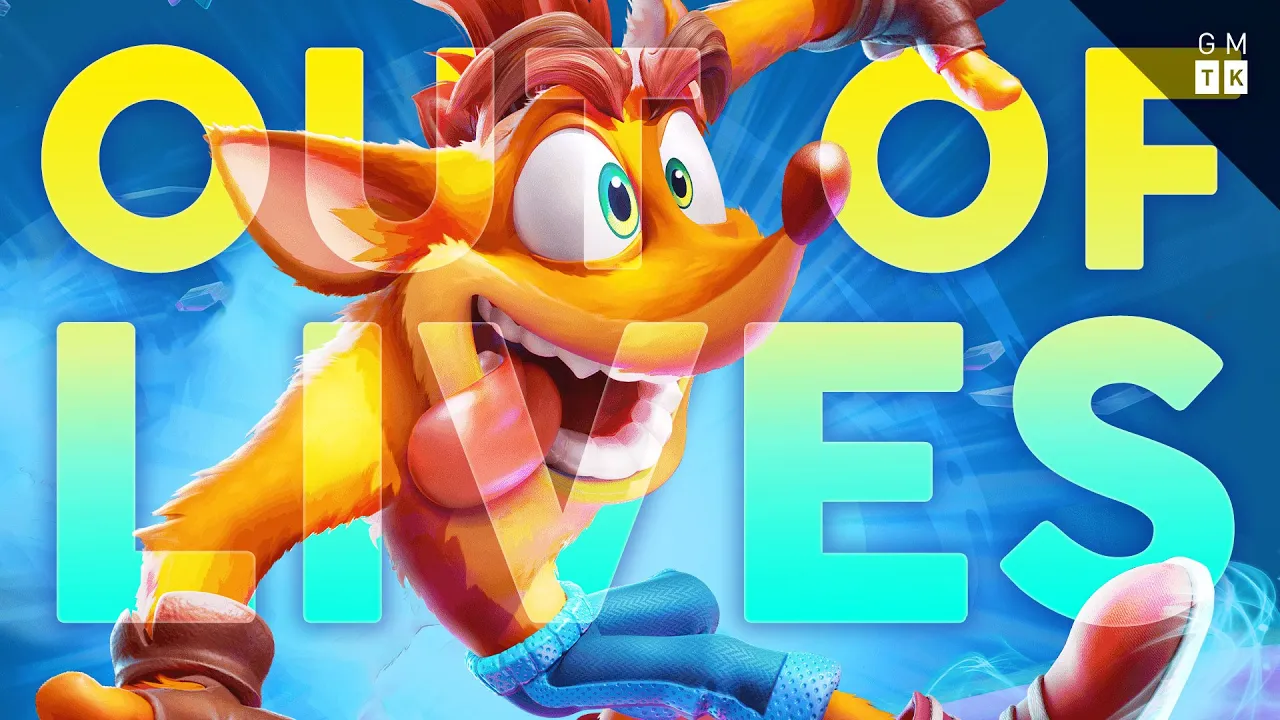
Before you get to play Crash Bandicoot 4, you have to make a big decision. I'm not talking about whether or not to accept a 20 page software license. Or a 24 page privacy policy.
I mean, there's nothing more bodacious than legalise. Uh. No, I'm talking about whether you want to play in the Modern or the Retro play-style - which is all about whether or not you want the game to feature a lives system.
Now, putting aside the questionable practice of asking players to make fundamental game design decisions before they've even started playing… this does bring to mind an interesting design debate that has raged in games for the last decade or so. Particularly in platformers, but also side-scrolling brawlers, shoot 'em ups, and more. And that's this - is a lives system still relevant game design - or just an antiquated relic of the arcade era?
Well, I'm Mark Brown, and this is Game Maker's Toolkit. First, let's define what a lives system is, so we're all on the same page. Lives dictate how many times you can retry a challenge, before you're forced back to some earlier part in the game.
So there are points in the game where your progress is saved permanently. But between those, there might be several checkpoints where your progress is only saved temporarily. If you die, you'll lose one of your lives and then return to the last temporary checkpoint.
But, if you run out of lives, it's Game Over, the temporary checkpoints are lost - and it's all the way back to your last permanent save spot. There might be some quirks like continues, or whatever - but that's the basic concept: it's all about permanent and temporary checkpoints. Over time, the gap between the permanent save spots has shrunk - take the Donkey Kong series where it's gone from the very beginning of the game, to specific save points in the world, to the start of every level.
And that's what you get in Crash 4's Retro mode - levels mark permanent progression, but checkpoint boxes are temporary. Recently, however, the concept of lives has started to disappear entirely. Now, every checkpoint is a permanent mark of progress and while some games might still count the number of lives you lose, there's no penalty for wasting hundreds on a single bit.
So, Super Mario Odyssey is the first major Mario game without lives - which is probably sensible, as they carried almost no meaning in Super Mario 64. Most indie platformers have ditched the concept entirely, with Super Meat Boy maker Edmund McMillen saying "removing lives altogether lets the designer base difficulty more on the actual level design and challenge and less around the penalty of losing lives and restarting". And now Crash 4 recommends you play in Modern mode which gets rid of lives, and lets you infinitely return to those mid-level checkpoints.
Now, the argument against lives is pretty obvious. When you run out of them and get sent all the way back to some earlier point in the game, it's simply frustrating to have to re-do bits that you've already finished. When Sonic Mania came out - which only has permanent checkpoints at the start of each zone - US Gamer published the written equivalent of an Alt-F4 rage quit, calling the lives system obnoxious and infuriating.
And just from anecdotal evidence, new and inexperienced players seem to find these penalties especially rough. Even if it's just back to the start of the level. Plus, lives systems are frequently unbalanced.
You either end up with so many extra lives that the whole system becomes meaningless, or have so few that the game's difficulty curve spikes up into the stratosphere. But there is also an argument for including a lives system. So, for one, the fear of losing significant progress is one fine way to ramp up the stakes to nail-biting heights.
Which can lead to precise and intentional play, rather than sloppy, brute-force attrition. And this also creates a greater sense of satisfaction when you finally find the next permanent save point. Lives also create a very high-value reward for players to find.
If a 1-UP mushroom or a Mega Man face is all that's between you and repeating half an hour of content, then that should really encourage players to hunt down 100 coins, play bonus mini-games, find secrets, and take risks to get extra lives. And finally, lives can create an interesting meta challenge. It's not about finishing a single sequence at any cost - but instead it's about completing a string of sequences where your performance in each part can carry across into the rest.
For example, finishing a Mega Man level usually involves perfecting the early parts - so you have enough health, lives, and ammo to face the robot master at the end. Okay, so lives have pros and they have cons. But maybe it's not just a choice between having lives in the game, or not having them at all.
Maybe designers can do something more interesting? First, we can try to solve the problem of lives becoming unbalanced by tying them to levels, rather than the character. So in Furi, you'll always start each boss fight with exactly three lives, which means you never begin a stage with an overblown advantage or a crushing disadvantage.
Elsewhere, games find ways to reduce the sting of losing all of your lives. In Kero Blaster, you get to keep all your upgrades and cash, even when you run out of lives - which makes repeating those old areas less frustrating. And because you wake up in hospital, you get access to a special drug store where you can buy handy upgrades like extra lives and health.
And that's not the only game that makes it less annoying to repeat content after a Game Over - Sonic games let you try alternative routes on repeated visits, and roguelikes are entirely built around losing massive chunks of progress - because they make up for it with completely randomised content. There are also games that ditch lives in favour of permanent checkpoints - but still find ways to add a sense of meta challenge. So in Shovel Knight, the checkpoints can be destroyed - which gives you handy gems, but also makes you go back further if you die.
Are you willing to risk that? There's a similar idea in Panzer Paladin - you have to activate checkpoints by inserting a weapon, so it might be better to skip them altogether and keep your arsenal stuffed. Meanwhile in Ori and the Blind Forest, you can make your own checkpoints by spending a certain type of currency.
It's up to you to decide where to save your progress - and up to you whether you can afford it. But perhaps the smartest approach of all, is to flip the entire concept of lives on its head. Instead of punishing players who run out of lives, games can instead reward the players who manage to complete a sequence without having to retry too often.
So while most bullet hell shooters let you play with infinite continues - there's a whole community around doing a 1CC (or one credit clear) where you try to finish the entire game without dying. And over in Sonic Forces - the number of retries players use in a level are counted against the final score. So to get the high ranks, you need to finish the stage in a single life.
And there's actually a really smart version of this in the game that kicked off the whole video: Crash Bandicoot 4. The game still tracks your lives in Modern mode, even if there's no penalty for losing them - and that's because every level has a gem that can only be unlocked if you manage to finish the entire level with fewer than three retries. System like these mean that new players never need to worry about running out of lives - but advanced players can opt-in to the additional challenge and peril of a lives counter.
So, are lives outdated? Well, it's really down to how they are implemented. How they are balanced, how they are supported by the other systems in the game, and how they are presented to the player.
But more importantly, it's about why they are implemented. Lives are one of those things that can be added to a game simply because "that's what platformers have always done", or in some misguided attempt to capture the feeling of being a retro game. But great games aren't made by thoughtlessly copying trends and tropes.
The most amazing games come about when every single system is added with intention, thought, and care. Hey, thanks for watching! I want to give a shout out to the GMTK Discord - I often talk about upcoming videos in there and ask people for ideas and suggestions.
It's available to all Patrons on any tier, and it's a cozy, well-moderated place where you can talk about game design without, you know, The Gamers clogging everything up. It's a good place. So cheers, I'll see you there.