We are often told that the squat is the king of all exercises, a non-negotiable movement for strength. For a significant portion of the population over sixty, continuing to perform traditional, deep squats is not merely inefficient; it is actively accelerating joint degeneration. We know that after the sixth decade of life, the risk of symptomatic knee osteoarthritis and catastrophic falls increases sharply.
Yet, millions of older adults are forcing their joints through biomechanically compromising positions simply because they are following advice designed for a thirty-year-old body. The physiological reality is that what built muscle in your forties may simply destroy cartilage in your sixties. We are going to correct this approach today by replacing high-risk mechanics with three superior movements that prioritize longevity, joint preservation, and functional independence.
Before we analyze the physiology behind these safer alternatives, I would like to ask you to take a moment to engage with our community. Please comment below with your current age and the country you are watching from. It is genuinely encouraging to see a global network of seniors taking proactive control of their physical health, and I make it a point to read and reply to these comments personally.
If you are new here, please consider subscribing as we continue to explore evidence-based health strategies. Now, let us look at why we need to change our approach. Strong legs in our senior years are not about maximizing load; they are about maximizing function.
The first major shift we must make involves replacing the traditional squat with the Sit-to-Stand exercise. This is not a regression; it is a tactical adjustment. The primary issue with a free-standing deep squat for an older adult involves the shearing forces placed on the knee joint.
As we age, the menisci—the shock absorbers between your thigh and shin bones—naturally thin and lose hydration. When you squat deeply without exceptional form, you increase the compressive load on these wearing structures. Furthermore, without a tactile target, many seniors descend too quickly, relying on their connective tissue to "bounce" out of the hole rather than using muscle tension.
This is a recipe for a meniscus tear. The Sit-to-Stand exercise eliminates this risk while improving strength in the quadriceps and glutes, which are the primary drivers of mobility. From a medical perspective, this movement is superior because it uses a "closed chain" mechanic that mimics the most essential daily activity: rising from a seated position.
A study published in the Journal of Geriatric Physical Therapy highlighted that consistent practice of this specific movement pattern led to a strength increase of over thirty-five percent in older adults. This translates directly to improved gait speed and stability. To perform this correctly, you place a sturdy chair behind you.
Unlike a gym squat, where you might worry about depth, here the chair acts as a safety stop. You begin seated with feet flat, hip-width apart. The critical biomechanical cue here is to lean the trunk slightly forward to engage the core and shift your center of gravity over your feet.
You then drive specifically through the heels to stand. This heel drive recruits the posterior chain—the glutes and hamstrings—taking pressure off the anterior knee. You lower yourself back down with a slow, controlled tempo.
That descent is arguably more important than the standing phase because it trains the eccentric strength of the quadriceps, which is the braking system of the body. If you cannot control your descent into a chair, you are at a much higher risk of falling when gravity takes over. By mastering this simple, supported motion, you build muscle density without grinding the internal structures of the knee.
Building upon the foundation of muscular strength we established with the Sit-to-Stand movement, we must address the second, and perhaps more critical, component of aging physiology: proprioception and balance. This leads us to the second movement, the Supported Split Stance Hold. One of the glaring deficiencies of the traditional squat is its stability.
When you squat on two legs positioned symmetrically, you have a very wide base of support. You are stable, but you are not challenging your nervous system to maintain equilibrium. In the real world, falls rarely happen when we are standing still with feet wide apart.
They occur when we are in a staggered stance—walking, turning, or stepping over an object. As we age, the speed at which our nerves conduct signals decreases, and the sensory receptors in our joints that tell us where we are in space become less sensitive. This is why a senior with strong legs can still have a high fall risk; the hardware is strong, but the software is lagging.
The Supported Split Stance Hold addresses this by placing the body in a position of "static instability. " By staggering the feet—one forward, one back—we narrow the base of support and force the stabilizing muscles of the hip, specifically the gluteus medius, and the ankle complex to engage. To perform this, you stand near a wall or a high-backed chair for safety.
You step one foot forward and one foot back, keeping the feet hip-width apart to avoid walking on a tightrope. You then lower your hips slightly, distributing your weight evenly between both legs. This is not a lunge; it is a static hold.
You maintain this position for fifteen to thirty seconds. The medical value here lies in the isometric contraction. Isometric exercises allow us to strengthen muscle tissue at specific joint angles without the wear and tear of repetitive grinding motion.
You are stimulating the muscle fibers and, crucially, training the brain to stabilize the body in an asymmetrical position. A study in the British Journal of Sports Medicine identified balance deficits as a stronger predictor of falls than pure muscle weakness. This exercise directly targets that deficit.
When you hold this split stance, your brain is working overtime to interpret signals from your feet and ankles to keep you upright. You will likely notice that one side feels significantly more unstable than the other. This asymmetry is normal, but it is a risk factor.
By identifying and training the weaker side, we correct imbalances that often lead to injury. If you find the position too easy, you can shift more weight onto the front leg, increasing the load on the quadriceps without adding impact. If it is too difficult, use the hand support freely.
The goal is not to prove you can balance like an acrobat; the goal is to safely stress the balance system so it adapts and improves. This static loading strengthens the connective tissues around the knee and hip, providing a corset of stability that protects the joint during movement. It serves as the bridge between sitting safely and moving confidently through a dynamic environment, which brings us to the final and most complex requirement for functional longevity.
We have discussed building raw lifting power with the Sit-to-Stand and refining static balance with the Split Stance Hold. Now, we must integrate these elements into a dynamic movement that replicates the unpredictable nature of daily life. The third exercise is the Step Back Lunge to Chair, a movement that many geriatric specialists prefer over any form of squatting.
This exercise is vital because it introduces a vector of movement that is often neglected: the backward step. Most people are comfortable walking forward, but the ability to step backward and lower one's center of gravity is essential for maneuvering in tight spaces, such as a kitchen or bathroom, where many household falls occur. Anatomically, the knee joint can handle significant load, but it struggles with shear force when the shin bone slides forward excessively.
In a poor squat, this forward slide is common. However, studies from orthopedic literature, including the Journal of Orthopedic and Sports Physical Therapy, suggest that "reverse" movements—stepping backward—keep the shin bone more vertical. This significantly reduces the stress on the patellofemoral joint (the kneecap) while still demanding high activation from the quadriceps and glutes.
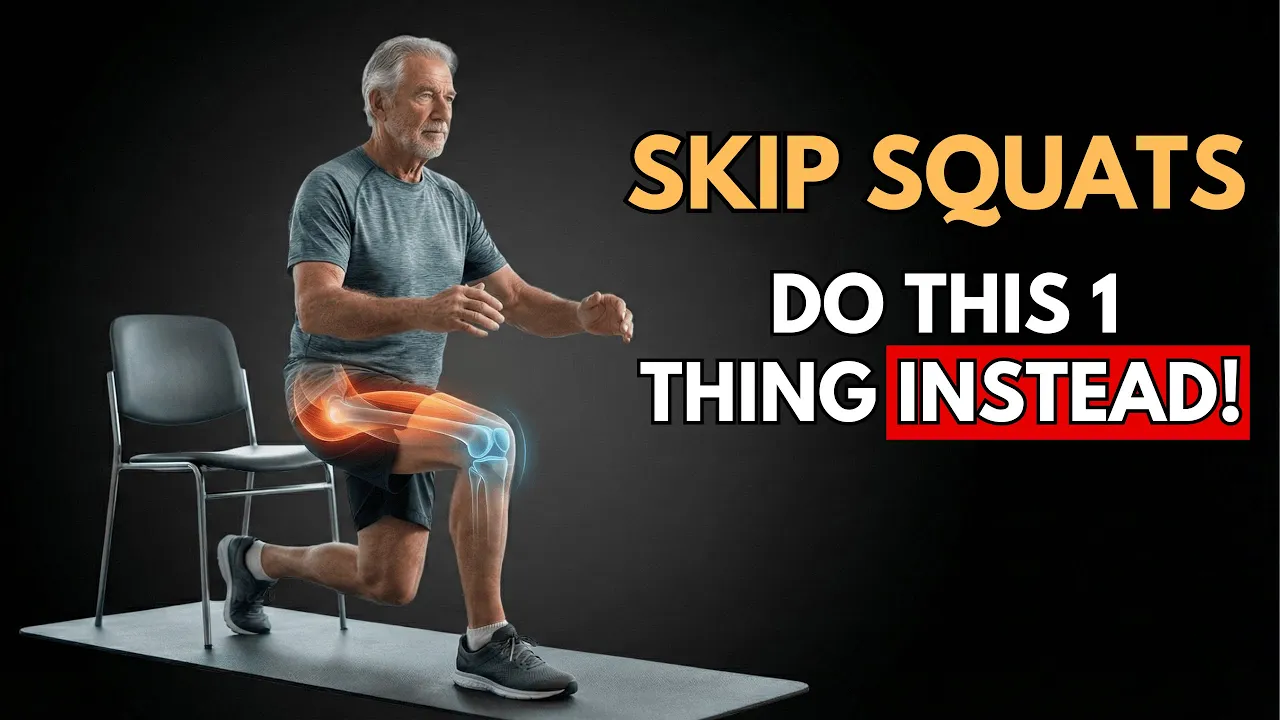
This makes the Step Back Lunge an incredibly joint-friendly way to build muscle. To execute this, stand facing your sturdy chair. The chair is there as a depth gauge and a safety net, not necessarily to sit on fully.
You step one foot back comfortably, keeping the chest high and the core braced. You then lower your hips straight down until your glutes lightly tap the chair or hover just above it. Then, and this is key, you drive through the heel of the front leg to return to the standing position.
This creates a powerful contraction in the front leg without the grinding sensation many feel when squatting. This movement teaches "deceleration. " Aging results in a loss of power, specifically the ability to stop a movement quickly.
When you lower yourself into this lunge, you are training your body to absorb force. This is the exact mechanism required to catch yourself if you trip. You are teaching your nervous system to coordinate the hip, knee, and ankle simultaneously while the center of gravity is shifting.
Start with a small range of motion; even a shallow step back activates the necessary muscles. As you gain confidence, the light touch to the chair ensures you are maintaining a consistent depth. Ultimately, maintaining strong legs after sixty is not about mimicking the workouts of bodybuilders.
It is about "training smarter. " It is about understanding that the biological priority has shifted from maximum output to maximum preservation. By utilizing the Sit-to-Stand for power, the Split Stance for stability, and the Step Back Lunge for dynamic control, you are building a body that is resilient against the specific threats of aging.
You are protecting your independence. We avoid squats not because we fear effort, but because we understand anatomy. If you apply these three principles consistently, performing them with focus and control, you will likely find that your knees feel less inflamed and your confidence in walking improves.
Please, leave a comment regarding which of these three variations you intend to incorporate into your routine first. Your feedback helps us tailor future discussions to your needs. Remember, consistency is the medication that no doctor can prescribe, but you must self-administer.