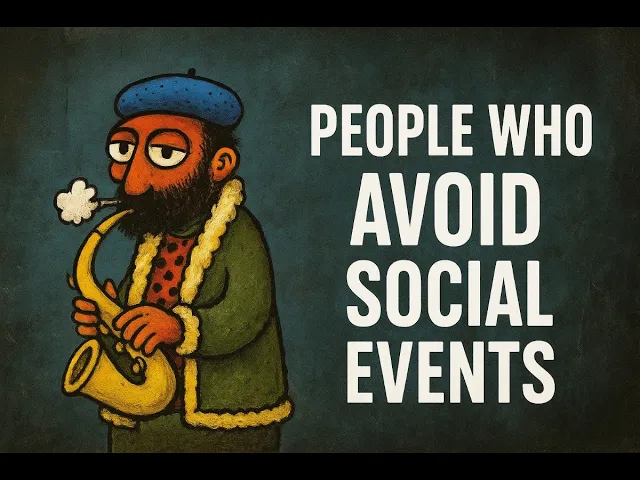
[music] There are people who don't hate people. They just can't seem [music] to stand the noise of a crowd. The chatter, the laughter, the constant need to perform.
You'll find them making excuses before a party, hesitating before replying yes to a friend's invitation. Staring at the mirror, wondering why something as simple as being around others feels like an emotional marathon. They aren't cold or arrogant or antisocial.
They just feel life differently. The psychology behind people who avoid social events isn't about shyness or disinterest. It's about protection.
It's about the quiet battle between connection and comfort, between [music] wanting to belong and needing to breathe. [music] You see, for some people, social events don't recharge them. They drain them.
Every conversation feels like another tab open in their brain. Every smile, another layer of performance. It's not that they don't care.
It's that they care too much. They pick up on tone shifts, micro expressions, energy changes. They notice when someone fakes a laugh or hides discomfort.
Their minds are wired for deep perception. And that kind of awareness comes with a cost, [music] over stimulation. Social anxiety isn't always fear.
Sometimes it's emotional exhaustion disguised as withdrawal. Psychologists have long talked about introversion. But what we often miss is that introversion isn't the absence of social desire.
It's the craving for meaningful exchange. [music] People who avoid social gatherings aren't avoiding people. They're avoiding the superficiality that often comes with large groups.
Their nervous systems thrive on sincerity. When they say, [music] "I'd rather stay in," it's not laziness. It's emotional preservation.
They need quiet not because they dislike others but because quiet is where they return to themselves. There's also something deeply psychological about why social events can feel suffocating. [music] Every group setting subconsciously triggers a primitive mechanism in our brain.
[music] The need for social safety. Humans evolved to survive in tribes and being excluded once meant literal death. So even today when you walk into a room full of people, your body still scans for acceptance.
[music] Do I fit in here? Am I being judged? For those more attuned to emotional nuance, this scanning process never stops.
The mind keeps analyzing, comparing, assessing. No wonder it feels easier to stay home. But here's the paradox.
Many of these same people who avoid social gatherings often crave deep connection the most. They want to be understood, but not crowded. They want intimacy without exposure.
They want to talk, but only when words mean something. They want to laugh, but not in the echo of small talk. This is [music] the quiet pain of the socially avoidant.
The tension between isolation and authenticity. Because it's not loneliness they fear, [music] it's disconnection in a crowd. If you've ever declined an invitation and then felt guilty about it later, you've touched this paradox.
You scroll through the pictures of the event, people smiling, lights glowing, and a small part of you whispers, "Maybe I should have gone. " But the truth is, deep down you knew it wouldn't have felt right. Not because you didn't belong, but because you would have been there in body, not in spirit.
You would have been counting down the minutes till you could leave without looking rude. You would have smiled through exhaustion. That's not belonging.
That's survival. Researchers studying emotional sensitivity found that some people possess what's called high sensory processing sensitivity. These individuals process stimuli, [music] sights, sounds, emotions more deeply than others.
Crowded environments can overwhelm them. Conversations layered over music, flashing lights, constant movement. It's not just distracting, it's painful.
Their brains literally register more information per second. To protect themselves, they withdraw. Avoidance then isn't always dysfunction.
Sometimes it's intelligence. It's the body saying, "This environment is too loud for my soul. " But society rarely understands that.
We live in a world that rewards extraversion. We praise the loud, the charming, the ones who can work the room. We see solitude as a flaw, silence as awkwardness, and reflection as weakness.
People who avoid social gatherings often grow up being told, "You need to open up more. Don't be so quiet, or you're missing out on life. " But what if missing out on noise is how they find meaning?
What if they're quiet is not a problem, but a preference? There's also a deeper psychological layer, the link between self-concept and social behavior. Many socially avoidant people have spent years in environments where they felt unseen or misunderstood.
Over time, the brain forms an association. Being around people equals emotional discomfort. The subconscious remembers rejection the same way the body remembers pain.
So when someone invites them out, their mind doesn't just see a friendly gathering. It sees a potential replay of judgment. It's not avoidance of people.
It's avoidance of emotional repetition. And yet, the most interesting thing about these people is that they are often the most emotionally intelligent ones in the room. When they choose to enter it, they listen more than they speak.
They notice details others overlook. Their empathy runs deep, but so does their fear of being drained. It's as if they hold a candle that burns brighter than most, but melts faster, too.
Every social encounter costs energy, and they measure that cost carefully. But this doesn't mean they're doomed to solitude. In fact, many socially avoidant individuals flourish in one-on-one connections.
They shine in safe environments where they can be authentic without performing. Studies show that introverts and socially anxious individuals often excel in long-term relationships because they invest deeply once they trust. They might not show up to every party, but when they do show up for you, emotionally, mentally, it's real.
Still, we can't ignore the loneliness that sometimes comes with this pattern. Avoiding social events may protect from over stimulation, but it can also isolate from opportunity. Humans are wired for belonging.
Even the most introspective souls need to feel part of something larger than themselves. The challenge lies in finding environments that feel safe enough to engage without self- betrayal. For some, that might mean small gatherings, shared passions, meaningful rituals.
It's not about forcing social behavior. It's about redefining it. In recent years, psychologists have identified something called social fatigue.
It's the emotional depletion that follows prolonged social exposure. You might notice it after a day of meetings or after hours at a party. That subtle sense of numbness as if your emotions have been stretched too thin.
For highly sensitive individuals, that fatigue arrives sooner. It's not dramatic. It's gradual.
A smile becomes heavy. Laughter turns hollow. And suddenly, you just want silence.
Not because you're sad, but because you need to return to equilibrium. People who avoid social gatherings often build elaborate rituals around this. They might arrive late and leave early.
They might volunteer to help in the kitchen, not to escape people, but to have a reason to move away from the center. They might scroll on their phone between conversations, not out of disinterest, but to momentarily retreat into control. These small actions are coping mechanisms, ways of managing the invisible pressure of social energy.
[music] And here's something we rarely talk about. Avoidance isn't always a sign of weakness. Sometimes it's a form of wisdom.
[music] Knowing your limits, recognizing your needs, honoring your nervous system. That's emotional intelligence in motion. The problem isn't that they avoid, it's that they judge themselves for doing so.
We've been taught that being social equals being successful. [music] But what if being self-aware is the real success? Still, balance matters because total isolation, while comfortable at first, slowly turns into emptiness.
The human psyche needs mirrors. People who reflect parts of us we can't see alone. Growth happens in connection, even if that connection is quiet or rare.
So, the real goal for those who avoid social events isn't [music] to become extroverts. is to find ways of being social without self- erasia. You can start small.
A coffee with one trusted friend, a walk with someone who understands silence, an online community where you can speak on your own terms. Socializing doesn't have to mean parties or noise. [music] It can mean resonance.
It can mean eye contact, shared laughter, deep [music] presence. What people who avoid social events truly seek is not isolation. [music] It's authenticity.
They aren't hiding from others. They're searching for something real enough to come out for. And sometimes they just need others to understand that.
[music] To not take their absence personally, to know that when they say, "I can't make it. " It's not rejection. [music] It's regulation.
They're not saying no to people. They're saying yes to peace. It's a quiet kind of courage.
The kind that doesn't get celebrated, but deserves to. Because it takes strength to stand against the pressure of conformity. to honor your emotional bandwidth in a world that glorifies over stimulation.
[music] The psychology of people who avoid social events isn't a story of fear. [music] It's a story of emotional economy. Every interaction has a cost and they've simply learned to spend their energy where it matters most.
[music] Sometimes the hardest thing for people who avoid social events isn't saying no. It's living with the echo of that no. The guilt that follows, the quiet wondering if they've disappointed [music] someone, if they've closed another door without meaning to.
They replay the moment in their heads trying to justify it. [music] I just needed space. I was tired.
Maybe next time. [music] But deep down, they know this isn't just about one event. It's a pattern, a rhythm their life keeps falling into.
[music] Connection calls and silence answers. What most people don't realize is that avoidance isn't born in adulthood. It begins much earlier.
Maybe it started when a child felt unseen in a room full of people. [music] Maybe they were the listener in a loud family or the quiet friend in a group of talkers. They learned that being still was safer than being loud, that watching was easier than joining.
Over time, that stillness became identity. [music] They didn't stop showing up. They just stopped being fully present.
Psychologically, this creates what researchers call emotional inhibition. [music] The tendency to suppress expression to avoid discomfort. It's not about fear of others.
It's about safety within oneself. But here's the beautiful truth. People who avoid social gatherings often carry extraordinary inner worlds.
Their solitude gives birth to creativity, reflection, and empathy [music] that can't thrive in constant noise. They are the thinkers, the observers, the writers, [music] the quiet anchors who keep balance in a chaotic world. Their silence isn't emptiness.
It's the space where meaning grows. But [music] when they spend too long there, that same space can turn into a cage, one built from overthinking, self-doubt, and imagined judgment. [music] Psychology calls this the avoidance cycle.
The more one avoids a discomfort, the more powerful that discomfort becomes. Each no feels like relief in the moment, but strengthens the association between socializing and stress. It's like closing a window to keep the noise out, but soon the air grows stale.
Breaking that cycle isn't about forcing social interaction. It's about changing what it represents. Instead of seeing social events as energy drains, they can become experiments in self-expression.
Small opportunities to [music] stretch without snapping. One of the most misunderstood traits of people who avoid social settings is that they often possess high self-awareness. [music] They notice the micro shifts in their body.
The tightening chest before entering a room. The shallow breath before speaking. The quick heart rate when attention turns their way.
That awareness if untrained turns inward and becomes self-consciousness. But with practice, it can transform into emotional control. The key isn't to mute awareness.
It's to anchor it. Grounding techniques and slow breathing, sensory focus, small mantras remind the brain, I am safe. Because much of social avoidance isn't about people.
[music] It's about the body remembering moments it didn't feel safe. And yet, the irony is this. Many people who avoid social events are some of the most emotionally generous individuals you'll ever meet.
They love deeply. [music] They remember details. They check in quietly.
They show care in ways that go unnoticed. They just struggle with the stage of [music] life. The part that demands performance.
For them, love isn't loud. It's the small text at midnight. The thoughtful gesture, the way they listen without interrupting.
[music] Their connection isn't made in the crowd. It's made in the quiet moments no one else sees. There's also an evolutionary psychology angle to [music] this.
Not everyone is designed to be the center of the tribe. In ancient social groups, balance was key. Some hunted, some gathered, some guarded.
The ones who preferred observation often detected threats, sensed emotional tensions, noticed patterns others missed. Their quiet was survival. Today, that same sensitivity translates differently.
It might mean picking up on tone shifts in conversation or reading the mood of a room too quickly. When every detail hits at once, the mind retreats to silence [music] as a defense mechanism. The modern world doesn't make that easy.
It glorifies visibility. If you're not networking, posting, or performing, [music] it feels like you're falling behind. But the truth is, social avoidance isn't laziness.
[music] It's rebellion against overstimulation. It's the body's way of saying, "I refuse to dilute my peace just to [music] be seen. " Still, peace and growth must coexist.
Because too much peace becomes numbness, and too much solitude becomes self-erat. The goal isn't to fight the need for quiet. [music] It's to find connection that doesn't break it.
In therapy, there's a concept called graded exposure. It means taking small, manageable steps toward what feels uncomfortable. [music] Not to eliminate sensitivity, but to expand tolerance.
For someone who avoids social gatherings, that might mean attending for 15 minutes, then leaving guilt-free. It might mean calling a friend instead of meeting in person. The point isn't to force change.
It's to prove to the nervous system that connection doesn't always mean danger. Slowly, the body learns a new story. I can handle this.
But let's [music] go deeper. Why does it feel so emotionally heavy to simply exist around others sometimes? [music] Because social settings mirror us back.
Every interaction reveals something about who we think we are. When someone laughs and we don't know why, we feel separate. [music] When others bond over shared energy, we feel out of rhythm.
That dissonance reminds us of our inner distance, the gap [music] between the self we show and the self we are. The more authentic a person is, the wider that gap can feel in environments built on surface [music] connection. So the avoidance in many ways is a refusal to fragment.
[music] It's saying I won't split myself just to belong. That's not dysfunction. That's integrity.
But integrity can be lonely because the world often mistakes stillness for absence. The people who avoid social events aren't always missing. They're just elsewhere rebuilding their emotional energy, thinking deeply about things no one asked them [music] to think about.
They're replaying conversations, analyzing meaning, wondering if they were understood or if they overstepped. [music] They live in the aftertaste of interaction. Long after the event is over, their minds are still there, sorting, [music] processing, reflecting.
That's the cost of awareness. Yet in that same depth lies beauty. Because when they do connect, it's profound.
[music] Their conversations feel like shelter. Their attention feels sacred. You [music] don't need to fight for their interest.
When they're with you, they're truly with you. They give what most social butterflies can't. Undivided presence.
[music] They don't flit from person to person. They root into meaning. They're not chasing validation.
They're searching for resonance. [music] For many of them, healing begins with reframing solitude, not as escape, [music] but as a tool. You can love quiet and still crave connection.
You can enjoy isolation [music] without disappearing. Balance isn't found in constant exposure. [music] It's found in knowing when to step forward and when to step back.
When you start to see your own patterns without judgment, [music] avoidance becomes awareness. You begin to make choices, not out of fear, but out of alignment. The world doesn't need everyone to be loud.
[music] It needs listeners. It needs the people who feel the temperature of a room before anyone [music] speaks. It needs the ones who say less but mean more.
Social avoidance, when understood, can evolve into social wisdom. The ability to engage deeply, not frequently, because depth, not noise, is what creates real human connection. [music] And maybe that's the hidden truth behind this entire psychology.
The people who avoid social events aren't rejecting the world. They're longing for a version of it that feels real. A world where they don't have to filter themselves into bite-sized pieces [music] just to fit in.
A world where silence isn't awkward. Where eye contact replaces small talk. Where emotion is allowed to breathe.
[music] Until they find that world, they build it in their solitude. And sometimes that's the most honest kind of living there is. [music] Because one day when they do walk into a room again, they'll do it differently.
They'll no longer be trying to blend in. They'll simply arrive quiet, [music] grounded, whole, and the people who notice them will feel it. That presence that doesn't need attention, that [music] calm that doesn't seek approval.
That's the power of those who once avoided, they return with depth. [music] And maybe that's the lesson for all of us. Connection doesn't begin in the crowd.
It begins in solitude, [music] in learning yourself deeply enough to show up as someone real. When you understand your own silence, you finally have something worth saying. [music] When you honor your own space, you finally have room to let others in.
The people who avoid social events aren't broken. [music] They're building the kind of peace that makes real connection possible. And when they finally do connect, it's not performance, it's truth.