What will the 21st century economy face as crucial adversities in a post-pandemic scenario ? How to mitigate the effects caused by unbridled capitalism? What will have to be done to guarantee all citizens access to their basic needs , such as adequate food and education - however, without harming future generations, and what about Ecosystem protection measures?
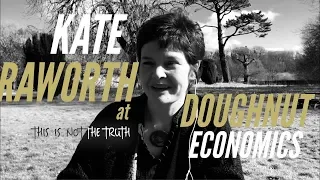
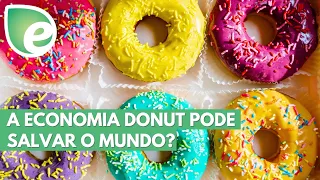
Faced with profound and relevant issues like these, economist Kate Raworth introduces us to Donut economics! The Donut economy takes into account current issues such as: extinction of natural resources , social inequality and global warming. Kate Raworth, philosopher, economist and professor at the Amsterdam University of Applied Sciences, also teaches at Oxford University.
In a simple way, it explains why it is necessary to review and update some concepts of traditional economics . In this way, she introduced the world to Donut Economics - which brings, in its essence, the rethinking of the economy in the 21st century. Co-founder of the Doughnut Economics Action Lab, works in partnership with agents of change, aiming through its conception to implement an innovative action, which defends an economic model that balances essential human needs.
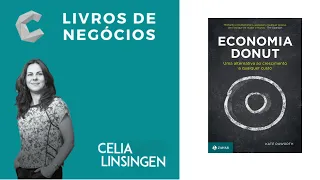
Kate wrote a book titled, “Donut Economy: An Alternative to Growth at Any Cost,” which soon became a bestseller, and has now been translated into 18 languages. Growth is a healthy and wonderful face of life. .
. Let me show you with my hose - here is the natural growth curve; things grow. And then you could say that some countries are down here on this growth curve, and they need to grow, to ensure that every person has health, education, housing, energy and transport, we need to see the economy grow.
But at some point maybe my country and other high-income countries are up here, although they are trying to grow, in fact they should mature. Brazil - where is Brazil? Somewhere along that line, and I think it's a very big question, the challenge is that all countries are really trying to do this.
Each country is structurally dependent on income, on a GDP (Gross Domestic Product), growing non-stop. And the cost of that is what governments are doing to sustain that growth. For the GDP to continue growing, governments break environmental laws in order to open them to the markets.
Sometimes they bypass health or labor regulations to increase revenue. So we always have to ask: if we are looking for growth, for what, and for whom? Who benefits from it?
And at what cost to other people, and at what cost to the planet? The concepts of Donut Economics were first observed in his 2012 article – “A healthy and fair space for humanity” (“A healthy and fair space for humanity”). Raworth propagates a reassessment of the parameters of Economic Science.
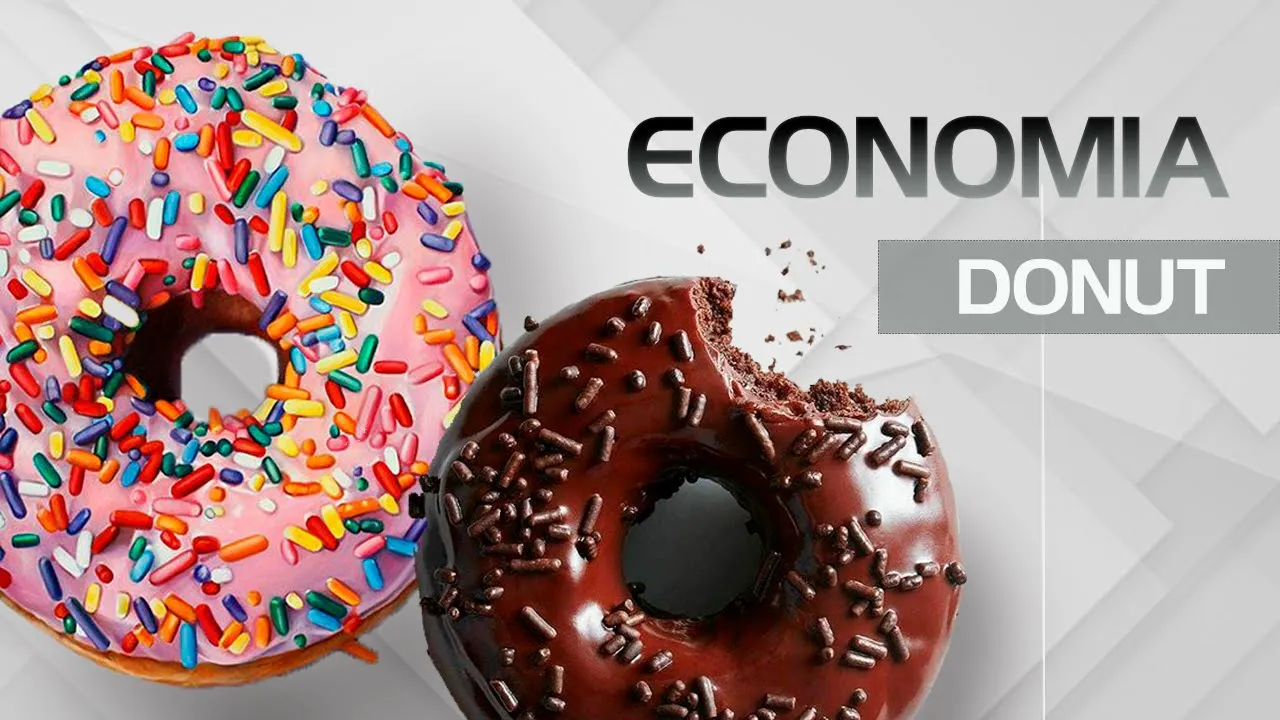
In 2021, Kate was appointed to the World Health Organization 's Council on Health Economics for All, by its president, and also professor of economics in the discipline of Innovation and Public Value, at University College London, Mariana Mazzucato. The philosopher was also nominated for the Audie Award for Business 2020 for her book. Raworth described the “Donut Theory” through the report by Daniela Chiarretti, carried out in the Valor Econômico newspaper of São Paulo, on 04/28/2020: ” inspired by the famous popular US sweet, with sugary and fried dough.
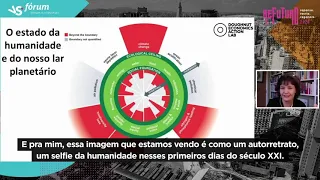
In allusion to the middle of the Donut, which is empty, it claims that “no human being should be after the environment” and “it is being filled first with basic needs” such as water, food, health, housing, work and income. According to Kate, the juiciest part of the Donut is what she considers a fair and safe space for humanity. On top of that, there is the ecological ceiling and the limit imposed by the earth's natural resources , and nothing must exceed it.
Therefore, society's mission, according to Raworth, would be to engage in issues such as: loss of biodiversity, destruction of the ozone layer and pollution. Given this, it is necessary to implement a regenerative and distributive economy, which will lead to less social inequality. The concepts proposed by the economist are already being applied by companies around the world, and in the Dutch capital.
The theory of Donut Economics, expounded by Raworth, and embraced by Marieke Van Doorninck, mayor of Amsterdam, is based on sustainable growth. Its methodology seeks to balance the economic needs of countries, cities and people, and the available environmental resources, including the questions “Amsterdam loves being a pioneer city; we have to transform the linear economy into a circular one so that resources are used over and over again, more consciously and slowly. We are using garbage from food, plastic, metals, paper.
We have been using the “donuts” I created as a starting point for a big vision of the city's future, and this has to spread to tomorrow and be part of people's lives”. Kate also details the situation in Brazil and raises questions about the country's future: “Brazil is known for being one of the largest countries with levels of inequality in the world. We need to transform this dynamic in countries, and create more distributive economies at its core.
This starts with investing in health and education for every citizen. And who runs businesses? How can workers earn more where they work?
How are we going to share land and make sure there is access to housing? These are very deep questions about how best to distribute an economy's returns . Pursuing growth alone does not lead to this.
” However, there are people who are inside this social vacuum, that is, outside the circular economy, outside the planetary limits. From this comes the understanding that this population must be brought into this economy - within products, services, governments - thus achieving integration for this part of the Donut. (.
. . ) Hunger map, based on the IBGE Family Budget Survey (POF), released on September 17, which refers to the years 2017 and 2018, identified that the total number of people with sufficient adequate food in Brazil it is the lowest in the last 15 years, it is worth remembering that everything happens shortly after the country finally leaves the United Nations' hunger map, an achievement that was applauded worldwide in 2014, according to the new survey 10.
3 millions of Brazilians were hungry during the survey, this is an increase of 3 million people without normal access to meals in just 5 years. . .
this count (. . .
) It is clear, with this, that countries with the magnitude of Germany is already beckoning positively to this possibility - that the Donut Economy can add to the environmental, economic and social development of the European Union. This model presented by professor Kate shows us limits, which are minimum and maximum, in a post-covid19 scenario, which can be adopted in front of the graphs where, according to the donut economy idealizer, they point to this scenario of possible recession. More than ever, this is, above all, the economy of the 21st century, according to Kate, must be attentive to Environmental, Social and Governance (ESG) (Environmental, Social and Corporate Governance ), and to commitments to social and environmental responsibility , as well as effective measures linked to ISOs 14000 and 14001, paying close attention to planetary and environmental limits, such as ocean acidification, chemical pollution, freshwater withdrawal, land conversion and biodiversity loss.
Such measures, according to the economist, will guarantee the social foundation, and the minimum necessary for a person's survival, that is, water, food, health, education, income, work, peace, justice, political voice, social equality and gender, housing, networks, energy etc, as prescribes in his theory of Donut Economics.