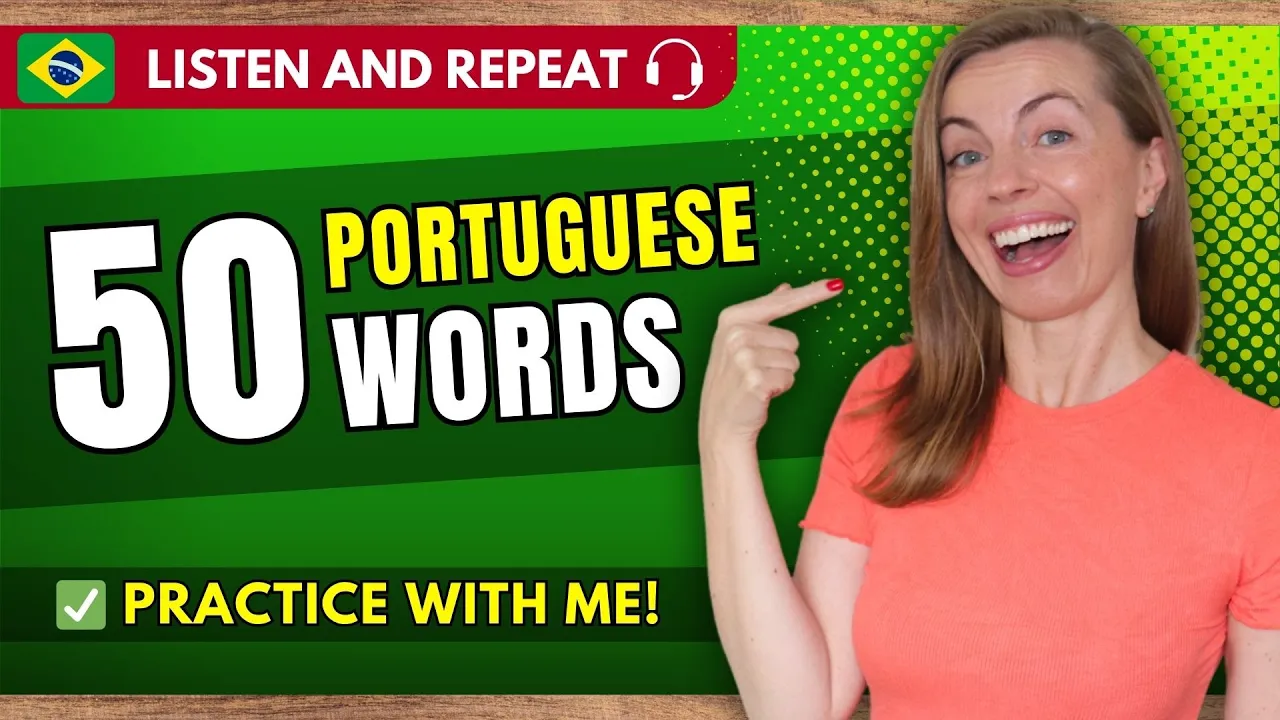
Are you curious about the most essential language-related words Portuguese learners should know? If you are, I invite you to join me. And if you are new to our channel, subscribe.
. . .
. . and catch up on the lessons you have missed.
Hello, everyone! Today you will learn 50 key words that are essential to anyone learning a foreign language. It is important that you repeat the words after me and the given examples.
So, let's begin. (Foreign language) 'Língua estrangeira' means foreign language. Our example.
I study a foreign language. (I study a foreign language. ) (Language) 'Idioma' means 'language'.
It doesn't mean 'idiom'. (Language) Portuguese is a beautiful language. (Portuguese is a beautiful language.
) (Dialect) 'Dialeto' means 'dialect'. Brazil has many dialects. (Brazil has many dialects.
) (Accent) 'Sotaque' means 'accent'. Your accent is beautiful. (Your accent is beautiful.
) (Native speaker) 'Falante nativo' means 'native speaker'. Practicing with a native speaker is great. (Practicing with a native speaker is great.
) (Alphabet) 'Alfabeto' means 'alphabet'. Learning the alphabet is important. (Learning the alphabet is important.
) Louder! (Learning the alphabet is important. ) (Vowel) 'Vogal' means 'vowel'.
Portuguese has oral and nasal sounds. By the way, below is the link to a lesson on that. (Portuguese has oral and nasal vowels.
) (Consonant) 'Consoante' means 'consonant'. B is a consonant. (B is a consonant.
) (Letter) 'Letra' means 'letter'. The letter X has five different sounds. Yes, it does.
Link to it is below. (The letter X has five different sounds. ) Repeat.
(The letter X has five different sounds. ) (Word) 'Palavra' means 'word'. What’s the word for ‘sentence’?
(What’s the word for ‘sentence’? ) (Sentence) ‘Frase’ means ‘sentence’. Is this sentence correct?
(Is this sentence correct? ) (School) ‘Escola’ means ‘school’. I study Portuguese at school.
(I study Portuguese at school. ) (Student) ‘Aluno’ means ‘student’. I am a good student.
So, if you are a man, say. . .
(I am a good student. ) Now, if you are a woman, … (I am a good student. ) (Teacher) ‘Professor’ means ‘teacher’.
Are you a Portuguese teacher? So, if you are asking a man… (Are you a Portuguese teacher? ) Now if you are asking a woman… (Are you a Portuguese teacher?
) (Class) ‘Aula’ means ‘class’. We have Portuguese class today. (We have Portuguese class today.
) (Course) ‘Curso’ means ‘course’. The Portuguese course lasts two years. (The Portuguese course lasts two years.
) It is important that you repeat after me in both moments. When I speak more slowly and when I speed things up. Next.
(Question) ‘Pergunta’ means ‘question’, as in. . .
Excuse me, I have a question. (Excuse me, I have a question. ) (Answer) ‘Resposta’ means ‘answer’.
What’s the correct answer? (What’s the correct answer? ) (Book) ‘Livro’ means ‘book’.
Can you suggest me a book to learn Portuguese? (Can you suggest me a book to learn Portuguese? ) (Notebook) ‘Caderno’ means ‘notebook’.
I write in my notebook. (I write in my notebook. ) (Dictionary) ‘Dicionário’ means ‘dictionary’.
I often use a dictionary. (I often use a dictionary. ) Repeat.
(Meaning) ‘Significado’ means ‘meaning’. What is the meaning of this word? (What is the meaning of this word?
) (Translation) ‘Tradução’ means ‘translation’. Is the translation correct? (Is the translation correct?
) Before we continue, don't forget to give the lesson a thumbs-up. That helps the channel a lot! Moving on.
(to read) ‘Ler’ means ‘to read’. Reading aloud help to learn. (Reading aloud help to learn.
) (to write) ‘Escrever’ means ‘to write’. Writing helps to learn. (Writing helps to learn.
) (to speak) ‘Falar’ means ‘to speak’. I need to speak more. (I need to speak more.
) (to listen) ‘Escutar’ means ‘to listen’. Listen carefully. (Listen carefully.
) (to ask) ‘Perguntar’ means ‘to ask’. What did you ask? (What did you ask?
) (to answer) ‘Responder’ means ‘to answer’. How can I answer that question? (How can I answer that question?
) (to practice) A very important verb. (to practice) ‘Praticar’ means ‘to practice’. I practice Portuguese every day.
(I practice Portuguese every day. ) (to repeat) ‘Repetir’ means ‘to repeat’. Can you repeat, please?
(Can you repeat, please? ) (to spell) ‘Soletrar’ means ‘to spell’. Can you spell your name?
(Can you spell your name? ) (to memorize) ‘Memorizar’ means ‘to memorize’. Memorize this word.
(Memorize this word. ) (to memorize) ‘Decorar’ besides ‘to decorate’, also means ‘to memorize’. Memorize this word.
(Memorize this word. ) (to point) ‘Apontar’ means ‘to point’. If I don't know a word, I point.
(If I don't know a word, I point. ) (to draw) ‘Desenhar’ means ‘to draw’. If I don't know a word, I draw.
(If I don't know a word, I draw. ) (Reading) ‘Leitura’ means ‘reading’. I need to improve my reading skills.
(I need to improve my reading skills. ) (Writing) ‘Escrita’ means ‘writing’. How can I improve my writing skills?
(How can I improve my writing skills? ) (Speaking) ‘Fala’ means ‘speaking’. I practice speaking every day.
(I practice speaking every day. ) (Listening) ‘Compreensão auditiva’ means ‘listening’. Listen to songs to improve your listening skills.
(Listen to songs to improve your listening skills. ) (Vocabulary) ‘Vocabulário’ means ‘vocabulary’. How can I boost my vocabulary?
(How can I boost my vocabulary? ) (Grammar) ‘Gramática’ means ‘grammar’. But don't worry!
Plain Portuguese has lots of videos on grammar. (Plain Portuguese has lots of videos on grammar. ) Repeat.
(Plain Portuguese has lots of videos on grammar. ) (Exercise) ‘Exercício’ means ‘exercise’. These exercises are useful.
(These exercises are useful. ) Give the lesson a thumbs-up! Dont forget it!
(Pronunciation) ‘Pronúncia’ means ‘pronunciation’. My pronunciation has improved. (My pronunciation has improved.
) (Practice) ‘Prática’ means ‘practice’. Practice makes perfect. (Practice makes perfect.
) (Conversation) ‘Conversação’ means ‘conversation’. Does anyone want to practice conversation in Portuguese? (Does anyone want to practice conversation in Portuguese?
) (Language exchange) ‘Intercâmbio de idiomas’ means ‘language exchange’. Join a language exchange. (Join a language exchange.
) (Partner) ‘Parceiro’ means partner. Find a language exchange partner. (Find a language exchange partner.
) (Studies) ‘Estudos’ means studies. I take my studies seriously. (I take my studies seriously.
) (Routine) ‘Rotina’ means ‘routine’. I have a study routine. (I have a study routine.
) Repeat. (I have a study routine. ) Now if you want to learn the most commonly used verbs in Brazilian Portuguese, I am positive you will enjoy that lesson.
Watch it and tell me later what you learned from it. Thank you very much for watching another lesson. See you next time.
Tchau!