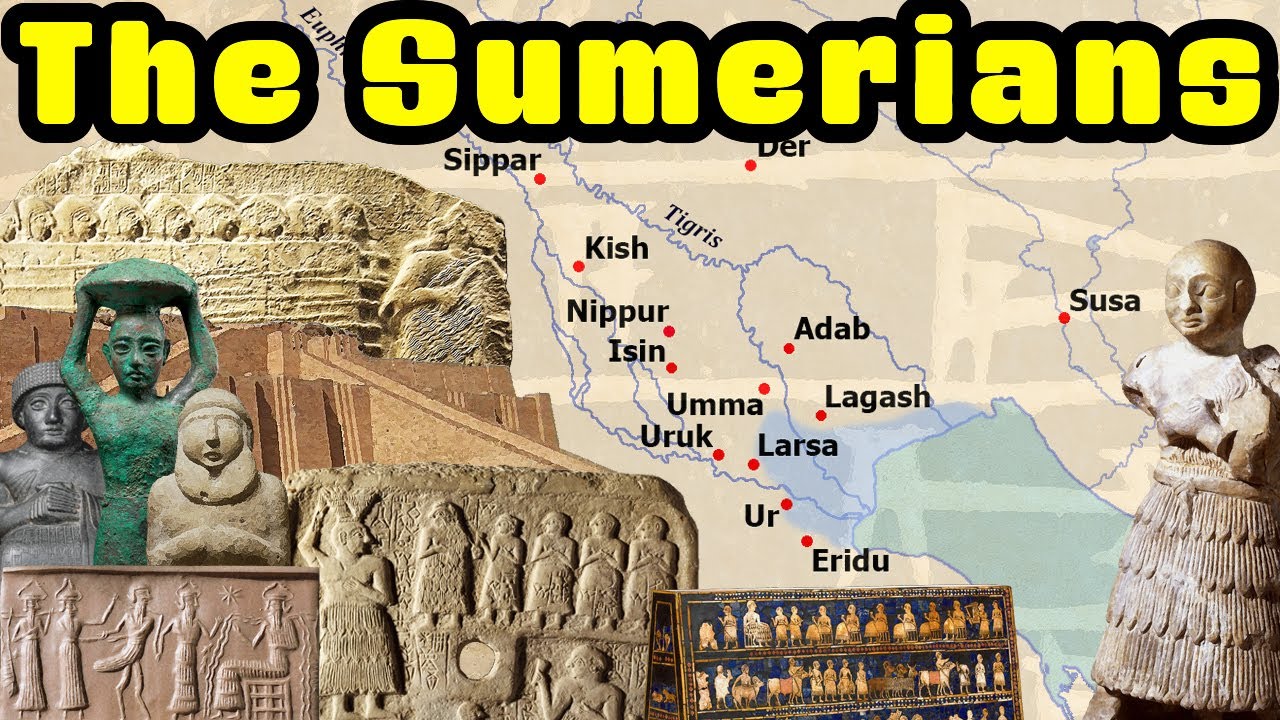
all right everybody um we are going to start our new unit today um on the ancient mediterranean so we're going to be focusing primarily on these civilizations that are surrounding what is now called the mediterranean sea so one of the first areas that begins to be populated by these more concentrated human populations is called mesopotamia so starting around 3 500 bc east that's 5500 years ago um we had these um city-states beginning to take root in modern-day iran and iraq we refer to this area as the fertile crescent it's it's somewhat of a crescent shape
there's plenty of water sun and natural resources in these areas you'll also notice that there is a proximity to salt water as well as fresh water we have the tigris and euphrates river in particular right here that are making this area have very rich soil that's perfect for farming and early agriculture so the coastline used to be a little bit further out the coastline has since receded in any case this is where we see a lot of what are what is acknowledged now to be human kinds first so we see the first known writing here
we see the first known cities and urbanization um organized religion of organized laws in government we see the use of the wheel and we also see agriculture so there's a lot of really important stuff that's happening in this area so there were many many different civilizations and groups that occupied this area we focus on four of them in apr history sumer babylon assyria and persia so what you have to imagine is that in this area thousands of years ago like people were looking for places that were relatively easy to farm they weren't going to like
start a civilization in the middle of the desert and then bring stuff there that doesn't make sense so what they did is that they they fought over these areas with with lots of natural resources and because of these resource-rich areas and the relative scarcity of them like you're going to see civilizations taking over the same areas over and over and over again particularly in ancient times ancient mesopotamia is known for all of these like successive civilizations building on top of one another so we're seeing these vast empires that are constantly changing names borders and hands
so um just to give you a little bit of background and to connect you to the global prehistory curriculum these are some of the transitions that we're seeing from global prehistory um basically we're focusing more on humans and human activities and art we're seeing city-states um and then we're also seeing people that are going beyond creating art for art's sake this is really important we have these and we have this this division of labor that is happening when you urbanize and you have a bunch of people that are creating city-states it is no longer necessary
for everybody to be a farmer um what ends up happening is that there's a class people that are farmers and they produce enough food for everybody as well as enough surplus to trade with other neighboring communities so that they can obtain materials that are not local to the area so what happens is that we end up getting the division of social classes and ultimately people in the upper classes notice that there's a couple of talented individuals that can represent their likeness in statues or paintings etc and they capitalize upon this ability to create images of
themselves and to create these narratives that basically assure and guarantee their power so we're going to see lots and lots of images of rulers kings etc and deities so the first of these civilizations is sumer so sumer is known for creating these complex irrigation system they basically created these channels um in the earth to get water from the euphrates river to flood these these areas so that they didn't have to like carry water from one water source to the field so it was particularly ingenious again we have a specialization of labor because some people are
farming not everybody needs to be focused on food so we have some people that are specializing in creating art or some that are occupying administrative roles um so there were several independent city-states within kind of like the mini kingdom of sumer um each of which was under the protection of one or more deities so we have an organized polytheistic religion so members of the ruling task were typically um or the ruling class were typically tasked with carrying out the god's divine wills um most of these mesopotamian civilizations are operating under a theocracy so basically you
have the gods and then you have a small number of people that communicate with the gods and they're basically playing telephones saying okay the god shame ash wants us to do this so we're gonna do this thing now so two archaeologically significant sites that are mentioned in the ap curriculum are er and uruk so you'll notice again that the these river systems are providing like the backbone of this super important area right here so the sumerians built these gigantic temple complexes from mud brick there is not a lot of stone that is naturally occurring in
this geographical region which is why a lot of the larger edifices are made out of mud brick so mudbrick is great the only problem though is that it is particularly susceptible to crumbling because it's mud you add water to mud brick and it turns back into mud so unfortunately a lot of the edifices from this time period are severely worn down or no longer exist however um even though there wasn't that much stone there was a lot of there were a lot of trade networks that were bringing in these other materials from faraway lands so
things like stone we also have semi-precious minerals including lapis lazuli from afghanistan and then from places like lebanon we're getting lots of different kinds of wood the sumerians are also credited with creating the first known writing system which is called cuneiform so cuneiform we we don't really what's what's funny about uniform is that most of the stuff that comes down to us is bookkeeping records basically saying like person a traded this with person b like it's a lot of it's not like particularly interesting um however there are a couple of like stories and fables and
narrative that have been passed down through cuneiform but most of the stuff that is found is basically like this is what this person traded for that there are also the cylinder seals that were made that could basically be rolled into clay to authenticate um a trade agreement or some other such item they're particularly commonly found in burial sites um there's also a lot of evidence that the sumerians enjoyed recreation and entertainment there's um a lot of stories um the most famous of which is the epic of gilgamesh and then there have also been musical instruments
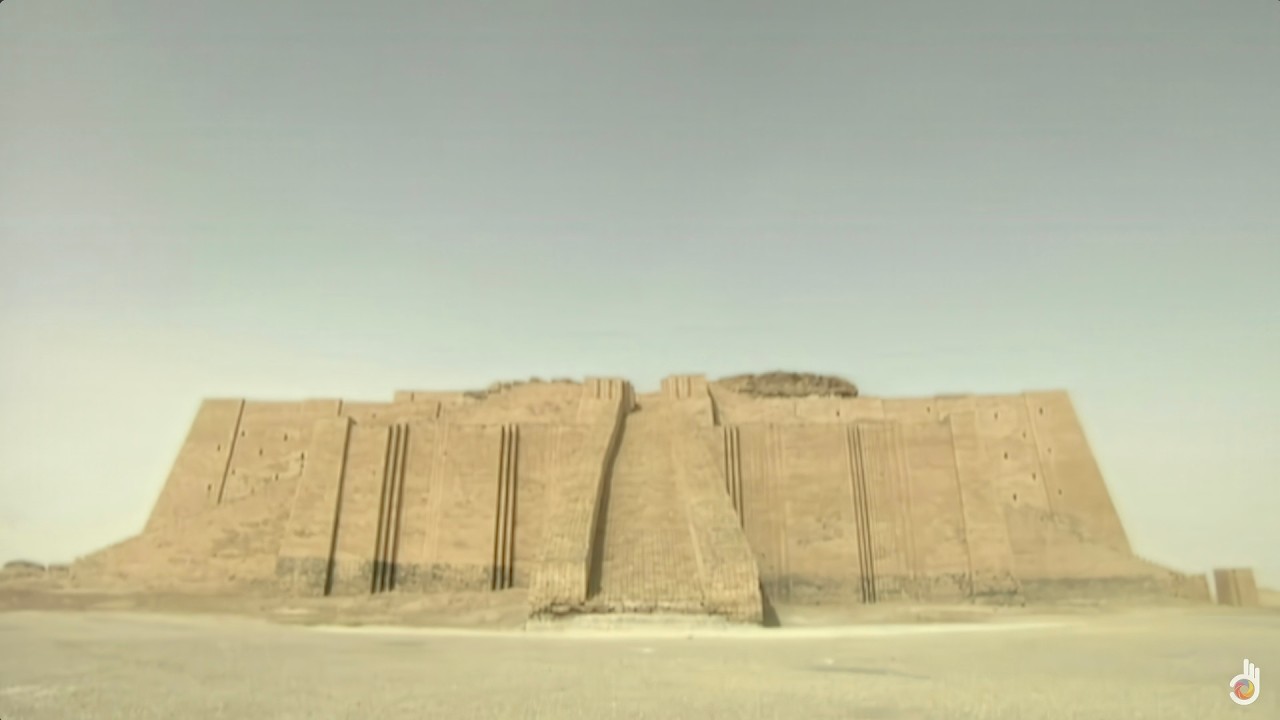
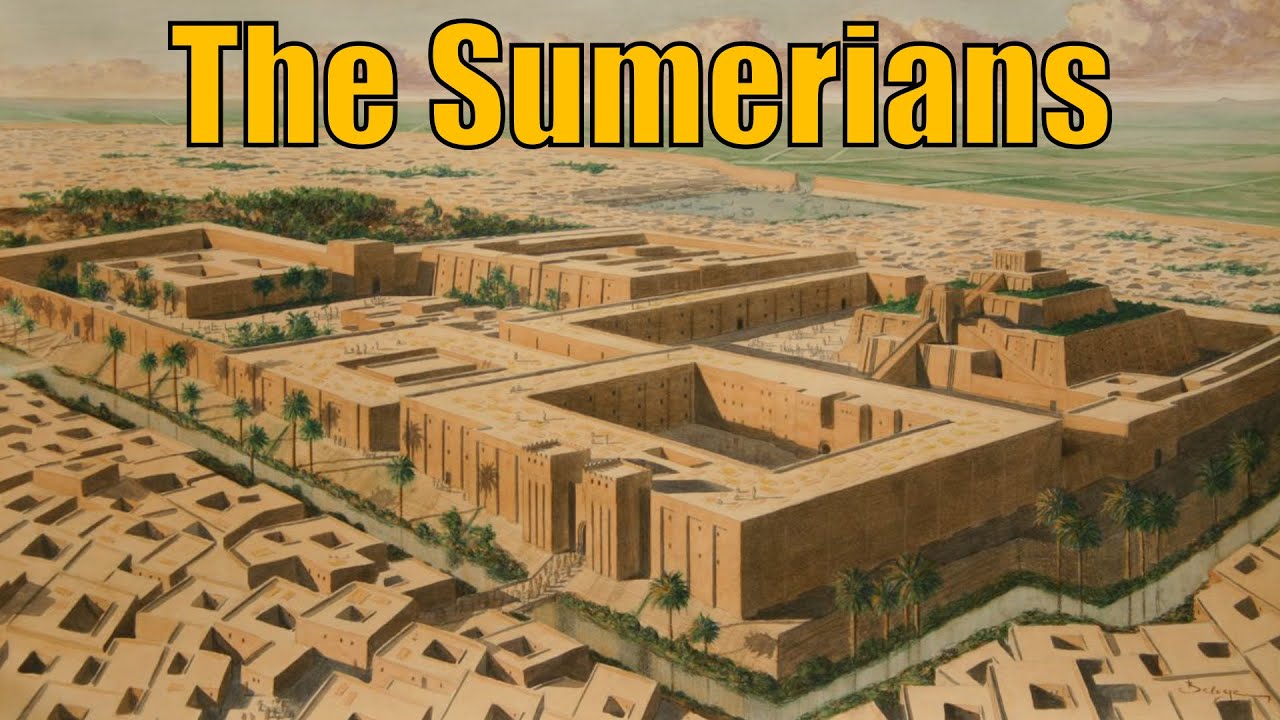
found in burial sites so this is an example of a harp so this is our first ap artwork of the unit it's referred to as the white temple and ziggurat so um this is something that students get confused a lot the ziggurat is this mud brick thing like this platform that's being created the temple is the thing at the top so what it remains today are the foundations of the temple and the um kind of like the worn away remains of the ziggurat so the city of uruk was again one of these architecturally significant sites
in ancient sumer uh and the city of uruk was said to have been protected by the sky god anu so he was kind of like the roughly the sumerian equivalent of zeus so it was this elevated structure about 40 feet tall at its zenith that was built in the center of the city so that anu could descend and then communicate with the royalty and clergy in the temple so remember that this is a theocracy a theocratic government so there's a couple of people that are permitted to enter the temple and commune with the gods so
the temple itself is modestly sized this is not a place for congregational worship like we're used to and a lot of the monotheistic religions that are practiced today this is not like a church um this is not a like a like a mosque it is a very kind of like small more private and exclusive area for a certain member of a certain kind of like stock of the ruling class so the temple was once coated with bitumen which is sort of this waterproofing tar-like cement which made it this gleaming white inside and out so the
inner temple or the temple also created or contained a cella or an inner area that had several rooms and each of these rooms was somewhat private and it's there where the members of the ruling class would sit and then basically wait for the gods to manifest before them and tell them what to do so another interesting feature of the ziggurat is that it had tapered sides it's a little bit difficult to see in this image right here but if you look in this image you can see that like the sides are not per exactly perpendicular
with the ground they kind of go at an angle so you might recall that this is made of mud brick so if water sits on the surface too long the entire structure is going to collapse in on in on itself so there were actually these slats that were carved into the sides of the ziggurat and these tapered sides to encourage the water to slide right off when it rained there was also this terrace on the outside um of the ziggurat right here that was large enough to conduct outdoor rituals there are some figures here in
this reconstruction to give you a sense of the scale and what the temple may have looked like we don't even know if it had a roof or not like the only thing that remains are a couple of the foundations so this is entirely speculative these are examples of votive offerings that you might have found in these architecturally significant areas or these archaeologically significant areas um these are made of gypsum so a lot of times again stone in this particular context had to be imported from elsewhere so it cost a lot of money to get something
like this commissioned so hundreds of these kinds of statues have been found in temples these in particular were found buried beneath the floors so most of them are between one and two feet high a couple of them are around 30 inches high they were usually commissioned by donors to be placed in temples to pray for them in their absence so again we when we talk about like the white temple and ziggurat like not the average person is not allowed to enter this temple so oftentimes they would commission these proxies to pray in their place so
the ins there is usually an inscription at the base in cuneiform that would say something like it offers prayers um or it would have the name of the patron who commissioned the sculpture so there is some evidence that these statues were designed in the likenesses of their patrons there are a couple of distinguishing features between all of the the male appearing statues for example it's not like they're carbon copies of each other um each of these statuettes has their hands classed in a praying position um or close to one another and almost all of them
have this beaker like some sort of glass that they that is usually for the purpose of libation so libation is like a ritual hand washing or ritual pouring of water there's some negative space that has been carved out between the legs and sometimes you'll see it between the arms as well this is something that's a bit of a departure from a lot of the prehistoric statuary that we've seen this is a little bit more difficult to do and it requires more precise tools so this is a pretty significant development you'll see in a lot of
ancient mesopotamian art that the men have these really long rippling beards they oftentimes also wear these knee-length skirts women on the other hand have these robes that usually cover one shoulder so what you also notice when you look at these figures is that they have these extremely large eyes um so it's not like people from ancient mesopotamia had gigantic eyeballs as far as we know a lot of people theorized that the eyes were made large in these statues to symbolize eternal wakefulness so this statue was always there and it's always awake and it's always devoting
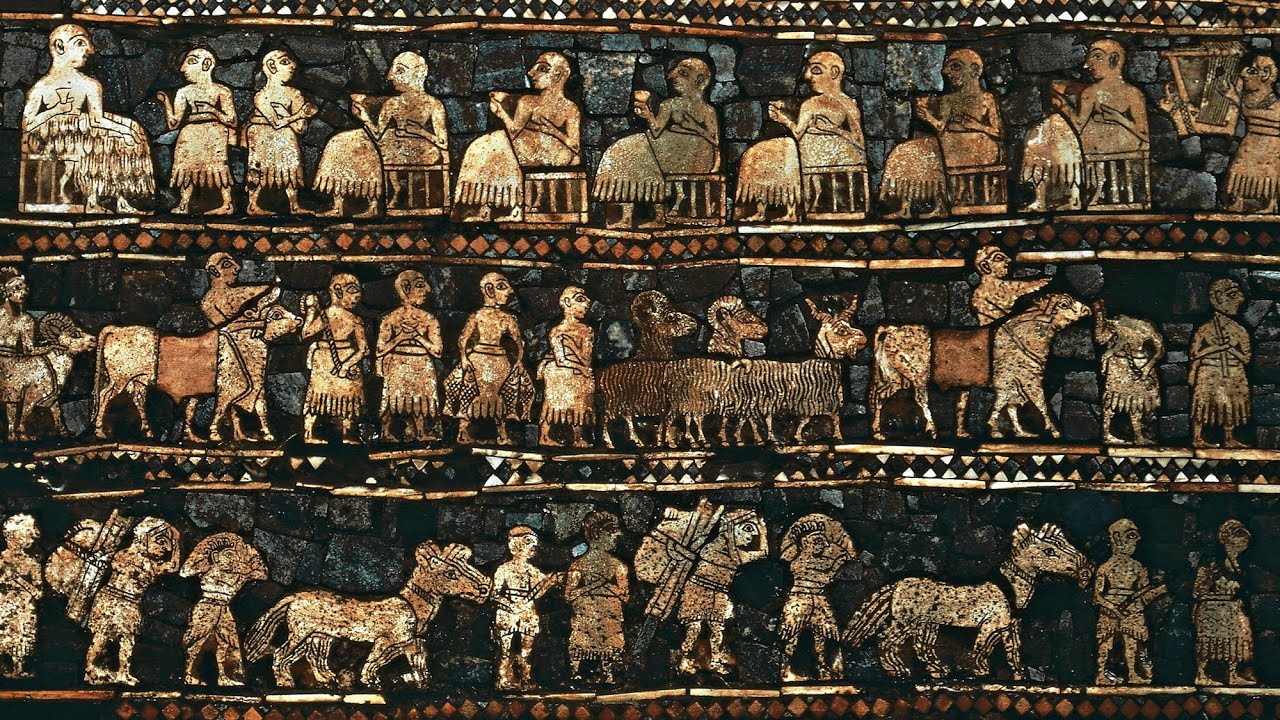
itself to prayer our next piece is called the standard of er this piece was actually found in a royal cemetery in the royal tombs at ursa there were distinct social classes and if you were a really important person then you were buried with lots of cool stuff um oftentimes the super rich and powerful would have servants sacrificed and then buried with them so that they could have people do stuff for them in the afterlife excuse me so this may have been a standard which is basically an image that is stuck on a pole and um
carried during a military procession there's also um some resemblance to a musical instrument so if you look at the uh the heart from back here they usually have this box shape as a base to them so it could have been a bass drum musical instrument as well so this piece was certainly not the most lavish thing found in the tombs but it is historically significant in that it shows a narrative it was made from very expensive imported materials including red limestone and shell as well as limestone shell and lapis lazuli which is this blue in
the background so this stuff was not stuff that would occur naturally in the geography of this land so it had to have been imported from elsewhere which demonstrates evidence of extensive trade networks during this time so the standard of er is not particularly long it's about 20 inches long and it displays this narrative in registers so a register is basically a a narrative band so there are three registers in this image right here the register here a register here and a register here so we're going to see this term over and over again in in
ancient art because it's a pretty frequently occurring narrative format so this particular narrative reads from bottom to top and there are two sides we have one side that is frequently referred to as the war side which is this one right here and then the other side is referred to the peace side so on the war side we basically have this narrative of the sumerian king and of course he is the tallest and most central figure in this narrative um that is dismounting from his fancy chariot to inspect these prisoners that have been seized so basically
um the the first thing that is happening is this conquest right here we have the this individual here in a chariot that is running over prisoners and then the ones that are that survive are basically stripped and then taken to the king on the peace side we basically have preparations for a feast we have all of these these fancy items perhaps war booty um or things that were seized seized from the conquered people that are being brought to like in a procession to the palace and being prepared for entertainment on the very top again the
king is the very tallest and the very largest figure he is sitting and he's still taller than everybody else in this narrative right here and then we also have some entertainment here there's a guy with a harp so um you'll also notice that the um figures and the animals are in twisted perspective which is again this this arrangement of the figures where you're seeing like composite features it's not like a natural way for figures to be occurring in so i have the war and the peace sides um zoomed in for you here so that you
can see them a little bit better so again here's the king here's a chariot with wheels which is an important development at this point in time what's really interesting is this bottom register right here i was reading recently and somebody noted that like these mules right here or horses some sort of weight-bearing animal like their their gates like the distance between their legs increases so we have them kind of like walking here and then they're moving their way up to a gallop and the the gate is getting wider and larger so there's almost like the
suggestion of motion that is happening where they're starting out slow and then they're trotting and then they're getting faster so it could be that this is like four separate like instances of of people on chariots or it could be like this is step one this is step two this is step three and this is step four and these are the same figures um so whenever we see this like continuing um action where there's a suggestion that like we're seeing the same figures over and over again this is called a continuous narrative so basically think of
it as a comic strip without the divisions between the sequences to show a progression of a narrative so we'll see this pretty frequently in art history so keep that term in mind here's the p side here again is the king and then here's the entertainment again you'll notice the use of twisted perspective you're seeing both feet when the figures are seated you're also seeing the face in a profile view everything except for the eyes which are shown from the frontal view unfortunately some of the inlay has been lost here but a lot of the details
still remain so we don't really cover the acadians um but i wanted to bring up this statue because it shows evidence of a couple of things that are really important at this time one of which is the use of metal casting so and that wasn't really that wasn't really evident in any of the works from this unit so i wanted to include it to show you that people have been using metals um to create artwork as well as weapons for for thousands of years including in mesopotamia so this was an image that was likely of
an acadian ruler you'll notice that it's not in the state that it would have would have been made for intentionally you can see especially from the frontal view that the eyes have been gouged out and it's a little bit more subtle but the beard has also been snapped off too so again this is a pretty like this isn't this is a time that's fraught with conquest and people taking over the same lands um and lands exchanging power and changing names over and over again over the course of thousands of years so there's a lot of
violence that's happening um and particularly when a ruler is usurped um or there's a coup or he is overthrown in some way oftentimes a lot of the images that bear his likeness were destroyed um or if they were particularly important materials in the eyes like there could have been some sort of precious stone inlay in the eyes they were oftentimes like gouged out to to get to those precious materials in there so whenever you see an image that within its own context would have been significant like either a ruler or a deity or other like
some sort of important figure and it's been destroyed we call that iconoclasm so iconoclasm is something that we'll see over and over again in art history basically it's just evidence of some sort of deliberate destruction particularly in artwork we're going to be moving on to babylonia um in terms of time it didn't really last that long as an empire king hammurabi was basically the the guy that that made the babylonian empire happen in its first installment and as for and as soon as he died on the babylonian empire kind of dissolved there was a brief
resurgence of the babylonian empire about a thousand years after its initial inception uh of course a lot of stuff is carrying over from the sumerians in terms of architecture religious traditions and so on so remember that sumer was this tiny little area right here we have now expanded many folds to include a pretty broad region that spans five seas basically as well as a lot of these important waterways so king hammurabi what is perhaps the most famous mesopotamian ruler known today he is best known for creating this set of state ordained laws that focused on
like if you do something bad then something equally bad is going to happen to you you probably recognize the phrase eye for an eye that comes from king kamaravi's code for a time babylon was likely the largest city in the world having a little under a quarter million people in it which was massive for this time so the city of babylon was rebuilt again about a thousand years after its initial conception um and this is what this is a reconstruction of that rebuilding right here so the gates of ishtar are particularly famous there's a reconstruction
of them in germany um in one of these museums right here if you've also been to risd rhode island school of design um there is a recreation of the ishtar gates in one of the the outdoor areas so there was also this massive ziggurat um that was about 250 feet tall and this was actually said to be the origins of the biblical narrative of babel which was this this massive tower that was basically the this initiating event where people said oh we're gonna build a tower to heaven and then god was like how about you
don't and then made everybody speak different languages so this this narrative was based off of the city's massive zebra so here's the ish targets again we're seeing twisted perspective feature pretty prominently so this is our babylonian artwork the steel of hammurabi so remember that steel is a word that is basically referring to a fancy rock so this is basalt which is a sort of volcanic stone so this was set up in babylon and of course like when people go in and conquer stuff they take it and they move it elsewhere so an eliminate king took
the steel from babylon and then brought it to susa so the text that has been inscribed on the stone is in the acadian language there's 51 columns of text in which there are inscribed about 300 laws and these laws are hammurabi's law code so there is interestingly some use of foreshortening in the image up here it is quite subtle um but this is basically the ground level right here and the throne as well as the beard of the um the the king shamash are at a slight angle they're not entirely parallel with the ground level
here so it's almost suggesting that this is going back into space rather than being completely flattened additionally we have the figure of hammurabi here who is being presented with a measuring rod and a coiled rope um by the god shamash so shamoshi is wearing this crown with four rows of horns his beard is longer and fuller than hammurabi's indicating his status and even though he's sitting he's just a little bit taller than hammurabi again we're seeing this hierarchy of scale here hammurabi has a speaking gesture typically that means like a hand close to the mouth
and we have this notion of theocracy here again we have the gods telling important mortals what to do and then those mortals then tell everybody else what to do so what shamash is doing here is he's presenting hammurabi with the tools to construct and maintain social order now moving on to assyria so of the four civilizations that we cover the assyrians were perhaps the most militant uh you might call them spartan in nature um a syrian society really revolved around the military and they were extremely aggressive in their tactics so again we have original like
sumer right here and then the babylonian empire at its resurgence taking over about this much area and never expanding even into egypt so they're extremely aggressive in their tactics oftentimes they would terrorize or terrify their victims of the submission one particular tactic is that they would go into a small town and like kill everybody in it and burn it to the ground and then the other surrounding towns would hear about it and they would be they would surrender so this was a way that the assyrians could basically ensure that they didn't lose as many soldiers
so of course if you're going around and conquering everybody that you possibly can you're going to be taking all their stuff and you're going to be amassing considerable wealth so there is a lot of of capital that was obtained from these conquests that was then put into the construction of palaces as well as art within those palaces a lot of times the kings chose to have themselves depicted as these like very masculine stoic figures um king asher bonapal in particular um was known for his his desire to have himself depicted as this like very manly
guy there's these beautiful narrative release sculptures inside of his palace that show him hunting lions and what's interesting is that like he and these these guys that he's hunting with have these very stoic faces but the artist has taken particular care to to depict a lot of emotion on the lions so um this was like one of the ways that the assyrian kings would kind of like affirm their masculinity they would have these controlled environments and they'd have these wild animals brought into them and then they would hunt them within the controlled environment to basically
show everybody how how cool they were so the piece from the assyrians that we cover are lamasu so if you've ever driven past the citadel on the way to the airport um lax then you've probably seen this form before this like winged bull with a man's head if you drive past the citadel in in southern california you'll see them on these giant pillars so these real lamazu that were built in the citadel of sargon the second were almost 14 feet tall and they were actually constructed elsewhere and then hauled to the citadel using ropes and
sled sled sleds so this feat was so noteworthy that there are actually narrative relief sculptures that depict this event happening one interesting feature of the lamasu besides the obvious chimeraism is the fact that these statues have five legs one two three four five so when you look at these statues from the front as you can see in this one right here you can see both of the legs standing in the front whereas if you were to look at these statues from the side you can only see four legs so this was kind of like artistic
problem solving in the sense that like you couldn't really hollow out the space right here it wouldn't be structurally sound it wouldn't be weight bearing if you did that and also if you were in the front and you saw that your lamas who only had one leg it wouldn't project that image of power and stoutness and solidity so this was kind of a way for them to for the artists to show this particular creature from multiple angles in a way that they thought was the most accurate so there were two of these lamasu that were
in this particular citadel um and they were intended to support the gate as well as protect the seven walled citadel that they were installed in so the assyrians were super paranoid um they basically knew that like if there were was a well-coordinated effort that all of their hard work could be for nothing so there's a notion here when you look at the the design motifs within these lamasu that this repetition we have this same form that is used for the feathers um these same forms that are used for the these patterned bits of hair along
the sides and in the beard this really conveys a sense of like harmony and stability also too they're 14 feet tall you can imagine that as you're coming up to the walls of the citadel you're seeing these massive statues that are almost three times the height of the average man at the time so they're intended to be apotropaic so apotropic is this fancy word that basically means having the power to ward off evil or bad luck the last civilization that we cover with regard to each mesopotamia is persia or the academic empire so the accommodated
empire absorbed babylon and it was absolutely massive so again we have sumer right here babylon which is like and then we had the assyrians which was like this and then persia is expanding even further east and a lot of historians theorize that had the greeks not defeated them then they would have expanded even further so this was the largest empire to have ever existed at its time and a lot of what we know about persia actually comes from the greeks so you'll notice that they're pretty close to modern day greece right here and they did
occupy a lot of these areas that are part of modern day greece there was a lot of tension between these two communities some of which you may have observed in the movie 300 which is this fictitious account of this of this battle between the persians and in particular the spartans so um the persian empire was multi-ethnic and in relative terms extremely tolerant of the conquered people's faiths languages and political structures they didn't basically say you have to become exactly like us they said you know it's fine continue doing what you're doing but every year we
want a tribute from you basically to signify your loyalty and as kind of like an insurance policy so when we look at the audience hall of darius and xerxes and all the associated structures you're actually going to see members of these of these nations that are offering tributes to the persian kings so um the persian empire was eventually toppled by alexander the great who out of respect and formal formality to legitimize his control over the empire actually bury the last persian king in this massive tomb so according to the greeks the persians liked to party
so this information is a little bit biased because of like particular circumstances but this was an example of serving where that was found in one of these treasuries um of the king so basically they would invite everybody over to their palace and then serve them food and stuff on these in these cups and these plates made of solid gold like you can again imagine like the more area that you're covering the more resources that you are also obtaining so this is an extremely wealthy empire so this is the audience hall or apadana of darius and
xerxes it was built it was added to over several successive generations by different persian kings so it was not all built in one generation it's this massive complex that consists of many different buildings um it was built on a a plateau that was overlooking a plane so again we're seeing this habit of people to build important stuff in high places the audience hall or the apodona was intended to basically awe and impress like it was this massive space that was used for festivals and receptions and around 10 000 people could stand inside the audience hall
just on its own so again this is the abadana or audience hall right here a little bit over 100 by 100 meters so there are originally 72 columns inside of the audience hall only 14 of them remain standing today and these columns were almost 65 feet high so this was extremely tall for this time and to add kind of like to the impressiveness of this remember that this area is not particularly rich in stone materials so all of this stone pretty much had to be sourced from elsewhere so they had to pay vast amounts of
money to get the stone to build this place from elsewhere so that's also attesting to the wealth and lavishness of the persian empire so each of these columns had a capital we're going to see this word over and over again too a capital is basically a column topper and these columns typically had this design motif of like the head shoulders and front part of the body of animals like bulls um or eagles or griffins so the roof of course is no longer there it was made of timber and the timber itself was imported from lebanon
so again they have to cart it from hundreds of miles away to get it here and it was sealed with plaster to keep the the spaces between the timbers tight there are also these relief sculptures on the terrace and stairs on the outside of the audience hall that are particularly famous and they depict this procession of persian nobles dignitaries and guards as well as members of these 23 subject nations that are bearing items from their lands to the persian king as tributes so what's super interesting is that each of these um members of the tribute
nations they're all dressed in such a way in their hair and beards are arranged in such a way that say like this person is from this area this person is from that area so what this is conveying essentially is that this is a very cosmopolitan but organized and structured empire there's a harmony and stability and a coexistence that is suggested in this coexistence of these of these figures but still like the persian empire has absolute power so alexander the great when he came in and he conquered um the persian empire around 330 bce basically ordered
the audience hall um and the rest of this complex to be raised to the ground to signify like the fall and of course the the persians then invaded athens and then destroyed the acropolis so we'll talk about that in a couple of days so these are some computer generated reconstructions of the audience hall from multiple angles this is the that stairway that was pictured here on this slide and again you it's really difficult to get a sense of how big and how grand this place was because it's not much more than foundations and a couple
of columns nowadays but hopefully these reconstructions give you a sense of the scale and the awe that people would have felt when they came into this area so again several different buildings and complexes this is an aerial view of the the ground plan of this particular structure so whenever you see a circle inside of these walls right here that means a column so this is the audience hall of darius and xerxes today right here again not many of the original columns remain you can see a couple of people um visiting the site to give you
a sense of the scale there's some reconstruction that is happening over here and here again is that aerial view of that ground plan that's right here you