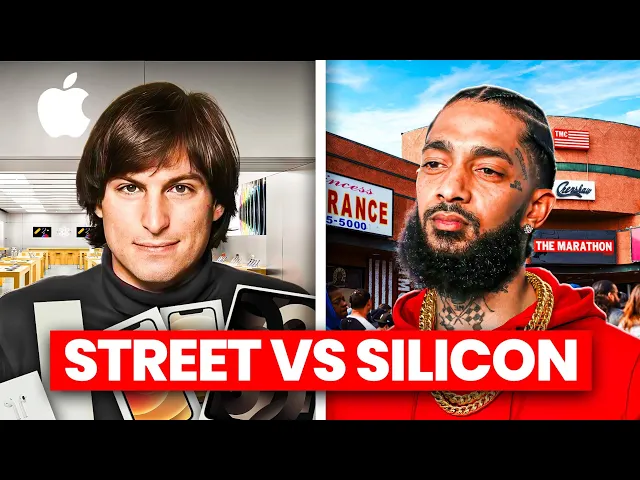
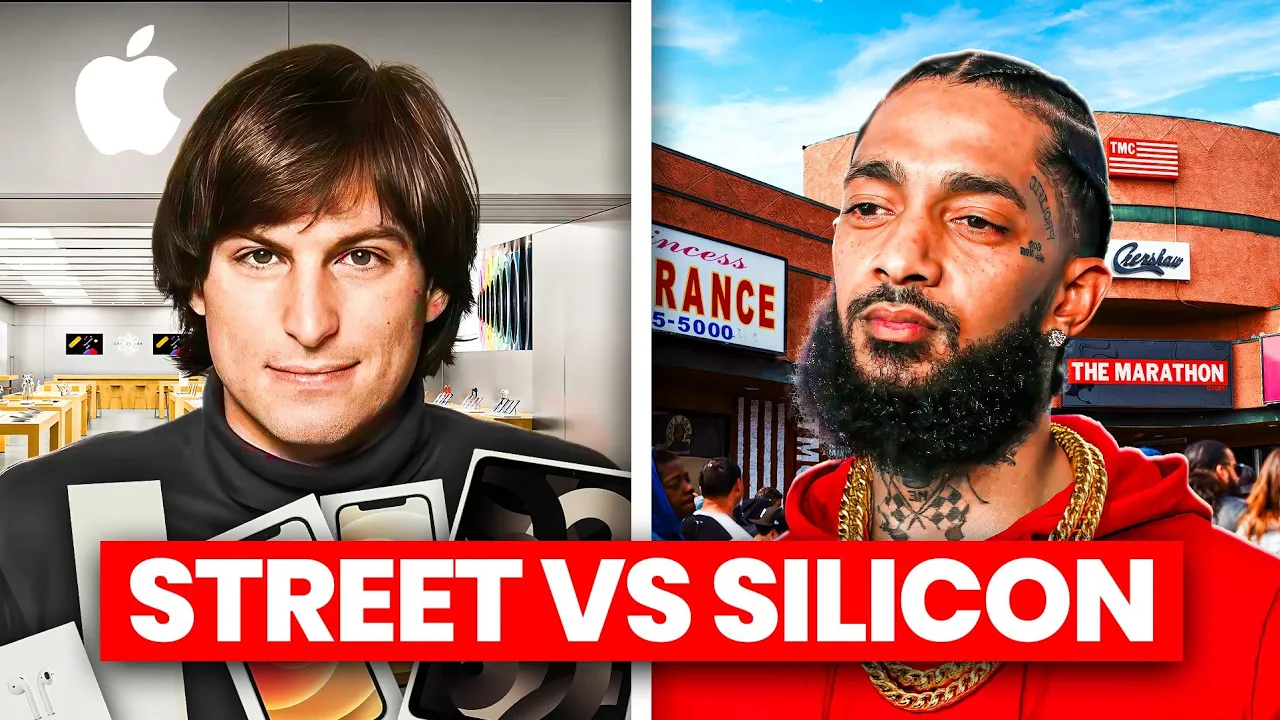
How Nipy Hustle stole Apple's entire business model and made it work in the streets. One of the lines you said something about you're integrated vertically. Yeah.
I said my cultural influence even revolution. I'm integrated vertically. Y'all [ __ ] blew it.
This man sold a $100 mixtape and people lined up around the block to buy it. I kind of was inspired by the Apple store. They was like he's triggered.
He kind of stood on my idea like [ __ ] You got to act and you've got to be willing to fail, you know, with starting a company, whatever. If you're afraid of failing, you won't get very far. I look at Apple, I see them following the same rules.
You know, very few companies or brands are integrated vertically. We built the whole economy on Congress. We scrambling trying to get the store open.
We finally ready. The greatest people are self-managing. They don't need to be managed.
Like, we about to make the store a smart store. So, I'm like, what? I'm like, no, no, no, no.
We don't got time for that. I don't even know what. Like you say, I don't know what is a smart store.
Sure. It'll have a marathon logo on the back. We got a app.
You can download the app. Once they know what to do, they'll go figure out how to do it. He make everything.
He go in and he integrated with the clothing. And it was the first smart store. Just like a hustle, a genius, a hustle, man.
My goal is to be like hip-hop's first completely vertically integrated brand. The ones that succeed are people that just have an idea that they want to get out expressed out into the world. We honor the people that ain't quit.
We honor the people that stay down. And often times they have to start a company cuz nobody else will listen to them. You know, you look at companies like Apple, raw material to retail.
That's the vision behind the marathon store. While Apple was selling $1,000 phones, Dipsy Hustle was moving $100 CDs like they were limited edition Jordans. Same strategy, different streets.
Apple didn't get rich selling iPhones. They got rich by controlling everything. Chips, devices, software, even the stores you buy them in.
No middlemen, no dependencies, just total control. The biggest risk is not taking any risk. Mark Zuckerberg said that.
But Nipy Hustle lived it and reverse engineered Apple's entire playbook without ever setting foot in Silicon Valley. But here's the crazy part. While most artists were begging labels for deals, Nipy was building what Apple built.
Complete vertical integration. He owned his masters. He owned his store.
He built his brand from scratch and ran it like a CEO. Every dollar, every message, every move flow through channels he controlled. Apple and Ipsy.
On the surface, they couldn't look more different. But if you strip it all down, they both discovered the same truth. The secret that separates legends from the forgotten is ownership.
So what does a trillion dollar tech empire and a street entrepreneur from South LA have in common? They both cracked the code most businesses die trying to figure out complete vertical control. Stay locked in because today's video breaks down how one blueprint built two empires and why 99% of people will never understand this level of strategic thinking.
Let's get into it. Welcome to Hustlers in the Hood. Now before we break down how they pulled this off, we need to understand the foundation both empires were built on.
What is vertical integration? The company that like destroyed industry like Apple. Apple got 100% vertical integration.
They control the aesthetic of the store, operating system, the product, the whole. Say your homie starts a clothing brand. He comes up with the designs, but he sends them to a third party printer.
Then he lists the shirts on Amazon to sell. Sounds like a business, right? Wrong.
He's got no business. She's got a job. Because when you zoom out, you'll see what's really going on.
The printer controls his production. Amazon controls pricing, shipping, and customer data. Everybody's taking a cut.
He's not running the system. He's just another plug in someone else's machine. Now, flip the script.
Same dude, but this time he prints the shirts himself, sells them on his own website, controls the branding, sets his prices, and owns every customer relationship. Every piece of the pipeline belongs to him. That's vertical integration.
I always felt like what make Apple dope is a complete ecosystem. Apple integrates everything. It integrates product management, marketing, manufacturing, engineering.
Get your phone the same colors that the operating system and your phone is the same colors that they store. Apple got the Apple campus where they train their employees and they, you know, manufacture their chips. A vertically integrated with words.
Like I didn't see that in rep. Old school vertical integration for the business school students. is not just about making a product.
It's about owning the entire journey from idea and raw material to the customer. No middleman giving profits. No outside forces calling shots.
Maximum ownership. Maximum upside. But when you control the full pipeline, you don't just make more money.
You control how people experience your brand, who gets access to it, and what it means to the world. And that's exactly why Apple and Nipy cut out the middleman. But here's where it gets interesting.
They both took this concept and weaponized it in ways most people never even noticed. Monetizing control, Apple Music versus Proud to pay. Apple could have just made iPhones and called it a day, but they saw Spotify controlling music distribution and said, "Nah, we're building our own lane.
" First with iTunes, which allowed users to purchase music directly, then with Apple Music, essentially combining their two biggest products. They didn't want a slice of the streaming pie. They wanted to own the entire bakery.
When you buy music through Apple, you're not just going through some thirdparty service taking cuts. You're buying directly from them. Higher margins, deeper loyalty, stronger ecosystem.
Every purchase makes their grip tighter. It's not just the music. It's called infrastructure.
That's vertical integration in motion. Nipy Hustle saw this playbook and couldn't wait to replicate it in Cshaw. We ain't set the business model.
Steve Jobs and Apple said 99 cents a song. He's read Contagious by Jonah Burger, a book about making ideas spread. One insight changed everything.
People don't just buy products, they buy meaning. That logic clicked just like Apple. The message was clear.
Don't let someone else package your vision. Own the platform and control the narrative. So in 2013, he dropped a Crenshaw mixtape for $100, not through a label, not on iTunes, direct to fans.
Each tape came with exclusive memorabilia and concert tickets. He called it Proud to Pay. Fans supporting the music directly.
Zero middlemen involved. I thought that there was a potential for it to be supported, but I didn't expect it to people to gravitate to it as much as they did. I was surprised.
I thought I could sell a thousand units. That was the goal to sell 1,000 units at $100 each, but it turned into a wildfire. A $100 mixtape might have sounded wild at the time, but the math was beautiful.
No label taking 80%, no streaming service taking 30%, no retailer taking cuts, just creator to platform to fan. Jay-Z co-signed the idea and bought 100 copies. The media lit up.
More importantly, the model proved itself. Each sale wasn't just a transaction. It was a statement from the fan saying, "We believe in this and we want to be a part of it.
" Here's how it looks when you break it down. Traditional music model, artist, label, streaming, fan. At every step, a cut is taken.
A layer is added. The connection weakens, the profit gets smaller. Apple and Nipsy's model, creator, platform, fan.
No friction, no filters, total control. Neither were chasing volume. They were building value.
And they did it by owning every step from creation to community. But here's where the strategy gets even more powerful because vertical integration doesn't stop online. The real game changer is controlling where the product meets the people.
Retail ownership. Apple stores versus the marathon store. The marathon store.
I kind of was inspired by the Apple store. When you go into the Apple store, the colors is the same as the Apple packaging. The vibe is the same.
They got a certain aesthetic. They got the glass stairs. Apple figured this out early.
If you control the store, you control the story. That's why you just can't walk into Walmart and grab an iPhone. You go to an Apple store.
You walk into a world. Because that store isn't just a sales counter. It's part of the product.
The layout, the lighting, service, packaging. Everything's designed. So when you walk in, you're not just buying a phone.
You're stepping into their ecosystem. When you own the retail experience, you just don't sell. You shape perception.
You control the message, the margins, and the moment of truth. Now, here's where the parallel runs even deeper. When Apple was crafting luxury retail experiences in high-end malls, Nipy was doing the same.
Writing the heart of Crunch on Slawson with the Marathon store. But like Apple's stores, this wasn't just a place to cop t-shirts. It was a physical extension of Nipy's brand, a command center.
I didn't see no no hip-hop artist with their own retail aesthetic and their retail, you know, network. So, I was like, it'll be dope to establish my own retail space that when we drop albums, we can go to Best Buy, we can go to Target, we can also go to the Marathon store. And when you get in there to buy the album, you surrounded with other products.
I see crunch shirts in the crowd and marathon hats and all that. Nipy owned the building, controlled every piece of inventory, integrated apps, and augmented reality to create digital experiences tied to physical products. We scrambling trying to get the store open and we did like a little mini dock.
We finally ready probably like a week and a half before the grand opening and hustle like we about to make the store a smart store. So I'm like, "What? " I'm like, "No, no, no, no.
We don't got time for that. I don't even know what like you say I don't know what is a smart store. He's like, "No, trust me.
Trust me, bro. We don't got time. " And so he make everything.
He go in and he integrated with the clothing and and it was the first smart store. And that's why I just like hustle. A genius, a hustle, man.
This wasn't a boutique or pop-up. It was culture, technology, and storytelling wrapped in one space. It's a smart store.
So if anybody had a crunch shirt, it'll have a marathon logo on the back. We got a app. You could download the app and you can stream content off the app onto your phone.
Limited drops, community connection, exclusivity that made every purchase feel earned. Not just bought. Nipy wasn't just selling merchandise.
He was controlling the point of contact. The same strategy as Apple in a different neighborhood, but with the same discipline. Here's how it looks when you break it down.
Brand control funnel, product, store, experience, loyalty. Apple's version, they made the device, sell it in their store, deliver the experience, and keep the customer locked in for life. Nipy's version.
He creates the music and merch, sells it at the Marathon store, builds an exclusive experience, and turns fans into believers. In both models, the store isn't an add-on. It's a strategic asset.
It closes the loop between creation and community. That's how vertical integration evolves from a business concept into a cultural weapon. If you're feeling this video so far, please leave a like on it and subscribe to Hustlers in the Hood to join our community.
We're all about highlighting the grind and the wins that make a difference. Now, let's get back into it. And now this is where the strategy really pays off because the final layer of this model isn't just about making money today.
It's about building something that outlives you. Long game. Apple's developers ecosystem versus vector 90.
Now here's where Apple's genius really shows. They didn't just sell devices. They built an ecosystem where everyone else could plug in and build wealth.
While Apple controlled the infrastructure. Take the app store for example. Developers create apps but Apple owns the rails, the distribution, monetization, and the rules.
They give developers tools like Xcode and APIs, but once you build for Apple, you're locked into their world, and so are the users. Apple turned millions of developers into value creators, all while taking 30% of every transaction. That's not just vertical integration, that's vertical domination.
This strategy empowers others to innovate while ensuring that Apple remains at the core of a vast interconnected digital economy. Nipy took that same principle and flipped it into real world infrastructure. again right in South Central.
Nip's vision extended beyond music and merchandise. He recognized that true empowerment came from creating opportunities for others to build and succeed. That vision materialized into Vector 90, a co-working space and STEM center in South LA, co-founded with real estate developer David Gross.
Vector 90 wasn't just some community center with computers. It was an incubator for the next generation. So, Vector 90 is a 5,000 square ft.
The top level is a co-work space for any inner city entrepreneurs, a inner city co-work space. And in the bottom half is a science, technology, engineering, and math center, which is basically the skill set you need to go into Silicon Valley. Just like Apple created tools for developers to build apps.
Nipy created a space for his community to build futures, coding boot camps, entrepreneurship programs, and tech access for kids who've never seen it before. There's an incubator aspect of it that as these entrepreneurs utilize this space to create companies, apps, you know, visionary things, they can bring it to Dave and myself and the rest of the team and make a pitch and every year we going to fund uh four of them. The strategy was identical.
Apple built a digital ecosystem. Nipy built a physical one and in both cases the mission was the same. Create a platform where others can build, succeed and pass it on.
Apple enables developers to reach global markets. Nipy enabled local talent to reach their potential. Different scales, same system.
Quick head-to-head comparison. Let's break down what you're really looking at. Two completely different worlds.
Identical architecture. Product. Apple dropped iPhones.
Nipy dropped mixtapz and meanings. Both delivered value that people lined up for. Platform.
Apple had iTunes and iOS. Nipy had crowd to pay and TMC app. Own platforms.
Owned experience. Distribution. Apple's 500 plus stores worldwide.
Nipy's Marathon store in Crrenshaw. Each want a controlled environment, curated, intentional, theirs retention. Apple locks you in with iCloud and Apple ID.
Nipy locked in fans with drops, apps, and direct access. Not customers, but community. And the long game, Apple empowers developers to build inside its world.
Nipy created Vector 90 so his people could build inside theirs. Ownership was never the end goal. It was always about the system, vertical integration all the way through.
Now, when you see all of this laid out side by side, something becomes crystal clear. This isn't about just two success stories. This is about a blueprint that most people completely miss.
When people talk about Nipy, they always remember his grind, the tragedy, and the inspiration. But his real genius was in the design. He didn't chase cosigns.
He created control. He didn't license his brand. He built the infrastructure to deliver it.
What you're looking at is vertical integration built from the ground up. a blueprint that turned fans into investors, a neighborhood into a network, and a hustle into a system that could run with or without him. The store still operate, the brand still moves, the system still runs.
And that's the point. This wasn't some lucky break or street hustle gone viral. This was intentionally engineered architecture.
Apple showed the world what vertical integration looked like within Silicon Valley. Nipy showed us how it could live on Krenshaw and still scale, still last, still inspire. This is the kind of playbook that builds generational wealth.
and Nipy mapped it out piece by piece. If you learned something from this breakdown, don't just like it, apply it. And if you're serious about ownership, strategy, and long game moves, hit that subscribe button.
We'll see you in the next one. base.