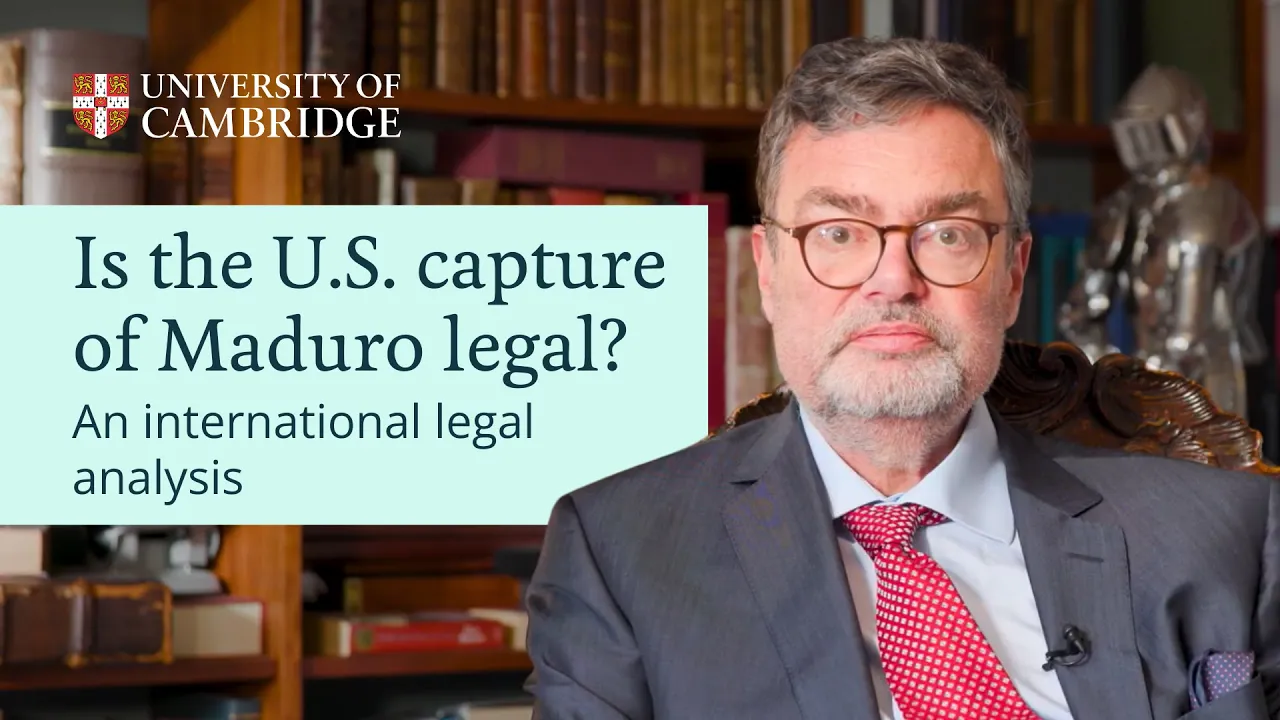
The US operation in relation to Venezuela is clearly international unlawful and it will be very important for the international community to identify it as an unlawful operation and to identify the US as a violator otherwise the credibility of the international legal system will be severely undermined. Is this about oil, natural resources? Well, the odd thing is that in this instance, the United States have not disguised in any way that for them it is about oil.
Uh you would have expected uh much more emphasis on the argument that this is a pro-democratic intervention. Well, if it was then uh you know as the moment at the moment there are no steps taken to assist the democratic opposition to come to power or to have fresh elections rapidly. Instead the US is dealing with the government which it purports to have replaced.
In fact it has only removed the head of the snake but the snake still wiggles is active and exists. That government is now taking steps to repress the population to stay in power. And the United States seems to be quite interested in that because it presumably believes that that government under the threat of the further use of force will deliver to it the demands the US has made in relation to oil.
The US argued that the nationalizations of the 1970s and afterwards were a kind of stealing of the US oil of US claims to oil or contracts and of their investments. Uh internationally this isn't quite true. a state is entitled to nationalize uh foreign assets provided that it's not done in a discriminatory way.
But the US argues that it can now take over the oil sector in Venezuela, the richest oil deposits in the world apparently. And rather than having some sort of subtifuge or explanation, democracy, self-defense, some other ground, they are saying quite clearly yes, that's what what we are hoping to do. And that is entirely unprecedented.
Uh the fact that you entirely step out of the international legal system or even the sort of bounds of ordinary human human decent conduct and say we just want what you have and we'll simply take it because we want it. Uh that is uh very very unusual. No, there's absolutely no justification in international law.
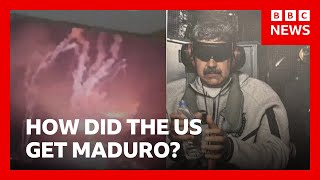
The American government are trying to argue that this was merely a law enforcement operation, that Maduro was duly indicted by US court and that acquiring him for trial uh has really no international implications. That is manifestly wrong. As President Trump himself in his initial press conferences emphasized, this was a very major military operation involving some 150 airplanes, bombardments of parts of Caracas.
Uh clearly this is a use of force and there's no legal justification available for it. There was no UN mandate. It's not a case of self-defense.
And even if there could exist a justification of sort of pro-democratic intervention, that apparently is not what the US has been doing. Rather, they have kept most of the government in place, the very government which they accuse of being entirely undemocratic in order to uh help satisfy their demands for Venezuelan oil. Well, is this then a violation of Venezuelan sovereignty or is there any merit at all in the US argument that it was just a judicial process of extracting a duly indicted criminal uh for trial in the US courts?
Uh the answer to that is quite simple. The fact that the US qualifies it in the domestic law as an internal criminal law does not in any way change the fact that this involved massive violations of international law by which the United States was bound and that in the first place is the prohibition of the use of force. A state cannot use force to implement its national interest.
Be its interest in capturing an alleged drugs offender. Be its interest of uh recapt recapturing oil that allegedly was stolen or being its interest in wanting to see somebody else in government in a foreign state. That is a violation not only of the sovereignty of Venezuela, but it is an offense against international law as a whole because the prohibition of the use of force is such an important rule for the international system as such.
Now, is there a justification that the United States could invoke like the protection of the American people from drugs trafficking? The United States have argued very strongly that thousands and thousands of Americans have died or been adversely affected by the importation of drugs from or through Venezuela involving even its president, Mr Manduro. Whether or not that's true, this is not a justification for the use of force.
The international response to offenses of that kind is a law enforcement response. uh it can't be to launch a war in order to end the problem. In international law, the only way that you can justify the use of force if you have no UN mandate to use force is self-defense.
Self-defense requires under the UN charter an armed attack against the state. And an armed attack is just that, an attack with military or similar means that has the kinetic effect uh that you would ascribe to a fairly major sustained military operation. Obviously, drugs trafficking is very far removed from that.
So, there's no justification under the doctrine of self-defense. There are many states like Cuba and others that have suffered from US sanctions for many many years arguing that even those milder means of exercising influence are unlawful. That really depends on the treaty based trading relations between the US and Venezuela.
The US is not generally obliged to trade with Venezuela uh and unless it has promised to do so in specific treaty relations or agreements with them uh it may be able to terminate or suspend this. But of course what the US then did was to enforce their own national determinations internationally through a blockade uh of uh Venezuelan oil shipments. So they listed some of the vessels used to transfer Venezuelan oil, argued that that was somehow unlawful to transfer it and then they started to board and actually in a way to abduct uh some of the larger oil tankers later on in this period in the weeks just before the armed intervention.
That uh is an unlawful act. The imposition of a blockade in fact is considered an act of aggression in international law, a warlike act. And uh therefore this in itself was already quite a serious initial infraction of the vi of the rights of Venezuela.
In principle uh international law uh does not take a view on who is the government. So if the question is who gets to decide who is the president or head of the government of a state classically speaking the answer was whoever exercises effective power. Um in more recent practice some states have started the old practice of recognizing or not recognizing governments again in order to express approval or disapproval in relation to democratic credentials.
But uh even if they do so, it's more a political act trying to communicate that one is not content with the democratic credentials of a particular government. But of course, you need to deal with that government if you want to have effective decisions from a state like Venezuela or any other state. Therefore, international law still is based on the doctrine of effectiveness.
Whoever is in power, you are likely to deal with as a government. the prohibition of the use of force is the greatest civilizational achievement of mankind uh over the last 100,000 years or so. The discovery that we do not want to live in a world where violence determines the way we have to live, where violence determines who owns our property.
somebody other than ourselves. Maybe that kind of attitude and approach uh needs to be rejected and opposed because we are at risk of returning to an international order of the 19th century, not even the 20th century, the pre-united Nations or League of Nations era, where states claimed the right to use force to implement what they claim to be their international rights or their claims. And uh that of course means that only powerful states uh can implement their interests and to do so at huge cost to others.
And if really uh we accept that you can use force to implement interests that are not backed by the international legal order uh we have regressed very very significantly. People seem to have forgotten the lessons of World War I and World War II which we here in Europe still remember. and that is that war is not a good thing.
It's not a glorious thing. It is a destructive thing that visits horrors on ordinary people. The people of Ukraine are experiencing that at the moment.
But how can we oppose the use of force by the Russian Federation in Ukraine if at the same time we accepted once undertaken by the US in other places? The essence of international law is that the same legal rules apply to all. So those who have opposed Russia's invasion of Ukraine, those who say that China shouldn't invade Taiwan, those who say that generally speaking, we don't have want to have a world that is akin to one of us stepping outside of our house and being knocked over the head by someone taking our watch or wallet.
uh it's exactly the same at the international level. We do want to have a sense of security, a sense of stability and uh asurances that we will not be uh subjected to uses of force which essentially is war and that we need to reject. Ordinarily, the international system provides one principal remedy to allegations of the unlawful use of force and that is the UN Security Council.
Of course, in the UN Security Council, the United States is a dominant power having a veto. So, there couldn't be any decisions directed against the US and there was not even a draft resolution introduced or voted on when the Security Council discussed the situation in Venezuela. Presumably the UN General Assembly where all members of the UN are equally represented will discuss this issue as well.
125 states of the group of non-aligned states have already rejected the intervention is unlawful and that really is the mechanism through which the international system protects itself even in cases where it's not realistic to overturn the result of an unlawful act like in this case uh the US intervention. What is important is that this is clearly identified as an unlawful act and then condemned by the organized international community by international institutions. The UN Secretary General has condemned it as a dangerous president uh and by individual states.
Therefore, it was quite disappointing to see that the European states and the security council were not really united. There was little Denmark which few threatens over Greenland that identified this and the US uh as an offense committed by the US. Uh the Spanish who are close to Latin America did the same.
The French already were slightly more qualified in their condemnation and disguised it a little bit. But the United Kingdom had the odd approach to say that Maduro was a very bad person with which everybody agrees. uh there were significant violations of human rights of democratic processes full stop and then the US said of course we are attached to the international legal order the UK said but it didn't bring the two together in the sense of saying and this was a significant violation of that order by the United States and that is a failing the UK argues it's a very complex situation and therefore we are not going to pronounce on it but in reality the situation is very here.
This obviously was a manifest violation of international law. Now, could this be a case of pro-democratic intervention? There is such a doctrine in international law, but it is a controversial whether it actually has legal force and b if it does, it applies only in very narrow circumstances.
So this is different from the aim of some western states to advance democracies in other states or to try and oppose uh autocratic practices of other governments. There is no argument that for those aims you can use force you can use war. Instead, this is an argument which says where a government cannot ever conceivably claim to have been created on the basis of the will of the people, then others can act to remove that government.
And there are only two cases where this is at times accepted. The first is a counterconstitutional coup where a military hunter takes over and displaces a democratic government. international action can be taken to restore that government.
This was done with the blessing of the UN Security Council when there was a coup in Haiti at the end of the cold war. The security council authorized the United States to lead a coalition to restore democratic governance in Haiti. When confronted with the UN Security Council authority to do so and a US flatillaa approaching, the generals gave up.
So there wasn't an actual use of force in the end. However, under the authority of the African Union, there have been many cases where action was taken to overturn a counter constitutional coup. Just uh last month in December, that very thing happened in relation to Benin where there was military action to stop an ongoing coup against the established government.
But here we don't have a case of a counterconstitutional coup. uh here there was controversy as to whether the elections were free and fair but that is far removed from overturning the entire constitutional structure of a state. The second case is where you've had elections the result is clear and is announced and then the government in power refuses to hand over power.
Again, in that circumstance, you cannot conceivably argue that that government is based somehow on the exercise of the will of the people because it's just been made manifest that the people have rejected those authorities. Again, we don't have such a clear-cut case here. Uh yes, there's probably electoral fraud that can be demonstrated in the elections, but we don't have an official result that has remained uh unimplemented.
In any event, in all those cases, we need authoritative author. We need authority being granted by an authoritative international institution like the UN, maybe regional body, in this case, the Organization of American States, and obviously there's no such authority. Well, the first one is that uh there will now be a debate whether this episode even more than the unlawful invasion of Iraq in 2003 changes the international system as a whole.
After 2003, the UN got together. So there was a change in government in the US and afterwards there was a reconsecration of the principles of the organized international system and the UN charter. That doesn't seem likely here.
The question is whether we will now have a international system where you have regional great powers. The US in its own hemisphere or what it claims to be its own hemisphere. Russia it's near abroad.
China in its own region where they dominate possibly even through the use of force and where others have to sort of accommodate their own relations with these great powers uh have to accommodate themselves with them. Uh or whether the rest of the world unites and stands up in defense of a more balanced legal order that insists on the classical principles of the sovereign equality of all states. Now, does all of this mean that we should give up on the United States?
And they have abandoned that which united us with them for the last century really since the League of Nations, World War I, World War II, throughout the protection of Europe during the Cold War leadership of George Bush the Elder, the good Bush during the initial cold postcold war period. You remember the defense of Kuwait through the United Nations combined with the US and other militaries. Uh, is all that over?
Um, I fear it is. Uh, I don't think this is a blip that can be walked back. It is an important episode that will influence other states, Russia, China, but also other powers that are kind of regionally dominant.
India, Pakistan in their own region, Nigeria in its neighborhood, uh maybe some others. uh and if they adopt the kind of attitude which is if we can do it we will whatever the law says uh that would be quite dangerous. So the question is whether the rest of the world can unite in defense of this principle.
Not in a way that is anti-American, but in a way that defends the principles we all are interested in maintaining. And the risk is that the US have moved so far away from this basic consensus that it's probably not going to be easy or possible to persuade the US otherwise. Um but at least the rest of the world can insist that these principles remain relevant and should regain relevance also in relation to the US should ever there be a change in the outlook of the US administration.
Now why is it that nobody is talking about what presumably ought to be the principal issue now which is the future of Venezuela. Um the odd thing is that the president has been removed. The US seems to have endorsed the vice president who is a Maduro loyalist and has demanded his return to Venezuela.
Um all the government structures are in place and from yesterday onwards they have redeployed the police and others. Apparently they uh arrest people on the street, demand to see their telephones and check whether they had celebratory messages about the removal of Mr Maduro. Um, obviously this doesn't bode really well for a transition and that is really a very concerning issue because you now have leaders of the opposition who were in exile or abroad like the Nobel Peace Prize winner or the act the person who supposedly won the elections presidential elections of 2024 who is in exile in Spain.
When they return, presumably they are not just going to sit there, but they will inspire a popular opposition if this government just says, "Well, we lost the president, but we continue as before and if the US allows them to do so, provided they deliver on what the US demanded in relation to oil reserves and having a US takeover really of the oil economy. uh one would foresee that this would give rise to significant internal conflict in Venezuela and the only way that that could be averted would be to have a firm transition plan where there is a clear path towards fresh elections a new electoral commission which is fair and international guarantees that the electoral process will be free and fair otherwise I think everybody is quite concerned about violence breaking out or increasing repression. Winning the day by having not the release of the political prisoners but even more political prisoners to intimidate the population at large.
>> How would Russia and China respond to all this? Well, we were treated to the unedifying spectacle of having the Russian ambassador to the United Nations defending the prohibition of the use of force after the suffering they have imposed on the people of Ukraine. China was similarly vicorous.
Uh China and Russia together perhaps along with Cuba or states of that ilk obviously have been very very outspoken in criticizing the US operation. In the Security Council, the Russians were extremely harsh and tough. You might have thought that they would want to uh do some favors to Mr Trump in exchange for the US uh slightly soft position on Ukraine, but they were trying to really profit from this episode by portraying themselves as the key defenders of the international legal order.
Um, obviously this really helps the Russians in terms of maintaining their campaign in Ukraine. Many people are worried that China might uh exploit this situation in terms of its relations with Taiwan. Um, this may have been on the cards anyway some years down the line.
Possibly this event has accelerated it having undermined uh the kind of credibility of an argument by the US to resist the use of force by another state. Well, what's next? Uh the honest answer we don't know because the Trump administration has raised so many issues where even the use of force uh is being left as a specific or sort of general threat hanging in the background.
We have heard that the US might want to intervene in Iran should there be civilian casualties in the present wave of protests. Well, if so, how would that work against whom? uh is it meant to overthrow the government and if so what would then be the situation that emerges?
We have heard that Colombia might be another target. Uh is that going to be the same that one just removes the president and sees what happens? How would that be going?
Uh then there is Panama. Panama apparently is already trying desperately to negotiate with the US to avoid uh a repeat of the earlier invasion of Panama which resulted in the removal of General Noa. Uh and uh they are under pressure to remove any Chinese influence in relation to the Panama Canal and uh in a way to reverse the deal that President Jimmy Carter had struck with Panama which handed control over the canal to them.
And some of the other issues we saw Canada Mike Carney himself actually not condemning very strongly or at all the US action in relation to Venezuela. Absolutely astonishing. The Canadians normally are the greatest defenders are amongst the greatest defenders of the international legal order but they have been quite meek on this particular issue.
And then we have famously of course the issue of Greenland. are the United States going to do a Crimea? In Crimea, you had a large Russian naval base already there.
All they had to do was to take over their insignia, the Russian forces, and take over the place, uh, claiming that this wasn't really an armed invasion, but that little green men had taken over the country, and under their protection, there was a referendum in favor of joining Russia. Here we have some significant military presence in Greenland. Is that going to be used as a means of pressuring the Greenlanders and possibly even the Danes into giving up sovereignty uh or in case of the Greenlanders uh giving up free self-determination in favor of some sort of association with the US?
That seems to be the hope of the US government to come up with a sort of association arrangement that extricates Greenland from Danish sovereignty. uh and uh we'll have to see uh to what extent Denmark and her allies will be able to resist that.