I'm here at a very interesting point in the evolution of Education in the United States and some other countries that in a way when Nancy and I were at read we imagined that this could happen and we thought well how long could it take gosh it might take 10 20 years maybe who knew okay it took a little longer than that but but we may be at a real turning point in in the following regard ever since the beginning of Education whenever that began probably cave people did education with their cave babies education has proceeded
entirely in the absence of evidence it has preceded in within a circumstance in which decisions were made about educational programs and practices based on tradition based on fads based on policies based on almost anything except for hard evidence and as a result in any field of endeavor in which that is the case in which evidence plays a very minimal role the progress takes place in the form of a pendulum where something is in and then after a while people get tired of it and it goes out and you wait long enough you can almost set
your watch it will be back in some other form it will be back under some other name and then it will go out and it will come back again and we make no progress although we feel as though we're going somewhere and that it has been the case for a very long time and you can contrast it very much with the situation in such as medicine and agriculture and technology engineering all of which do pay a great deal of attention to evidence and therefore make consistent progress year by year you can be confident that not
in every area and you know not in a smooth pattern but you could be confident that 10 years from now there will be met better medical treatments for many diseases you could be confident that 10 years from now the productivity of agriculture in many areas will have improved or the cost-effectiveness or you know that that whatever objectives there are in agriculture will be better and the reason you can be confident is not because you have you know anything about the particulars of which diseases or which cows or which seeds or which you know one thing
or another are going to change but because these school these programs these areas of endeavor have a commitment to evidence and because they have a commitment to evidence people are working very hard throughout the world to try to create better and better solutions knowing that these solutions will be put to the test and if they are successful they will be widely adopted and this will make a difference at end and continue to move the field forward education has not been this way but it is becoming this way to a much greater extent than it was
once that want the case and what I'm going to be doing today is kind of telling you where things are right now in this regard and telling this this extraordinary story that we are literally in the middle of the reason it's particularly useful time or interesting time is that in December of 2015 the United States Congress of all people I mean the last people you would imagine to get together and do something sensible did get together and do something sensible got rid of no child left behind and replaced it with something called every student succeeds
act or esse which has all kinds of provisions in it nobody really knows what all the provisions are but that that among them has definitions of what it means to have a strong evidence base for a given program or practice and consequences just a few nothing too serious but consequences in terms of you know if you use those programs that do have a strong strong evidence of effectiveness there are various circumstances in which you could get extra points on a grant application or otherwise have positive consequences for your school or district and the implications of
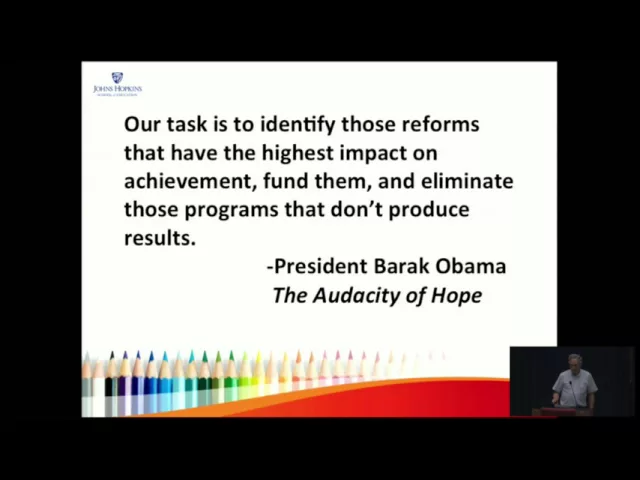
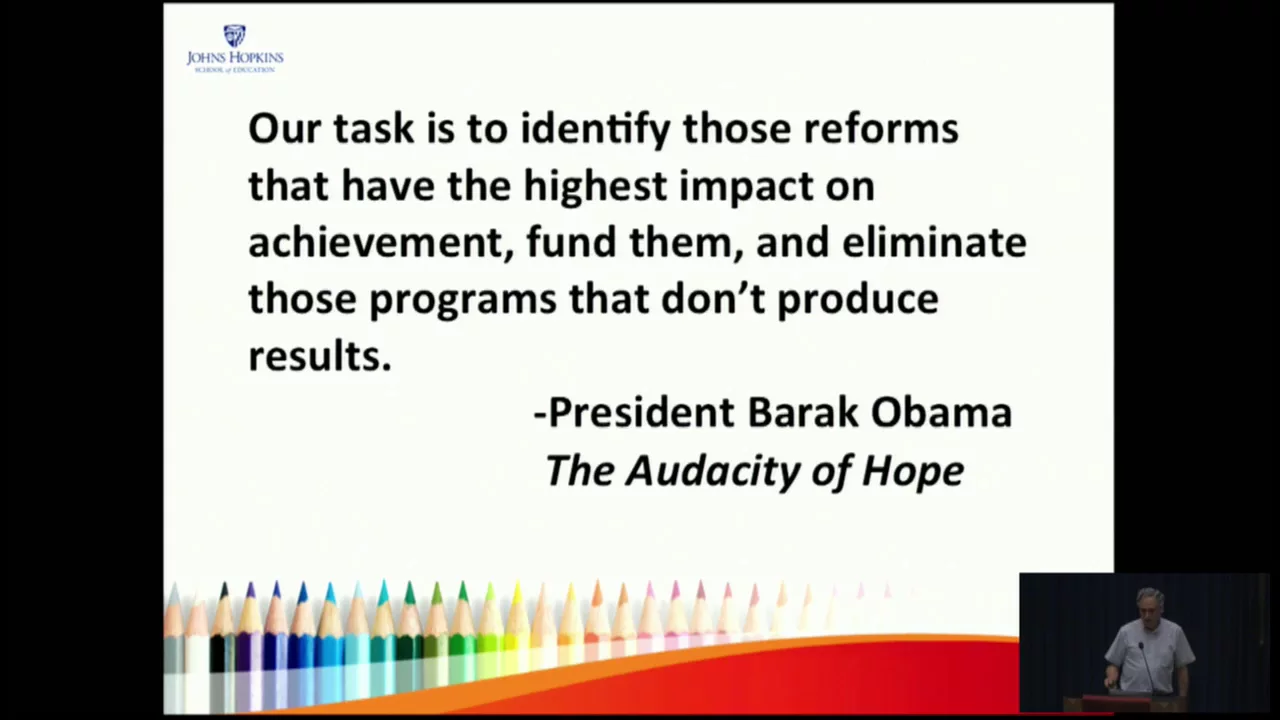
this are just beginning to form at this very moment it could end up being a total bust it could end up being something quite extraordinary and that's the story I'm hoping to tell all right so here's a picture of one of our you may recognize this guy and here is a quote from a book that he wrote in which he lays out a basic principle of government that has not really been articulated before nearly as clearly that he wanted to find those reforms in all fields that have the highest impact on achievement fund them and
eliminate programs that do not produce results that's pretty radical if you said it about medicine of course it wouldn't be radical in the slightest but if but to say it about education in particular is a radical statement and he followed through on that idea and not only in education but or not in other fields as well that are going through a similar transition had where they didn't use to have evidence involved and now they do so what's the concept here school reform ordinarily is it is a story of churn of ideas coming and going of
things that are changing just to change or because a new political party comes into power and locally or nationally and so we see things that that come and go accountability and assessment is always very controversial and people are always doing different things with it whether these assessments and accountability strategies actually produce better achievement doesn't ever seem to enter into the the conversation people fling evidence back and forth at each other about that but the evidence really comes after people's ideological beliefs similarly with governance for schools such as charters and vouchers there are people who believe
in charters and vouchers there people who don't there's evidence about the effectiveness of charters and vouchers mostly negative doesn't make the slightest bit of difference the people are for or against them based on whatever the their beliefs were before teacher evaluation the under Arne Duncan there were teacher evaluation plans that were imposed upon teachers coast-to-coast that had not been piloted in a single school nobody knew what they were going to do how they were going to work they were gen xx practice they were generally disastrous they were warned against by statisticians who said these that
that bacing teacher evaluation in part on teacher on the degree to which teachers were getting higher scores from their personal kids is something that statistic cannot be done in secondary schools you had situations in which math teachers would be considered the best teachers in their state in the fifth period and should be fired based on second period does this make any sense I don't think so but it prevailed because it was politically popular that in among certain people that were proposing it and the evidence did not make any difference in you you could name almost
any issue curricular issues instructional issues many many kinds of things in which evidence could be obtained oftentimes does exist but simply has not affected the debate in any consistent way so stop the pendulum I want to get off and I hope I can convince all of you that you would like to get off of that particular pendulum as well and I mentioned this already that in fashion in the in areas that that don't lend themselves to evidence hemlines go up hemlines go down things become you know in because they're in and then after a period
of time people get tired of them and they change because they're old they're no longer attractive I grew up in the in Washington DC and nearby was Silver Spring Maryland and it was loaded with Art Deco buildings quite lovely Art Deco buildings except that when I was growing up the the appearance of Art Deco meant that something was old and therefore it was ugly and therefore it was torn down not because Art Deco wasn't lovely but because it was old it indicated that it was built a long time ago and that's how fashion changes is
things go in and out obviously in art the things are the same and in many many other areas change happens but it happens not because things are better but only because they are different people get tired of the old way in so word-of-mouth is what causes changes in education tradition politics marketing any number of things cause change none of which have anything to do with the evidence of whether they are actually beneficial for children this is what has to change this is this fundamental dynamic here is susceptible to change thinks outcomes and education can be
measured there's a reasonable discussion to be had about circumstances in which that's difficult to measure things and what's an adequate measure and things of that kind but fundamentally it is possible to measure educational outcomes and to be able to know what works and what does not and that and to begin to make decisions based on that and that that will have consequences far beyond just simply identifying those programs that currently exist and then using them more but rather changing the way the innovation enterprise operates in education so what is what is evidence-based reform as I
mentioned earlier it's modeled on other fields like medicine agriculture and engineering and what it's intended to do is it was just saying first off to identify those things that already have good evidence of effectiveness and use them more but more importantly to create a dynamic in which you have innovators philanthropy government school districts themselves many many people engaged in a process of creating things that they think are going to be more effective than what exists today that dynamic is what will fundamentally change education to its core imagine if you will and America decided that it
needed to be first in the world in algebra the idea here is that you could specify what are the outcomes of algebra that you want and you could specify them more broadly than the current standardized tests that are used but but you could have whatever measure you think is is valid and meaningful but you said that whichever programs are designed that are capable of being used broadly replicated as as often as you want and that you would that should that should you meet a high standard of evidence that your algebra program would be widely adopted
so you could become wealthy if you know if that if that's your goal or famous if that's your goal or whatever you like but you could solve the heck out of algebra the key concept however is that there's a standard that is not merely the standard of what looks good but there's a standard of improving students actual algebra performance now take that algebra example and use it to think about effective preschool programs effective early reading programs effective elementary science programs or math programs or whatever you need middle school science math programs social studies programs writing
programs you know whichever area you can possibly imagine there's nothing in all of education that cannot fundamentally be measured in terms of its outcomes and you could identify those things that worked and that even as soon as you did the day after that happened you would start an enterprise of development evaluation dissemination that is already well underway by the way under primarily federal funding but you would greatly accelerate it because many other actors would get involved a key analogy to this is what happened in medicine in 1964 in 1964 because of the thalidomide crisis there
was a legislation that was passed in the US Congress that required that medicines be safe proven safe and effective and as a practical matter what they meant was that they had to be subjected to randomized evaluations of a very high level of quality before they could be widely disseminated there are graphs that you can see that look that that show the amount of research activity in medicine and it's you know the research activity is going along going along going long and here is 1964 I am until to this day medical research throughout the world continues
to accelerate at a dizzying pace why because there is respect for evidence because there because everyone has a clear understanding that proven that new medicines new procedures new new things that actually can make a difference in the lives of people are going to are worth investing in both from a monetary perspective and in terms of a an impact on people kinds of perspective and therefore drug companies invest in research government invests in research philanthropy invests in research and and a huge number of very talented researchers are working day and night on whatever issue there is
to try to move forward practice and availability of solutions in medicine this same thing happens in every field where this transition has taken place and that's what I'm really talking about here in education so imagine then that you had it a circumstance like what I've essentially been destructive describing you have educators who are evaluating their needs and choosing among proven interventions so that imagine going back to my algebra example that rather than talking to the rep from Pearson and the rep from Macmillan mcgraw-hill in order to decide what algebra text you should use that event
that committees at school districts would be look would be looking at the evidence on which algebra programs actually make a difference the and they would tell the Pearson rips when they called they say hey I'm so glad to hear from you do you have any evidence for the for the programs that you want to show me and they say mmm you wouldn't meet the standards of the you know the what works Clearinghouse or whatever you say oh okay well call me when you do click OK nothing people don't click anymore but you know what I
mean but regardless of who creates a program whether it it uses technology whether it doesn't use technology whether it's professional development whatever you would have you'd be choosing among programs and practices with strong evidence of effectiveness this doesn't say you have to choose program X hopefully there would be many programs that you could choose among and you could shoot make that choice based on any number of attributes that cost or could be you know because you like the philosophy or that you've heard that your buddy down the road used that program and they really liked
it but it doesn't matter as long as you have confidence that all of those programs are all proven to be effective so this this requires that you would have a variety of things in each area that is building up the there have been substantial investments by particularly by the federal government in the shelf if you will of educational programs in particular the Institute for education Sciences which is the main research agency and Department of Education has been funding this kind of research and development and in the Obama administration they they created a new program much
larger called I three for investing in innovation that has been funding large-scale development of new programs about third party randomized evaluations of existing programs or new programs in then dissemination of the programs that have been proven to work all of these things have created progressively more and more proven solutions in in many many different fields in beginning reading in science in in mathematics in social-emotional learning in many other areas and so we're not there we're not all the way there we don't have solutions for absolutely everything and we don't have enough solutions in many areas
but we're way way way beyond a starting point we have a lot that's ready to go right now and a lot that's nearly ready to go or we'll be fairly soon imagine now that you also had funding from the federal government or from or from local state governments that encourages the use of programs that have strong evidence of effectiveness so that should you decide to use that algebra program the government might say you know we are not telling you what to do you don't have to use a proven program and all if you don't feel
like it but if you do then here's a fund of money that will give you to help you pay the costs of adopting that new proven program that actually is one of the things that is in the new essa legislation where it in in the most clear form their preparer requiring the use of programs in in what's called school improvement grants school improvement grants have been around for a long time it's kind of been an embarrassment but the these are schools elementary and secondary schools that are the worst schools in all of America they've got
their scoring and the lowest 5% of schools in their state and they have for a long long time these are places that need the best we possibly have to offer them and they need it right now and they need it school-wide not just in one subject or another and up to now these schools have been offered things that are horrible just just you know they're they've been asked to make up their own programs locally and the programs that they've made up have been very disorganized and the outcomes have been embarrassingly bad this new legislation is
saying that that we need a different approach we need to be able to provide this additional funding for these schools in terrible shape but it needs to be focused on things that have been proven to work things that are known to make a substantial difference in the outcomes that we're that we're looking for so it's one example of how government could say we're not telling you what programs to use you have a broad range of things that you might choose but we want to see that whatever you do choose show us some evidence that this
thing has been evaluated in high quality preferably randomized doesn't require randomized but preferably randomized experiments and found to be effective on the kinds of measures that are considered valid for the outcomes that you're looking for primarily reading and math in this case in seven other areas of this education bill there are incentives these are situations in which schools or districts can apply for money from the federal government and the government says we're not saying you'd have to use proven programs at all but we're saying that we'll give you some extra points on your application if
you choose to do so so if you can show bring forward evidence to show that a given program that you're adopting is been proven to make a difference then you could earn additional points based on on the quality of quality of that evidence now it's important to understand what we're talking about here and and there are a number of things that kind of sound like evidence-based practice but are not first off we're absolutely positively not talking about top-down mandating of practices that are quote supported by research educators this is a little-known fact that educators are
human beings and human beings hate to be told what to do they like to have choice they like to have agency and in the case of education buying an educational program is not like buying a pill in you know there's a might be in medicine it's not like you know buying a thing and you buy it and you and the fact of buying it is all you have to do in education things need to be implemented and the chances are pretty slim that you're going to implement something very well if it's been forced down your
throat let's be honest so it's very important that government again be it federal state local entice people to use proven programs but do not force them to do so and that when they do even when they entice that they offer a variety of possibilities so that people can say all right I understand why it's in the interests of children and the interests in there for government to you know to highlight programs with strong evidence of effectiveness but we still get to make a choice our local you know we have our local needs we have our
locals you know politics and in situations fine that's good but there's a reason for us to use something that has strong evidence of effectiveness and is ready to go a second is that we're not talking here about providing teachers individual teachers with general principles that are supported by research now I write an Educational Psychology text and it's loaded with general principles intended for teachers that help teachers to conceptualize the task that they have as teachers and to do as good a job as possible with that information so I'm not saying that that those principles are
not useful for teachers to have they're very useful for teachers to have but general principles are not at all the same as proven programs general principles help teachers to conceptualize what they're trying to do and they give them you know hints and but they're they're too small to make a huge difference they're very much you know reinterpreted by the by individual teachers and so government really doesn't have a role in terms of saying you know you have to wait three seconds to give kids you know feedback on their answers or you have to do this
kind of grouping of children for instruction or you have to you know any number of kinds of things that are not programs and they're not you know big stuff but that are you know equally important but so those kinds of things can go along pretty much the way they have what we're talking about here is the point at which a school says okay we need a new approach to middle school science what we've been doing is just not that good in middle school science we need a whole approach to medical school science let's pick something
that has been proven to improve performance in middle school science if that's what we're after or our kids are not getting to third grade reading in adequate shape we need to do something about that what are the programs and practices that have been proven to get you to third grade reading successfully at a very high level in let's say you know in schools where we're reading would be a difficulty so we're talking in general about things that are at the level of schools or at the level of departments that are beyond the the range of
what an individual teacher does that are supported by research another is that we're not talking about having educators become researchers themselves that's welcome it's wonderful if if teachers do become researchers but the kinds of research designs that we're talking about here are far far beyond what individual teachers or schools can do on their own just to give you a picture of what I'm talking about here usually programs of this kind are evaluated in studies where you know forty to fifty schools are assigned at random to use a given program or to continue doing what they
have been doing it's simply not possible to do these kinds of giant studies that are required to get valid information evaluating school level programs that are done at a very small level by local folks oftentimes it teachers and small groups of or small groups of teachers or small groups of schools can can can have terrific ideas and create something that then can work their way up the line in terms of becoming evaluated and can be of enormous impact eventually but it's not the kind of thing we're talking about where teacher says I've got a great
idea and my ideas as good as anybody other else's idea and I tried it out and my kids did better than they used to do that's not the kind of research that is going to qualify under under this kind of circumstance it's going to be much larger and more technically difficult than that if you really want to be able to put a lot of reliance on it and well then similarly you're asking each school to invent its own research informed methods again schools are always free to invent their own research informed methods if they want
to and that's a fine thing to do if you're a group of teachers or you are a principal and you want to use research informed methods and go to it but it's not what we're talking about here because what you what you do in that circumstances you be making maybe making terrific choices but you're not creating something new that then has been evaluated and found to be effective again it could be a first step in that direction but it's not it's not the whole the whole process now there are number of things that are going
on that are moving in this direction I think I've mentioned maybe all of them already but here's a convenient list I've already mentioned the essa standards of of evidence this is extremely important this has never been true anywhere in the world that anybody has ever defined what it means to have strong evidence of effectiveness actually in essa there are three levels that count one is called strong evidence of effectiveness which is where you have at least one study that in which schools or classrooms were randomly assigned to use a given program and compared to a
control group that was randomly assigned to keep doing what they were doing over a period of at least a year and found to do better on a an accepted measure of the outcome so if you have done that in the end the schools were assigned at random then you qualify for the strong criterion in under essa there's a second level that's called moderate which is exactly the same as what I just said except it's quasi experimental and what quasi experimental means is that you have a group of schools that's designated non randomly to use the
program and another group of schools that serves as a control group you've got measures that indicate that the two groups of schools are very very similar in terms of prior achievement in terms of demographics in terms of other kinds of factors so that you're pretty confident that the that the experimental and control schools are quite similar before the program began and then you look to see whether the outcomes are better in the group that's using the experimental program so that's called moderate exactly the same as the randomized except for the randomization the third is something
called promising which means that there's a correlational study so a correlational study could mean that you have schools that are already using a given program and you're finding other schools that are not and you're making a comparison between the schools controlling for prior achievement and other factors have to say that in my own lobbying efforts and those of many others that I've been working with we we tried to fight against this one this is not a really terrific research design but politics one and it is included in the list but nevertheless having these definitions gives
people who do care about evidence a basis for saying okay I'd like to start wherever we can to pick programs that are as high on that list as we possible so that we can move forward our kids in line with what essa is suggesting there may be an incentive for it there may not be but at least we're clear about what we're trying to achieve in improving using evidence and data to improve outcomes okay so I guess I already talked about these elements of the essa standards okay and I already talked about some of the
consequences in essa for using these programs but I think that one of the things that beyond the specific provisions is that throughout the legislation essa is encouraging the use of proven programs and if the Department of Education follows this up as they as they say they will then it will become something that at least people are buzzing about it peeps something that will be considered when people are making decisions about what programs and practices to use in their schools particularly for the children who are most vulnerable evidence generally comes from schools that are the most
impoverished schools that are that are experiencing difficulty and the in federal policy generally applies particularly to those schools so where this is most likely to make a difference is in high poverty schools rural urban wherever they happen to be and and so essa will particularly encourage the use of proven programs in places where the need for them is deemed to be the greatest the evident in investing in innovation that I mentioned the i3 program is the largest effort in education that's ever taken place I should tell you I'm you know this is extraordinary they have
spent 1.5 billion dollars so far on development and evaluation of programs in all different areas from preschool through 12th grade I was talking to a reporter from the New York Times about this and just you know carrying on about how exciting and wonderful this all was and under unprecedented and there was she was just kind of silent for a while and I said what's what's what's the matter and she said well I usually write about Madison and what you're talking about is chump change this is you know it's it's for education it's beyond human imagining
that anybody would invest this much but in in Madison that's not so much but the great thing about education is that that medicine has to cure an awful lot of diseases we only have to cure one disease ignorance you know once we start learning how to solve some of the enduring problems that we have in education that a lot of those solutions will generalize to you know if you find solutions for algebra I'm willing to bet that that they will also work for math seven and they'll also work for trigonometry or they're you know with
appropriate adaptations to a degree that they might not generalize so much in medicine so they're the possibilities of real breakthroughs I think are particularly large as we get going any case so I three has been investing money and they're using something that was invented for I 3 and now extent has extended into other fields which is called tiered evidence standards which means that if you have no evidence at all you get a little bit of money to develop your program okay a little bit of money could be three million dollars which in education terms is
a lot of money a lot of little bit of money if you already have some evidence like a single study supporting your program but you need further evidence you can get what's called a validation grant where a third-party evaluator evaluates your program and you might get fifteen million dollars to do that which in again in education terms is like whoa okay now it's down to twelve million dollars but it's still a really big net about amount of money and if you already have large-scale randomized experiments behind your programming so it's really proven to work already
you can get what's called a scale-up program a scale of funding which at the moment is twenty million dollars luckily we got one for success for all a few years ago when those the amount of money available for those things was fifty million dollars oh those were the days but but the idea was that at that stage you still had to have a third party randomized large-scale evaluation done on your program but otherwise most of the money was supposed to go to help you scale up to help you disseminate proven programs so this is continuing
under essa and will continue to to move forward but the concept here is really important that the that you can move up the line if you start with a good idea you get you prove that it can can work that you know you can get some evidence for it you can have a third party evaluation later on if it works out you can have it to get support to disseminate it nothing like that has ever ever existed in education for sure the Institute for education Sciences I mentioned has been doing work that's very similar to
what I three does but on a smaller scale and also does more theoretical work it's more likely to be done by universities but otherwise very similar tiered amounts of money depending on the quality of evidence that you already have in England there's something called the education endowment Foundation very much patterned on i3 that where there are some friends of mine who were sitting around minding their own business and the new Conservative government mind the word conservative late 125 million pounds on them and said here use this over the next 15 years to develop and evaluate
programs for England schools and they've been chugging away doing fantastic work creating a whole bunch of models and every one of them at can readily be brought over to the US and vice versa met some of the programs that they're evaluating there are US programs now there are pitfalls to this as this because this effort becomes known in the education world there's a lot of concern that there will be too few effective programs many programs as to as is true of medicine the majority of programs that get evaluated fail and we have to get over
that it's okay we learn from the failed evaluations too but one of the things that we learn is about you know that that that those those that do succeed are what matters and we can't be discouraged by the fact that that many of the things that we had great hopes for didn't work out that's just part of the process it's something that's kind of a dirty secret of research is that the vast majority of things in certainly human Ares and in medicine and other areas fail when they're subjected to large-scale evaluation but it's not the
number that fail it's the number that that succeed that move you forward in the short term even as we learn from the things that don't work out as we wish they did but there are also things that succeed but don't go to scale sometimes it's because we have university professors that made them and they don't really feel like going to scale that's like business that's not fun that doesn't get them any publications or get make them famous or anything like that and so there are some things that are never tried to go to scale and
or they may be created by a local school district that just wants it for themselves but they don't really want to disseminate it to any other places beyond themselves so that's a another problem there are obviously there are disagreements about research methods although that's calming down a great deal and certainly there are legitimate discussions about what kinds of measures should count and that sort of thing but those seem like solvable problems as long what's really important is creating the political will and the the intention the excitement at the level of schools and districts and and
in the in the world of practice about using proven programs so here's the vision for the future an attainable vision for the future so imagine now as I have said before that you've got teachers and administrators choosing among proven programs and practices I have a I write a weekly blog for the Huffington Post which you might want to check out it's kind of amusing at least it's always on evident on evidence in education in today's actual blog today's Thursday right so today's actual blog was about Sears catalog and it said I think it's a nice
image here when I was in high school I had a job delivering Sears catalogs in what Maryland suburbs of Washington and completely ruining my my mother's 1960 Chevy station wagon and one of the things that was great about this job though was that everybody was so glad to see me because the Sears catalog was cool it had all kinds of possibilities in it and people would just open up the catalog and start you know paging through it looking at all the you know it was it was it was a book full of dreams all right
kind of consumerist dreams but there you are and because we didn't have any internet back then you know so what do you how do you dream without the internet it's impossible but imagine that you married the Sears catalog with Consumer Reports so now you look at the thing and it says here's a washing machine you got oh could I use a great washing machine that's really cool whoo but the repair record is awful for this thing well it doesn't get closed clean so let me look at another or you know whatever the the product might
have been imagined that you got your Sears catalog and it gave you that same that same appealing information about all the wonderful things you could do in your school and now I'm transient transitioning back to school he gave you that that same set of visions of possibilities of what you could do in your school described them in appealing ways and gave you the information about what the evidence base is for those things so that you can make wise choices for your children whatever the government is doing in terms of incentives or whatever you are the
steward if you're a school leader or a teacher or a superintendent you are the steward of the educational development of your children so you want to know you should want to know what the evidence base is and have it summarized in a useful and trustable kind of way that is what is needed in education just as it was needed in you know Sears catalogues years ago is a way to get access to that kind of information so that teachers and administrators could be sitting around and going through these very colorful Sears catalog kinds of things
and finding the things that make most sense to their particular place second there would be the robust research and development enterprise that would be constantly developing and disseminating new programs one of the things that that I'm hoping would happen and that certainly happens in medicine and agriculture is that the front end development that creates things that you can actually use you know that actually save lives or give you better cows also justify a great deal of basic research on the back end that people don't even read about in the newspaper you know they're they're just
you know but they're going on because they feed into a process of research and develop that I just kill my okay I probably did that the other okay so that that it would could help support the entire sequence all the way from basic research to application and dissemination and and build some respect for research in the world of Education let me tell you being a research being an education researcher we get no respect we need you know groupies and you know oh I never never mind the groupies part but but to get some respect for
the entire enterprise I think would be very important you could create networks of schools that are using similar programs and that therefore could share their wisdom of practice based on using that that approach so that you could link them electronically you can you could have conferences at which people come and share the best practices that they're doing and what would be different from what happens now is that people would have a common language people would be able to discuss you know I'm using that same algebra program that you're using did you have this problem yeah
we had that problem too and this let me show you what we did with that whether in person or not and it would create a different dynamic in terms of funding of Education because in a sense education always gets the crumbs from the table because it's seen as something that has to do with how children women people that don't you know that don't usually get a lot of investment because it's even though people theoretically can see how education contributes to the economy some big manly things like economy they don't really see that connection very clearly
if they could see how investment in proven programs in investment and the research that continuously produces proven programs actually makes a difference in outcomes so that you're progressively expecting that things will be better you'll have the same confidence as we do in medicine that 10 years from now educational outcomes will be much better than they are right now because of the research then people then our political leaders might be more willing to put up serious money for that entire process including for the implementation and for the education at all okay that's a little dreaming so
basically that's my story I'm sticking to it it may not be the craziest thing you'll hear tonight if you stick for dr. Demento I guess but let me stop here and see if you have any questions