Over the past few years, the United States dollar has strengthened against the world’s currencies. The Japanese yen has seen a striking decline. Even the Euro, which has traditionally been considered a stable reserve currency, dipped below parity with the dollar in 2022 for the first time in two decades.
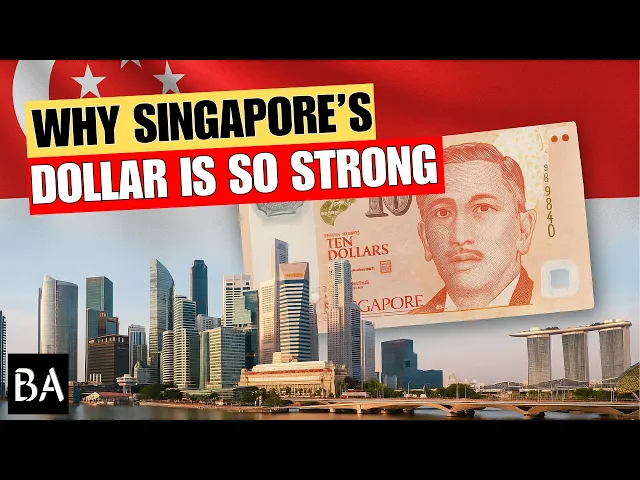
Emerging market currencies like the Malaysian ringgit, Indonesian rupiah, and Philippine peso have also lost value relative to the greenback. And yet, amid this global dollar surge, one currency stood out for its resilience: the Singapore dollar. The Singaporean Dollar has emerged as one of the world’s most resilient and best-performing currencies, not just in the past few years, but in recent decades.
If you traveled from Singapore to Malaysia in the late 1990s, you might recall that 1 SGD could buy only about 2 Malaysian ringgit – during the 1997 Asian financial crisis, the ringgit fell to around 2 ringgit per $1 Singaporean dollar. Today, 1 SGD fetches roughly 3. 4 ringgit, a nearly 70% jump in two decades.
Likewise, against the U. S. dollar, the SGD has strengthened: in 1997, USD/SGD spiked to around 1.
70 (meaning one US dollar cost $1. 70 Singaporean dollar); as of 2023 it’s about 1. 35, indicating the SGD’s value has risen by ~20% against the greenback.
The Singapore dollar is one of the strongest and most stable currencies in the world – a fact often remarked upon in financial circles. But why is this the case? Why has the Singaporean dollar performed so well in the past few years, and in recent decades?
Well, there are various answers to this. One way to view this is simply because of the Singaporean economy. The Singaporean economic success is often described as a “miracle,” but at its core are very tangible policies and fundamentals that translate into a strong currency.
Economic fundamentals matter greatly for exchange rates – robust growth, low inflation, and healthy trade all tend to support a currency’s value. But other than a formidable economy, there is one more important answer to this, and that is the Singaporean central bank. Unlike most central banks that adjust interest rates to guide their economies, the Monetary Authority of Singapore (MAS) uses the exchange rate as its main monetary policy tool.
This approach is highly unusual – Singapore is one of the few countries in the world to do this – but it has been central to keeping the SGD strong and stable. Take a look at it this way. Since the early 1980s, MAS has operated a managed float regime targeting the Singapore dollar’s value against a basket of currencies.
This basket, known as the S$NEER (Singapore Dollar Nominal Effective Exchange Rate), is a trade-weighted index of Singapore’s major trading partners’ currencies. MAS doesn’t announce the basket composition (it likely includes USD, CNY, MYR, EUR, JPY and others in proportion to trade) and keeps the target band undisclosed. But in practice, MAS periodically adjusts the band’s slope, width, or center to either appreciate, depreciate, or stabilize the SGD.
For example, in times of rising inflation, MAS will set a policy of modest SGD appreciation (by increasing the slope of the band) to make imports cheaper and tame inflation. During recessions or deflationary periods, MAS can flatten or even lower the band, allowing the SGD to weaken and support export competitiveness. This policy has been effective for Singapore’s circumstances as a small, open economy where exchange rates strongly influence import prices (and thus inflation).
By directly managing the currency, MAS can address inflation pressures more nimbly than using interest rates. In the boom years before the 2008 global crisis, MAS “allowed the Singapore dollar to appreciate steadily” which “helped keep a lid on domestic inflation”. Conversely, during downturns like the Asian crisis (1997–98) or the 2001 tech bust, MAS eased the SGD’s rise or let it dip to cushion the economy.
Over time, this has made the SGD one of the least volatile currencies in Asia. According to MAS studies, the variability of Singapore’s trade-weighted exchange rate has been much lower than that of free-floating currencies like the USD or JPY. In other words, the MAS keeps the SGD on a steady and strong course, avoiding wild swings.
Then there’s also interest rates, which are Market-Drven and U. S. -Linked.
One side effect of this regime is that MAS does not use domestic interest rates as a primary tool. Singapore’s interest rates are largely market-determined and tend to track global rates, especially U. S.
interest rates. Why the U. S.
? Because investors can move funds freely in and out of Singapore, so if U. S.
rates rise significantly above Singapore’s, money might flow out – but MAS’s exchange rate policy implicitly counters that. In practice, Singapore’s short-term rates (like the interbank rate SIBOR or the newer SORA) closely follow the U. S.
Federal Reserve’s moves. The benefit is that Singapore rarely experiences destabilizing interest differentials. For example, in 2022 the Fed hiked aggressively (425 basis points in one year) and many regional currencies (like the ringgit) fell because local rates didn’t keep up.
Singapore, however, saw its market interest rates rise alongside U. S. rates, “so the SGD experienced less pressure from yield differentials”.
In plainer terms: because Singapore’s rates mirrored U. S. rates, investors had less reason to dump SGD for USD during the Fed’s rate hikes.
This contributed to the SGD’s resilience during a period when many currencies weakened against a strong dollar. A vivid illustration came in 2022: The U. S.
dollar was surging as the Fed raised rates; Asian currencies like the JPY and MYR tumbled to multi-decade lows. The SGD, while not immune to the dollar’s strength, held up relatively well. By year-end 2022, USD/SGD was roughly 1.
34, barely changed from a year earlier – meaning the SGD was flat against a roaring USD (in fact, the SGD appreciated slightly on average in 2022). How? MAS had tightened its exchange rate policy multiple times from 2021–2023 (steepening the appreciation slope and even re-centering the band higher) specifically to combat imported inflation.
Those moves allowed the SGD to strengthen in nominal terms even as the USD was strong, offsetting some inflation from pricier imports. Meanwhile, Malaysia’s ringgit depreciated ~10% against the USD in 2022, partly because Bank Negara Malaysia raised rates more slowly and explicitly prioritized domestic inflation over defending the ringgit. The contrast underscores MAS’s approach: rather than let the currency slide and import inflation, MAS leaned against the wind, maintaining SGD strength to safeguard price stability.
Another advantage of Singapore’s exchange-rate-centric policy is evident in crises. In 1997–98, when the Asian Financial Crisis ravaged regional currencies, Singapore was relatively insulated. The SGD was not immune – it fell about 20% against USD at the peak of the turmoil– but this was mild compared to the 40–80% crashes seen in the Thai baht, Indonesian rupiah, or Korean won.
Analysts note that “only Singapore proved relatively insulated” during the Asian crisis, largely due to its strong fundamentals and credible monetary policy, though it still suffered economically. MAS had built up hefty FX reserves and kept a steady policy, deterring speculators who found easier targets in countries with fixed or lax regimes. In fact, by 1999 the SGD had recovered much of its lost ground.
Fast forward to the Global Financial Crisis of 2008: MAS eased the SGD’s appreciation path (turning it to a zero slope) to support the economy, and once recovery took hold, returned to a gradual appreciation stance. The SGD remained broadly stable in value through that turbulent period. This track record of stability has given the SGD a reputation as a sort of regional safe-haven currency.
While the Japanese yen or Swiss franc are traditional “safe havens” globally, the Singapore dollar has increasingly been seen as a safe haven within Asia. During bouts of uncertainty – whether regional political strife or global market volatility – investors often park funds in Singapore thanks to its stability. For example, during recent global uncertainties like the U.
S. debt ceiling scare or the Russia-Ukraine war, “some investors [sought] refuge in safe-haven currencies like the Singapore dollar”. This dynamic further boosts the SGD in times when other currencies might be selling off.
Now, beyond these, there are a lot more answers for the Singaporean dollars’ strength, ranging from its credit rating to enormous reserves. But anyway, do let us know what you think. Thanks for watching!