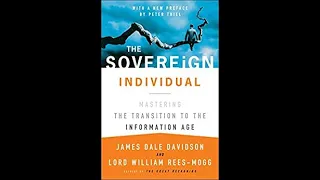
the sovereign individual mastering the transition to the information age written by james dale davidson and lord william reese mogg and it was first published in the year 1997. this book is about how the information age is going to give rise to the sovereign individual at the expense of modern day nation states and even though it was written in 97 20 some years ago it's still very relevant today so we're going to take a look at it and dig in and see what it's all about there's 11 chapters and in this video we're going to go
over chapter one just the transition of the year 2000 the fourth stage of human society now why is this chapter important it sets up the context of the book that early on the authors come out and explain their theme so they introduce the theme of the book frame that theme in a historical context and then provide a high level overview of the key topics related to that theme to be discussed in detail in subsequent chapters and the theme of the book is this it is the new revolution of power which is liberating individuals at the
expense of the 20th century nation state so let's unpack that a little bit what do they mean by the new revolution of power essentially they're talking about the internet age that we're living in right now but they described it as technological improvements or innovations which alter the logic of violence there's a very interesting term right there logic of violence that is talked about a lot throughout the book and by that they mean how violence is organized and controlled typically nation states have dominated this space for the last couple hundred years they've excelled at organizing violence
controlling violence deploying violence and it's been their game and the authors point out that they feel that this is the real mover and shaker on the geopolitical landscape and they identify the logic of violence as a hidden cause of change because they feel like it's often overlooked then they introduce a term called mega politics and they identify that as the hidden factors that alter the boundaries where power is exercised they dig into this later but from a high level there's four branches to the mega political lens that they will employ to make sense of what's
going on around them that's topology climate microbes and technology so in addition to these technological improvements or innovations which alter the logic of violence that are giving way to this new revolution of power they point out that microprocessors are paving the way for the emergence of a cyber economy this is essentially where we are today quick side note i'm recording this in september of 2021 so almost 25 years after this book was originally written and at the time of the first publication the internet was very new at least to the general public and so they're
calling out that these microprocessors are paving the way for the emergence of a cyber economy our online economy as we know it today and they felt like it would have these following characteristics that it would be untaxable it would be encryptable and private it would transcend locality would be lacking physical threats and less prone to violence and that long-term jobs would give way to more ephemeral task based employment we've seen a lot of this stuff play out already in the early days of the internet online transactions weren't taxable but eventually governments caught up in online
sales are now usually taxed these days encryptable and private to be online and have privacy and have your data encrypted but you really have to go out of your way to to achieve that transcending locality is interesting this is basically pointing out that because these technological improvements would be providing a new class of tools and services and that these tools and services would be taking place online that individuals would no longer be bound geographically to any one area lacking physical threats less prone to violence and long-term jobs give way to more ephemeral task-based employment we've
definitely seen that in the last several years with the rise of the gig economy so in in addition this new revolution of power is this notion that the authors point out that the proliferation of microprocessing based devices would ultimately subvert and destroy the modern day nation state that's a pretty bold statement and there's a lot going on there and the authors dive into detail as the book goes on so we'll see more of that so the second part of the theme of the new revolution of power which is liberating individuals at the expense of the
20th century nation state is the liberation of individuals so how are individuals being liberated because of this new revolution of power the authors feel that because of the transition from the industrial age into the information age that individuals would have opportunities for increased income inability to accumulate greater wealth greater degrees of individual autonomy monetary independence via cyber currencies increased self-reliance and more choices through private markets and they point out one of the things they get into is that they have an evolving definition of success and wealth and what it means to be wealthy and they
felt like in the information age it wasn't going to be so much about how much money you made or how much wealth you have but also about this notion of greater degrees of individual autonomy is that being a signifier of wealth the ability for somebody to go somewhere or do whatever they want when they see fit they felt like that would be just as important a factor in terms of success as we view income and wealth these days or previously another thing they point out monetary independence via cyber currencies there's a really good quote from
this part of the chapter i want to share it with you it says in the information age individuals will be able to use cyber currencies and thus declare their monetary independence when individuals can conduct their own monetary policies over the world wide web it will matter less or not at all that the state continues to control the industrial area printing presses their importance for controlling the world's wealth will be transcended by mathematical algorithms that have no physical existence in the new millennium cyber money controlled by private markets will supersede fiat money issued by governments this
is pretty cool because they're basically just calling the rise of bitcoin that first surfaced in late 2008 in response to the financial crisis at that time so they talked more about this and it's cool to see how this is played out 20 some odd years down the road down the line and the type of world we're living in these days where bitcoin is has essentially taken over a huge aspect of the monetary world just yesterday september 7 2021 we had the first nation state el salvador officially declaring it as their national currency so the third
part of this theme of the new revolution of power which is liberating individuals at the expense of the 20th century nation-state is the expense of the nation-state so why is this individual liberation occurring at the expense of the nation state the authors point out that these technological innovations are tipping the scales in favor of smaller groups and even individuals and because of them because of these innovations smaller groups and individuals could pose a legitimate threat to somebody like ignition state so examples of this would be terrorists and hackers and because of that the nation states
would no longer have a monopoly on violence and that these technological innovations would ultimately result in declining tax revenues and the nation state being in a situation where they are less able to extract and redistribute its citizens income and wealth and this goes back to the liberation of individuals having more choices through private markets because if you get into a situation where the nation state loses its ability to tax its citizens they're not going to be able to provide all the services that they previously were able to provide and so if those services aren't provided
by the nation-states presumably somebody else in the private market sector is going to come in and start providing them and when multiple private market entities are providing a service there will be competition they'll be forced to operate more efficiently and at a lower cost or a lower price point to the at least consumer or recipient of that service and that's going to equate to more choices through private markets which is part of this liberation of individuals having more choices another thing that's an artifact of these declining tax revenues is that nation states won't be able
to fund their militaries as well as they had previously and that's going to jeopardize the monopoly on violence that nation states typically had for the previous couple hundred years so what if the nation state doesn't like losing its power its ability to tax its citizens in its monopolization on violence how might they push back nobody likes to lose their power the authors called that we would see unchecked printing of fiat currencies seizing property violation of human rights censorship of speech and information restricting access to technology and sabotage and or block emerging technologies and again i'm
recording this video in september of 2021 and so it's been a pretty wild 18 months or so basically since march of 2020 and there's a lot of there's a lot of the stuff that has come to light and this notion of unchecked printing of fiat currencies we really saw that in response to the 2008 financial crisis the form of quantitative easing and then when the pandemic hit in march 2020 it really kicked into high gear and i saw a figure recently something like 37 percent of all fiat u.s currency has been printed since march of
2020. i'll fact check that and put a link in the description and as far as restricting access to technology and sabotaging or blocking emerging technologies we've seen a little bit of this as well you have countries like china over the last couple years banning app banning access to apps that were built by companies from the west there's been several instances over the last few years of governments attempting to block and or ban bitcoin or make cryptocurrencies illegal and that typically has failed thus far and they end up backtracking on that so we've seen some of
these aspects playing out as we progress into the information age in the nation state is experiencing these growing pains of their inability to tax and losing their monopoly on violence and how they're reacting to it again why is this theme of the book why is this important enough to consider it's important because it can profoundly change the ways in which an individual chooses to exist and behave throughout their life it gives you a framework for understanding the larger zoomed out version of what's happening around you and by having that understanding it gives you an opportunity
for making more informed decisions and keeping this in mind helps to contextualize the larger scale socioeconomic events that are unfolding every day and these events affect us as individuals not only locally but also regionally in our towns and states nationally at the nation-state level and internationally on the global scale so it really affects everything all across the spectrum and in what context is this revolution taking place the author spent some time briefly going over the stages of economic life in social organization as we understand it these days over the last from the last several hundred
thousand years so from a high level you have hunter gatherer agricultural industrial and information and over the last couple hundred years we've been in the industrial age and the end of the millennium marked our transition from the industrial age into the information age which is where we are now or at least we're in full swing of that transition and they also talked about how over the years over the millennia many people have predicted the year 2000 as the end of the world and they cited some examples here for one isaac newton apparently claimed the world
would end in the year 2000 nostradamus predicted the coming of the third antichrist in july of 99 carl jung claimed there would be a birth of the new age in 1997 and a gentleman by the name of dr edward yardini in 1998 warned of widespread disruption due to y2k so the authors believe that the end of the millennium the coming of the year 2000 was definitely significant and that it not because the world was going to end it was going to be like the death of everybody but that it marked the end of the modern
phase of western civilization aka the industrial age and its transition into the information age so that's about it for the first chapter as the book goes on we're going to continue digging into this theme of the new revolution of power which is liberating individuals at the expense of the 20th century nation-state and we'll see how technological innovations amongst a megapolitical landscape are altering the logic of violence and ultimately tipping the scales in favor of small groups and individuals at the expense of overbloated inefficient irrelevant and increasingly impotent large-scale geopolitical bureaucracies known as the modern day
nation state