Though the early idealists cared greatly for logic and its role in reasoning, with Hegel basing the structure of his entire corpus in Aristotelian logic, not much of it was very influential or original. But as the roots of the analytical tradition began emerging in the 19th century, several new concepts and interpretations arose as Llull’s, Hobbes’ and Leibniz’ project of developing logical notation akin to mathematics was finally properly established with the ascension of symbolic algebra, as well as entrenching logic within the scientific method. Mill and Comte were contemporaries, and frequently exchanged letters.
Though Comte himself didn’t offer much novelty within logic, he inspired Mill to develop what he called the Inverse Deductive, or Historical Method of logic toward societal analysis, a clear influence from the positivist project of dealing with social issues using the scientific method. Though he thoroughly criticizes any a priori concept, Mill suggests we can derive stable scientific laws by observing empirical data on society over time, and checking them against the laws of psychology and biology, or more specifically, ethology, the study of animal behavior, as we are also animals. Through this inductive process of observation then, we can reach laws to deduce certain predictions – laws that would not have a priori necessity, but would have “strong a priori reasons” to be correct; thus, an “inverse deductive” method.
Much like in Pascal’s Wager, the rationalist necessity of the a priori sphere takes at most a strong probabilistic possibility, in this case based on empirical data. Though much more developed, this method of reasoning is still central to the social sciences to this day. During their lifetime, one of the most important names in modern logic arose.
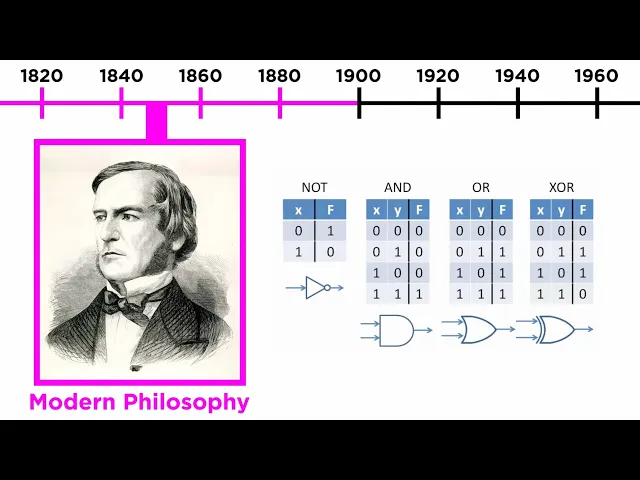
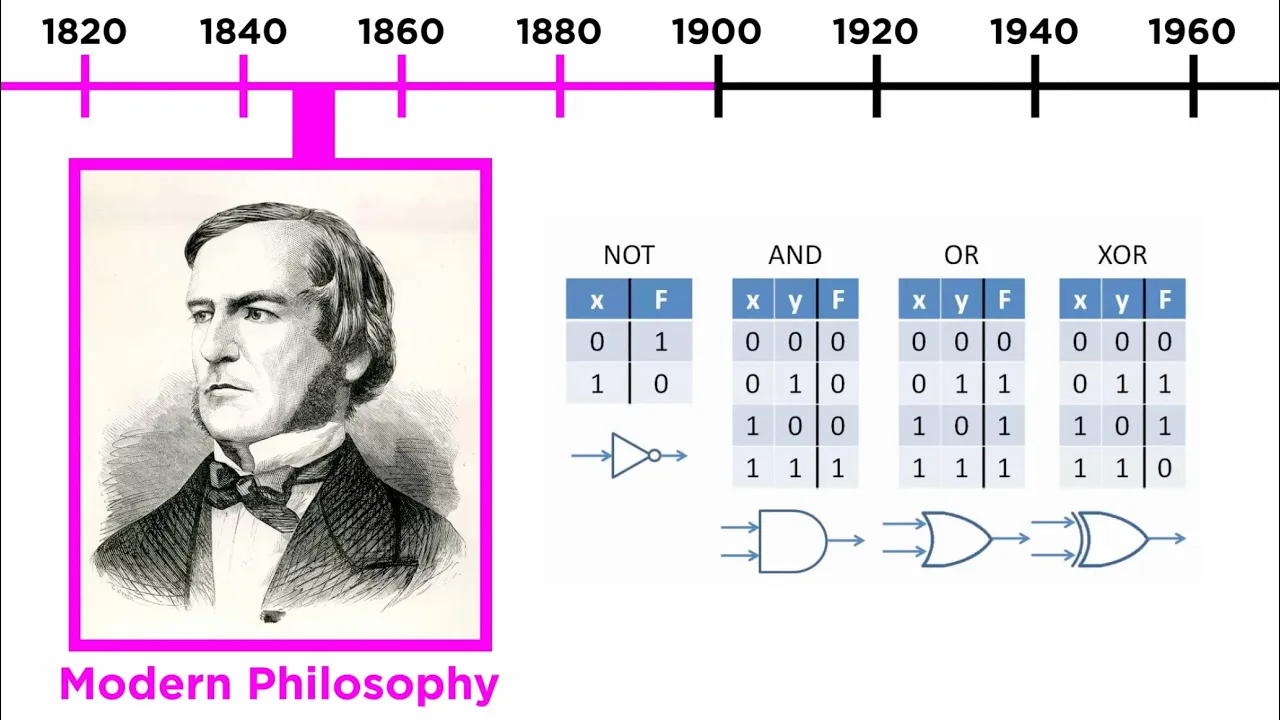
The first to encapsulate the intent of all his predecessors as well as Mill to move toward an actual logical system which could be treated with the same objectivity and practicality of algebraic calculus was George Boole during the mid-19th century. His goal was to reduce all logic to a mathematical science, a project since embraced by early 20th century analytic philosophy, and which he helped develop. You may have heard of him, as Boolean operators are still being used in several technologies, programming languages, and also in search engines, such as Google.
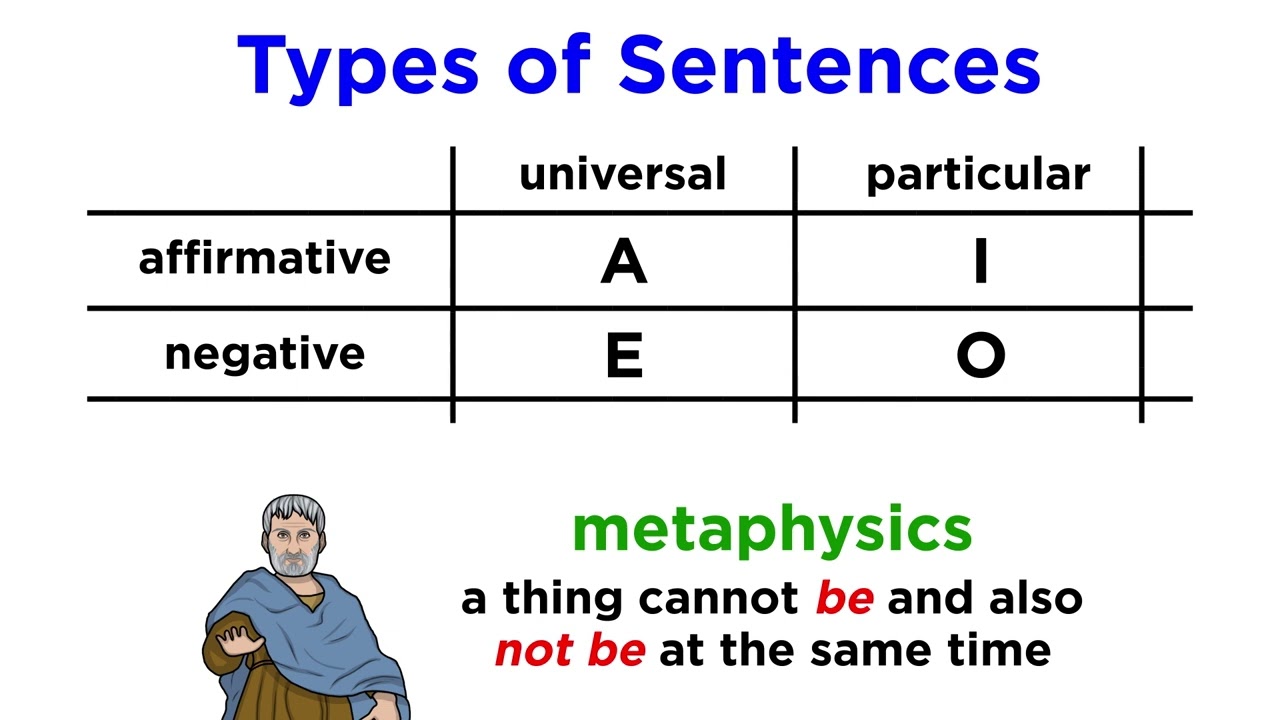
Though still technically aristotelic, Boole reformulated the entire format in which logical procedures would occur, and shifted its focus from a sentence-based system toward a symbolic, algorithmic one. Truth and falsity were referenced as 1 and 0 respectively, and variables such as A or B became the x and y of algebra. B-type propositions then would shift from “No A is B” to “xy=0”, and A-type propositions from “All A are B” to “x=vy”, where “v” would represent an indefinite class.
In the latter example, if we meant to say “All men are mortal”, “x” would refer to “men” and “y” to “mortal beings”, and thus “x=vy” would mean literally “All men are some mortal being”, which according to Boole is the proper formulation of the original aristotelic phrase, as all “men” regardless of identity would necessarily be some member of the category “mortal”. His greater focus, however, was in propositional logic. Let’s recall the modus ponens “If x then y/x/Then y”, which we saw in the tutorial on Logic in Ancient Philosophy.
That would look like this in Boolean algebra: “x(1-y)=0/x=1/y=1”. Propositional logic is also where he developed his operators, which are relevant to this day. In order to deal with complex propositions, Boole proposed symbology such as “P” or “Q” as generic variables for any propositions, while Greek symbols phi or psi refer to specific expressions, and the operators “and”, “or” and “not” respectively became these symbols that can be found within the expressions.
So complex propositions such as “It’s either rainy or sunny” would be represented by P or Q, and “It’s either not rainy or it’s windy” by not P or R. The Greek letters come into play if we want to represent an entire complex proposition with one symbol, to then make even more complex propositions. To put this to use, if it was a visibly sunny day, we could perform the following calculations given certain premises: “1.
P or Q/2. not P and R/3. Q/4.
not P [Modus Tollens of 1 and 3]/5. R [Modus Ponens of 2 and 4]”. Thus, our conclusion would be 6.
Q and R. We could read this calculus as “It’s either raining or it’s sunny, and if it’s not raining then it certainly is windy, since all the noise outside must be generated by either rain or wind. As I look out the window to a sunny day I confirm that it is not rainy, as it can only be one or the other, so it is also a windy day.
Therefore, in conclusion, it is a sunny and windy day. ” All of these developments would set the bedrock upon which contemporary logic would develop itself even further from Aristotle. But like many that came before and after him, Boole never succeeded in his life goal of reducing logic into mathematics.
However, more than anyone else before him, he proved that logical analysis must have a strong mathematical perspective in order for it to truly progress. Peirce was very much impressed by the work of Boole, and it was vital to his pragmatist perspective. Logic was central to his whole theory, and likewise he developed it in several manners.
In his semiotics, logic had three different purposes: 1) as “speculative grammar”, or a way to discover the meaning and use of different and new symbols, 2) as “logical critics”, which represent most classical logic with both inductive and deductive logic, and also his new “abductive” logic we will delve into later, and 3) as “methodeutic”, which focuses on the psychological, economic, and rhetorical aspects of the previous uses of logic, thus being less objective than logical critics and more focused on advantages of given propositions instead of their validity. Since all besides 2 veer into other territories apart from logic, we will focus on his development of inductive reasoning and the creation of abduction. In order to understand if there was actually any logic to scientific discovery, he developed induction into abduction, or retroductive logic.
Its final formulations characterized it as more of an inquisitive demand for the explanations of facts. In the scientific process, if one faces a surprising fact X, one should attempt to understand what event Y would have come to pass for that fact X to come into being. An abductive syllogism would be represented as “X/If Y, then X/Thus, Y might be true.
” It is a non-necessary reverse engineering of the phenomenon, attempting to derive its possible cause through new hypotheses, instead of merely deducing its consequence. One could parallel an abductive inference to games like mastermind, hangman, or the more contemporary wordle: you always try to make the most probable guess on what the secret word is based on every piece of new information you gain with each attempt. The next word you guess, however likely, might not be the actual answer: this uncertainty and dependence on probability is the core of what an abductive inference is.
We can also think about the work of a detective: when they follow clues, each piece of evidence helps them to an image of a mysterious crime. Given that the wrongdoer probably hid the relevant evidence of his crime, the detective needs to work with an incomplete set of clues to understand what happened in order to make a reasonable guess as to who is guilty, and this judgment will be better or worse based on the quality of the evidence. Abductive reasoning is a good example of logic applied in other fields like criminalistics, forensic science, and even archeology, fields far from the theoretical and philosophical.
Inductive reasoning was also further developed by Peirce, condensing the intent of Mill and his antecessors with three main forms: 1) crude, where a generalization is made from past experience such as “I have never gotten ill with disease X, therefore I never will”, 2) qualitative, which was his first formulation of abduction, and attempts to generate a hypothesis by generalizing it, instead of testing it as his final formulation of abduction did. And 3) quantitative induction attempts to analyze the probability of a law by comparing random sampling of a given case with the results observed. If one were to observe, let’s say, 7 sheep, and recorded observed color, wooliness, hoof shape, and diet, and afterwards all of these qualities were confirmed to be present with minimal variation, then a high likelihood of all sheep having these qualities is observed.
The final validity of inductive methods then, similarly to the probabilistic aspect of abductive reasoning, is always based on its further enhancement with greater sampling. All of these developments in logic by Peirce would be crucial to 20th century developments for every area he delved into. From psychology to mathematics, from economics to language, much of what has been achieved today can be traced either directly or indirectly to his systematizing and creations.
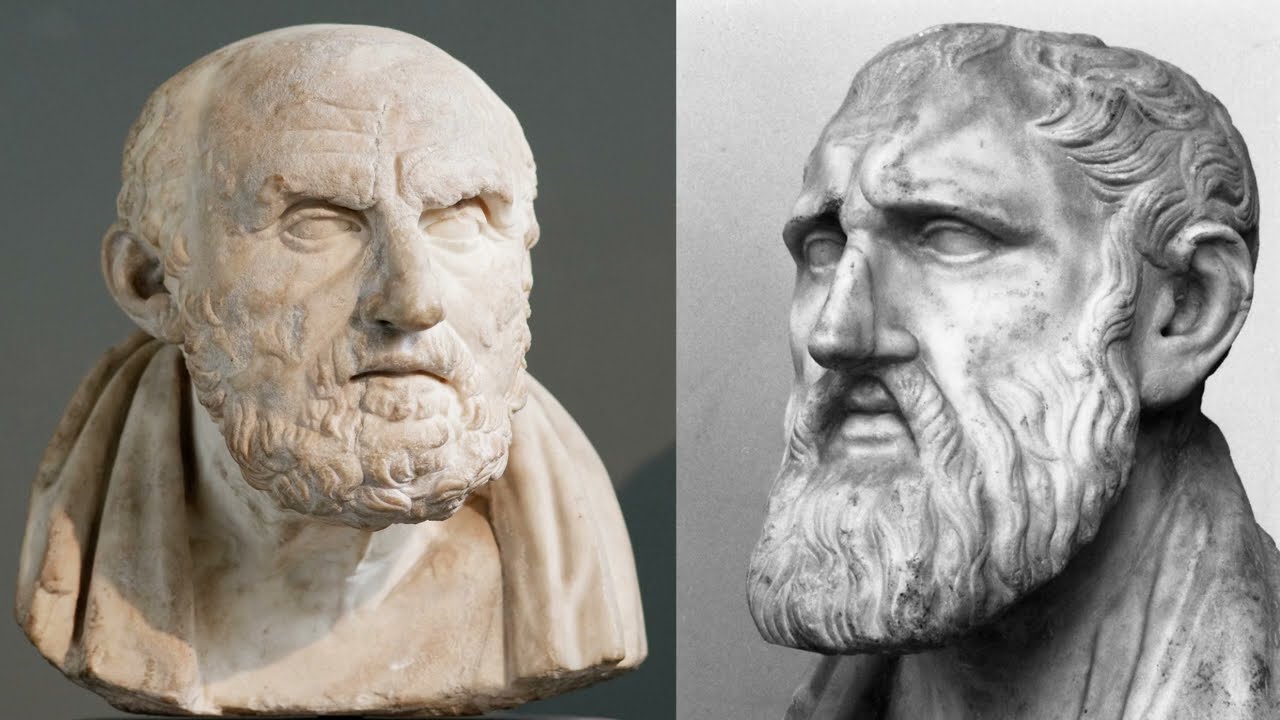
Clearly the modern era in logic and philosophy as a whole represented the enormous development which resulted in the paradigm shift most areas would undergo in the 20th century. In complete contrast with the stagnation from the dark ages, the modern period saw the rise of several figures important to the development of logic, much like Chrysippus and other important Greek figures were in developing Aristotelian logic toward new horizons, with logic now barely resembling its original roots. So much so that as this period ended, Frege brought about a revolution which finally surpassed the old Greek spirit of logic, but we will save that for another tutorial.