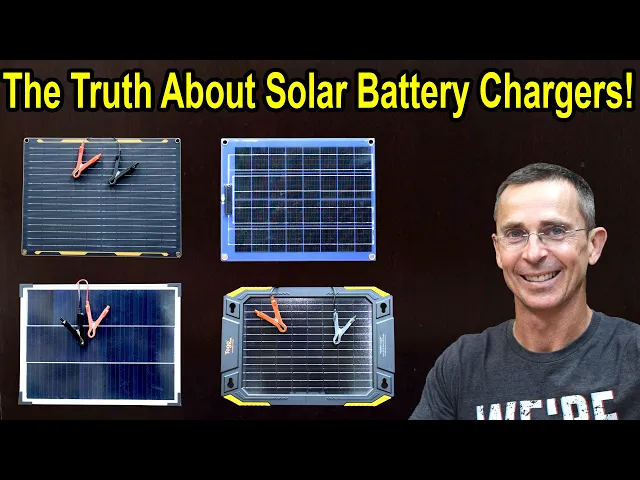
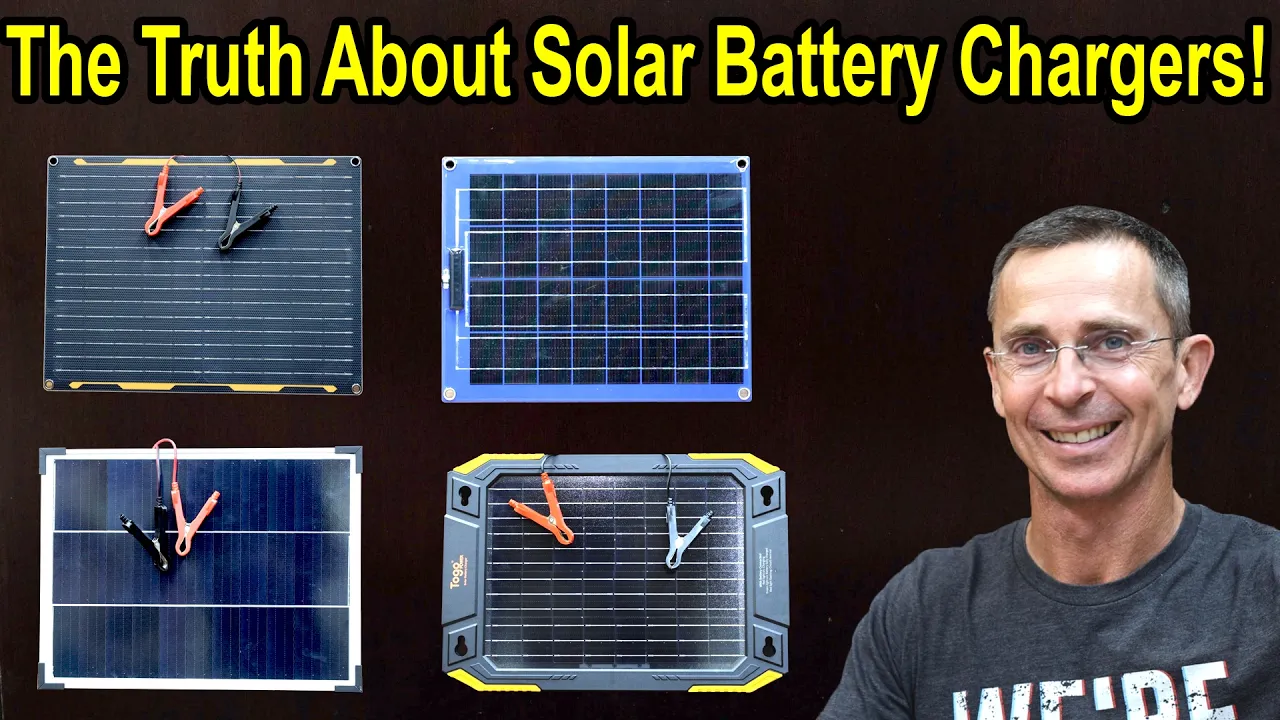
The nice thing about a solar battery CHARGER IS YOU DON'T HAVE TO DRAG A POWER CORD all the way out to the vehicle that needs a battery charge. So, the question is, is that $20 charger just as good as the one that cost $265? Well, let's find out.
In a first test, we'll compare solar production and overcast and sunny conditions. Then, we'll compare the float charge cut in and cutout voltage. Unfortunately, not all the chargers offer reverse polarity protection.
Not all the panels will survive the impact test. At a price of $18, the least expensive solar battery charger we'll be testing is made by Shashuing. The manufacturer claims a 30 watt solar car battery charger and maintainer.
They claim the solar panel can withstand high wind pressure, snow load, and extreme temperatures. We're going to test that. It's supposed to include overcharge and reverse discharge protection.
We're going to test that. You can use the cigarette lighter port to charge the car battery. And the Shashing is made in China.
Weight is sometimes an indicator of quality, and the Shashuking weighs 154 g. In the first test, let's see how the solar battery chargers perform with overcast skies. I'll test the solar panels while they're flat on the ground and at a 28° angle.
I'll be using a tester specifically designed for testing the performance of solar panels with the panel completely level with the ground and we're very close to midday right now at 0. 8 watts or 19. 47 volts.
With the panel laying at an angle of 28° and towards the direction of the sun, 0. 76 watts at a price of $28 is this Hoy brand. They claim it's a 20 W 12volt monochristine battery maintainer.
It comes with a 10 amp solar charge controller and extension cable with battery clips with O-ring terminals. You can use this for off-grid power or for charging 12volt batteries. It's supposed to protect the battery with under and over voltage protection as well as short circuit protection.
And the Hoy is made in China. And the Hoy is pretty heavy at 1,598 g or 3. 52 lb.
The Holo Sissy's charge controller on the right shows 22. 5 volts and the tester shows 22. 13.
The Hoy Sissi is at 6. 09 09 watts laying flat at a 28° angle. 6.
47 watts at a price of $30 is this new power brand. They claim it's a 20 watt 12volt solar panel car battery maintainer. It's supposed to include a lighter plug, alligator clips, and a portable trickle charger.
Eight suction cups on the panel so it can be installed on a plain surface. It can be used with 12volt DC batteries as well as lithium batteries. And the new power is made in Vietnam.
And the new power is pretty light at 746 g or 1. 64 lb. The new power isn't nearly as good as the Hoy at 3.
35 watts laying flat and 18. 97 volts. The 28 degree angle didn't help at 2.
68 watts. Also, the price of $30 the same price as a new power is this Volt Hero. The Volt Hero is rated for 20 watts.
It's supposed to be both a charger and a maintainer. The monochrystalline silicone panels are supposed to be capable of up to 30% conversion. Designed for lead acid, gel, and life P4 batteries.
Includes a 10 amp smart solar charge controller. And the Volt Hero is made in China. And the Volt Hero is the heaviest yet at 1,510 g or 3.
32 lb. The Volt Hero moves into second place behind the Hoy at 4. 13 watts and around 20 volts laying flat.
Unfortunately, the 28° angle didn't help at 4. 11 watts at a price of $30 is this TBR brand. It's a 20 watt 12volt solar battery charger with a 10 amp charge controller.
It also comes with extension cables with battery clip O-ring terminals. You can also use this as an off-grid solar charger system. works with AGM, flooded, gel, deep cycle, and sealed lead acid batteries.
They claim it's designed to handle sand storms, strong wind, thunderstorms, blizzard, and hail. It's supposed to provide overvoltage, discharge, short circuit, in reverse polarity protection. And the TBR is made in China.
The TER weighs 1,274 g or 2. 81 lb. The TBR performed the best lying flat so far at 6.
37 watts and just over 22 volts. The amount of overcast sky is going to vary somewhat in the ters at 4. 57 watts using a 28 degree angle.
At a price of $25 is this EBL brand. The previous chargers are rated for 20 watts. The EBL is rated for 25.
They claim it's a portable and foldable solar panel charger. They claim a cell efficiency of 23. 5%.
They claim cutting edge smart IC technology. They claim protection against overcharging, overheating, overload, overcurren, and shortcircuit protection. You can use the suction cups to attach the solar panel to the windshield and the EBL is made in China.
The EBL weighs 1,024 g or 2. 26 lb. The EBL is only at 13.
14 volts at 4. 87 watts lying flat. The 28° angle isn't helping at 4.
18 watts or about 21 watts below its 25 watt rating. At a price of $50 is this Grestell brand. Just like the EBL, the Grestle is a 25 watt charger.
It's designed to both charge a battery as well as serve as a trickle charger. They claim 24% high conversion efficiency, 98% high light transmission. It's designed to work with all different types of 12-volt batteries.
It has a built-in blocking diode to prevent reverse charging without extra maintenance at night. They claim it even works on cloudy days. We're going to test that.
And the Gresel is made in China. And the Gres weighs 1,034 g or 2. 28 lb.
And the Gres moves into the lead at just over 7 watts at just under 14 volts. The Grestle is at 8. 87 87 watts at a 28° angle.
At a price of $50 is this Soul Perk brand. The Grestle is rated for 25 watts, but the Soul Perk is rated for 20. It's a solar battery and trickle charger maintainer with an upgraded controller.
Includes an adjustable mount bracket for car, boat, or RV. It'll charge any type of 12volt battery. It's constructed of a low iron tempered glass surface.
They claim a lifespan of up to 25 years. Designed for strong wind, thunderstorms, blizzard, and hail. We're going to test that.
They claim an efficiency of 21 to 30% and a Soul Perk is made in China. The Soul Perk weighs 1,324 gram or 2. 92 pounds.
The Soul Perk performed well at 5. 81 watts at around 20 volts. The 28°ree angle hurt the performance at 3.
85 watts at a price of $59. Is this NXQ WLL? Let's just call it the NX brand.
They claim a maximum output of 20 watts. The Glima is a high power semiflexible monochrystalline silicon panel equipped with a waterproof gasket to prevent moisture from entering the interior. They claim it works with lead acid batteries.
It has a built-in maintenance pulse and the built-in charging module provides overcharge protection. And the NX is made in China. And the NX is pretty light at 524 g or 1.
15 lbs. The NX moves into the lead at 10. 67 watts at 14.
7 volts. The NX performed about the same at 28 degrees at 10. 49 49 watts.
The best yet at a price of $60 is this Toga Power. It's a 12volt battery charger and maintainer with a built-in MPPPT. They claim it's IP67 waterproof.
They claim it has the ability to track max power point to increase charging efficiency by up to 30%. It's supposed to be very efficient even in low sunlight. Automatically adjust and produces more voltage and batteries while trickle charging but not overcharging.
And the Toga Power is made in China. The Toga Power weighs 1,462 g or 3. 22 lbs.
The Toga power seems underpowered at around 2. 68 watts and around 10 volts which is not enough to charge a car battery. At 28 degrees, the voltage is just too low at around 10 volts and only 2.
28 watts. At a price of $80 is this Flex Solar brand. It's a charger maintainer and trickle charger with built-in charge controller.
Include cigarette lighter plug, alligator clips, O-rings for OBD2 connector for car. They claim that when the power is close to full on the battery charge, it automatically switches to trickle charging mode. At this point, it provides a small and stable current.
It's designed for lithium, gel, AGM, and flooded. The built-in charge controller is supposed to prevent overcharging, and the Flex Solar is made in China and a 636 g or 1. 4 lb for the Flex Solar.
The Flex Solar only mitted to 4 watts at around 19 volts. At a 28° slope, just under 5 watts at a price of $86 is this Sooner Power brand. They claim it's a 20 watt 12volt solar battery trickle charger and maintainer pro.
They claim it has a built-in intelligent controller. It's supposed to be waterproof. It has a three-stage charging algorithm, bulk, absorption, and float.
They claim it's not just an advanced trickle charger. It's an advanced solar battery charger maintainer. And the Suna Power is made in China.
And the Sunna Power is by far the heaviest yet at 284 g or 4. 59 lb. The Suna Power performed better than average, lying flat at 7.
33 watts at around 22 volts. at a 28 degree pitch, 5. 79 watts, which is actually pretty good.
At a price of $112 is this shoe mocker brand. The shoe marker is absolutely massive and they claim only 15 watts of production. It's supposed to be a battery charger and maintainer with a solar charge controller.
The solar panels are supposed to be water resistant. They claim that the charge controller is designed to prevent overcharge damage. It's compatible with lead acid batteries.
It does not advertise lithium batteries. And the shoeer brand is made in China. And the shoe bucker is quite a behemoth at 4,926 grams or 10.
86 pounds. The shoe marker performed poorly compared to the competition. While lying flat at 3.
08 watts or around 20 volts at a 28°ree pitch only 2. 25 watts, which is not very good at a price of 265, the most expensive solar charger we'll be testing is made by Pulseek. They claim a maximum energy production of 12 watts.
It's supposed to be a charger and a maintainer. They claim it extends the battery life by 3x. It's supposed to remove solation.
They claim this solar panel is virtually indestructible. We're going to test that. It works on all 12volt batteries including AGM gel, VRLA, and flooded cell.
And the Pulse Tech is made in India and is 994 g or 2. 19 lb for the Pulse. The Ptech performed the worst in the competition while lying flat at 0.
12 watts at around 18. 3 volts. And the 28° pitch did not help at all at 0.
1 watts. Taking the average solar production lying flat and at 28 degrees, the NX came out on top at 10. 58 watts.
The Grestle finished in second place at 7. 95 watts and Suna power third at 6. 56.
Solar panel size is a factor to consider and the Shashuking is the smallest at 5x 12 in which works out to 65 square in. The PTSE is also pretty compact at 125 square in and the NX3rd at 165. There's not a cloud in the sky and the solar panels have been soaking up heat for several hours.
I've made several attempts to find the best possible solar panel angle to maximize solar production. Unfortunately, the Shashank Sting is only at 2. 22 watts.
The Hosissi is rated for 20 watts and it's about 3. 5 watts short of its rating at 16. 49.
The new power is also rated for 20 watts, but the heat is really impacted the new power at just over 14 watts. The Volt Hero is handling the heat better than the new power at 15. 55 watts to move into second place behind the host The T-R is also suffering from the heat at 14.
37 watts or over five watts short of its rating. The EBL is supposed to produce 25 watts, but it's over 10 watts short of its rating at just over 14. The Grestle looks almost identical to the EBL, but it continues to outperform the EBL at 15.
71 watts. The Soul Perk is very hot to the touch in the direct sunlight, and it's well below its 20 watt rating at 14. 51 watts.
The NX continues to perform above average and moves into the lead at 16. 77 watts. The Toga Power continues to trail the NX at 14.
19 watts and is really struggling in the heat. The Flex Solar is rated for 20 watts and it seems unaffected by the heat at 21. 52 watts to move into the lead.
For the solar battery charges with a 20 watt rating, the Sun power is performing about average at 14. 75 watts. The shoe marker is a really massive and heavy panel and it's really struggling at only 11.
86 watts. The Pulse Tech is rated for 15 watts and it's about 3 watts short of its rating at 11. 97 watts.
In hot sunny conditions, the Flex Solar produces the most energy at just over 21 a. 5 watts. The NX finish in second place is 16.
77 and Hoyissi third is 16. 49 watts. Solar battery chargers are meant to be portable and efficient and the Flex Solar is the most efficient at 0.
12 watts per square inch. The NX and the Pulse are also very efficient at 0. 1 watts per square inch.
Weight is another factor to consider and the Flex Solar is the most efficient at 15. 35 watts per pound. The NX finish in the close second at 14.
52 watts per pound. I'll set up the solar battery chargers outside and directly on the other side of the shop door. I'll test the performance of the solar battery chargers.
I'll do this so we can observe the test equipment in the proper lighting. The left side of the green screen shows the batteries voltage. The multimeter on the right shows the current flowing to the battery from the solar battery charger.
Let's ignore the negative symbol on the multimeter. The battery is almost dead at less than 1 volt and the Shashuking is charging the battery. I've reconnected the Shashuking to a fully charged battery and the Shashuing is not stopping the charging even though the battery is overcharged at 15.
5 volts. So, this charger will likely overcharge the battery and cause damage. The Hoy is in place and is already charging the battery at less than 1 volt.
The Hoy is supposed to have a factory float charge setting that cuts out at around 14 volts or less. However, the battery is at 16. 2 volts and the whole is still overcharging the battery.
Just like the Host the new power is already going to work on charging the battery at less than 1 volt. Also, just like the Host the new power is also overcharging the overcharged battery at well over 15 volts. At very close to 4 volts, the multimeter on the right shows a voltage cutin from the Volt Hero.
The battery is now at 13. 1 volts. And the multimeter on the right shows the Volt Hero's float charge cutin point taking place at 13.
1 volts. And the charge controller on the Volt Hero just cut off power to the battery at 14. 1 volts.
So, that's a 13. 1 cutin and a 14. 1 cutout voltage.
The T-Bird is already going to work charging the battery at less than 1 volt. Unfortunately, the tur isn't stopping the charging process, even though the battery is overcharged at 15. 5 volts.
And the EBL just kicked into action at less than 1 volt. When the EBL is in float charge status, the EBL has a cut-in voltage at 12. 6.
And the EBL just reached a cutout voltage at 13. 8 volts. Just like the EBL, the Grestle is charging the nearly dead battery at less than 1 volt.
The cut-in voltage for the Grestle is 13. 3 volts compared to 12. 6 volts for the EBL.
The cutout voltage is also higher than the EBL's at 14. 1. The soul perk kicked into action and began charging the battery at 5 volts.
The soul perk is keeping the battery in a fully charged state at 13. 7 volts cutin. And the soul perk finally reached a cutout voltage of 15.
2 volts, which seems too high. The NX is good for charging a nearly dead battery and is charging the battery at less than 1 volt. The NX has a cut-in voltage of 13.
8 and the voltage cutout point for the NX is 14. 5. The Toga Power is charging the battery less than a volt.
In flow charge mode, the Toga Power is cutting in at 13. 8 volts, the same as the NX. The Toga Power just cut out at 14.
5 volts, the same as the NX. Most of the battery chargers began charging the battery at less than one volt, but the Flex Solar just began charging at 5 volts. The cut-in voltage is a little bit high at 14.
1, and the cutout voltage is also pretty high at 14. 4 volts. Just like the Flex Solar, the Sunna Power begins charging at around 5 volts.
Once in flow charge mode, the Suna power cuts in at around 13. 8 volts. The cutout voltage for the Suna power is around 14.
3 volts. The shoe marker is designed to begin charging a battery that has at least a 3. 3 volt charge.
The shoe marker just cut in at 12. 3 volts, which is well below a fully charged battery voltage at 12. 6.
The shoe marker continued charging the battery until reaching 14. 4 volts when it cut out. Just like most of the other battery chargers, the Pulse Tech powered on at just under 1 volt.
Once the Pulse Tech is in float charge mode, it cuts in at 13. 8 volts. However, it's now in 15.
5 volts and it still hasn't made it to cutout voltage. If you're looking for a battery charger that begins charging a battery that's in very low voltage state, most of the battery chargers power on at less than one volt of battery charge. Once the battery is in flow charge mode, the battery chargers have a cut-in voltage that ranges from 12.
3 to 14. 1 volts. The battery chargers have a number in the cell do not perform properly and do not have a cut-in voltage.
The cutout voltage range from 13. 8 to over 16 volts. Some of the battery chargers never stop charging.
Unfortunately, mistakes happen. So, let's see what happens if one reverses the solar charge connections on a car battery. And I just attached the positive charger clamp to the negative battery terminal and the negative charger clamp to the positive battery terminal.
Just a tiny spark and the shashing did not experience any damage and still works just fine. I tested all the solar battery chargers repeating this process and all but two of the chargers passed this test. The NX experienced a pretty significant spark and the battery charger wires became extremely hot.
A continuous connection and there definitely would have been some damage. The Pulse Tech also delivered a pretty hot spark and the wiring for the battery charger became hot very quickly. Both the NX and the Pulse Tech still worked just fine at the reverse polarity test.
An extended reverse polarity connection would have definitely caused damage to both chargers. Up next, let's use a Moe's hardness test kit to compare the scratch resistance of the solar panels. I don't have a way of measuring UV resistance right now, but the Shashuking is easily scratched with the number five pick.
When it comes to scratch resistance, the Hoy performed quite a bit better, finally experiencing damage with the number eight pick. The new power performed the same as the Shash Shuksting in experienced damage with the number six pick. And the Vault Hero performed the best yet with damage finally taking place with the number nine pick.
The T-ird is also very impressive and performed the same as the Volt Hero with the number nine pick. The ABL has a rubberized coating that doesn't seem to be experiencing too much damage from any of the picks. Just like the EBL, the Gussle also has a rubberized coating and it did not experience any damage from any of the picks.
The Soul Perk doesn't have a rubberized coating and it's over for the Soul Perk with the number eight pick. When it comes to scratch resistance, the NX is not very durable and experienced damage with the relatively soft number three pick. The Toga Power is much better than the NX and it experienced damage with the number eight pick.
The Flex Solar has a rubberized coating and the picks did not cause damage to the Flex Solar. The Sun Power seems pretty durable and experienced damage with the number eight pick. The shoe mocker is keeping up with the competition and it has light scratches with the number seven pick and deeper grooves with the number eight pick.
And a very expensive Pulse Tech scratches pretty easily with the relatively soft number three pick. Scratch resistance is a factor you might consider and the EBL Grestle and Flex Solar earned a perfect 10 as they did not experience any damage from any of the picks. The Volt Hero and Tber also performed well with the number eight pick.
If you're ever in a hail storm or even a tool storm, you'll definitely want solar panels that can handle some impact. Speaking of a tool storm, I'll drop this foot long/2-in socket extension from a height of 4 ft. And the Shashing just isn't very durable and experienced quite a bit of visible damage.
When it comes to impact resistance, the Hoy held up just fine. The new power is pretty soft and the socket extension left a pretty big dent in the solar panel. The Volt Hero held up just fine without any damage.
The T-AR also survived without any damage. The EBL held up just fine without any visible damage. The Greso held up just as well as the EBL.
Unfortunately, things did not go well for the Soul Perk and it's been ruined by the impact. The NX experienced a pretty big dent, but the solar panel still works just fine. The toe of power survived the impact without any damage.
The Flex Solar experienced a small dent from the impact. The Suda Power held up just fine. The shoe mocker also held up just fine.
The pulse tech is pretty soft and experienced a dent. Most of the solar panels survived the tool storm just fine with the best possible rating of one. Others experienced a small dent with a rating of two.
So, which solar panel is the best? The left side of the scorecard includes some basic information about each solar battery charger. The right side of the chart includes the graded categories.
I've converted the raw score into a first through 14th place ranking. Comparing solar battery chargers rated for 12 watts against those rated for 25 or even 30 watts may seem unfair, but then again, the solar panel with the highest watt rating did finished in last place. And the Flex Solar came out on top with the best average finish of 3.
5. If the battery has a voltage of under 5 volts, the Flex Solar will not charge the battery. In my opinion, the Flex Solar does keep the battery charged at too high of a voltage, but then again, others may disagree.
On the other hand, it performed well in just about every category of testing. It is pretty expensive at a price of around $80. The Grestle finished in second place with an average finish of 3.
7. It has the capability of charging a battery that's below 1VT. Also, the flow charge cut in and cut out points seem better than the Flex Solars.
It too performed well in just about every category, and it would definitely be my choice for a price of around $50. The Hoy Sissor solar panel performed well, but the charge controller failed to impress. For that reason, I would not purchase the Hoy The first solar battery charger I purchased was ABOUT 10 YEARS AGO, and they've improved quite a bit.
All the videos in this channel, including this one, are viewer suggested. So, if you have a video idea, I hope you'll take time to leave a comment. Thanks so much for watching.