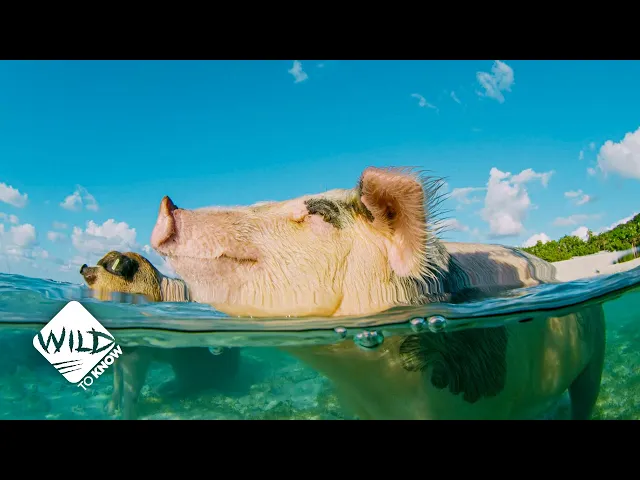
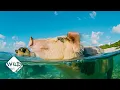
What is that? A fish walking on land. And is that really a pig swimming in the turquoise waters of the Bahamas?
And why is a bat living inside a carnivorous plant? That's all weird. And that's good because weirdness is nature's coping mechanism.
There always were, are and will be species that just look or do things a little bit, well, different. So let's explore the weird wonders of wildlife. And guess who's our weirdest contender?
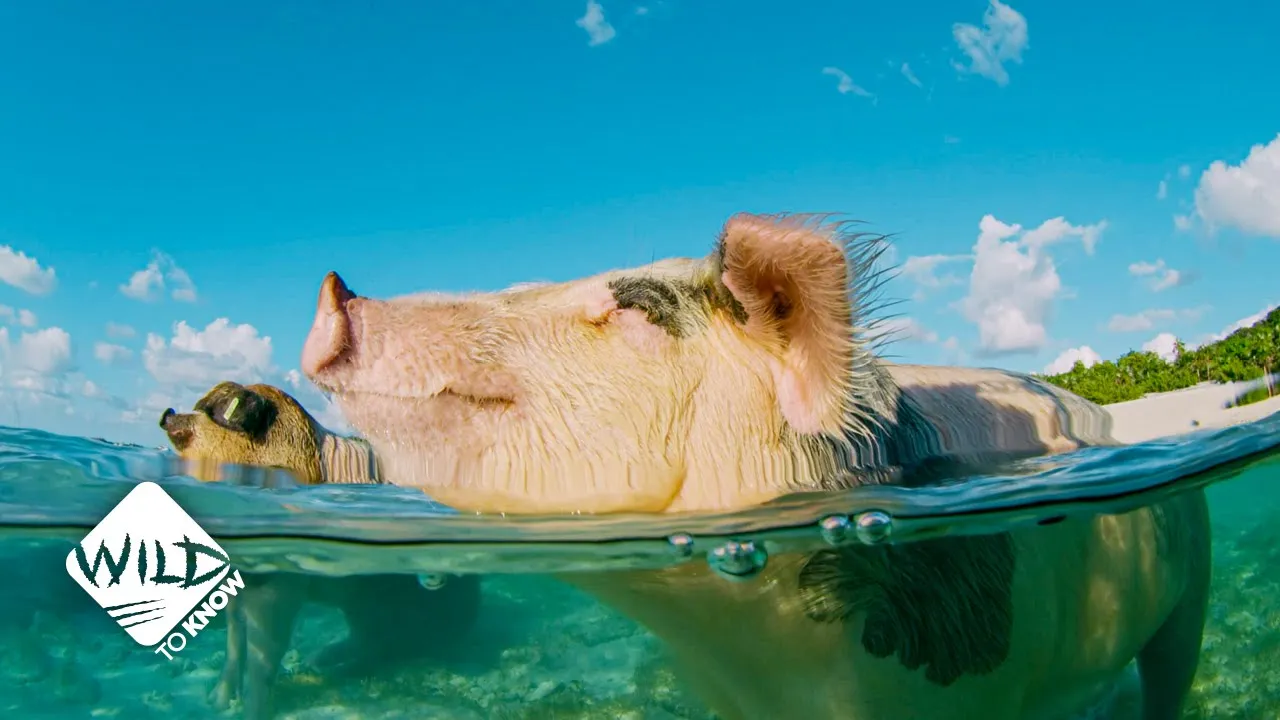
Get ready for a surprise. The Pigs of the Caribbean. Welcome to Paradise.
Crystal clear water and beautiful islands under the Caribbean sun. A world of relaxation, but also one where the line between paradise and peculiarity blurs in the bright sunlight. In the heart of the Bahamas.
Some unexpected characters have made this tropical paradise their own. The pirate pigs of the Caribbean. These swimming swine have their own definition of weird as they embark on an unusual aquatic adventure.
Legend has it that these pigs were castaways from a wrecked pirate ship and the only survivors to reach land. But the real story is more down to earth. The inhabitants of a neighboring island released these robust and resourceful pigs onto an uninhabited island, knowing they are true survivors.
As tourists flocked to the picturesque Bahamas. These clever pigs found a unique food source, sunbathing visitors, or rather their food scraps. While beachside treats were enough at first, a few crafty swine then took things to the next level: by swimming out two approaching boats.
With that, they gained an edge over their competitors who remained on the pig beach, and the tourists were more than willing to reward their daring exploits. Some visitors even decide to join the swimming pigs for a quick dip in the turquoise waters of the Bahamas, which may be even weirder. Ready for our number nine?
The bats in the carnivorous plant. Our next contender - well, actually, there are two of them - need each other to be weird. And they live here in the rainforests of Borneo.
It's Nepenthes hemsleyana are carnivorous plant and the tiny Hardwick's wooly bat. After a long night flying around the bats seeks a cozy home and it finds it! Nepenthes hemsleyana knows how to attract its guest a dish shaped wall at the back of the pitcher reflects the bats echolocation calls.
It's practically a glowing roadside motel. This picture is like a custom made bat bedroom snug and safe. And luckily for the bat, it's the only carnivorous plant with a “no digestion” policy.
It's so snug in there that the little bat is in no danger of slipping into the plant's acids. The rent, well, it's paid in bat droppings. Yep.
This weird relationship has its own unique currency. But why has the plant evolved in such a way that it attracts a bats to poop into it? It all comes down to the fact that Nepenthes hemsleyana is exceptionally poor at trapping insects, so the pitcher plant depends on the bats poop as fertilizer.
The perfect motel for the Hardwick's wooly bat. The only bat that has ever been found roosting in a carnivorous plant. Let's jump right into number eight.
The walking fish. This is a mudskipper. A fish equally at home, in water and on land.
It's kind of rewriting the rules of “fishdom” as it is able to walk and to breathe out of water. Mudskippers trap air in their gill chambers, which looks more as though they're screaming like crazy and absorb air through the surface of their skin like an amphibian. Both methods are only possible if they are moist enough, which is an easy task here in the mangroves of Southeast Asia.
To move forward on land, mudskippers have to modified fins that double as legs. Improved with the special feature of adapted shoulder joints. The fish can walk, run or jump where no other fish would dare to.
To protect their territory, they engage in a weird showdown like these blue spotted mudskippers here. Mouths wide open, sideways head swipes and flamboyant displays of their dorsal fins. And their weirdness doesn't stop here.
Their bizarre look is enhanced by the large moveable eyes on top of their head. This feature is perfect for their semi-aquatic life in the mangroves, hiding in the shallow waters, but still being able to see what's going on above is a crucial part of the mud skippers survival gear. Their world is a constant tightrope walk as they have to outsmart shorebirds at low tide and evade hungry fish at high tide.
Mad respect for evolution and how it's shaped this small fish into something weird. Number seven the salmon addicted humpback whale. Here she is!
Our female humpback whale. A stealthy and brilliant mastermind. She's busy planning a heist worth several million dollars.
Her target, a salmon hatchery. For her to succeed, she needs to overcome a challenge. A weird one.
Does her 12 meter humpback whale body fit into this 12 by 8 meter pen? Our giant master thief visits the Alaskan coast every April for a delicacy rarely on a humpbacks menu - salmon. Her timing is impeccable.
She arrives right before the salmon hatchery release. She is remarkably silent in her approach. But the people working here already know: She is on the way!
They have to come up with an effective security measure. This year, they only partially open the net. This allows the tiny salmon to hide behind the net or make haste to the open ocean.
In turn, our giant thief can't just approach and swallow the entire shoal. But, well, this brilliant humpback whale doesn't play by the rules. She deftly sneaks in through the tiny opening.
She maneuvers with maximum precision, carefully shifting her enormous body and long fins through the hole. And then she scores! With just one gulp, she swallows a gigantic number of salmon.
Worth several million dollars! An expensive taste made possible by a very weird heist. Now for number six, the next casting spider.
Let's transport ourselves back to the wild heart of the Bornean rainforest Within the thicket of its lush jungle, there's a fearsome predator on the prowl. At least if you're an insect. Consider this your trigger warning because there will be spiders in the following scenes.
This spider Deinopsis this has huge light, sensitive eyes. No movement goes unnoticed in the shadows of the rainforest giants. Deinopsis thrives here in the darkness.
She's not a spider who waits until her meal happens to get caught in her web. She's a spider who knows what she wants and gets it with her special hunting method. She spins her nets between her front legs.
It's unusually flexible once prey comes within reach. She strikes! Before her unsuspecting prey even realizes it.
The game is over. Here let's watch that in real time. Fast as hell!
Deinopsis or better known as the net casting spider. What a unique way to use your own spider web! For number five let's dive down to the sandy ocean floor to the eel in the hole.
Wait for it. Yes. Here it is.
The Hawaiian garden eel. This species is only found on the sandy floor off the Hawaiian Islands. Garden eels are not only weird to look at with their slender bodies and huge eyes, but they also live quite a peculiar life.
They spend pretty much their entire lifetime in the same hole. They're the ultimate introverts. Garden eels are weird, even among other eels.
Morays in comparison are more solitary and hide in rock crevices to ambush unwitting prey. But they still change positions regularly. Other eels make migrations to spawn from freshwater to the sea.
That's far too busy for garden eels. They prefer to gather in small groups and to settle where ocean currents flow. And there they let themselves drift with the stream and have their favorite food zooplankton washed into their mouths, popping out of the sand like a synchronized performance.
But be cautious. Any visitor prompts a swift retreat back into the home. There's just one reason to leave the home for mating.
There's just one reason to leave the home for mating. But they only take this step when not a single mate is within reach. And even when doing the deed, they're still stuck halfway inside their one and only hole.
Number four! The nosy proboscis monkey. These primates daily life is unbreakably linked to the rhythm of the tides.
They jump forward to the sea when the water recedes in the mangrove forests and return to the jungle when the water rises again. But you probably want to know about the nose. It's weird, right?
This outrageously oversize nose sets them apart from all the other primates. It comes in a variety of shapes and sizes. But what's truly remarkable is that males have much larger ones and females.
Why? The bulbous noses are thought to play a crucial role in attracting mates, making them a symbol of strength and desirability. When it's courting time, the male with the most impressive nose often gets the girl.
But there's more to those noses than meets the eye. They may also have a use when it comes to vocalization. Listen to this.
Scientists believe that these exaggerated noses help amplify the monkeys calls, making them more distinctive and audible in the dense rainforest. Food for thought. Maybe Size really does matter, at least in the proboscis world.
Third place. Now let's go deeply weird and dive into the depths of our oceans. The deep sea is a realm of darkness and cold.
Down from 200 meters to 4000 meters below the surface where sunlight never reaches and the pressure is crushing. But still, it is home to animals. Some of the strangest creatures on earth!
Like the Viper fish with its long fang like teeth emitting bioluminescent light to lure prey. Or the vampire squid equipped with a cloak of webbed skin or the Atolla jellyfish with its remarkable talent for creating a dazzling light show when threatened. But this one is the undisputed king of weirdness in the deep sea.
The barreleye fish. This enigmatic fish has a head like a transparent window, granting us an amazing view of its upward facing eyes encased in a shield filled with fluid. These eyes are no ordinary pair, either.
They possess the power to rotate, enabling the barreleye to scan the dark abyss above on the lookout for elusive prey or lurking dangers. Long may he reign in weirdness. Number two, the kangaroo in the tree and the silver medal goes to an odd tree dweller.
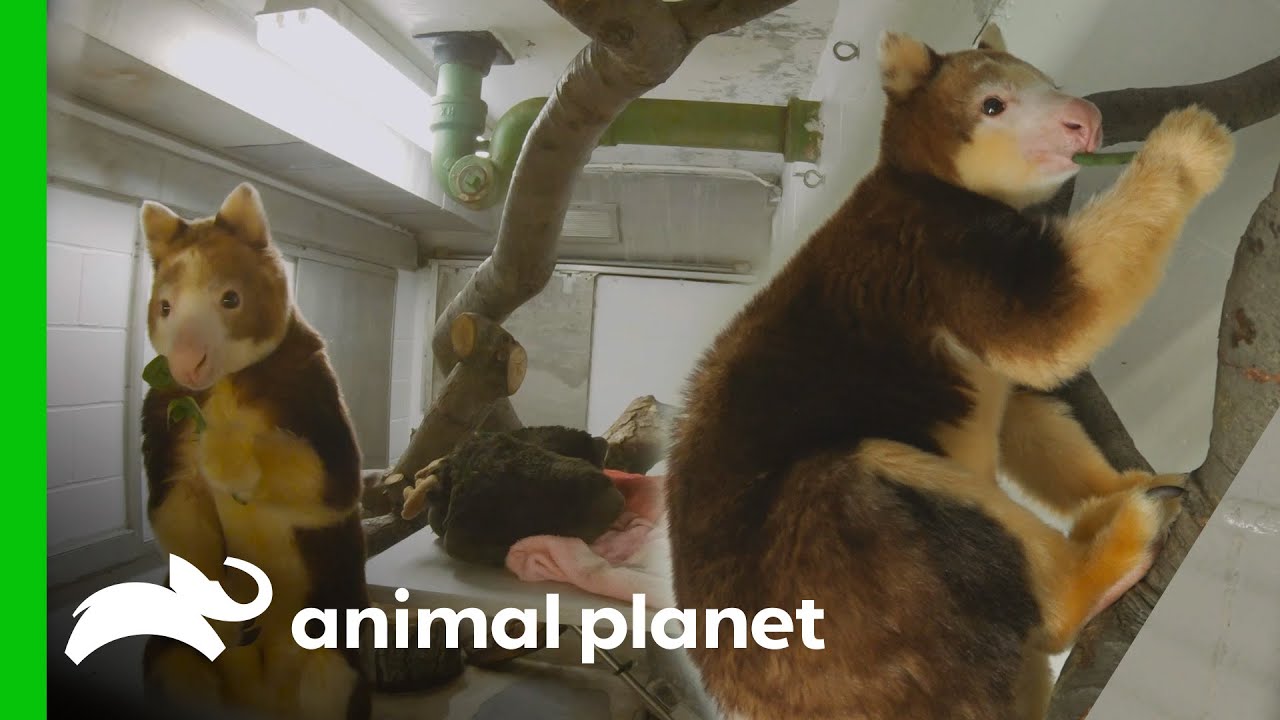
See, this here is not a monkey. It's a kangaroo. A matchies tree kangaroo, to be specific.
Tree kangaroos are like the kangaroos quirky tree hugging cousins. What separates them from their iconic relatives is their incredible adaptation to an arboreal lifestyle. Unlike their hopping cousins, tree kangaroos are built for life among the treetops.
They're strong for limbs are equipped with sharp claws, perfect for grasping branches and climbing, even if it looks a bit clumsy. Their hind legs, while not built for hopping long distances, are great for stability as they navigate the heights of the rainforest. These adaptations have allowed them to conquer a new habitat and another food source.
And while some can even jump from one tree to another, others apparently still have to learn the basics of how to climb a tree. . .
. Now, here comes our winner. Drm roll, please.
The gold medal goes to the elephants underground in Uganda, on the slopes of Mount Elgon, a strange and spectacular phenomenon unfolds. Each night a procession of at least a dozen female African elephants make their way down to the hidden chambers of Kitum Cave. But why do they plunge into the darkness and squeeze themselves through the narrow passages underground?
The answer is salt. The female elephants, particularly those who are nursing or having a baby on the way, have an increased need for minerals. Their goal: the layers of mineral rich sand that satisfy their heightened demand for essential nutrients like calcium, magnesium and sodium.
A study found that the rocks of Kitum Cave contain over 100 times the sodium content per gram compared to the average level in plants. But the elephants can't just lick the rock. Their tongues aren't long enough for that.
They have to scrape the salty earth from the walls with their stubby tusks and collect the mineral rich sand in their mouths. The route into the cave and the technique of scraping the walls are passed down from generation to generation. A peculiar tradition, unique to the elephants of Mount Elgon.
After hours of digging, the elephants have had enough of their dark mine and returned to the surface. Until the next night begins. Which of these animals fascinated you the most?
Let us know in the comments below. And if you enjoyed this journey into the weird world of wildlife, don't forget to hit that like button and keep watching our videos.