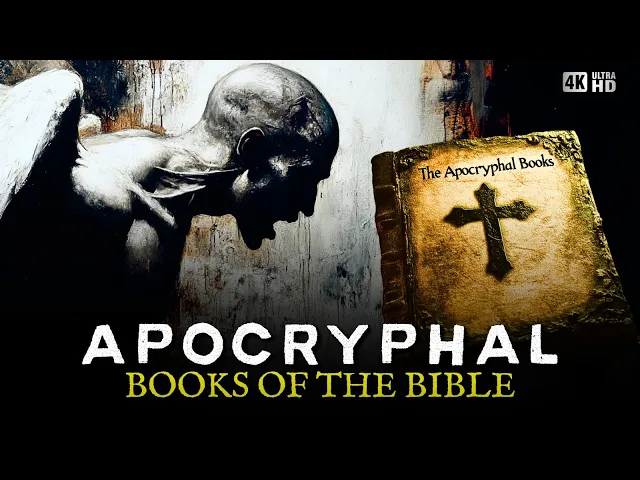
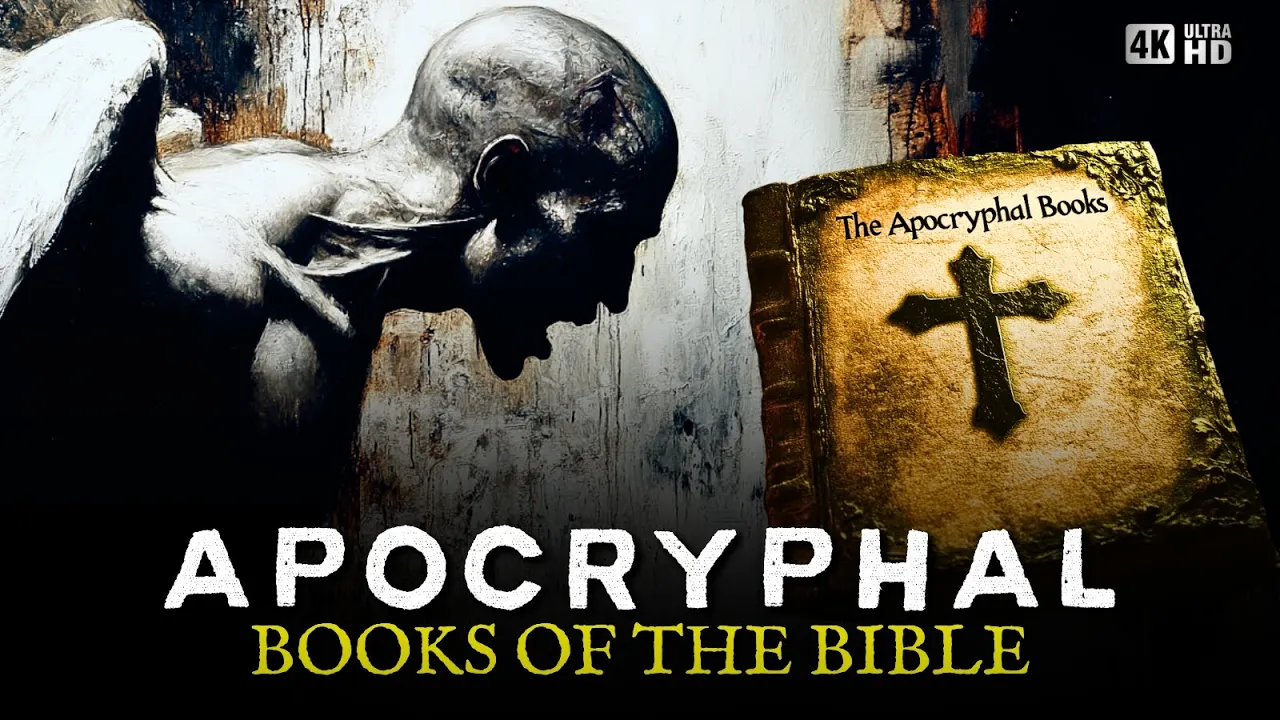
The apocryphal books are ancient texts that speak of fallen angels, giants, prayers for the dead, salvation by works, and hidden mysteries. But they were removed from the Bible because they carry dangerous doctrines and serious errors. Today, you will discover what these books are, why they were excluded, who tried to keep them, and the warning God left for those who alter his word.
What you will learn here about the hidden books of the Bible will completely change the way you see the history of the Christian faith. From the earliest centuries of the Christian faith, a silent enigma hovered between the lines of the sacred texts. Writings that existed but were not read in public.
books that circulated but had no authority. Familiar names, curious stories, different doctrines and all of them received the same label, apocryphal. But what exactly are these hidden books of the Bible?
The term apocryphal comes from the Greek apocryphos meaning hidden or secret. At first the word seemed almost complimentary, something so sacred that it should be reserved. But over time, especially in biblical tradition, it came to indicate texts of questionable origin with doctrinal content that was doubtful and without evidence of divine inspiration.
And here is the key point. What defines whether a book is or is not inspired by God? It's interesting to note that not all so-called apocryphal books are the same.
There is an important division that is often overlooked. Some are called pseudapigrapha writings falsely attributed to biblical figures such as a manuscript signed by Enoch or Moses but in fact they were not. Others are called duterrocononical which according to Catholic tradition are the second list of inspired books even though they do not appear in the Jewish cannon.
Do you see the gravity of this? It's like someone finding an ancient manuscript signing Isaiah's name adding new doctrines within it and expecting the churches to accept it as the word of God. This is exactly what happened with various apocryphal books in the Septuagent, many of which were later canonized by the Catholic Church at the Council of Trent in 1546, not by divine revelation, but by doctrinal convenience.
Now, think about this. If these books were truly inspired, why did Jesus and the apostles never quote them? Why were they absent from the Hebrew cannon?
Why did Martin Luther and the reformers remove them based on the doctrine of the sufficiency of scripture? The answer begins to form here and it leads us to an even deeper revelation. In the preface to the King James Bible of 1611, these books were placed between the Old and New Testaments and the translators themselves warned that they should not be used to establish doctrines.
This shows that while they had historical value, they did not carry the divine seal of inspiration. They were included, but with a warning, a clear sign that they did not belong to the eternal body of the revealed word. And more, many of the books excluded from the canon contain historical errors, chronological absurdities, and strange doctrines, as we will see in the following topics.
They make us ask how could something so distorted come from the God of truth. The Holy Spirit who guided the authors of scripture could not contradict himself. And that's why from the beginning the faithful discerned.
There are books that edify and there are books that confuse. Amidst the vast library of ancient times, there are books that for centuries were read, copied, and even revered by certain religious groups, but never carried the divine mark of inspiration. These books, known as apocryphal, form a set of texts surrounded by doctrinal controversies, historical errors, and strange doctrines that often seem to directly oppose what the scriptures reveal.
The apparent piety they carry is exactly what makes them so dangerous. After all, the most effective deception is the one that disguises itself as truth. Tobit, one of the most well-known duturo canonical books, presents a curious story about a young Jew, his blind father, a dog, and an angel in disguise.
Raphael the angel teaches the young Tobias how to catch a fish and use parts of it as spiritual medicine. According to the text found in Tobit 67, the heart and liver of the fish would expel evil spirits while the gaul would cure blindness. Furthermore, in chapter 12:9, Raphael openly claims that armsgiving saves from death and purges all sin.
This statement is in direct conflict with the biblical doctrine that only the blood of Jesus can purify sin. There is no basis in all of the inspired scripture for the idea that charitable works can remove guilt before God. This is a merit-based doctrine contrary to grace disguised as devotion.
Judith is another emblematic example. a beautiful and astute widow who deceives and seduces the enemy general Holofernes gets him drunk and decapitates him in his own camp. The problem is not only the violence of the scene, but also the fact that the book makes a serious historical error right in its first verse by stating that Nebuchadnezzar was king of Assyria, not Babylon.
The geopolitical confusion in the text raises serious doubts about its reliability as an inspired document. Furthermore, the narrative itself exalts lying as a virtuous strategy contradicting clear proverbs in scripture such as Proverbs 12:22, which states that lying lips are abominable to the Lord. The Wisdom of Solomon is a book that tries to pass itself off as a writing by Solomon, though it was composed hundreds of years later.
The text mixes elements of Hebrew Revelation with Platonic philosophies, even claiming in chapter 8:20 that souls exist before the body. A clear reference to the doctrine of pre-existence of souls, something entirely foreign to biblical theology. At another point in chapter 11:17, the book suggests that God created the world from pre-existing matter, an idea that goes against the clear teaching of Genesis 1:1, where God creates all things out of nothing with only his word.
Ecclesiasticus, also known as Sirak, is extensive, poetic, and full of moral advice, but it often slides into legalism and the doctrine of salvation by works. In Ecclesiasticus 3:30, the author declares that armsgiving atones for sin as water puts out fire. This humanistic theology presents a salvation that can be earned, something completely opposed to the gospel, where justification is received by faith, not by works.
Even more revealing is the fact that the author himself admits in the prologue that his writings are not on the same level as the law, the prophets or the other canonical books. In other words, even the writer recognized that his work was not inspired. The book of Baruk attributed to the scribe of Jeremiah tries to imitate the tone of the exilic prophets but lacks depth and reliable historical connection.
A particular addition to the book of Baruk is the so-called Epistle of Jeremiah, which spends much of its time mocking idols made of wood, stone, and gold. Despite the emphasis against idolatry, the text lacks any prophetic value, and its forced language reveals an author trying to seem inspired, but without the anointing of true revelation. The books of first and second Mcabes stand out for their historical content.
They recount the Jewish resistance against Henistic rule, particularly the persecution under Antiochus Epiphanies. However, even though they are useful as a record of the times between the Old and New Testaments, the second book contains a doctrine that directly contradicts the gospel. In 2 Mcabes 12:44-46, it is said that Judas Mcabeas made a collection to pay for an expiratory sacrifice for the dead with the goal of having their sins forgiven.
The narrative states that this action was holy and beneficial. This passage was later used as the basis for the Catholic doctrine of purgatory, a teaching that is refuted by the clarity of Hebrews 9:27, which declares that it is appointed for man to die once and after that the judgment. The additions to the books of Esther and Daniel also serve as evidence of the artificiality of the apocryphal texts.
In Esther, entire chapters of prayers and speeches are inserted with language and theology completely distinct from the Hebrew text. In Daniel, episodes such as Susanna, Belle, and the dragon, and the song of the three youths, appear. Bell, an idol that supposedly consumed food offered to it, is exposed by Daniel with a trap of flour.
The dragon is destroyed with an explosive cake of pitch and goats hair. All of this is much closer to legendary literature than the prophetic style of Daniel whose fidelity and accuracy are hallmarks. Among the extracononical apocryphal books, the so-called pseudapigrapher, we have texts like the book of Enoch.
This is one of the most intriguing and dangerous. The text presents itself as having been written by Enoch the seventh from Adam and talks about a rebellion of angels called the Watchers who descend to Earth, take human wives, and produce giants called Nephilim. Enoch 7:2 claims that these giants were about 3,000 cubits tall, equivalent to more than 1,000 m in height.
The book narrates that these beings taught magic, astrology, and witchcraft to humanity. It presents an angelology full of names absent from scripture such as Uriel, Ragwell, Sariel, and others. These hidden revelations border on esotericism and contrast with the biblical silence on so many details.
The book of Jubilees in turn is a chronological reinterpretation of Genesis and Exodus based on cycles of 49 years, the Jubilees. It states that Adam and Eve stayed only 7 years in Eden. The text also presents laws supposedly given before the law of Moses, such as the observance of the Sabbath being practiced by angels in heaven.
The narrative claims that Abraham celebrated Passover centuries before the institution of Passover in Exodus, an unacceptable anacronism for anyone familiar with the progression of divine revelation. The Testament of the 12 patriarchs presents supposed final speeches of the sons of Jacob with words full of mysticism, vague prophetic visions, and moral appeals of varying quality. In some parts, the book even suggests that the patriarchs had detailed knowledge of messianic events, a forced attempt to validate human traditions rather than transmit authentic prophecy.
All of these books, which some call the hidden books of the Bible, were rejected by the Hebrew tradition, were not cited by Jesus or the apostles and never received confirmation from the Holy Spirit. They can be called forbidden books of the Bible, non-inspired books, or even books that the King James Bible does not have. But the most important thing is to understand that the reason for their exclusion was not political but spiritual and doctrinal.
They not only fail to uphold the truth, they distort it. And this is exactly what we will see in the next point. Did these books ever belong in the Bible?
and if so, why were they removed? Although today they are considered books outside the Christian cannon, the apocryphal books were present in some versions of the Bible, but never as part of the inspired scriptures rather as auxiliary texts included by tradition, not by divine authority. This distinction is crucial.
The Jews, the guardians of the Old Testament, never recognized the apocryphal books as scripture. Neither Jesus nor the apostles cited or referred to them as the word of God. The emergence of these books in the biblical context primarily occurred through the Septuagent.
The Greek translation of the Old Testament used by Jews in the diaspora. The Septuagent included some historical and religious books that were not part of the Hebrew cannon. And it was through this translation that the apocryphal books began to circulate among gentile Christians.
However, this does not mean that they were considered inspired. They were simply accessible. When Jerome translated the Bible into Latin, creating the Vulgate, he made it clear that the apocryphal books did not belong to the canon.
He referred to them as ecclesiastical books, meaning useful for reading but not authorized to define doctrine. Still, under pressure from the church of the time, they were included in the body of the Vulgate, which increased their popularity. The King James Bible of 1611 also included them, but in a very clear and cautious manner.
The apocryphal books were placed between the Old and New Testaments in a separate section with the explicit warning that they should not be used to establish any doctrine. This demonstrates that their presence was purely editorial, not theological. The fact that they were physically printed in some editions does not mean that they ever truly belong to the canon.
The structure of ancient Bibles itself showed that they were seen as distinct and the absence of these books in the New Testament and in the Jewish lists reinforces that they were never inspired by God. Therefore, the apocryphal books never truly became part of the Bible in a legitimate sense. Their inclusion was circumstantial.
Their authority was always questioned and their removal was a return to the purity of the sacred text. And this leads us to the next point. Why were they definitively excluded from the Christian cannon?
What is it in their content that makes them unacceptable as the word of God? The definitive removal of the apocryphal books from the Christian cannon was not an arbitrary decision, nor one driven by political disputes or denominational interests. It was a choice based on clear spiritual criteria, divine inspiration, apostolic use and doctrinal coherence.
And the apocryphal books failed on all these points. The first and most important criterion is inspiration by the Holy Spirit. The canonical books were recognized as inspired because they carry the unmistakable signature of God, fulfilled prophecy, spiritual authority, theological unity, and recognition by God's faithful servants throughout the ages.
None of the apocryphal books were cited by Jesus or the apostles as scripture. This alone is decisive. When Paul writes in 2 Timothy 3:16 that all scripture is given by inspiration of God, he refers to the books accepted in the Jewish cannon, the same one recognized by the reforming Christians centuries later.
The second criterion is apostolic use. All the books of the New Testament were written by apostles or under their direct supervision. And the apostles in turn based their teachings on the Hebrew Old Testament, never on the apocryphal books.
At no point does the New Testament present direct quotes or recognize these books as spiritual authority. This silence is not accidental. It is a silent and definitive rejection.
The third criterion is doctrinal coherence. The apocryphal books fail here alarmingly. As we have already seen, they teach practices and doctrines that contradict biblical revelation.
Tobit teaches that armsgiving forgives sins. Second, Mcabes advocates prayers for the dead. Ecclesiasticus promotes salvation by human merit.
Judith presents lying as a virtue. The wisdom of Solomon suggests the pre-existence of the soul. These teachings are not only foreign to the Bible, they directly contradict it.
Accepting them would be admitting that the Holy Spirit contradicts himself, which is impossible. Furthermore, many of these books do not have a known author, nor were they recognized by the faith community in the Old Testament. They were isolated works arising during periods of prophetic silence when God was no longer revealing his word.
And this is significant. The 400 years between Malachi and John the Baptist was a period of waiting, not revelation. When the New Testament begins, it recognizes the authority of the prophets who came before and not the apocryphal authors who emerged during that interval.
The exclusion of the apocryphal books, therefore, was a purification of the body of scriptures made according to the eternal standard of truth. It was this discernment that guided the Protestant Reformation when the reformers rejected the additions made by tradition and returned to the original word clean, inspired and sufficient. Now, as we understand why they were rejected, there is a decisive and unavoidable question.
Did Jesus and his apostles, who were the direct voice of God on earth, recognize these books? or does their silence tell us everything we need to know? If the apocryphal books were inspired by God, we would expect to see them in the words of the one who is the living word, Jesus Christ.
We would expect to find clear citations in the teachings of the apostles who were commissioned to speak in the name of the Holy Spirit. But when we dive into the New Testament, what we find is absolute silence. Throughout Jesus' ministry recorded by the Gospels, there are numerous citations and references to the Old Testament.
He quotes Moses, Isaiah, Jeremiah, Daniel, the Psalms, always recognizing these books as sacred scripture. In Matthew 22:29, Jesus declares, "Ye do heir, not knowing the scriptures, nor the power of God. " What scriptures were these?
the same Hebrew cannon that excluded the apocryphal books. When Jesus says in Luke 24:44 that everything written about him in the law of Moses, the prophets and the psalms must be fulfilled, he defines the three traditional divisions of the Old Testament and the apocryphal books are not among them. The same pattern appears in the apostolic letters.
Paul, Peter, James, John all quote the Old Testament abundantly. But never at any point do they mention or cite any passage from the apocryphal books as authority. Even in the Acts of the Apostles where references are made to Jewish traditions, the Apocryphal books remain absent.
This absence is not accidental. It is a silent but definitive rejection. Jesus and the apostles recognized and quoted only the books inspired by God.
Those that had already been accepted by the faithful Jewish community. The apocryphal books may have circulated among some communities. They may have been read as religious literature, but they were never treated as scripture by the son of God himself.
And this carries great weight. If Christ himself, who is the center of divine revelation, did not recognize them as the word of God, how could we? If the apostles, filled with the Holy Spirit, never turned to them to ground their doctrine, how could we give them authority?
The silence of Jesus and the apostles is a resounding answer. They knew how to discern the voice of the Father, and they chose only what was truly inspired. The apocryphal books for them were merely human literature incapable of sustaining faith or revealing salvation.
This evidence inevitably leads us to the next question. If the apostles rejected these books, who then wanted to keep them and why? Although most faithful Christians based on scripture rejected the apocryphal books as inspired, there were those who kept them and they were not few.
The clash between human tradition and the divine authority of the word spans centuries with the apocryphal books at the center of this silent yet decisive battle. In the early centuries of the church, while the biblical cannon was being recognized through continuous use in churches, some local groups already showed appreciation for certain apocryphal books. A few early church fathers such as Augustine on some occasions cited books like the wisdom of Solomon and Ecclesiasticus for moral edification but always with less weight than the canonical books.
Others such as Jerome took a clear stand against attributing any doctrinal authority to them, insisting that they were useful for reading but not for building the foundation of faith. But the issue did not end there. In the tradition of the Ethiopian Orthodox Church, for example, the acceptance of books considered apocryphal went even further.
To this day, the Ethiopian Bible includes the Book of Jubilees, the Book of Enoch, and other texts such as the Apocalypse of Baruk and the Psalms of Solomon. These books are read and considered part of their cannon, placing this tradition outside the Hebrew cannon and the New Testament recognized by most Christians. The Book of Jubilees in particular retells Genesis with a chronology based on cycles of Jubilees, alters details of the sacred text, and introduces laws not even found in the Pentetuk.
These additions create a parallel theology imbued with legalism and mysticism completely deviating from the progressive revelation that God gave to his people. The influence of these texts also appears in early Gnostic communities which used books like the Gospel of Thomas, the book of secrets of Enoch and other pseudapigrapher to support their occult and heretical doctrines. These writings promised secret revelations, hidden wisdom, and alternative spiritualities, all in opposition to the clear and public light of true scripture.
However, the decisive moment for the official canonization of the apocryphal books in Western Christianity occurred in 1546 during the council of Trent. The Catholic Church in direct response to the Protestant Reformation decreed that the duterrocononical books should be considered part of the official biblical cannon. Tobit, Judith, wisdom of Solomon, Ecclesiasticus, Baroo, one and two Mcabes and the additions to Esther and Daniel were then incorporated definitively.
Anyone who refused to accept these books would be anathematized, meaning excommunicated. This movement was not motivated by new revelation or historical evidence, but by doctrinal interests. The apocryphal books supported practices and doctrines that were being heavily questioned by the reformers.
Prayer for the dead, purgatory, merit-based salvation, intercession of saints and angels, ideas absent in the canonical scriptures, but present in the apocryphal books. Meanwhile, the reformers, men like Martin Luther, John Calvin, and Olrich Zwingi, returned to the standard of the Hebrew cannon, rejecting the additions made by medieval tradition. They called for a return to what Jesus, the apostles, and the early church recognized as the word of God.
Luther, although he initially included the apocryphal books as useful for reading, placed them separately and clearly identified them as non-inspired, warning God's people not to base their faith on them. This division remains to this day. The Catholic Church and some Orthodox churches still maintain apocryphal books in their cannons.
Protestant churches heirs of the reformation recognize only the 66 books inspired by apostolic and prophetic authority. Therefore, the maintenance of the apocryphal books was not a spiritual decision but a choice of tradition against scripture. A choice that sought to uphold fragile doctrines over the immutable authority of the revealed word.
And in light of this choice, the true church of Christ chose the narrow path, the return to the sufficiency of scripture with no additions or omissions. This struggle between tradition and scripture paved the way for the great purification of the canon, a work of cleansing conducted during the Protestant Reformation, where the word of God once again shone in its original purity. And that's what we will see next.
In the 16th century, amidst a backdrop of doctrinal corruption and tradition overshadowing the truth, God raised up men to carry out a work that would change the course of Christian history, the Protestant Reformation. This movement was not merely a revolt against ecclesiastical practices. It was a call back to the supreme authority of the scriptures, purging the cannon of the additions that human tradition had tried to impose.
Led by figures like Martin Luther, John Calvin and other reformers, the Christians of the reformation rediscovered an ancient and powerful truth. The holy scripture is sufficient in itself. They realized that the true cannon had already been established, recognized by Christ, confirmed by the apostles, and preserved by faithful communities from the beginning.
What later tradition had added needed to be removed. It was in this way that the apocryphal books which had been officially canonized by the Catholic Church at the Council of Trent were rejected by the reformed churches, not based on human opinions, but based on solid spiritual criteria. The apocryphal books were not in the Hebrew cannon, were not cited by Christ, were not used by the apostles, and contained doctrines contrary to the revealed faith.
The reformers chose to follow the Hebrew cannon as the basis of the Old Testament, the same one that Jesus and his disciples recognized. This decision restored the Bible to its pure format, the 39 books of the Hebrew Old Testament and the 27 books of the Apostolic New Testament, totaling the 66 inspired books that we know today. The 1611 King James Bible, although it included the Apocryphal books in a separate section for historical and cultural reasons, also reflected this principle of separation.
The Apocryphal books were useful for reading, but had no authority to establish doctrine. And thus over time later editions of the King James completely removed the apocryphal books from their main body reaffirming the Protestant conviction that only the word of God is a lamp to our feet and a light to our path. Psalm 119 105.
This purification of the cannon was not a loss. It was a spiritual victory, a return to the roots, a recovery of the authority of the Bible over the tradition of men. It was the reaffirmation of the eternal principle that God's revelation is complete, perfect, and does not need additions or corrections.
The Reformation restored to the church what should always have been its most precious treasure, the pure, faithful scriptures, sufficient to lead man to salvation in Christ Jesus. But with such responsibility in hand, a solemn warning arises. God had already left a severe warning for those who dared to add or take anything from his word.
A warning that few today dare to remember. When the Holy Spirit sealed the final words of the written revelation, he left no room for doubt. God closed his word with a solemn warning recorded in Revelation 22:18-19.
For I testify unto every man that hears the words of the prophecy of this book. If any man shall add unto these things, God shall add unto him the plagues that are written in this book. And if any man shall take away from the words of the book of this prophecy, God shall take away his part out of the book of life and out of the holy city and from the things which are written in this book.
These words are clear, definitive, and eternal. Adding to what God has revealed is an act of rebellion. Taking away from what God has spoken is an act of betrayal.
Both actions brings severe judgment. And although the text directly refers to the book of revelation, the principle echoes throughout scripture. The word of God is complete, perfect, and sufficient.
The attempt to include apocryphal books as scripture, whether by tradition or doctrinal convenience, violates this divine principle. It is not a secondary matter. It is a matter of spiritual life or death.
When men decide to add their own words to God's words, they place themselves under a curse, lead the people away from the truth, and dilute the message of salvation. The sufficiency of the scriptures is one of the pillars of true faith. Everything we need to know God, receive salvation in Christ, and live in holiness is contained in the inspired books, the same ones that have been recognized since apostolic times.
To add or subtract from the word is therefore a direct affront to God's sovereignty over his revelation. As we study the history of the apocryphal books, the books excluded from the canon, the hidden books of the Bible, the books that the King James Bible 1611 carefully separated, we understand that zeal for the purity of scripture is not just an academic matter. It is a spiritual battle.
It is the defense of God's voice against the voice of men. And the warning of revelation stands firm. Whoever tamper with the word, tamper with God himself.
If you want to continue deepening your understanding of the true history of the Bible and uncover more hidden truths that transform our faith, subscribe to the channel now and turn on the notifications. Here we seek the pure and faithful word revealing what many prefer to hide. And everything is done for free thanks to the support of people around the world like you.
You can support us even more by becoming a channel member, purchasing our ebooks, or making a donation through the links available on the channel page. Join us in this mission.