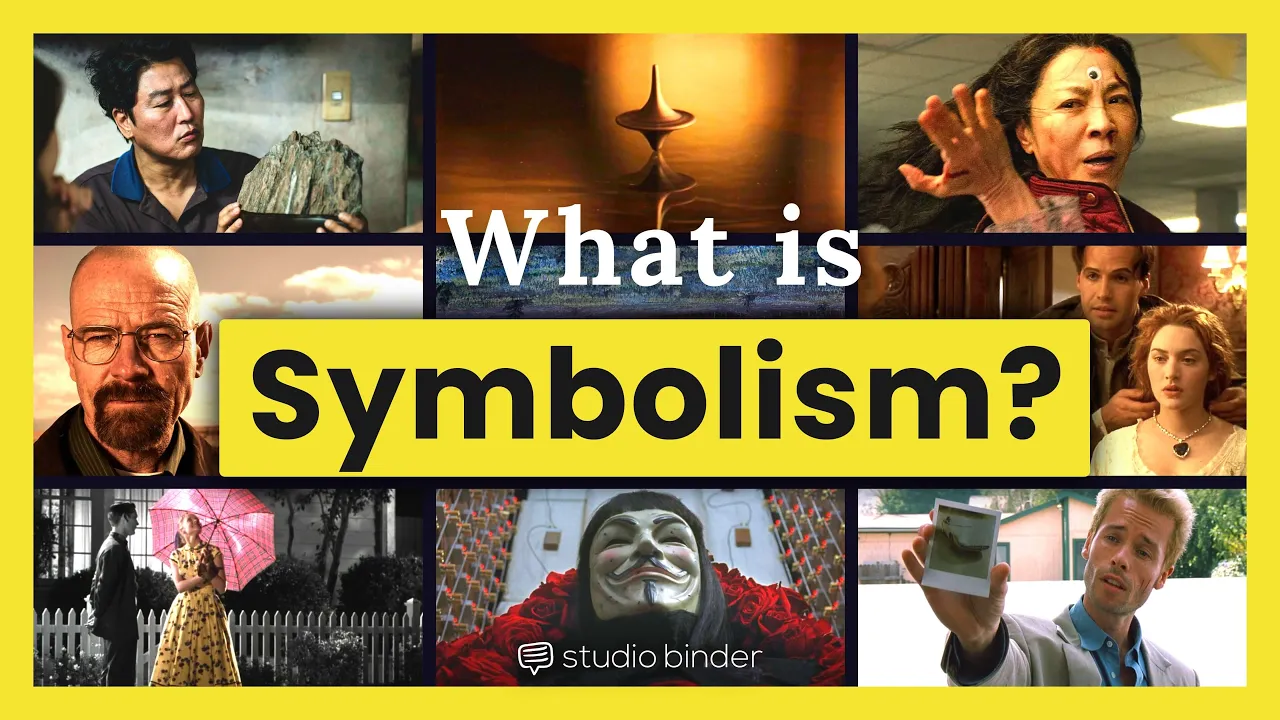
Great movies contain multitudes. Objects take on meanings much larger than themselves. Characters represent ideas.
And plot points speak to bigger themes. These layers are created through symbolism. And when done well, can make an audience return to a movie again and again.
- Symbolism. What is the symbolism there? Let me explain it to you.
- This is 'What is Symbolism? '. Before you begin, subscribe to StudioBinder and click this symbol to stay up to date on all our videos.
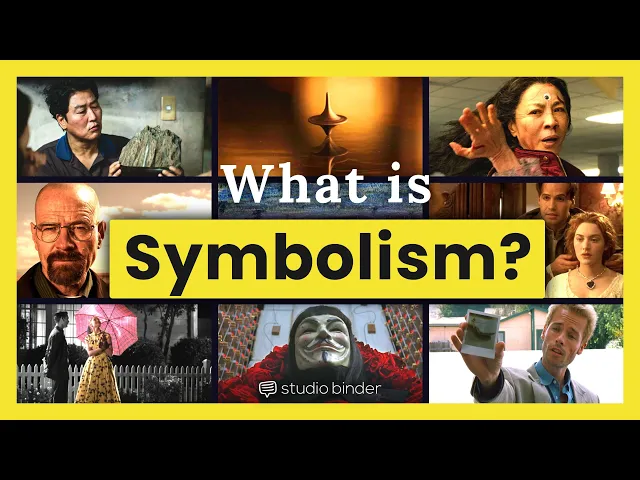
Now let's start uncovering hidden meanings. Symbols are elements in a story that represent an idea, object, or person. Like when a coin is more than a coin.
A jacket is more than a jacket, or a polaroid represents the entire structure of a story. The word comes from the Greek 'Symbolon', which means 'token' or 'mark'. Symbols can be explicit, or they can be implied, and are up to an audience's interpretation.
- Vincent! - We happy? - Yeah, we happy.
- A filmmaker can consciously create symbols, or symbolism can be created by a viewer. And two different viewers can find two different meanings in a symbol. - There is something there, right?
- Not if you can't see it, there ain't. - For a filmmaker like David Lynch, this blurry line between artistic intent and audience interpretation is intentional. - People have a right to analyze a thing and say what it is for them, and to criticize it one way or another.
It's beautiful. But I really believe the film should stand on its own, and there should be nothing added, nothing subtracted. - Screenwriting scholar John Truby writes, Just as character, theme, and plot are big puzzles to fool and please the audience, a symbol is the small puzzle that works its magic deep below the surface.
As such, having a firm command of symbolism is necessary for directors, screenwriters, editors, production designers, and many more positions on a film set. Let's look at various types of symbolism. Symbols can take many forms in a film.
In fact, anything you can see or hear has the potential to become a symbol. Characters themselves can be symbols. Using a character to represent a larger idea allows that idea to evolve and become more complex as the character's arc progresses.
Dr Frankenstein, for example, operates as a symbol for the ruthless pursuit of scientific progress. - It's alive! It's alive!
It's alive! - His character arc, then, represents the unintended consequences of this pursuit. In 'Halloween', meanwhile, Michael is an embodiment of evil.
This symbolism isn't complicated throughout the film, but it makes him all the more terrifying, and shows us what different people will do in the face of evil. John Carpenter explains how the simplicity of the symbol made the film so successful. - It's one of the two scary stories that we, we can tell.
One is the evil is inside, or the evil is outside. Now that goes way back to us tribal. We're sitting around the campfire and we've just come out of the trees.
- Symbolism can also be found in setting. - Just a moment. - The office and office space, for example, represents homogeny and tedium.
How characters react to the setting, therefore, tells us a lot about them. Some embrace the sameness, others struggle with it. Symbolic settings can allow a filmmaker to create larger allegorical meanings.
By having Pandora represent untouched nature, for example, James Cameron is able to tell a fable about environmental destruction wrought by humans. - Let's have a big hand for our very first volunteer, Katniss Everdeen. - Something as small as a character's action can also be symbolic.
In 'The Hunger Games', the three-fingered salute becomes a symbol for pro democratic resistance. This action becomes a quick way to show the revolutionary mood sweeping over the districts. An action can also represent a character's interiority.
In 'Breaking Bad', Walt shaves his head because of his chemotherapy. But the act takes on symbolic meaning as he transforms from a well-meaning suburban dad to a ruthless drug dealer. - This is not meth.
In 'Macbeth', Lady Macbeth's scrubbing of her hands represents her overwhelming guilt. Of course, objects too can become symbols. In 'Crash', cars represent violence.
When the characters are attracted to cars and car crashes, the audience can interpret this as commentary on modern society's increasing obsession with violence. J. G.
Ballard, the author of the book the film was based on, noted, Although there's comparatively little sex and violence in the film, it's one of the most sexual and violent films ever made because of the explicit assumptions set out in every frame that sex and violence are inherent in the experience of driving a car. - Did you fantasize that Vaughn was photographing all these sex acts? - As though they were traffic accidents?
- Yes. They felt like traffic accidents. - Titanic meanwhile uses the heart of the ocean necklace as a more personal symbol of Rose's connection to Jack.
- Jack, I want you to draw me like one of your French girls wearing this. - Alright. - Wearing only this.
- Her throwing it back into the sea represents her liberation from her memories of tragedy and an affirmation of the life she led after it. Entire colors can also act as symbolism. In 'Vertigo', green is a very symbolic color, but what it actually represents is debatable.
One interpretation is that green represents Scotty's obsession with Madeline. When he finally turns Judy into Madeline, at the height of his obsession, she is bathed in a ghostly green light. 'Pleasantville', meanwhile, uses a transition to color as a symbol for individuality and breaking with norms.
- They have a lot of potential, they just don't know any better. - Well, they don't have that kind of potential. - Oh yeah?
Look at that. - Wow, what happened to your gum? - I gotta go.
I'm gonna meet Skip at the flagpole. - The many forms of symbolism can also have many uses. By definition, symbolism adds depth to a film.
But what purposes can this depth serve? Often, filmmakers will use symbols to comment on larger ideas that exist outside the confines of their movie. For example, 'In Apocalypse Now', the river can be seen as a symbol for America's involvement in the Vietnam War.
- Captain, just how far up this river are we going? - It's classified, Chief, I can't tell you. - The farther upriver the characters go, the deeper they entrench themselves in a quixotic journey with a murky end goal.
This symbolism allows Francis Ford Coppola to comment on the unwinnable nature of the Vietnam War. - Someday this war's gonna end. - In 'Adaptation', meanwhile, Charlie's brother Donald acts as a symbol for mainstream filmmaking.
- I meant to ask you, I need a cool way to kill people. Don't worry for my script. - Charlie Kaufman uses the character to satirize how formulaic much of Hollywood screenwriting is.
- I'm putting in a chase sequence. Uh, so the killer flees on horseback with the girl. The cop's after them on a motorcycle.
And it's like a battle between motors and horses. Like technology versus horse. - And they're still all one person, right?
- Well that's a big payoff. - But symbolism can also be used on a narrative level. In 'Inception', for example, the spinning top is established as a symbol for Cobbs grasp on reality.
- An elegant solution for keeping track of reality. - Was it your idea? This one was hers.
She'd spin it in the dream and it would never topple. Just, uh, spin and spin. - This makes the final shot of the movie all the more intriguing.
- Hope you stick with it. Serpent's the source. Change your life.
Swear to God. - In 'Point Break', surfing comes to symbolize freedom. So when Johnny becomes more interested in the sport, the audience understands that he is also intoxicated with the lifestyle it represents.
- Special Agent Utah, I knew I could count on you. - In the end, when Bodhi begs for Johnny to let him surf one last wave, the underlying message is clear. He would rather die outside of the system than live within it.
- My whole life has been about this moment, Johnny. Come on, compadre. - As both of these examples illustrate, symbols can be used to effectively pack an emotional punch.
- You and me, we're in a club now. If a filmmaker has effectively established meaning in an object, the return of that object can be resonant. - I would like to award you the highest honor I can bestow.
- Wow. - In 'The Cranes Are Flying', the cranes represent peace and happiness. They are introduced early in the film, when Veronica and Boris are together and in love, and the Germans have yet to invade Russia.
The cranes return once more at the end of the film, after the war is over, but now Veronica watches them alone as Boris has died in battle. The symbolism works as a poignant reminder of the toll paid in order to bring about peace. For symbols to serve ideological, narrative, or emotional purposes, a filmmaker must know how to create them.
Building symbols requires careful attention to detail, and a keen understanding of the undercurrents already present in your film. So your first step is to identify the themes of your film, and then decide which symbol would best connect and communicate that theme. Typically symbolism is intricately connected to ideas already present in a movie, allowing both the symbols and the themes to become more evident to an audience.
Ingmar Bergman's 'Wild Strawberries' is primarily focused on introspection and coming to terms with one's life. And the titular fruit becomes an abstract symbol for nostalgia. 'Citizen Kane' too deals with similar themes.
Its symbol for nostalgia is more obvious, Charlie's childhood sleigh. Step 2. Decide how obvious they want their symbol to be.
- You can see right through me! Often, this calculation depends on the purpose of the symbolism. If the symbol is integral to the narrative, it typically is more easily identifiable, since the audience may need to understand it to understand the film.
For example, the Guy Fawkes mask in 'V for Vendetta' self evidently represents rebellion, and one that is not confined by a single individual. - Symbols are given power by people. Alone, a symbol is meaningless, but with enough people, blowing up a building can change the world.
- Thus, when we see more supporters wearing the symbol, we know that support for rebellion has increased. And because it's anonymous, it's much harder to stop. Symbols that represent larger, more profound ideas that are relevant outside of a movie's world can be more subtle, since they are not required to follow a movie's plot.
In 'The Sixth Sense', it could be argued that the color red symbolizes the afterlife. But this doesn't need to be obvious to a viewer to understand the film. It only adds more depth to the viewing experience if you catch it.
Step 3. Decide how to introduce your symbol to the audience. How a symbol first appears informs how an audience will interpret it.
In 'Ghost Dog: The Way of the Samurai', the protagonist represents dignity in the face of an uncaring society. Jim Jarmusch establishes this symbolism by introducing Ghost Dog alone in a run-down shack reading from the Book of the Samurai. This is a character who keeps to himself and follows a strict moral code.
- The way of the samurai is found in death. Meditation on inevitable death should be performed daily. - Step 4.
Decide where your symbol should reappear. In 'The Night of the Hunter', a musical motif is used to symbolize a sinister perversion of Christianity. The preacher repeatedly sings and whistles the hymn, 'Leaning on Everlasting Arms', and the song is used to increase tension off-screen.
Just when the children think that they are safe, a cymbal recurs to remind them that the evil is inescapable. In 'Forrest Gump', a floating feather symbolizes Gump's ability to go wherever life takes him. Robert Zemeckis uses this symbol to bookend the film, highlighting that the randomness of life will continue long after the movie ends.
Symbolism can make films endlessly fascinating, with audiences debating meanings and theories for years to come. Symbols can make us see objects, people, and places through a different lens. And after all, isn't that the goal of filmmaking?
Get started in your filmmaking adventure with StudioBinder's pre-production software, which includes everything screenwriting to storyboarding. Until next time, watch closely. You may find hidden meanings right in front of you.
Are you watching closely?


![Ultimate Guide to Scene Transitions – Every Editing Transition Explained [The Shot List, Ep 9]](https://img.youtube.com/vi/TKXBAaQB03U/maxresdefault.jpg)