Genesis 1-24 have the major doctrinal changes [music] of the entire Joseph Smith translation. Unfortunately, we do not have all [music] that he did. In fact, we only have a small portion.
The vast majority of women across the four standard works come in the Old Testament. Going back to the text, this is a [music] difficult book to understand. And one of the reasons is and welcome back to Scripture Central.
[music] I'm Lynn Hilton Wilson, part of the team that tries to build enduring faith in Jesus Christ by illuminating and defending restored scripture. [music] And I am thrilled to be welcoming you back. Shalom into the Old Testament.
We're going to be walking in [music] steps of our ancients. And this book is difficult and it's wonderful and it's hard and I'm [music] thrilled to be able to go through it with you in a little different focus this year for 2026. I've been vacasillating over a title and [music] one of my research assistants came up with handmaidadens her and harlots and I've adjusted that a little bit because I wanted to focus on some of these unheard voices in the Old Testament.
So I think the title we'd like to use is handmaidadens, harams, and heroins find the Messiah in the Old Testament. And as we go through the Old Testament this year, these unheard voices I would like to bring forward. I think most people know of Adam and Eve and Sarah and Abraham, you know, but there are thousands of women that we um do not always reference.
I don't want to just do the women, though. I'd like to focus on the underlying goal of seeing the Messiah, the promised Messiah. Remember in Hebrew this word means the anointed one.
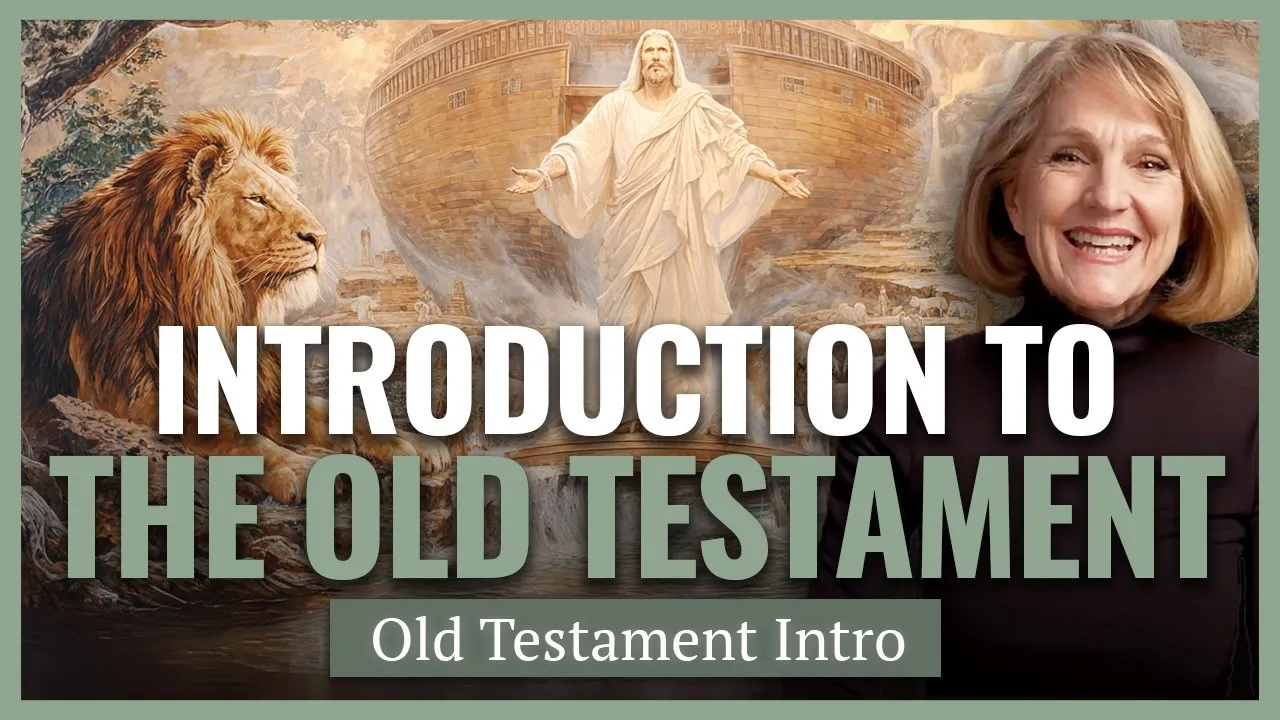
And we use it in English as Christ. To find the Christ in these texts, in the symbols of the temple and to find them in the lives of these women who have sometimes been less remembered. Today I'm also excited in this introduction to be able to talk a little about the Joseph Smith translation and the book of Abraham.
I want to start out with a bird's eye view and then we'll zoom in a little more closely for this introduction. As you know, there's 39 books in the Old Testament. But that's the Christian Bible.
When it's the Hebrew Bible, they didn't canonize it. They didn't close the text until after the New Testament was closed. And in the divisions of the Old Testament, they have the law, the writings, and the prophets.
And as you know, the law is the first five books of Moses. We call it the Pentatuk or the Torah, Genesis, Exodus, Leviticus, Numbers, and Deuteronomy. And these were supposedly written by Moses on Mount Si.
But we know there's been lots of changes, not only from the Joseph Smith change, but they mention it in the Book of Mormon and modern scripture as well. The writings are books like Joshua and Judges and Ruth and Kings. We also have Proverbs.
This is the poetry, the beautiful job. Um the pro and the psalms which are their hymns, their songs. Ecclesiastes.
So that's the writings. And then we have the prophets. The major prophets are Isaiah and Jeremiah both Jeremiah and Lamentations.
And then Ezekiel and Daniel. And then the minor prophets. There's 12.
Hosia and Joel and Amos, Obadiah, you know, all those all the way down to Malachi. And I also would like to emphasize the times in the Book of Mormon that refer to these ancient texts. And I hope to bring those up in addition because I believe that the Book of Mormon is one of the best commentaries on the Old Testament.
Remember, the Book of Mormon is also an ancient text. It comes out of 600 BC and it is a beautiful connection between the two. We have the vast majority of women across the four standard works come in the Old Testament.
I've been studying this for years as I'm preparing to write a dictionary on all references to all women in all scripture. And the Old Testament is three times more references to women than the New Testament, than the Book of Mormon, than the Doctrine of Covenants, then the progay price, you know. So this is very important to us.
In fact, in the Old Testament, we have 132 named females. Now, I'm sure most of you could name Eve and Sarah and Rebecca and Rachel and hopefully Miriam and Hannah and lots of other great ones, but 132 is what I my goal is this year. On the unnamed women, we have 1,756.
Some of those are fictional. I've got about over 50 fictional women. As I've categorized these references, there are 2,748 references to females or their families in the Old Testament.
And I love this organization of families. Most of these women are single or whatever. And as you look down at the hes, you see there's not only a lot of harlots and harams, but there's also help meet.
And these unheralded voices need to be heard. I'm just thrilled that we have this opportunity to go through nice and slowly this year and look at some of them. As I look at these references, the majority of them are just on she or her.
Um, but as you look at the either my handout or my slides, I have a lot of charts with exact numbers and details that just give you a flavor for how are women described in this ancient text. I personally feel like one of the best commentaries we have is the Joseph Smith translation, which includes more references to women than we even had before. When Joseph Smith starts doing this translation of Genesis, it is just after the church is organized.
Remember the Book of Mormon came hot off the press just two weeks before the organization of the church. And Joseph and Oliver, the Whitmers, Emma, many people have been focused so carefully on getting the Book of Mormon out. But just about 3 months hot off the press, Joseph Smith receives a commandment that I want you to start translating the Bible.
I think this must have been overwhelming to him. The It's one thing to bring forth new scripture, but the Bible was so sacred in the second great awakening. Remember, these are the people of the book.
This is literacy in America where it was so important. Joseph obeys the Lord though and begins and the wonderful amazing things that come out of the first few chapters of Genesis are blessing us even today. And if you look across the entire biblical translation, Joseph starts in Genesis and he gets a few chapters in and the Lord says, "Stop.
Move to Kirtland. " And then he does a few more in Genesis and the Lord says, "Stop now and go to the New Testament. " He finishes the New Testament.
The Lord says, "Don't waste your time on the Apocrypha. Go back to the Old Testament. " Genesis 1- 24 have the major doctrinal changes of the entire Joseph Smith translation.
The major changes are in these first few chapters of Genesis 1- 24. And I'm thrilled to be able to look at those today. And last year, I should have a link as well to my handout on how the book of Moses came to be and how the book of Abraham came to be.
I'll just give a little brief review now. But this different scribes who were recording Moses one was Oliver Cry. He had just finished writing the entire Book of Mormon two times and the second time almost entirely by himself.
And then he sits down and as the scribe again in June of 1830, we're back down in Harmony, Pennsylvania for Moses chapter 1 and Moses chapter 2. Then up in Fet, New York, Joseph um asks John Whitmer to step in and we get Moses chapters five and um we continue on. Emma steps in for Moses chapter 6.
You know, we get different people. Sydney Rigdon comes in by Moses 7 because remember the Lord calls Oliver and um David on a mission. But the book of Abraham, I went into a lot of detail last year when we discussed it.
But just as a quick reminder, um there was an Italian soldier who was fighting with Napoleon who um came down all the way through Italy and when he got to Egypt and and Napoleon began losing favor um he is rejected now amongst his people in Italy and he is left there as a refugee and he becomes an archaeologist. His name is Antonio Lo and he excavated the tombs in the valley of the kings and um he is able to find many many things and upon his death he has written out his will and he's gives all these beautiful Egyptian things to two different families. His son takes some of them and is going to send them to America to sell upon his death.
And there in an auction, a man, an Irish young man, um, named Michael Chandler buys them. And he buys them thinking there's something inside. And he spends $6,000.
That was an enormous amount of money in those days. And as you recall, um, he he doesn't sell them very fast. And he hears about someone up in Ohio who might be interested in ancient text.
And so he goes clear up there, but all he has left by that time are just these four mummies and a few scrolls. And he's very disappointed. Joseph says, "I can't afford this.
You've got to just give us the scrolls. " He says, "I'm not breaking it up. " And so Joseph got the three male mummies, the one female, and then these two major scrolls, and then a few fragments of the scrolls.
And I talked a lot about this in the past and if you are interested there's a fabulous BYU studies article on this um from 1991 that you can look up. But the bottom line is Joseph realizes after he purchases these that these have stories from Abraham, stories from Aimilec, stories that are not in the scriptures. And so as he began translating on November 19th in 1835, he made rapid progress in November and early December, but things then went slower.
Now, unfortunately, we do not have all that he did. In fact, we only have a small portion. Uh we only have 1/4th of what he translated, but we are very grateful for what he does have and what he was able to give to us.
Another bird's eyee view. Now looking at the Old Testament, going back to the text, I just want to emphasize that this is a difficult book to understand. And one of the reasons is is the King James English.
Most translations of the Old Testament, whether you're reading it in German or Spanish or English, have a theological base. The King James version is most often used by angophones in the Church of Jesus Christ of Latter-day Saints and other faith traditions as well. But it is very difficult to understand.
And the King James version is laced with a theology of the translators, many of whom were Calvinists, many of whom were Puritans, many of whom were part of the reformed tradition that thought God had complete control, that very few are saved, that agency does not exist. And you see this filtering through the text. Sometimes the King James translators were acting in opposition to the Catholic translation, the Bishop's Bible.
And that's why when King James came to the throne, he immediately wanted to switch over this theology from Catholicism to Protestant. And that's where we have this translation. But I would encourage you this year to look at other translations as well.
And I appreciate the fact that the rest of the international church is reading many different translations. And the thing that is sacred is the spirit to help us guide through this beautiful text and to find these gems. And one of the most beautiful part about the Old Testament are these beginning chapters.
We are so fortunate. Joseph Smith is coming out of the second great awakening and his theology is completely different. He does not see things the same as his culture when it comes to Genesis.
And as we step in next week in the book of Moses chapter 1, um it is not in our text and we receive a completely different view of the purpose of God and the purpose of man and the purpose of Satan's work. And I hope that you can continue on and stay with us as we now begin this year looking not just at the handmaidadens and the herums and the heroins, but all the other great characters in this beautiful book of scripture. I pray that the spirit of the Lord will guide your studies and that this can just be a stepping off place for you to dive into the text and find meaning there.
This is ancient scripture, which means you're going to have to work a little bit harder, which I think means the spirit of the Lord will be more important in your study. And I have had a witness that not only are the scriptures the word of God, but the scriptures are also what can bring the spirit of God into our lives. And that is the cleansing agent.
That is what can take us to our savior. That is what takes us to our knees. I testify that Jesus is the Christ.
He is the promised Messiah and he is coming again. And I leave this with you in the name of our savior Jesus Christ. Amen.