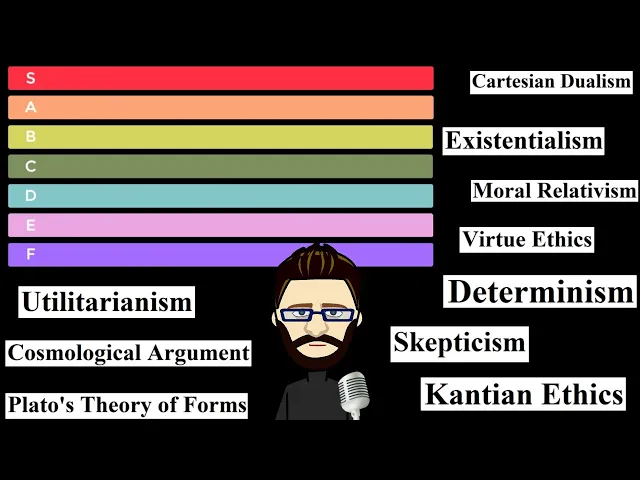
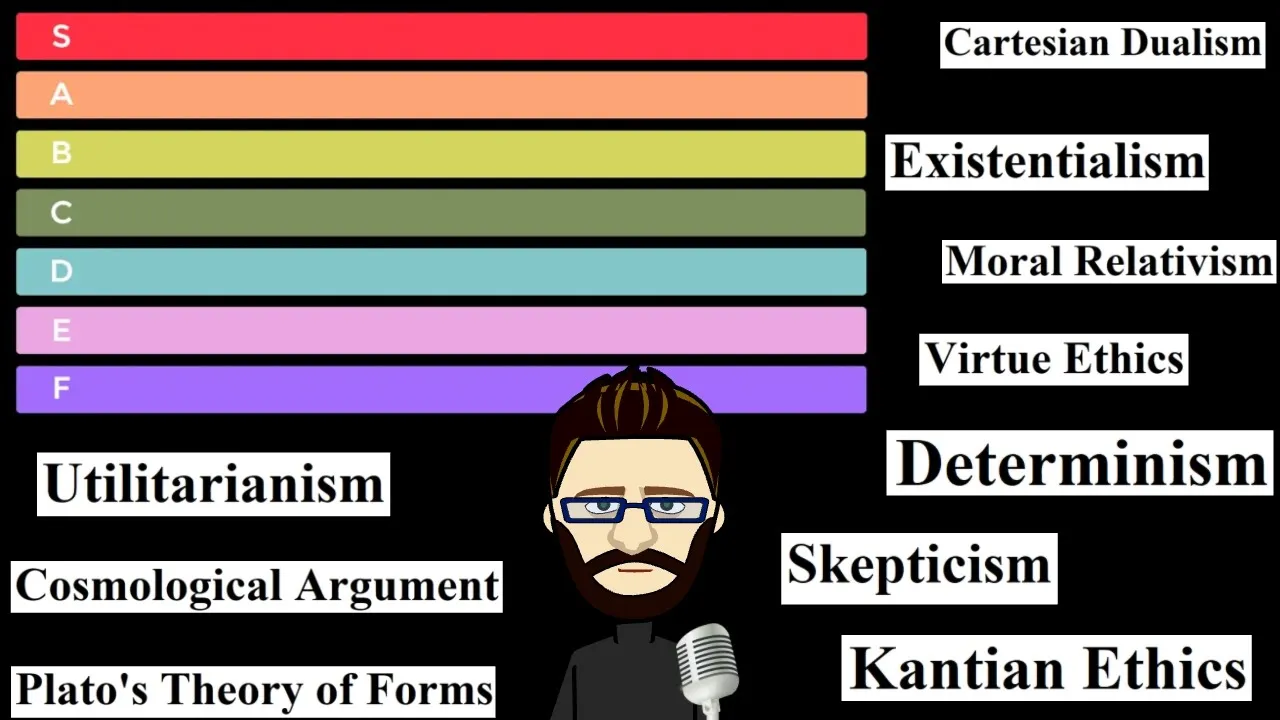
[Music] welcome to philosophy the channel where we discuss and debate different philosophical ideas my name is George and in this video I want to rank a bunch of different philosophies in a tier list so I'm sure you're all familiar with the tier list starting at S as the Supreme tier then AB bcde e and at the bottom F being the worst rank so what we're going to do is go through a bunch of different philosophical theories beliefs arguments in a bunch of different areas so philosophy of religion ethics meta ethics philosophy of Mind philosophy of
perception and a whole lot more and we're going to place each of these philosophies on this tier list what's going to determine the rank is down to how solid the philosophy is so how convincing is the argument how much sense does it make how well does it hold up to criticism now of course every philosophy has its challenges but what will rank a philosophy higher is how well it can be defended against uh against the critiques and how easily the theory can be adopted now it's not about should you or do you adopt any of
these but just how good of an argument are they so let's get let's get the screen sorted we have 35 different philosophical theories to go through if we can get these on the screen great yep so I'll give a very brief brief description of the theories and then place them uh this is just my opinion so if you disagree with any of the placements please let me know in the comments below and before we begin each of these theories we have a specific philosophy via video on they've been discussed and debated I have discussed and
debated them with John I'll tag a link uh to each of these um as we go through them and there'll be links uh below as well um so if you're unfamiliar with any of these theories please please go ahead watch these debates uh we've spent so much time discussing these philosophies which puts me in a in a good position to rank them so let's get started okay number one let's start with the teleological argument so an argument for the existence of God it basically says because the universe is gold directed and in a state of
motion it needs a designer and that the Universe and the laws of nature are so intricate it's not down to chance uh but must have been designed and this designer would effectively be God now I'm going to place this in the C category a middle tier Theory it is quite convincing because yes the universe is intricate and intricate things do need a designer Pal's watch analogy is a good example of this but I can't put it in the higher tears because ultimately there are some serious flaws in the design of the universe which will make
problems for an intelligent designer also given an infinite amount of time and exact world like ours could come about by chance I think that there is an argument there and also the universe is not a watch or it's not a phone so the analogist arguments only go so far so because of that c tier number two let's go utilitarianism okay so an ethical theory that says the right action is that which generates the greatest good for the greatest number now I'm putting that on a b tier I actually think most most of our ethical choices
are centered around doing the greatest good for the greatest number I think that's common sense and pretty obvious right I mean you wouldn't save a burning building with one person over a burning building with a 100 people I mean you just wouldn't most of the time moral choices have a utilitarian leaning however not always certain rights Trump the majority's happiness and a pure utilitarian Outlook can lead to like organ harvesting or other tragic action there has been some groups to go through like rule utilitarianism or preference utilitarianism and things like that to try and cover
the flaws uh but generally it is a good ethical Theory so I give it a b all right our third one is determinism okay I am putting this as an a sorry to the Free Will Libertarians out there but it's just such a convincing Theory determinism uh being the theory that we have no Free Will and all our actions are determined when you look at biological determinism or logical determinism and how little choice we have in the creation of who we are yet this affects our personality which affects our choices it's just so hard to
argue against the biggest problem with determinism which keeps me from putting it on the S tier would be firstly I don't like the idea of determinism on an emotional level that does play a part in how one adopts a theory the idea that every choice you think you make has already been determined and you have no free will is kind of depressing uh you're just sort of going along for a ride and you can't actually affect anything but the main one the main problem I have is I'm trying to get my head around what's the
point of Consciousness without free will like why are we or how Have We Become conscious sentient self-aware if our thoughts and choices are just determined and laid out we're no different than a character in a movie or a book this bugs me uh something doesn't add up so it keeps me from putting it on the S tier let's move on to number four we'll go for the ontological argument that's than which nothing greater can be thought of okay so this is the idea that the concept of God is a perfect being to be perfect you
need to have actual real existence therefore God exists I'm putting this on the etier really unconvincing argument trying to define God into existence is basically what you're trying to do I I think K's argument that existence cannot be a predicate just destroys this argument the only reason it's not on the F tier is because it's quite clever in its delivery like you need to think about it before you utterly destroy it but like initially it seems quite convincing almost deceiving so I think e tier for that okay number five cartisian Jewel ISM okay so by
cartisian jism I am talking about a large chunk of the meditations so the doubt that de goes through the evil demon right to I think therefore I am right down to the Mind Body distinction ultimately the idea is that the mind and body are two distinct entities okay I'm putting this on the B meditations is a solid piece of work great great reasoning from the beginning dayart really brings us to a dualism conclusion in a great way dualism itself is convincing just on a common sense level you know your thoughts are different from your body
the mental is clearly different from the physical there are however a lot of challenges to this and some good arguments against I would say the problem of interaction being the main one but dualism does hold up and dayot does a good job in explaining this so be tier for me moving on Canan ethics right so deontological ethics but advocated by K so what is morally good is down to the action it's down to duty not the end result that's it in a nutshell I put this as a c uh yes duty is important are human
rights deriv from a theory of this kind however the axe murderer lying scenario just really puts a strain on this theory for me utilitarianism makes more sense so I think middle of the road is okay right okay next we have let's go nonnaturalism can also be referred to as intuitionism so some meta ethics here this Theory claims that moral language cannot be reduced to any natural language so it cannot be defined but we just know right and wrong based on a moral intuition I'm going to be generous here I'm giving this a B I think
a moral intuition really makes sense like we don't need a God to know morality we don't need books and books and essays and essays about right and wrong it's just in us it's just natural like like how we see rotting meat and we feel sick and we see murder and we just feel it's wrong we just know it's wrong obviously there's always moral disagreements which poses a problem for a universal intuition and the intuition itself is kind of metaphysical so so I don't think it can go past the B tier but it is a convincing
Theory and it takes a lot of the leg workout for ethicists okay let's stick with ethics and we'll go virtue ethic ethics specifically aristotlean ethics um the idea is we shouldn't really discuss moral actions per se it's about living a virtuous life it's about how you should live aim towards your purpose of reaching emonia so like being a good human live by the golden mean and practical wisdom I'm putting this at a c I like this Theory but as an ethical Theory it's like average uh maybe a life philosophy sure but for ethics you have
some problems it makes sense it does it's it's quite convincing but Aristotle gives these 11 moral virtues to live by like courage and modesty and others but this this like so many metaethical problems with these they sort of leave you with more questions I think um but I do think there's a lot of good lessons here the golden mean being the the main one a great philosophy to to try and live by so yeah I would say C okay so so what's that what have we done so far is that eight so eight okay oh
wow so we still got quite a few to go to all right let's let's go back let's go back to the screen all right then so let's stick with ethics and we'll go situation ethics uh by Joseph lecher so treat each situation by doing the most loving thing so live by agpe do what's best for your fellow man um you may say I'm being harsh here but I'm going to give this an e it's a bit lazy um it's like utilitarianism meets Jesus you know do the loving thing but for each situation like sure but
what is the loving thing you know that's why we turn to ethical theories like I I don't know I'm not convinced by this ET okay moving on let's get off ethics for a bit and we'll go to philosophy of perception and we'll look at John Lock's primary and secondary qualities the idea that half of what we perceive is mind depend dep so when we look at an object this object will have primary qualities the primary qualities are the shape length size quantity these all exist in the external World however these primary qualities have powers that
create secondary qualities in our mind now secondary qualities are things like taste smell sound and color these are all products of the Mind they are not in the external World they are solely ideas so I'm giving this a B I love this Theory it makes total sense it's more or less backed up by science why it doesn't go further than a b is because it's ultimately an indirect realist Theory and and so we're trying to understand an external world where half of what we perceive is apparently only in the mind uh and all we immediately
perceive is just our own ideas of the external world so then do we even need the external world so anyway that's why it stays at a B next uh we'll go the cosmological argument back to philosophy of religion right everything that exists as a cause the universe exists so the universe needs a cause we need something beyond the universe to cause it this thing needs to be an UNC Call's calls the first calls so this must be God I actually going to give this a b definitely better than the other logical arguments for God you
know what cause and effect is quite convincing right it's ubiquitous that's how we understand Science And scientists are fairly confident the universe began to exist so it had a beginning nothing comes into existence un cause so I think it's fair to argue that the Universe needs a cause also the calam version is really convincing The Logical problems of an actual infinite universe and all of that but why it stays at a be we are giving god the uncaused powers which really we could give to the universe itself right even though this universe came into existence
say at the big bang it could have come from an infinite super universe that caused it so there's some issues here it stays at a B right so sticking with philosophy of religion we come to the problem of evil if God is all loving and all powerful why is there evil in the world okay I'm giving this an S right this this goes on the S TI here we go our first s TI this argument is devastating for the classical theist I mean the mental gymnastics to try and overcome this is crazy the the Iran
theodicy the augustinian theodicy the Free Will argument you can't overcome it I'm sorry if God is benevolent and omnipotent and omniscient you really shouldn't have a world with so much pain and suffering yeah so problem of evil St hard to argue against very convincing okay back to philosophy of perception and we'll go for Barkley's idealism evolving from locks primary and secondary qualities forget the primary qualities okay all of reality is in the mind everything is mental everything we see or experience are just mental ideas there is no external World outside of our minds and something
only exists if there is a mind there to perceive it okay to be is to be perceived I love this Theory this this is what philosophy is all about okay reality is all in your mind I love it I'm putting this at a B tier okay it same tier as locks primary and secondary qualities but I would say it's stronger than locks because we don't have that veil of perception we're not trying to get knowledge of an external world with only mental ideas because there is no external World okay Barkley has some really convincing arguments
here the likeness principle the master argument and let's be honest so much of our reality is mental dropping the physical world is probably the logical Next Step but why it stays at a B the continuity argument is tough on the theory okay why would a candle burn if no human is there to perceive it or if there's no physical world and it relies to too much on God sustaining everyone's mental ideas so if you're an atheist this Theory just doesn't work so it stays at a B all right next emotivism some more meta ethics morality
is just human emotion when someone says murder is wrong all they are saying is I dislike murder just expressing an emotion right nothing right or wrong about the statement murder is wrong as a statement is not right or wrong it's nothing in fact statements can only be true or false if they meet the verification principle analytic or synthetic statements only otherwise they are meaningless statements and so to say murder is wrong is just a meaningless statement I'm giving this a c it is quite convincing you know all moral disagreements and moral differences are reason explained
with this you know just difference in Emotion we don't need to go past human experience to explain moral language however the theory is built on the verification principle but fails against the the verification principle so so you to say language is only meaningful if it meets the verification principle that statement doesn't meet the verification principle so it fails by its own criteria devastating from a logical perspective but the theory has some sense so I'm giving it a c all right back to ethics we have natural law the idea that God has written morality into nature
and humans have an instinct by God to recognize this I like this Theory you know it's a form of intuitionism uh but it needs it needs God to be a lawgiver so it's tough uh it's tough you you have to hold on to the fact that that that God exists you have to have God in the equation um I was thinking C but it might have to be a d because of that um yeah all right d d all right okay next nihilism okay so life is meaningless there is no inherent value or meaning to
life that's it for me this is an e as a theory there's not much to it as a philosophy it's quite depressing but it's I don't know it lacks all imagination and inquiry you know because you you haven't just because you haven't seen God or aliens or Wizards you think there's nothing more to life it's a bit boring it's a bit lazy it's easy to argue against you know anyone with some meaning or value in their life would not be convinced by this so uh yeah doesn't do well all right next let's do Plato's theory
of forms some metaphysics here the idea that there is a greater reality of which everything we experience in this reality there exists a perfect form or version of in the greater reality I give this a c it's a solid C firstly it's a wonderful metaphysical Theory I mean greater realities perfect forms and we perceive lesser versions of Perfection I mean this is what you want in a metaphysical Theory but always always with metaphysics there's so many challenges it makes sense you know it does make sense we have concepts of things and the argument can be
made that the concepts come from a perfect version in another dimension but it will never be proven it's a wild belief you hold it won't go further than that so see all right but but but sticking with Plato we have have his allegory of the cave I'm putting this in the S tier yes we have another s tier now everyone's Gateway into philosophy has to be the allegory of the cave what an amazing story is this a philosophy in itself um it's kind of the precursor to the theory of forms but it's layered you know
it's about exploring past what we immediately perceive every philosopher has to leave the cave so to speak and this allegory just puts it all into perspective I love it I want it I want this on the S tier definitely an S tier one for me sticking with the great ancient Greeks let's go for Aristotle's theory of causation the idea that everything is moving towards a goal towards a purpose and we have an unmoved mover that gives everything its direction this is kind of like the telogical argument but it doesn't advocate for like a classical God
more so it's just like a movement or a force in the universe um it's also like an early scientific theory in a way as it uses like the direction and movement of nature as evidence I give this a be there is a lot of sense in this uh you can't deny the end movement of Nature and the purpose of things that exist and Aristotle doesn't put too many attributes to God to make this like a philosophy of religion so a b is fair okay next we have skepticism I'm focusing this on David hume's skepticism so
all our knowledge comes from inductive reasoning inductive reasoning is only from experience so we can never be certain of any knowledge we can't be certain that the sun will rise tomorrow or gravity will continue or humans won't suddenly all turn into frogs um I'm putting this as an F all right here we go our first F on the list it's pointless like what's the point of this we can't trust our knowledge so how do we know anything or how can we do anything like what comes from this Theory other than being a bit edgy and
who honestly lives by this or believes it like really there's there's not a lot of thought behind this it just trashes inductive knowledge and so what we have to live our lives with the possibility that we can all turn into mashed potato I don't know I don't this is clearly there is clearly order and inductive knowledge is solid so why why be a skeptic on every bit of knowledge you've attained what's the end goal for this anyway f for me but but sticking with Hume we have the is a problem which I'm giving an a
to this is a great problem for ethesis how can we derive Arts so action guiding behavior from physical facts about the world a great start to ethics and a question I feel ethicists have always and will always struggle with next okay pantheism guys here we go another St I love this Theory it makes complete sense the universe is God of course it is we can literally get atheists and um I was say theist to agree if if we need a God to create the universe and God is infinite then why not say the universe is
God and the universe is infinite and therefore God is everywhere because God is everywhere and God is conscious because we are conscious and we are a part of of the universe and a part of God it just makes so much sense it's well defended I love it pantheism sta definitely right back to religious ethics we have the youth ofro dilemma is good good because God commands it or does God command it because it's good a great question it either trivializes ethics or God's omnipotence but it's definitely something a theist needs to think about I'm putting
this as a b there is a debate about God being the good and I think the theist has a way to evade the problem but I want to look into it a bit more to wrap my head around it uh nonetheless it's a great question not so much of philosophy as a philosophical challenge but I give it a b all right uh next we'll do existentialism ah I I have a soft spot for existentialism I find it quite empowering you know make your own meaning Forge your own existence but oh I think I think I'm
going to give it a d there's not much to it it's a follow on from nihilism but as a philosophy there's just not much substance and like I said the second you have any sort of belief in something greater than the physical world the theory doesn't continue um but but if we move on to absurdism I like this I might be being a bit generous but I'm going to give it a c it's it's kamu explanation of wanting to find meaning in a meaningless world that just makes a bit more sense rather than just like
there's no meaning or create meaning the the absurdest explanation of The Human Experience does hit home right we do want to find meaning but we're in a silent Universe we can't find meaning so the ju toos gives us this absurd reality it makes sense it does fall short I think C is generous but I'm sticking with it but as as far as the philosophy goes it's a bit weak all right okay what we on now there's there's 10 10 10 more to go okay 10 more to go we're almost there let's do it back to
determinism but specifically theological determinism and people we have another s this is a solid argument if God knows everything he would know the future and if he knows the future then the future is determined of course how can God know what I will eat in 20 years time if it hasn't been determined so if you believe in an omniscient God you have to be a determinist now there's some argument about God perceiving time in a nonlinear way and it tries to allow him to see the future whilst we still retain our free will it's a
weak argument no I'm sorry theological determinism is powerful it's convincing it's an st definitely um so let's go back to ethics and we have moral relativism okay so the idea that morality is just relative no universal truth just down to culture and and it's relative to the culture or time period that you're in I'm giving this A D um it does make sense it explains moral diversity moral disagreements and moral changes but it also simplifies moral ity down to like just almost like culture or ritual or celebration it dismisses the idea of moral truth or
finding a moral truth too easily um all right let's go now can transcendental idealism so building from Barkley's idealism but taking locks indirect realism and we have KS version which says that we perceive reality through a spatial temporal lens a time and space are effectively mind dependent ideas and our perception shapes and orders the external world we perceive this is a great metaphysical Theory I'm putting this as an a can does a great job here um so we have the indirect realist element but with this uh time and space spin on it and and we
kind of understand that time is relative right and it's a personal experience so this Blended in with the philosophy of perception makes it a really interesting Theory next we have SIM simulation Theory the modern day version of idealism now I am a fan but I can only give this a c it is compelling all right it's the idea that we live in a computer simulation uh we understand that humans one day will have the ability to create computer simulations with conscious programs and when humans get this ability they will most likely run millions and millions
of simulated programs so if that's the case we would have one actual reality versus millions and millions of similar ated realities which means the chances are that this is a simulated reality okay love the idea love the maths it is convincing but the philosophy of Mind component is not answered I mean to get to simulation Theory you have so much philosophy of mind to cover like what will it ever really be possible to create a conscious mind program with our level of sentience will these programs actually be alive what is consciousness it just fall short
of all these questions or takes them as a given so it can't go past the c um moving on liet's best of all possible world's argument okay so back to the problem of evil uh it's the argument that God did in fact create the best possible world he could have so I have to this is an FTI sorry but how can you really think an omnipotent being cannot do better than this I'm not I'm not saying it's all bad but come on we're talking talking about omnipotence things could be better it's a weak argument easy
to argue against it doesn't hold up FTI right next let's go back to existentialism and we've got ker guard's three stages of life this is interesting there's some wisdom behind this I like you know I think the idea of the aesthetic stage and the ethical stage and the religious stage does make sense but as far as the philosophy goes I don't know it's not there's not much meat there this is like a a life lesson sort of thing um you know more of like a a spiritual life lesson rather than a a hardcore philosophy so
for me I'm going to put this at a detail I don't think it can go past that interesting but just not enough as far as philosophy goes all right functionalism next one on the list so the human mind is just a computer program nothing more nothing less there is nothing special about our Consciousness our brain is the hardware our thoughts of the software I'm giving this a d there might be some truth to it but it dismisses the magic of the mind and I think uh sir's Chinese room thought experiment really blows this Theory out
of the water so D probably might be even a bit generous but we we'll stick with that okay three to go we're almost done next on the list is clipsism the idea that I am the only mind that exists all I have is access to my own thoughts so I can't be sure anyone else exists other than me okay honestly might be a bit embarrassing but I love clipsism I actually love the idea uh that I am the only mind in existence um I prefer the idea that I'm actually God and all of existence is
created by me what endless fun that would be but as a philosophy this is e at best um there's some reasoning behind it uh you know what it can be pretty convincing and it's hard to argue against but what's the point of it really why even have a name for it if anyone truly believed this why talk to anyone why interact why bother explaining this Theory like who are you explaining it to you're explaining it to a character that you have created a version of your mind in a dream world what's the point narcissistic lazy
but I still love it anyway it's still an e it's an e almost there almost there let's now go for moral skepticism also known as error Theory the idea that all moral language is false every moral statement one makes is in error now macki is the main figure I have in mind here and I'm giving this a c macky's argument from relativity and queerness are good arguments and this is stronger than moral relativism because uh we have the moral language component to it and it doesn't try to assign any truth to morality the way more
relativism tries to assign like relative truth um but always with skeptical theories it trivializes the importance of Truth it just gives up because there's not a blatant moral fact and life is not that easy regardless of your ethical stance we have moral judgments and the point of moral judgments is to aim at truth so to just claim all moral judgments are in error then how can we take ourselves seriously when we have a moral judgment and then why do we care so much about them why is morality so important why are we so passionate about
our morals if they are all in error still Macky brings up some good points a solid C philosophy uh last one here we go final one on the list quasi realism another ethical Theory moral language is not realist however we treat it as though it is so morality has a fake realism attached this does actually make sense I give this a b it explains why we care so much about morality because we see it and treat it as though it's real but it also explains why morality can seem uh to be relative uh because ultimately
it is anti-realist it's it's a nice blend of moral realism and anti-realism as well as cognitivism and non-cognitivism uh the problem is it tries to be both and is in fact open to criticisms of both so whilst it can keep the benefits of both you also launch both critiques at it as well um so I struggle to get it past a b status uh that's it there we go philosophy tier list uh we just went through 35 different philosophies and ranked them all uh I hope you enjoyed this video um if there are rankings you
disagree with uh you think I've been too harsh or too generous with any philosophies please let me know in the comments below and if you're interested in learning more about any of these philosophies we have debates on each of these on the channel I've listed each video below don't forget to like and share and for more philosophical content please subscribe to the channel take care I look forward to seeing you all soon