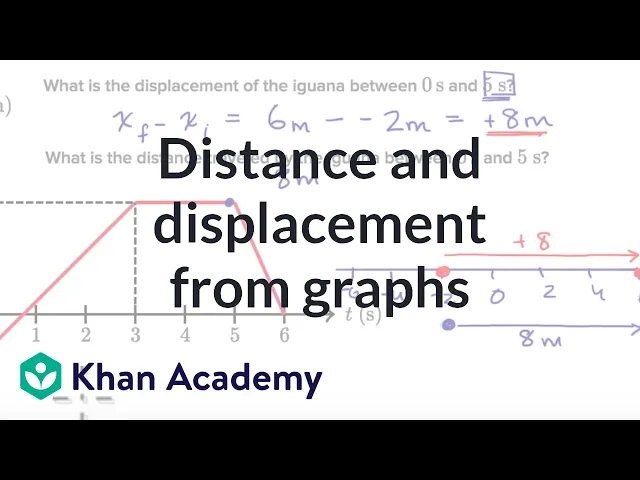
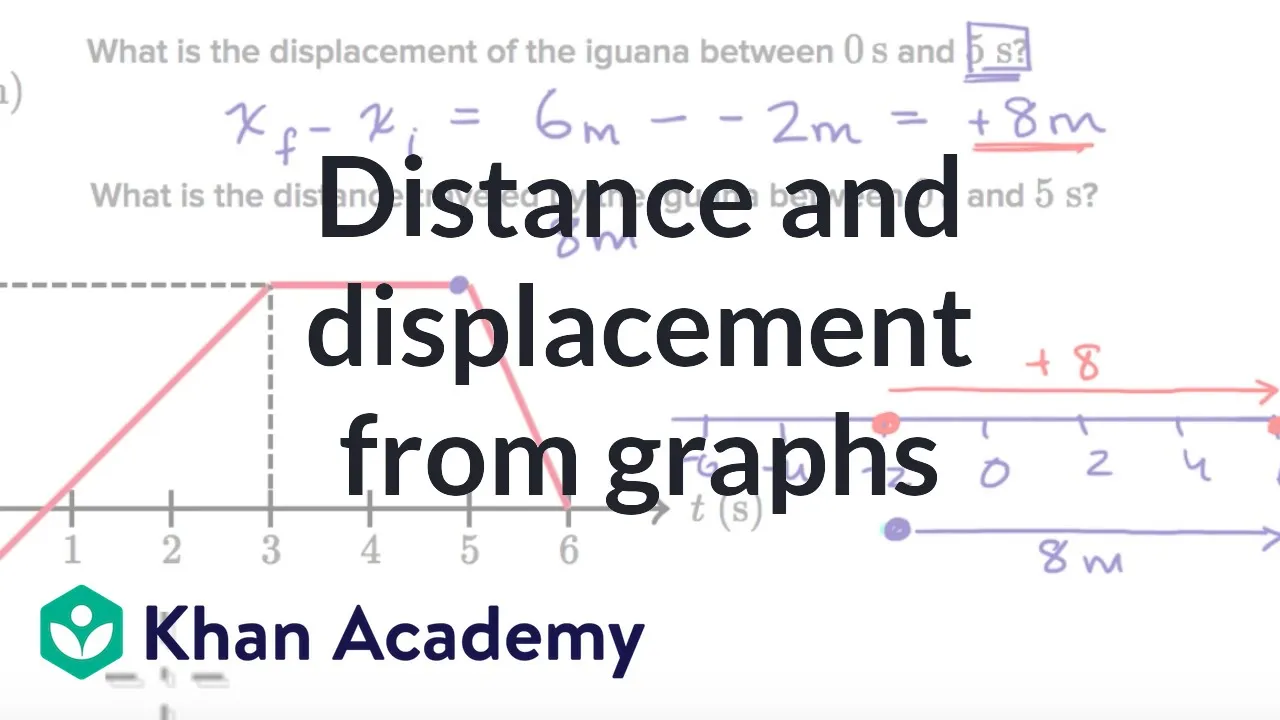
in other videos we've already talked about the difference between distance and displacement and we also saw what it meant to plot position versus time what we're going to do in this video is use all of those skills we're going to look at position versus time graphs and use them in order to figure out displacement and distance traveled so this first question says a 3.2 kgam iguana runs back in fourth along the ground the following graph shows the horizontal position of the Iguana in meters over time the first question is what is the displacement of the
Iguana between 0 seconds and 5 Seconds so be very careful it's not saying between 0 seconds and 6 seconds it's saying between 0 seconds and 5 Seconds so pause the video and see if you can figure that out well displacement is just your change in position and sign matters we care about Direction so it's going to be your final position minus your initial position well what is your final position well we're not talking about the final the high the last time that we have on the graph here our final is going to be at 5
seconds so our final position is at a positive 6 M so our final position is positive 6 M and from that you're going to subtract our initial position well our initial position was at -2 M -2 M and so this is going to be equal to 6 - -2 is postive 8 m so one way to think about it is net this iguana shifts 8 MERS in the positive direction and if we think positive direction is say to the right it would be 8 m to the right we could draw a number line here so
if we it's sometimes confusing because we're talking about the horizontal Direction but we're plotting position vertically here but we could take the same number line and make it horizontal and you'd have -6 -4 -2 0 2 4 68 and so what's happening here is the iguana is starting at -2 and then over the next 3 seconds it goes to positive 6 it goes over here and so it shifts to the right by eight and that's what we saw right over there 6 minus -2 is 8 now what about the distance traveled by the Iguana over
that same time period pause the video and see if you can figure it out well the the distance is the total length traveled the total path length but once again it went from -2 all the way to positive 6 over the first 3 seconds and then it just stays there so if we think about distance we're actually going to get the same result even though we don't care about Direction here we just care about the magnitude we still get the same thing it traveled 8 m so it travels 8 m so we're going to get
the exact same result now what would be interesting is to think about what would be different if instead of 5 Seconds if this said 6 seconds if this was between 0o and 6 seconds well then for displacement we would say hey look we went Plus 8 but then we're going to go another ne6 so this right over here let me make this you're going to go another -6 and so you actually have you would have the Plus 8 minus 6 so if you did it for all the way to the 6th second then your displacement
is going to be plus 2 m you have the eight and then you subtract the six another way to think about it is you would finish at zero you started at -2 0 - -2 is 2 if you wanted to think about the distance between 0 seconds and 6 seconds well you would have this 8 m and then you would go even though you're going going back to zero so you're going back to zero right over here 6 M you wouldn't subtract it because the total path you travel 8 meters to the right and then
6 MERS to the left and so you would add them so if you said over the first 6 seconds instead of the first 5 Seconds this would be 14 M let me make that clear again displacement and distance in both cases you have plus eight over that first leg I guess you could say and then when we thought about displacement we subtracted cuz we're now moving to the left we move to the left by six so in the case of displacement you subtract the six and you have a net displacement of plus two but distance
the total path traveled you have the eight to the right and then six to the left which gives you a total path traveled of 14 let's do one more example here a 2.7 kg armadillo rolls in a straight line in the desert the following graph shows the horizontal position in the horizontal position of the armadillo in meters over time and so let's think about the same thing over the first 24 seconds let's go all the way to the 24th second let's think about what the displacement is and what the distance traveled is so first pause
this video and see if you can figure out the displacement over the first 24 seconds well this is going to be our final position minus our starting position our final position we're at 0 MERS our starting position we were at Time Zero we were at 6 M or let me just write the numbers down so it is -6 let me say that one more time at time 24 notice our vertical coordinate we are at a position of zero that's where that came from when we started at Time Zero our position was right over here so
our final minus our starting is -6 and you could also see that if you just look along this line we shifted from positive 6 to zero which would be a shift of six to the left if you made this horizontal or a displacement of -6 let me draw this on a horizontal line just to make this a little bit more clear so if you have Zer four oh zero three 3 6 9 12 15 so on and so forth we are starting at six let me do that purple color we're starting at six we do
a bunch of stuff in between but then we end up after 24 seconds at zero so our shift we went six to the left or we have a displacement of -6 0 - 6 is 6 so now let's try to figure out distance pause the video and figure out the distance that this armadillo travels over this 24 seconds so this is interesting so it's right here it starts off at position of six so let me do it right here it starts off at position of six it stays there for the first eight seconds then from
the 8th second to the 16th second its position increases by nine to get to 15 so it does this it goes to 15 so this is going to be plus this is going to be + 9 and then on the 16th second it goes from 15 back to zero so it goes from 15 back to zero if we were thinking about displacement we would write a minus5 here and then we would net these out to get to a a -6 but we're we're thinking about distance so we want we think about the absolute value of
the various parts of the path traveled so all of these are going to be positive we just say hey what is the total Journey so this is going to be plus 15 we just care about the lengths of these arrows not the direction and so 9 + 15 is 24 so this is interesting even though the armadillo traveled a total of 24 meters its entire path was 24 meters long its net shift its displacement is 6 m to the left and this is another thing to to emphasize this negative number this is this is implying
Direction it's saying if we're look at this number line it's saying to the left even if it was a positive six because we're talking about displacement it would imply positive would mean to the right distance doesn't tell you about Direction it just tells you the absolute magnitude of the total distance traveled or the length of the path