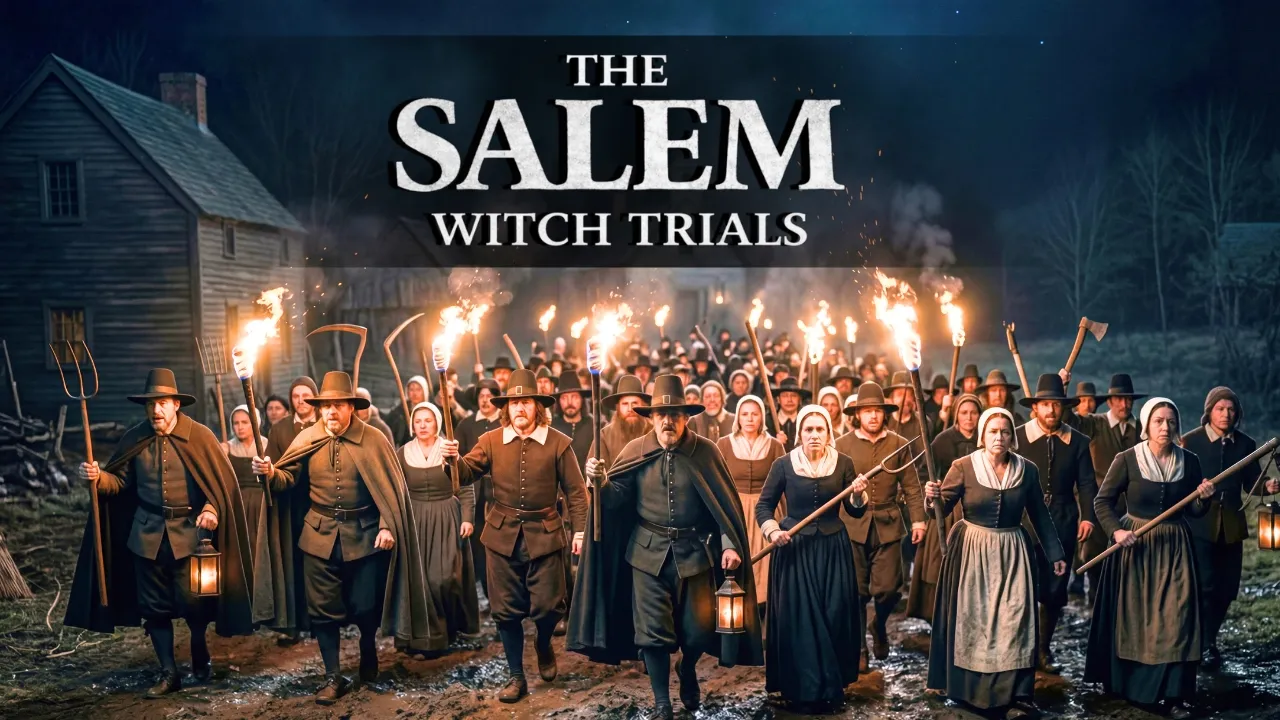
It began as a game, a forbidden curiosity shared in the shadows of a cold Puritan kitchen. In a society where children were seen and not heard, a group of young girls discovered a power more dangerous than the darkness itself. The power to point a finger and decide who lived and who died.
She is a witch. What started as an adolescent secret was seized by adults with old grudges and a hunger for land. This is the dark blueprint of how a society uses fear to devour itself.
Salem Village, now the town of Danvers, Massachusetts, was a small farming community in Essex County in the Massachusetts Bay Colony. It was a place under enormous pressure from almost every direction. The Puritan settlers who founded these communities had come to New England with a very particular vision.
They believed they had entered into a covenant with God, that if they lived faithfully, built godly communities and resisted sin, God would protect and bless them. But if they failed, if they let sin take hold, they would be punished severely. This was beyond a metaphor for them, it was a lived reality.
They genuinely believed that the devil was active in the world, constantly working to corrupt souls and destroy godly communities. The idea of witchcraft was taken absolutely seriously, both in theology and in law. Salem itself was also shaped by a sharp divide between two influential families, the Putnams and the Porters.
The Putnam family were farmers in the village, poorer, traditionalist and more isolated. The Porters were wealthier, with strong ties to the merchant class of Salem Town, the coastal port just a few miles away. The two families had been fighting for decades for control of Salem Village, its church, its politics, its land.
And then there was the question of the minister. In 1689, Salem Village got its first ordained minister, Reverend Samuel Parris. He was not well liked.
Parris had come from a merchant background in Barbados, had failed in business, and saw Salem as his last chance to regain status and authority. He arrived with rigid expectations, a free house, a guaranteed supply of firewood from the congregation, and ownership of the ministerial land. While Parris and everything he represented was supported by the Putnam family, he was actively opposed by the Porters.
When a significant faction in the village, tired of his perceived greed and rigid ways, stopped paying his salary and refused to attend his church, Parris used the pulpit to strike back. The bickering and lack of support for my ministry are the work of the devil! The community was split in two, and it was in this environment of resentment that the first screams began.
It started in Parris's own home. His nine-year-old daughter Betty and her cousin Abigail were playing an innocent game to discover their future. But instead of seeing their luck, the girls swore they saw a coffin.
The panic of having summoned the devil triggered the first outbreaks, which the authorities, instead of treating as trauma, treated as a crime. Days later, the girls began exhibiting strange behavior. They fell into violent fits, screaming, contorting their bodies, and falling into trances that no one could explain.
Soon, other girls in the village showed the same terrifying symptoms, and another, and another. The village doctor examined the girls and could find no physical cause. He went to Reverend Parris with the only answer he had.
The evil hand is upon them, sir. He believed they were bewitched. That single diagnosis ignited Salem.
On February 29th, 1692, under pressure from the adults around them, the girls began naming names. But they didn't start with the pillars of the community. They started with the outcasts.
First was Tituba, an enslaved woman in the Parris household with no social standing and no legal protections. The second was Sarah Good, a homeless pipe-smoking beggar who wandered the village asking for food and lodging. She was poor and was already resented by many of the people whose doors she knocked on.
The third was Sarah Osborne, an elderly impoverished woman who had scandalized the community years earlier by allowing a man to live in her house before they were married. These were, in other words, three women who already existed on the margins of Puritan society. A slave, a beggar, and a social outcast.
They were easy targets. All three were arrested and brought before the magistrates on March 1st. The hearings were not trials, they were interrogations, public ones, held in front of the entire village, presided over by John Hathorne, who operated less like an impartial judge and more like a prosecutor who had already decided on guilt.
He didn't ask if they were guilty, he asked why they had served the darkness. Sarah Good denied everything. So did Sarah Osborne.
But Tituba, likely terrified and pressured, did something no one expected. She confessed. I saw the devil and he bid me to write in his book.
I beg you mercy. Tituba's testimony was cinematic. She described the devil coming to her as a tall man dressed in black.
She spoke of black dogs, red cats, and a dark book signed with her own blood. And then, crucially, she whispered the words that set the town on fire. There are others.
With those words, Tituba saved her own life, as confessors were spared to be redeemed. But she condemned the rest of the town to a spiral of paranoia. Now everyone was a suspect.
The machinery of accusation was now unstoppable. It moved along the village's old grudges and land disputes. It didn't matter if you were a respected church member like Martha Corey or a four-year-old child like Dorothy Good.
Martha voiced her scepticism of the whole affair and had apparently made some dismissive remarks about the girls' fits. Her accusation shocked the community in a different way because if Martha Corey could be a witch, then the threat wasn't just coming from the margins. It was everywhere.
Dorothy was the daughter of the accused beggar Sarah Good. She was subjected to formal interrogations by magistrates in black robes. Her timid, frightened answers were maliciously interpreted by the court as a confession of witchcraft.
A four-year-old. She was jailed. She reportedly went insane from the experience and never fully recovered.
Her childhood innocence was devoured. In Salem, being accused was often as fatal as being convicted. Colonial jails were not modern detention centres.
They were freezing and disease-ridden dungeons. The system was also a business. Prisoners were forced to pay for their own meagre food, their blankets and even a daily fee to rent the very iron chains that bound them.
If you were poor and couldn't pay these fees, you remained in your cell even after being cleared of charges. The conditions were so horrific that many people died in the cold darkness of the jail before they could even face a judge. By April, the scale of the hearings was growing.
Dozens of people from Salem and surrounding towns were being brought in for questioning. And the accusers, mostly young women and girls, and many from the Putnam family with its own long history of grievances against their rivals, kept adding names. At the centre of the group of accusers was Anne Putnam Jr, 11 years old.
Her accusations would eventually destroy some of the most prominent people in the colony. In Puritan society, where women were often voiceless, these girls now held the power of life and death. The community watched all of this, and most of them did not push back.
If you challenged the accusers, you risked being accused yourself. On May 27th, 1692, the governor of the province of Massachusetts Bay, William Phipps, established a special court, the Court of Oyer and Terminer. Its mission was simple, to hear and to decide.
The court was given the task of clearing the massive backlog of accused persons sitting in jail. The stage was set for the gallows. At the head of the court stood Chief Justice William Stoughton, a man who saw mercy as a sin and his harshness as a divine necessity.
To ensure convictions, he allowed the most controversial weapon in legal history, spectral evidence. The logic was chilling. If a girl claimed to see your spirit in a dream, you were guilty.
To the court, the devil couldn't use an innocent person's shape without their consent. Therefore, if they saw you, you must be a servant of the shadow. Bridget Bishop was the first to face this logic.
Her crime? A sharp tongue, a flash of red lace on her dress, and a life that simply didn't fit the Puritan mold. On June 10th, she was led up Gallows Hill.
She was the first. She was not the last. In July, the hysteria claimed Rebecca Nurse, a 71-year-old grandmother and well-respected church member.
Her family had petitioned. Her neighbours had signed a written defence of her character. 39 signatures.
An extraordinary act of courage in a community where signing your name in her defence meant risking your own life. The jury initially found her innocent, but when the accusers erupted in screaming fits the moment they heard the verdict, the judge forced a reconsideration. She was condemned.
Beside her stood Sarah Good, one of the original three accused. Moments before her end, she looked at the minister and shouted, You are a liar. I am no more a witch than you are a wizard, and if you take away my life, God will give you blood to drink.
Legend says the minister who condemned her died years later by haemorrhage. Sir Liam never forgot. In August, five more people were hanged.
Among them was Reverend George Burroughs. He was accused of being the ringleader of the witches. As the rope was placed around his neck, he recited the Lord's Prayer perfectly.
According to the law, a witch couldn't do that. The crowd wavered, sensing a mistake. But the minister, watching from horseback, addressed the gathered people and told them not to back down.
The execution proceeded. September was the worst. While innocents were being condemned to the gallows, 80-year-old Giles Corey chose a different path.
He refused to even enter a plea, knowing that if he remained silent, the state couldn't legally seize his land from his children. Under the law, a defendant who refused to plead could be subjected to pressing, a procedure in which heavy stones are piled on the person's chest, one by one, until they agree to plead, or until they die. Giles Corey chose death.
Over two days, stones were piled upon him. When asked to plead, Corey only whispered two words, More weight. He died a silent hero, saving his family's legacy with his final breath.
By the time the September hangings were over, 19 people had been executed. At least five others had died in jail. More than 200 people had been accused.
The jails were full. The accusations were still coming. But something was starting to shift.
The crack that eventually brought the whole structure down came from an unexpected direction. By the fall of 1692, the girls stopped naming outcasts and started naming the elite. When they whispered the name of Lady Phipps, the governor's own wife, and targeted prominent military leaders, the authorities suddenly lost their appetite for the witch hunt.
The hunters were becoming the hunted. No one, not even the architects of the trials, were safe from the monster they had created. 17-year-old Mary Warren, one of the primary accusers, tried to tell the truth, confessing that the Fitz were a lie.
Immediately, the other girls turned on her, naming her a witch. To save her own neck from the gallows, Mary had to take it all back and rejoin the charade. The trap had become a prison for the liars themselves.
With the accusations reaching the highest levels of power, those who could stop the trials finally chose to act. In early October 1692, Increase Mather published a document called Cases of Conscience. His argument was surgical.
It was better to let ten suspected witches go free than to condemn one innocent person. Logic was finally prevailing over hysteria. On October 29th, 1692, Governor Phipps dissolved the infamous Court of Oyer and Terminer.
He banned further arrests and established a new court with one crucial rule. Spectral evidence was no longer allowed. By May 1693, the jail doors were opened and the remaining witches were pardoned.
The survivors didn't return to a hero's welcome. They returned to ruined lives. Farms were overgrown, livestock was dead, and reputations were shattered.
People who had testified against their neighbours now had to pass them on the road, or sit beside their surviving families in the same church. The silence in Salem was filled with the weight of what had been done. Samuel Parris, the man whose household ignited the fire, was eventually forced out, leaving behind a legacy of broken families and a cold, hollow apology, claiming he was easily led.
It wasn't enough. In 1696, he vanished from Salem, leaving behind a community he helped destroy. In 1697, Massachusetts held a day of fasting and soul-searching.
Only one judge, Samuel Sewall, had the courage to stand publicly in church and ask for forgiveness for his part in the tragedy. Years later, even Anne Putnam, Jr. , the most prolific of the young accusers, issued a public apology, claiming she had been a sad instrument of a great delusion.
But for those who had climbed Gallows Hill, these words came far too late. In 1711, the state offered £600 in restitution to the families. But for the first three victims, there was nothing.
Sarah Good was gone. Sarah Osborne died in a cold cell before her trial. And Tituba, she later claimed that Parris had beaten her and told her exactly what to say.
When the execution slowed, she recanted everything. She had made it all up. Forced.
After that, she was sold and vanished from the historical record, erased by the very system that used her. The trials were over and the hunt had ended, but the scars on the American soul are permanent. Salem lasted only 15 months, but its mechanics are timeless.
The judges weren't monsters. They were respected authorities doing their duty. The accusers were teenagers who found power in a world that gave them none.
And the neighbours who watched in silence were just afraid to be the next target. Salem is not a story about witches. It's a warning about believing completely and too quickly.
In anything. Today, we don't build gallows, but we still see the rush to condemn before the facts arrive. We see the pressure to join the crowd and the terrifying risk of being the only voice of doubt.
Salem is a reminder of how any society can devour itself when fear is used as a legal tool. We remember them as victims of a society that let mass delusion override reason. Don't believe too quickly and never stop asking why.
I'm Tim, watching the past so we can understand the present, and together we keep history reborn. I see you in the next era.