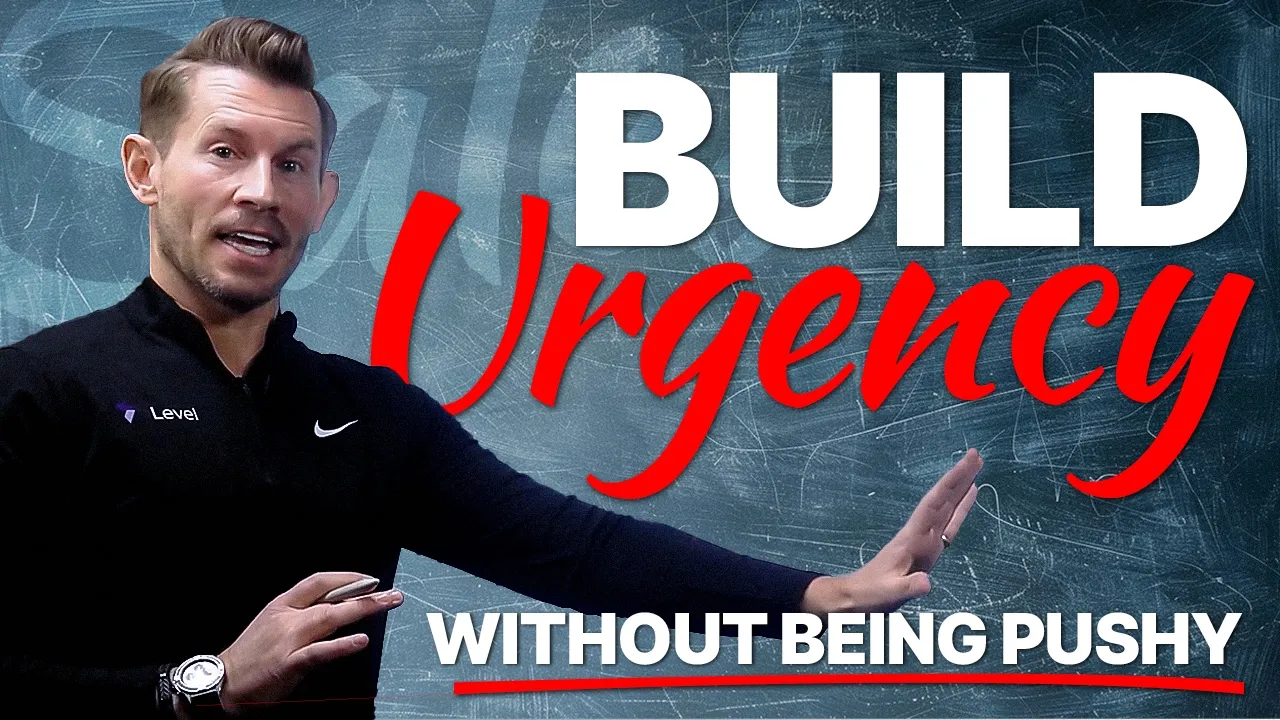
Hey, if you're a salesperson and you're having a hard time with prospects, like procrastinating, you're having longer sales cycles, you're always doing follow-ups, I'm going to show you three things that you have to start learning to build massive urgency to make the sale now rather than the prospect keep pushing down the road. Come to the buy board. I'm going to show you how to do this.
All right. Now, the first thing you do, how do you build urgency in the sale? That's going to be a little bit different if you're selling business to consumer compared to businessto business.
So, the first thing you have to learn is how to ask what we call NPQ consequence questions. Now, listen, write that down because what I'm about to show you can quite literally help you close more than you are now. So, consequence questions, NPQ stands for neuro emotional persuasion question.
Now, here's the three things this does for you. And then I'm going to show you a generic version so you can use it for your industry. And then I'm going to show you several industry specific examples so you can see how it's done.
The first thing you have to understand is you have to learn how to see doubt in the prospect's mind that they might be making a mistake without them getting upset with you, without them getting defensive because then their guard goes up. So, I'm going to show you how to use consequence questions for that. Another way that we want to use consequence questions to build urgency is we want the prospect, we want to get the prospect to actually defend themselves on why they feel they need to change their situation.
Is that good for the prospect to defend themselves on why they need to change their situation and do that with you? You're probably wonder like, "How can you do that, Jeremy? That's impossible.
" I will show you how if you pay attention. And then the third thing is you want to get them to question their way of thinking of why they've allowed the problem to stay the same. When your prospect starts internally questioning why they've allowed this problem or multiple problems to stay the same, they start to see that they need to change and they change with you because you're the salesperson.
Talk to them about it. Okay? So, write those three things down.
Very, very important. Right? Have you ever got a prospect that called you or emailed you and they were they were ready to go?
You thought they were ready to pay. Okay, it doesn't matter what you sell. They email or call you and they say something like this.
Hey, we really liked you and what you went over, but right now it's not a good time for us. Keep in touch. Or, hey, we really liked you in your presentation, but right now we decided to go a different direction.
Well, what do you do then? Are you gonna email them or, you know, you know, defend yourself and try to prove that you're right and they're wrong? You know, that doesn't work that well.
You're you're gonna have to play the numbers game. You might get one or two out of 10 people if you do it that way. I want to show you a way where you can get far more to actually come your way than playing the numbers game.
Instead of one or two out of 10, maybe a way to get six, seven, or eight out of 10 to come your way. Now, what I would suggest first is you actually call them. Calling them first is much better for you because you can hear their tonality.
You're there on the phone with them, hearing what they're saying. You can actually help overcome the objection rather than just emailing them stuff and then it's harder to overcome that because once again, you can't read their tonality. They can't read your tonality.
Now, I get on the phone. Hey, John. Hey, John.
Yeah, I got your message. And hey, don't don't worry about it. Can I um can I ask you something though?
And you can always get back to me later. So, I'm I'm remember I'm I'm always exiting. I'm always exiting the stage.
They feel like I'm not going to spend a lot of time with them. I always, you know, as my good friend Dan Ojie, we just did a uh we did a keynote speaking engagement together in Australia. He always talks about selling the exit.
I call it disarming the prospect means the same thing. So, I want to get their guard down where they actually can tell me what the real concern is. Now, what notice what I said here.
I didn't say, "Let me ask you something. " and then bulldoze my way in with a question. I don't want to do that because a lot of times prospects get defensive when you do that.
I say, "Can I can I ask you something? " Now, notice how my tone sound. Okay?
My tone sounds concerned. Okay? Now, why do I want to use a concerned tone there?
Because it's a tone that shows empathy. Remember, and write this down. Very important for you right now.
if you want to sell more. Your tone is how the prospect interprets your intention on why you're asking the question in the first place. Are you asking it to just, you know, you're defensive trying to make a deal?
Are you asking it because you are generally concerned about the consequence if they don't go with your solution? There's a big difference in how that's communicated to your prospects and them letting their guard down. And then I'm going to ask this, how Yeah, sure, Jeremy.
Go ahead. How can I Well, I guess how can I communicate to you that you might be making a mistake without you getting upset with me? Notice what I did.
Concerned tone, a tone that shows empathy. What if I did it like this? Well, how can I let you know that you're making a massive mistake here?
Like, this is a bad thing for you if you're not doing this. Now, I'm going to make them defensive. How can I communicate to you that you you might be making a mistake without you getting upset with me?
You know what they're always going to say? Oh, no. you're not you're not going to make me upset.
What did you have in mind? It triggers them to come to your defense because when you say without you getting upset with me in a concerned tone, they're not going to say, "Well, yes, I would be upset with you. " They're just not going to do that with the right tonality.
And then, okay, now that I've got their guard down, I want to find out what the real concern is. Then I'm going to go into what we call a consequence question. Okay, this is NAPQ as trademarked by the way, NAPQ consequence questions.
Well, because I'm concerned because what if you don't do anything about this? And now we're going to repeat back the really bad consequence. So, think about your industry.
Okay, I'm going to do an exercise with you before I show you uh I'm going to show you industry specific examples so you can see how this works. Write down the really bad consequence of problems that your solution would have solved for them that they know about their problems. Let's say if I sold for a marketing agency that's more B2B, okay, and I'm selling a higher qualified lead to a company.
And let's say during that discovery conversation, let's say this is the first call, discovery call or whatever. And let's say now I'm going over a proposal, a second call or whatever your sales cycle is. It changes depending on how big of a company you're you're selling to, right?
So, let's say that their biggest thing is that their salespeople are calling unqualified leads and most of those leads never answer and because of that they're losing a lot of their better reps to other companies that have better leads. That's the problem that you're solving. That's the consequence.
Okay? Well, because I'm concerned for you because what happens if you just keep getting all these unqualified leads to your reps that don't answer and you keep losing these reps to some of your competitors? I mean, how are you going to scale the company without those reps?
Okay, so let me repeat that. Now, I the reason why I'm starting off with a challenging tone here is because I want to trigger an emotion. Okay, I want to trigger an emotion, but I want to end it with a concerned tone where they know I'm concerned for them if that consequence keeps happening to them.
Yeah, because I'm concerned. Because what happens if you keep getting all these unqualified leads to reps that don't even answer the phone when they call and you keep losing your best reps? I mean, what happens to your business at that point?
Notice how my voice, okay, drops, okay, it goes from that challenging tone, emotional, down to more of a concern tone, a tone that shows empathy. And a good way while you're practicing tonality, okay, uh, and and by the way, if you if you want to learn more about tonality, just text me. I'm actually going to give you my number right now.
shouldn't do this, but text me at 4806372944 if you have questions about how do you learn tonality because a lot of you make comments in this section. I just don't have time to get back to them. So, just text me because I dedicate about two hours a day with me and some sales trainers and we actually answer your questions.
So, you're welcome to text me uh if you have questions about that. Okay, let's I mean I can show you this for every industry. Hopefully, you're starting to see how this works.
Let's say that you're a freaking chiropractor. Big industry for us as well. and you're selling some type of neuropathy that insurance doesn't cover.
And let's say that this person has diabetes, okay? They're 200 lb overweight, they're getting older, and that diabetes is causing their feet to swell up, okay, and the nerves get pinched off. And when that happens, they literally have to amputate feet or limbs.
It's a bad thing. The neuropathy helps solve that. Okay.
Yeah. Because what happens if you don't do anything about this? The nerves get pinched off.
and they have to amputate your foot. See? So, I'm starting off with that challenging tone.
Okay? And I'm ending with that concern tone. Okay?
So, what happens if you don't do anything about this? Your nerves get pinched off on that foot and then they have to amputate it. Now, that gets to internalize the foot getting cut off.
They visually can see that because of my tone challenging and then ending with a concern tone. And if they come back and say, "Well, I don't know. " But I mean, do you want to have to go through all that if you I mean, if you didn't have to, well, if I had to, Jeremy, I'm just not quite sure.
I mean, or let's say they come back and say, "No, no, I don't want that to happen. " I mean, then I can come back here with another I can loop back around. This is called looping.
Okay. NPQ looping. I can loop back around with another consequence question.
I mean, you certainly sound motivated. I mean, for you, why is this so important to you now? Like why not push it down the road like a lot of people do who end up having to be in a wheelchair the rest of their life.
See what I did there? That's another consequence question. Okay, that's like a double whammy there.
Okay, so if they come back and say, "Well, no, I need to do something. I mean, you certainly sound motivated. See how I'm getting them to qualify to me?
I'm now getting them to qualify and you certainly sound motivated. I mean, for you, why is this so important to you now? " Now, why would I say why is this?
Because now this is the treatment. If you're selling it, whatever this is, you're saying why is this? See how I'm emphasizing this with the verbal pauses there?
Because what if I said, why is this so important to you now? They don't hear the word this. Now, I get them to I mean, for you, why is this so important to you now?
I mean, why not push it? See, now I'm pushing them. I'm getting them.
This is called Some of you like, what the hell is he doing? This is called an identity frame. Okay, I will train you about this in a different training video.
Uh, if you want to learn about framing, identity framing, deframing, like preventing objections from happening, just text me at this number 486372944 and I'll answer your questions on that. Write that down real quick. 48637-2944.
Okay. Now, right here, I mean, why not push it down the road like a lot of people do who end up having to to be in a wheelchair the rest of their life? And now you're repeating back the negative consequence.
You don't want to say, "Why not push it down the road like a lot of people do? Cuz then they might push it down the road. " I mean, for you, why do this now?
I mean, why not push it down the road like a lot of people do who end up having to be in a wheelchair the rest of their life? Now, why would that matter to them? Because that's the consequence if their feet get amputated is they can't walk and they're in a wheelchair the rest of their life.
Are you with me on that? Okay. Now, like I said, if you have questions about, hey, how do I use consequence questions for my industry or what you sell?
Uh, I'll let you text me here. Couple hours a day, me and my sales trainers lock ourselves in the conference room and we actually answer these texts for you. So, 48637-2944.
And also go ahead and subscribe to this channel. My only thing is if you subscribe to the channel, do not share it with your competitors. You don't want to share what I train you here every week because I can assure you, you don't want them to learn these skills that I will show you.
So, hit the subscribe button, hit the notifications button, and you're welcome to text me if you need any help. Hope that helped you today.