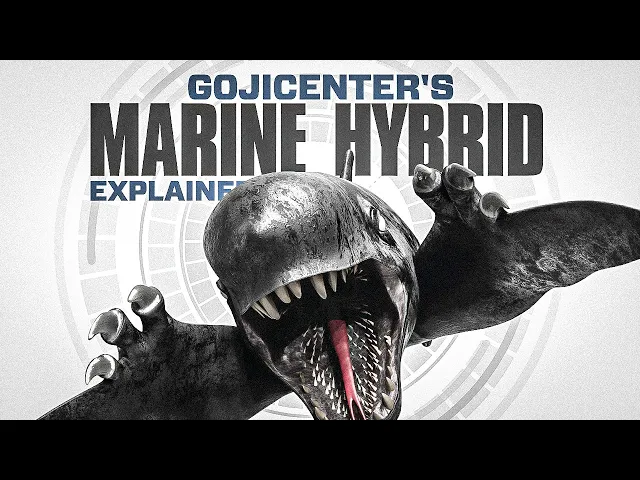
You're going to die today, >> Today on Cooji Center, we're diving into the lore of our own growing menagery of horrific hybrids. With corporate warfare ramping up in the same space Gastel Corp brought us, the Amperator and Mortaladon, another company will throw their name into the arena to bring forth a marine nightmare. Goji Center presents the next chapter in a chronicle that might be coming to bookstores near you in the future as we creep into the deep and witness what one group is about to unleash into the open ocean.
After numerous landmark breakthroughs in ancient DNA sequencing and restoration, various companies jumped into the new frontier of invention. Biological and specifically zoological development started to rival technological ones. One company, Orion Industries, attempted to spearhead development of a zoological weapons platform in the form of the ultimate attack animal.
Attempts to recruit the patron saint of genetic engineering, Dr Francisco Varro, by forceful methods was negated by the efforts of Gestalt Corp. Varro was shielded and recruited by Gestalt Corp themselves, leading to him spearheading development of the Mortaladon and Amperator projects that gobbled up multiple military contracts. But Orion will not secede from this hybrid war.
The skies and land might have competition, but the greatest frontier on the planet is at sea. The mission to create the most adaptable and reliable living attack and reconnaissance weapon for the largest potential battlefield on the planet starts now. The genome.
Recall that hybrids must be created with purpose. The 2. 0, for instance, was an attack animal meant to wipe out a dinosaur sanctuary.
and become a vector for disease, unleashing a global pandemic. Ultima Imperatrix, a highly marketable juggernaut created to entertain the masses in 1v one combat. Mortaladon, an anti-personnel hybrid useful for ground reconnaissance for military or private operations.
And finally, the Amperator line of aerial hybrids meant for the same thing, but predominantly in the air. The purpose of today's hybrid will be the same as the last two, but excelling in the deep with enough gadgets to dominate the seas and fend off any threats, no matter how large, as we'll soon find out. Starting with the base, the ocean provides a long list of excellent candidates to provide a solid base.
But today, we'll take a look at a family that brought forth some of the most dominating marine life forms in the present day. There are over 40 species of dolphin roaming the oceans today, ranging in size from the tiny 3-foot Hector's dolphin to the colossal orca that could rival some mosasaurs in size. If raw power was desired, picking free willie of all things would be the best option among dolphins, given that the modern orca are even larger than their prehistoric cousins.
But let's remember, the objective of this hybrid isn't to build something that would be a devastating apex predator meant to fight other animals. Instead, this is meant to be a trainable beast intended to perform a variety of tasks and eliminate human targets if the need arises. Making the hybrid excessively big would only make it easier to spot by both enemy sight and sonar.
Tipping them off to its presence and leaving it wide open to sonic attacks or dropped explosives that could be devastating beneath the surface. To hunt down the apex species of planet Earth as they roam the seas, we need something different. Making this thing the size of a megalodon or even orca would make it too obvious, but making it too small would reduce its capabilities.
A balance of the two just so happens to also include a species known for trainability and camaraderie even outside of its own kind. The false killer whale is an enigmatic beast that was first known from fossils before reports by mariners of pitch black orcas were confirmed to be the same species. as one of the next largest species of dolphin after the true orca and pilot whales.
Some of the largest males weigh in at over 2,000 kg and about 6 meters long. Big enough to throw their weight around, but small enough to escape notice. These pseudo orca also have a whole list of other helpful traits for this hybrid to get the job done.
Growing up to full size at about 8 to 10 years of age, but living well into their 50s or 60s, the hybrid having a false killer whale for a genome will help it reach more workable size quicker, but also have a potentially very long lifespan to assist its human comrades and pass along valuable experience and knowledge to younger successors. False killer whales are also very adept in a wide variety of habitats, thriving in shallow seas, but also being quite capable of diving into the depths. With some of the better developed oxygen storing adaptations in the bloodstream and organs, tolerance for high pressure, and a very well-developed sonar, even among dolphins, false killer whales have been known to dive almost a kilometer straight down and hunt in pitch blackness.
useful for sneaking up on certain locations by staying out of sight, as well as letting the hybrid feed itself off a huge potential list of prey in shallow or deep water alike. But it's the mentality and brain of the false killer whale that might prove one of the best assets. More docsile toward human handlers than most types of dolphin, false killer whales are extremely trainable and intelligent.
They also are one of the only wild animals that frequently team up with other species. False killer whales have been reported grouping up and hunting together with around 10 other species of dolphins and whales. This will not only predispose the hybrid into better cross species training and camaraderie, but also assist in stealth missions out in the wild.
Able to group up with wild false killer whales, the hybrid would still look a lot like one if you only saw the top of its body. Meaning it could blend in with the pod and easily be mistaken for just another dolphin by an observer until it's too late. Congruency is the name of the game when it comes to making stable hybrids and more toothy sitations have their own contributions to make.
Kovier's beaked whale is a gentle giant but one with a fantastic ability. Dining on deep water squid, this species has the record for the longest and deepest dive of any known air breathing animal. When one of them took a plunge almost 3 km straight down, and other recorded dives have lasted over 2 hours.
How will today's new hybrid benefit? Some of the internal anatomy, such as adaptations in the blood and organs like the kidney and spleen for storing more oxygen, can prove extremely useful to the hybrid. Even just a portion of the Kovier's potential would allow the hybrid to dive far further than most predators and sensors can go, letting it evade threats in the ocean, as well as stealth into favorable positions much easier by hiding in the depths.
Despite not having any teeth, this animal's contribution will be allocated in the internals of this hybrid to allow this creature to perform these feats. In terms of teeth, however, we'll have to bring back a terror from the long past. Meet Zyo Ficider, an animal both orca and great white would be terrified of if it swam our seas today.
Resembling a bottl-nose dolphin from hell. This was actually one of the macro predatory sperm whales in the same family the giant leviatan belonged to. Roughly the size of an orca, the main contribution from this beast would be the head.
Oversized by citation standards, this species has a very unique chomp. Instead of teeth that just grasp, hold, and crush like most predatory whales, this genus could employ a unique shearing bite that could dismember smaller targets or gouge chunks out of bigger animals. And with teeth proportionally larger than most marine reptiles and the orca, this would be overkill for dispatching human divers, but necessary for defending itself when it inevitably has to punch above its weight class, like with orcas or other hybrids it might run into at sea.
Sperm whales, or also referred to as cachelots, also have the doubled up protection of very dense blubber, but also extremely thick skin. some of the thickest and toughest of any animal with some sections and large individuals having a hide over a foot thick. Even when toned down for the hybrid at this size, it would still make its hide far tougher than most dolphins or marine reptiles of similar size and make it extremely resilient against both bullets and enemy predators.
Even if Zygopiciser lacked this feature, its relation to the modern sperm whale means a very small amount of the real life Moby Dick's genome could be added in without messing with the congruency of the hybrid to help toughen up the hide. The cashelots also have one last killer app that both the modern species and or zyoicer can add on. The melon is an organ that helps amplify and focus sonar clicks in communication used by most tooththed whales.
Meaning everything from dolphins to beluga to porpuses to sperm whales have this. Uniquely in sperm whales though, a special wax found within the distinct spermaceti organ adjacent to the melon helps to further amplify and focus this sound. The hybrid could employ this both to better communicate with each other and their human handlers at long range.
They could be trained to focus the sound into a sonic version of a flashbang. It was once thought sperm whales used this to stun prey. This technique would be very effective on squid, but to potential enemy hybrids using sound sensitive sitations in the mix or the vulnerable human divers on the other hand, this would be a case of the hybrid being trained and learning to use its tools completely uniquely to how the base species does.
Sound travels faster and with more force underwater than in air, and blowing out or damaging the eardrums of enemies under the waves is a very real possibility. This whale is the last of the sitations in our hybrid. The next wave of contributors will bring in some very strange but also very innovative abilities.
Starting us off, the Mosasaur Tylosaurus enters the genome to influence parts of the jaw and hind limbs, supplying the hybrid with additional cutting surfaces on the teeth, the capability of regenerating lost or worn teeth in a way more agreeable than the shark method, reinforcing the tip of the snout in congruency with the beaked whale and false killer whale to help with a ramming attack. and enlarging the hind limbs into a second set of flippers. Tyosaurus also brings its forked tongue and Jacobson's organ embedded in the roof of the mouth, allowing the hybrid to chemically test the water for tracking and detection purposes.
And to make the hybrid more cost effective to make more of it, some monitor lizards and relatives can employ meiosis parthnogenesis. Unlike the apomic parthnogenesis seen in some other hybrids that produce exact copies of the mother, this method produces offspring genetically distinct from the mother and can be tweaked to produce sons as well. And this dynamic can merge back with the whale template to make a readytouse social unit.
Male tooththed whales like false killers and orca work as lieutenants to their matriarch mothers, meaning a matriarch hybrid can become a natural leader to her sons and make training easier. If Tyosaurus lacked this trait, the very closely related monitor lizard genes, like those of the Komodo dragon, can be spliced in in replacement with very little impact on the hybrid and with congruency, minimizing the chance of side effects. You think we were done with the teeth?
No. To further bolster the ability of this hybrid biting into the soft surfaced hides of most marine animals and humans, both diver and crew, Orion acquired samples of Conodon DNA. These would be used to a very minor degree to upgrade the teeth and hone very sharp edges as these bygone fish had some of the sharpest teeth to ever exist.
A lot of offense happening here. Some very decent defense as well with the cashelot hide. However, there is something else that this creature will use for evasive and defensive purposes.
What you're looking at is a thick cloud of slime that rapidly expands roughly 10,000 times its original volume in contact with seawater, clogging up the gills or mouth of any attacker, forcing it to retreat. Courtesy of the Pacific hagfish, the glands and pores that excrete this slimy defense are located on the sides of the body. These could also serve as wound defects in the event a very sharp tothed creature comes along and manages to scrape even if it gets past the slime called epidermal thread cells.
These cells could line the skin near the glands. If damaged, they would release threads that mix with the mucus to form a highly fibrous sticky slime on the wound site. Mixing in with the hagfish contribution, the parts of the bobtail squid's ink sack adaptations would be extremely selectively edited in.
This squid uniquely has an integrated symbiosis with bacteria it can tolerate and help cultivate that can be added onto the skin or acquired out at sea. These bacteria which normally live near the ink sack of the squid would instead take refuge in the slime vents from the hagfish contribution. When the slime is vented out, the bacteria react and create a flash of glowing light.
Targets bound up by the slime would be easily tagged by being literally lit up like a Christmas tree and dazed from the sudden flash. These same chemicals in the ink can also affect the sensory organs of certain animals like fish or sharks, adding defense against potential hybrid combatants. Protecting the seemingly smooth areas is a contribution from one of the swiftest predators the ocean has ever seen.
The short fin Mo, a speedier relative of the great white shark, can supply dermal dentacles along the back, stomach, and other portions of the hybrid not occupied by the slime vents. Since these are on top of and embedded in the skin, they don't conflict with the sperm well contribution. Dentacles like these further help reduce noise while swimming and make the creature more streamlined.
The shark skin also supplies a more limited version of the various sensory pits found on the faces of sharks for detecting water pressure changes and electrical reception. Now, as our hybrid takes form, we'll now have to focus on probably the most unique anatomical changes to this citation form using three more genetic contributors. In order to be the best possible tactical aid in marine space, Orion needed to equip this animal with excellent vision.
These large eyes, courtesy of Temnodonttosaurus, one of the mightiest of the ichthyossaurs, would come in with the largest pair of eyes of any known animal and greatly bolster the vision at night and deep sea operations when the use of sonar clicks would reveal its position. Additionally, the large hind flippers would work together with the Tyosaurus contribution to make sure the hybrid has the necessary steering devices not found in Wales. able to navigate just as good, if not better, than any military underwater remote craft deployed against it.
To detect these and other targets, enter the second to last contributor, the leatherback turtle. These underrated sea reptiles provide internal adaptations, a highly refined magnetic field detection in the nervous system that picks up any machinery operating underwater. The hybrid would now be able to find, inspect, and whoever is unlucky enough to get sent down the chute would now deal with the batteries of throat spines that would ensure nothing is able to fight its way out.
These two aren't the most uncanny attributors to Orion's new hybrid. This is That's right, folks. And this is where the meta gets turned upside down.
You may be wondering, how on earth did this citation turn into a mermaid of death? And before we reveal the last contributor, note that the entire genome so far is made of marine animals for congruency and instincts and because it's also on brand. Now, finding hands on this hybrid may initially make you think that a terrestrial creature was involved, but no, take a look.
No, seriously. Sea otterters aren't the only large weasels to make it into the water. But they are readily available and rank among the most adept tool users in the animal kingdom outside primates.
And they also come with a tendency to use the back, the strongest part of the jaw to crack open tough objects like shells or in our case cracking skulls. But the main reason these show up is because of their forlims. In most marine tetropods, like the various mammals and reptiles that have gone back to the ocean, the entire hand was modified over time into a flattened flipper.
This is because advanced dexterity wasn't all that useful down here. But Orion wants its hybrid agents to be capable in some unexpected ways. In this case, the ichthyossaur contribution from earlier was blended in with the aspects of the sea otter.
Effectively, all tetropods, be they amphibian, mammal, or reptile, have a maximum of five digits. Short of fluke mutations, it has been this way since the first creature from the ocean crawled onto land. But selective adaptation and modification to the hawk genes can be done to certain digits in specific.
The earliest carnivorous dinosaurs initially had five fingers, but gradually lost all but three of them in the lineage that led up to birds. Even horses infamously modified and lost all but one of their toes into the hooves we see today, resulting in them unintentionally flipping us off on the daily given which toe was the one left. Yeah, it's the middle one.
So, Ichichchthosaurs like teenodononttosaurus had some of the strangest flippers that ever existed. With the individual finger bones dividing and multiplying into a very strong flipper, they can hold its shape very well while also being quite flexible when it needed to be. In the hybrid, selective editing allowed for digits four and five, the ring and pinky finger on your own hand, to be extended in length while having their bones divided into a flipper.
This freed up digits 1 through three, which are the thumb, index, and middle finger on your own hand you're looking at right now hearing us say this. The end result is this. A hand and a flipper on the same surface.
The influence from the otter also extends into making the shoulder joint and upper arm more flexible and larger, offering up an extended range of motion to help carry and manipulate objects or grab onto something or someone to pull them under. This sacrifices some speed and maneuvering, but the extra hind flippers on the feet help make up for the difference. It's not about being the absolute fastest or best in all categories, but excelling in the ones Orion wants.
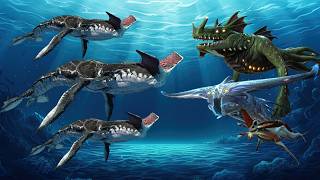
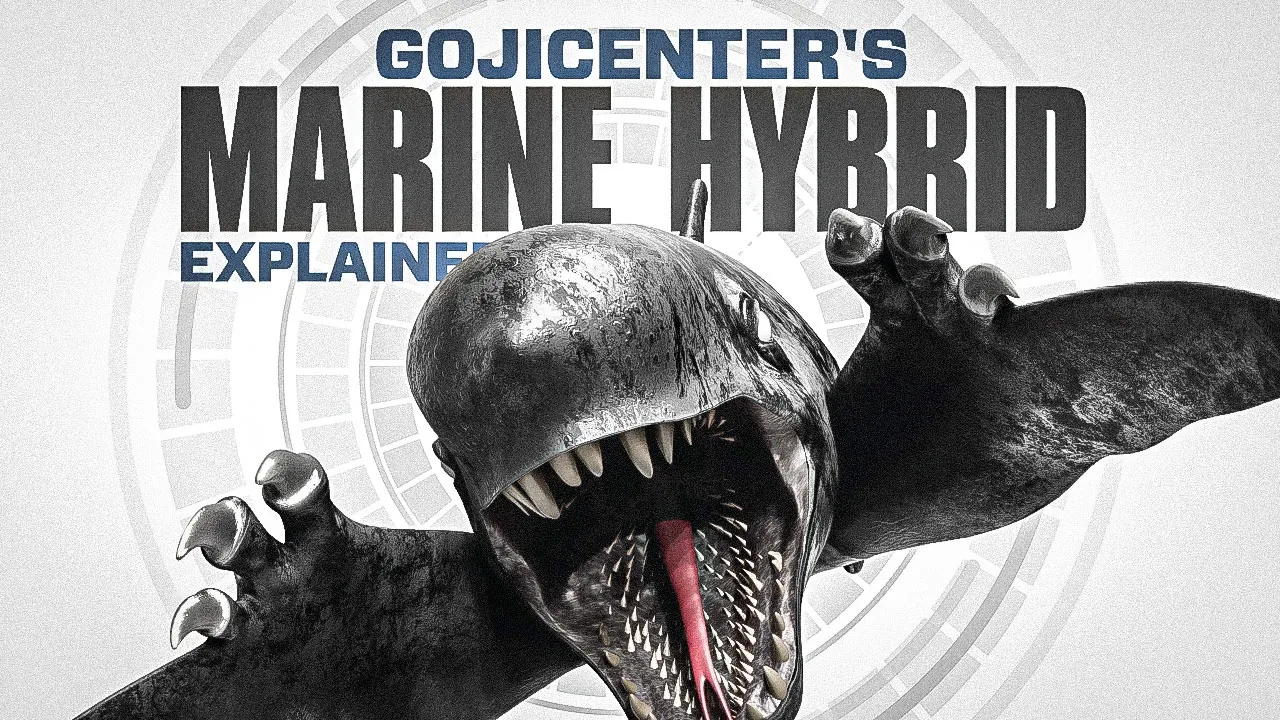
Now resembling a mermaid of death and answering the question, what if you gave an orca hands? Here is the end result. Siren of Venetrix, the Siren Huntress.
Measuring at 6. 5 to 7 m in length, weighing three metric tons. A fine-tuned blend of ocean predators past and present.
Able to work closely with human handlers for years at a time, the Huntress earns its name with specially trained and conditioned matriarchs leading pods of their sons that function like strike teams. Different members can be trained for different tasks, ranging from sabotage, fing or protecting swimmers or divers, fending off marine attackers, planting devices, tracking ships and submarines, or doing that dispatching themselves, whether it's divers in the water, rival predators or rogue hybrids with nature or granted weapons, or pulling a ship or target below the waves with a successful climb or lunge. An elite pod of the sirens could approach a location under the cover of joining a group of dolphin or false killer whale, obscuring their moments, even if spotted at the surface.
Then, after diving hundreds, perhaps over a thousand meters down to avoid any further detection, the group can swiftly move into position. The targets, rival nation fleets, pirating vessels, or more, wouldn't know what hit them by the time the explosives were put in place. Fully autonomous in the field if necessary.
They can hunt and forage for themselves in both shallow water and depths with confidence. And what threats a single one can't fight off, comrades can quickly come to its aid, or they can rapidly descend or ascend the water column to get out of range of their attacker. Chemical defenses also can keep the operatives alive in the field longer should they have to engage the enemy.
Tough hides help negate bullets fired into the water. Tentacles make grasping the hybrid painful and tricky in equal parts. And trying to grapple or bite the siren can result in a glowing smokec screen of slime that can irritate eyes, gum up gills, or clog jaws.
And with their own jaws strong enough to shatter bone, teeth that can rend right through armor and blubber alike, hands capable of wielding tools, and the intelligence to figure out creative ways to use any of those assets, natural or otherwise. The legendary sirens of the ocean are ready to claim their first victims.