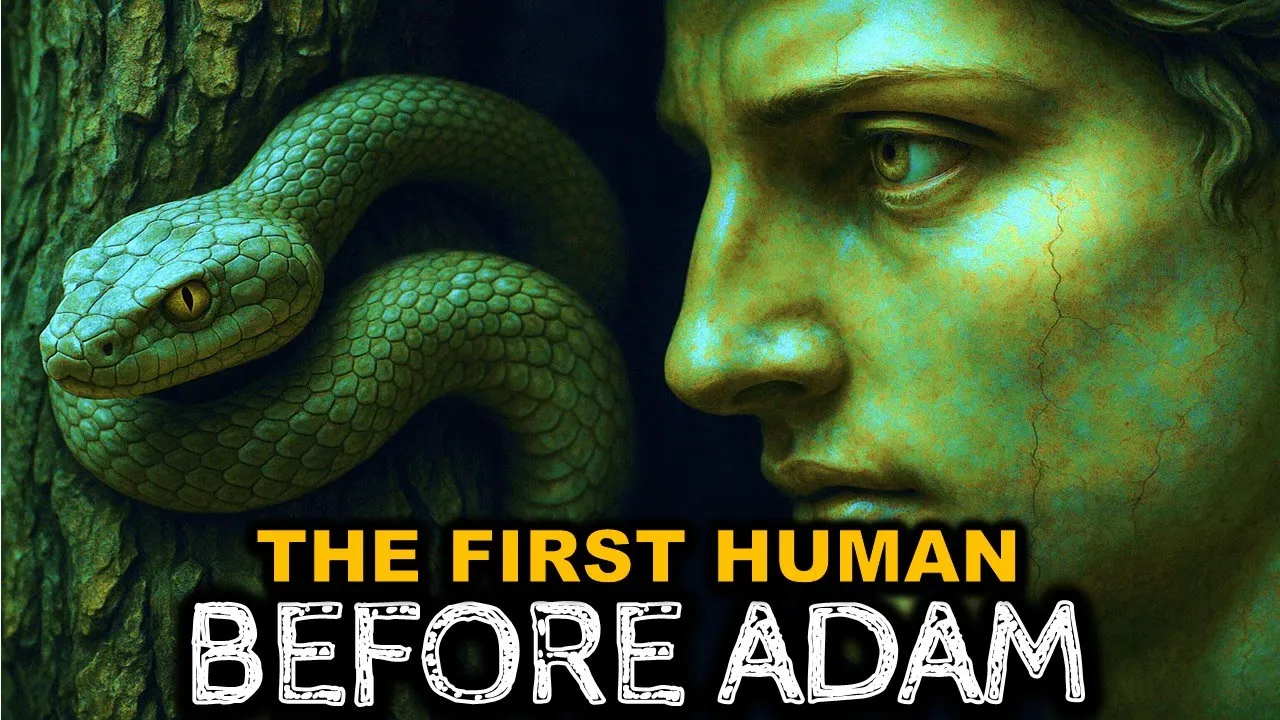
Was Adam really the first human ever created? Or is there something deeper hidden in the book of Genesis? Something that many have read, but few have truly seen?
What if the Bible actually hints at the existence of humans before Adam? What if Adam wasn't the first human, but rather the first of something else entirely? In this video, we'll dive into the Hebrew text, biblical clues, and theological theories that will challenge everything you thought you knew about the beginning of humanity.
Don't forget to like, subscribe, and stay with us to the end because this journey will not only challenge you, it may transform your understanding of the entire Bible. Let's get started. Let's open our Bibles to the very beginning.
Genesis chapters 1 and 2. At first glance, the Bible appears to give us a simple account of how everything began. But if you read carefully, you'll notice something that many people overlook.
There's not one creation account in Genesis. There are two, and they're not identical. Genesis 1 26- 27.
Then God said, "Let us make mankind in our image, in our likeness, so that they may rule over the fish in the sea and the birds in the sky. " So God created mankind in his own image. In the image of God he created them.
Male and female he created them. This happens on day six of creation. Humanity is created after the animals as the culmination of creation.
God creates mankind. Ha Adam in Hebrew as a plural unity. Male and female he created them.
No personal names, no garden, no specific location mentioned. just a sweeping declaration that humankind was made in God's image to steward creation. This account is majestic, cosmic, poetic, like a wide-angle lens showing all creation unfolding in perfect rhythm.
But then we turn the page and the tone changes. Genesis 2:7. Then the Lord God formed a man from the dust of the ground and breathed into his nostrils the breath of life, and the man became a living being.
Hold on. Formed from the dust? That's different.
This is not a grand declaration about mankind. This is one man, Adam, shaped by the hands of God like a potter molds clay. Then later in Genesis 2 18 to 22, we read, "It is not good for the man to be alone.
" So the Lord God caused the man to fall into a deep sleep. He took one of the man's ribs and made a woman from the rib. Here woman is not created at the same time as man.
She comes later from him. This is a deeply intimate story, zoomed in, personal and filled with symbolic details. So what's going on here?
Why do we have two different versions of creation? In one, mankind is created, male and female together. In the other, a single man is formed first, then animals, then finally a woman.
This has puzzled scholars and theologians for centuries. Some say Genesis chapter 2 is just a recap of Genesis chapter 1, like a close-up camera shot after a wide-angle view. Others say these are two distinct accounts, possibly written by different sources for different purposes.
Biblical scholars often refer to the Elohist and Yahwist traditions. In Genesis 1, God is referred to as Elohim, the mighty creator. In Genesis chapter 2, he's Yahweh Elohim, the personal covenantal Lord.
Could these different names hint at different layers of revelation? But here's the deeper question. Are these accounts contradictory or complimentary?
Some propose this. Genesis 1 describes the creation of humankind in general, the species. Genesis chapter 2 zooms in on a specific individual, Adam, chosen, placed in Eden, and given a spiritual assignment.
It's like Genesis 1 tells us when and how humanity was made. While Genesis 2 tells us why. And here's the most intriguing part.
In Genesis 2:5, just before God forms Adam, it says, "Now no shrub had yet appeared on the earth, and no plant had yet sprung up. For the Lord God had not sent rain on the earth, and there was no man to work the ground. No man to work the ground.
Did God form Adam? Because there was no one with the spiritual or agricultural role to care for Eden. This suggests Adam wasn't just the first man.
He was the first assigned steward, the first priest, the first image bearer with divine responsibility. So we must ask, was Adam the first human being or the first covenant human set apart in a garden temple with a mission that would impact all of humanity? Two creation accounts, two distinct tones, one grand mystery.
And now the question gets deeper. If Adam was placed in Eden after mankind was created in Genesis 1, then who were the people outside the garden? Stay with us because the next exploration may change how you read Genesis forever.
Let's go back to Genesis 2:5. A quiet verse often overlooked but packed with meaning. Genesis 2:5.
And there was not a man to till the ground. At this moment in the narrative, creation is in place. The earth is formed.
The streams are flowing. But something is missing. Not just any presence, but a specific kind of human role.
The Hebrew word used here for man is Adam, Adam. A term that can mean human in a general sense, man in a masculine sense, or Adam as a proper name. But here's the key.
The verse doesn't say there was no man alive. It says there was no man to till the ground. That means Adam wasn't just made because no people existed.
He was created for a purpose. This tilling wasn't merely about gardening. It was sacred.
The Hebrew word translated to till is avad which also means to serve or to minister. In other words, it can mean to cultivate but also to worship or serve in a priestly function. Now jump to verse 15.
Genesis 2:15, "And the Lord God took the man and put him into the Garden of Eden to dress it and to keep it. " Let's break down those two verbs to dress it. Again, the Hebrew is avad meaning to work or serve.
To keep it from shamar, shamar, which means to guard, protect or preserve. These are the same two words used to describe the work of priests in the tabernacle in Numbers 3 7 to8 and chapter 8 26. Numbers 3 7 to8.
They shall keep his charge and the charge of the whole congregation before the tabernacle of the congregation to do the service of the tabernacle. This isn't ordinary manual labor. This is sacred service, temple work.
In this light, Eden wasn't just a garden. It was a sanctuary, a prototype of the later tabernacle and temple. Adam wasn't just a gardener.
He was the first priest. His job was to serve God in sacred space, to guard it from corruption, and to mediate divine presence on earth. Think of it this way.
Adam wasn't created just to exist. He was created to steward a sacred space. He was chosen to walk with God in covenant relationship.
That's why Genesis 2 isn't about the creation of humanity in general. It's the appointment of a representative, a man called into spiritual leadership. So, was Adam the first biological human being?
That's still debated. But what seems clearer is this. Adam was the first covenant man set apart from the rest of creation to initiate a divine relationship.
His story is not just about being human, but about being holy, called to obedience, tested in choice, and responsible for the spiritual destiny of those who would follow. Later in the Bible, we see this echoed in Christ. 1 Corinthians 15:45.
The first man, Adam, was made a living soul. The last Adam was made a quickening spirit. Adam was the head of humanity in the garden.
Jesus, the last Adam, became the head of a new creation. So, next time you read Genesis 2:5, remember this wasn't just the making of a man. It was the launching of a mission.
Coming up, what happened outside the garden and who else might have been there? So far, we've explored the possibility that Genesis 1 and 2 describe not just creation in general, but the calling of a specific man, Adam, into covenant with God. But now things get really interesting.
Let's fast forward to Genesis 4, the story of Adam's sons, Cain and Abel. We all know the story. Cain becomes jealous of Abel's offering.
God warns him, but Cain ignores the warning and commits the first murder. Genesis 4:8. Cain attacked his brother Abel and killed him.
As a result, God confronts Cain and passes judgment. Genesis 4 11 to 12. Now you are under a curse and driven from the ground.
You will be a restless wanderer on the earth. And now comes one of the most baffling parts of scripture. Genesis 4 13-16.
Cain said to the Lord, "My punishment is more than I can bear. Whoever finds me will kill me. " But the Lord said to him, "Not so.
Anyone who kills Cain will suffer vengeance seven times over. " Then the Lord put a mark on Cain so that no one who found him would kill him. So Cain went out from the Lord's presence and lived in the land of Nod, east of Eden.
Let's pause. Cain says, "Whoever finds me will kill me. " Wait, who exactly is he afraid of?
At this point in the narrative, we've only been introduced to Adam, Eve, Abel, now dead, Cain. So, who are these other people that Cain fears will kill him? And it gets more intriguing.
Genesis 4:17, Cain made love to his wife, and she became pregnant and gave birth to Enoch. Cain was then building a city, and he named it after his son, Enoch. Hold up, let's break that down.
And Cain had a wife and a child. And then he builds a city. Ask yourself, why would Cain build a city if there were only a handful of people on Earth?
Who's going to live in this city? Who are these others living east of Eden? This passage has stirred debate for millennia.
Possibility number one, Adam and Eve had many unnamed children. This is a common explanation. Genesis 5:4 says, "After Seth was born, Adam lived 800 years and had other sons and daughters.
So maybe Cain married one of his sisters, someone born later, not mentioned by name. " It's a logical explanation, but it raises other concerns. Would an early audience assume incest is normal?
Wouldn't the narrator clarify this to avoid confusion? Possibility number two, there were other humans outside Eden. This theory suggests that Adam and Eve were not the only humans ever created.
Instead, they were the first covenant pair placed in Eden. While other human beings may have already existed elsewhere on Earth, these people would be descendants of Genesis 1, humankind created male and female in God's image. Adam, however, was formed separately for a divine assignment in Eden.
In other words, the people Cain feared may have come from that wider population. his wife may have been from outside the garden lineage. The city he built may have been populated by these others.
This idea is not new. Many scholars and theologians including some in early Judaism and Christian history have proposed the dual creation theory. Genesis chapter 1 equal to the creation of humankind.
Genesis 2 equal to the spiritual election of Adam. Adam becomes the federal head, the covenant representative. Not the first homo sapien but the first man to walk with God in a sacred space.
Think about this. Cain left the presence of the Lord. That means he was in Edenic fellowship before.
But after his rebellion, he goes to a place called Nod, meaning wandering, and integrates into a world beyond Eden. It's as if scripture is hinting that there is more to humanity's early history than what's happening inside the garden. Acts 17 26.
From one man he made all the nations that they should inhabit the whole earth. Some interpret one man here as Adam. Others believe Paul is referring more generally to humanity's common ancestry, pointing to unity, not chronology.
So here's the takeaway. Genesis 4 doesn't just record a murder. It reveals a world beyond the garden.
A world with people, with cities, with the potential for violence. A world God allowed to unfold yet chose to engage through a specific lineage. Adam, then Seth, then Noah, and eventually Jesus.
Cain's story opens a door to the possibility that Adam was not alone in the world, but was set apart by God to begin something sacred, something redemptive that continues even now. In the next section, we'll dig into the Hebrew language and discover how word choices in the original text point toward a deeper truth. Now, let's go deeper, not just into the story line, but into the language of the Bible itself.
Because sometimes the biggest revelations come not from what the text says in English, but from how it says it in Hebrew. Let's begin with the word Adam. Adam.
It's one of the most important and most misunderstood words in the early chapters of Genesis. In Hebrew, Adam can refer to a proper name, Adam, the first man in Eden, a generic noun, human, human being, or mankind, a collective noun, all humanity as a group. The confusion begins when we try to assign only one meaning to a word that carries multiple shades of significance.
Let's look at Genesis 1 26-27. Again, God said, "Then in our likeness, so God created mankind, Adam, in his own image. " Notice that in this passage, Adam clearly means humankind in general, both male and female.
There's no mention of a specific person, no garden, no dust, no rib. It's a sweeping statement of human identity and dignity. All humans are imagebearers of God.
But in Genesis 2, things change. Genesis 2:7. Then the Lord God formed the man Ha Adam from the dust of the ground.
Now we're dealing with her Adam, literally the man. It's not just a human anymore. It's the man, singular, specific, personal.
And in Hebrew, this subtle shift marks a major narrative turn. In short, Genesis 1, Adam equal to humankind, created as male and female, called to fill the earth. Genesis 2:3, her Adam equal to the appointed man, Adam, placed in Eden for a special purpose.
So now the question becomes, could it be that Genesis 1 is describing the creation of humanity in general? While Genesis 2:3 zooms in on the appointment of one man, Adam, for a covenantal relationship. If that's the case, Adam isn't necessarily the first human ever.
He's the first human with a mission, a command, and a consequence. This theory gains more strength when you consider another detail. Genesis 2:5 again there was no man to till the ground.
We've already seen that till the ground involves sacred service avad and shama priestly terms. God wasn't just looking for a human body. He was looking for a spiritual steward.
But now let's zoom out even further. Job 38 4:7. Where were you when I laid the foundation of the earth?
When the morning stars sang together and all the sons of God shouted for joy. This passage in Job offers a window into a cosmic backstory. It speaks of a time before Adam, a time when God laid the foundations of the earth and heavenly beings, sons of God, already existed and celebrated his work.
The Hebrew phrase here, Ben Elohim, Blohai Elohim, refers to divine beings, part of God's heavenly council. These are not humans. They are spiritual entities that predate the Eden narrative.
What does this mean? It means the story of Genesis is part of a much larger tapestry. Adam doesn't appear in a vacuum.
He enters a cosmic stage that's already active with divine order, spiritual beings, and a purpose that stretches from Eden to eternity. Even Eden itself may not be the whole earth, but rather a sacred space, a divine temple where heaven and earth meet. Ezekiel 28 13-14.
Speaking of Eden, you were in Eden, the garden of God. You were on the holy mount of God. Eden is described not just as a garden, but as a mountain sanctuary, a place of divine presence.
So, here's the big idea. Adam is a multi-layered word. He may represent one individual, but also humanity as a whole.
And Eden may represent more than a location. It may be a portal of purpose where the divine and human intersect. The more we study the language and background, the more the Bible reveals this.
The story of Adam is not about how humans evolved biologically. It's about how humanity was chosen spiritually. And now we come to the intersection of science and faith where genetics, anthropology, and theology all ask the same question.
If Adam was not the only human, what was his unique role in God's redemptive story? As we explore the mystery of Adam, the Bible isn't the only source that enters the conversation. Modern science and genetics have added new perspectives, ones that surprisingly echo some of the ancient questions we've already uncovered.
Let's talk about two intriguing concepts from the field of genetics. Mitochondrial Eve and why chromosomeal Adam. These terms sound biblical, but they weren't meant to be.
Mitochondrial Eve refers to the most recent woman from whom all living humans inherited their mitochondrial DNA. Y chromosomeal Adam is the most recent male ancestor from whom all men inherit their Y chromosome. But here's the kicker.
These two figures did not live at the same time. They weren't a couple and they were not necessarily the first humans, but simply the most recent common ancestors along two specific genetic lines. According to most scientific estimates, mitochondrial Eve lived about 150,000 to 200,000 years ago, possibly in East Africa.
Y chromosomeal Adam is estimated to have lived between 60,000 to 300,000 years ago, depending on the model. These timelines don't line up with a traditional Genesis chronology. And that's important because it suggests that the Genesis story might not be aiming to describe a biological timeline, but rather a theological truth.
Here's a vital question. Could it be that the Bible doesn't tell us about the first humans from a scientific point of view, but about the first humans in covenant with God? Let's revisit Romans 5:12.
One of the most powerful New Testament verses on this topic. Romans 5:12 say, "Therefore, just as sin entered the world through one man and death through sin, and in this way, death came to all people because all sinned. " This verse introduces the idea of federal headship.
Adam as the representative of the human condition. Paul isn't concerned with DNA or genetics. He's concerned with spiritual consequence.
When Paul says sin entered the world through one man, he's not arguing that Adam was the only man alive, he's saying Adam was the first one held accountable in a covenantal relationship, the first one given a moral law and the first one to break it. That's why Adam matters not as a genetic ancestor of all people, but as the source of sin consciousness, the beginning of our spiritual exile. Let's draw an analogy.
Think of Noah. Not everyone alive today is genetically descended from Noah's sons in an isolated way. But in the biblical story, Noah is the covenant link between pre and post flood humanity.
Adam plays the same role. He's not just a man in a garden. He's the starting point of spiritual accountability, the one through whom sin and death entered the world.
Now let's bring science and theology together. Science tells us humans existed in large populations. Humanity emerged through long complex processes.
Genetic ancestors are statistical, not individual prototypes. But theology tells us God entered into personal relationship with mankind. That relationship involved moral choices.
And Adam's story represents the beginning of spiritual form. 1 Corinthians 15:22. For as in Adam all die, so in Christ all will be made alive.
This is Paul's entire framework. Adam is not just the first man. He is the first archetype of fallen man.
Just as Jesus is the archetype of redeemed humanity. So what if Adam isn't meant to explain how the entire species biologically began, but how the human heart spiritually broke. Genesis then is not a scientific document.
It's a sacred narrative explaining why we need redemption. And once you see that, you begin to understand why the Garden of Eden isn't just a place in time. It's a symbol of lost fellowship.
Coming up next, what did ancient thinkers believe about the world before Adam? And could Eden have existed alongside other civilizations? Let's explore the pre-Adomite theories and the voices from early church history.
What if the world was not empty before Adam? What if the Garden of Eden wasn't the beginning of humanity, but the beginning of something else entirely? This brings us to one of the most fascinating and controversial ideas in biblical thought, the pre-Adomite theory.
This theory proposes that other humans may have existed before Adam or perhaps alongside him, but Adam was the first person to enter into a covenantal relationship with God. In other words, Adam wasn't necessarily the first human to exist. He was the first chosen human, the first priest, the first image bearer with divine assignment, the first to carry the weight of moral responsibility.
Let's revisit a curious verse. Isaiah 45:18. For thus saith the Lord that created the heavens, God himself that formed the earth and made it, he hath established it.
He created it not in vain. He formed it to be inhabited. That phrase he created it not in vain in Hebrew is tov it means empty formless chaotic it's the same word used in Genesis 1:2 when the earth was without form and void tohu vabohu.
So did God create the earth in chaos or did something happen before Adam's story that left it that way? This very question stirred the imagination of early Jewish and Christian thinkers, ancient interpretations and mystical insights. In ancient Jewish mystical literature, particularly in the cabalistic tradition, we find the idea that there were prior worlds before this one.
These worlds, it was believed, were destroyed or collapsed spiritually before the creation we now know, echoing a kind of divine reboot. Some rabbis speculated about worlds before Adam or even beings created before humanity. perhaps as a way to explain the strange gaps and tensions in Genesis.
Early church thinkers wrestled too. This wasn't just a Jewish conversation. Let's look at two towering minds of the early church.
Origin c 184 to 253 AD. Origin of Alexandria, one of the earliest Christian theologians believed in a pre-temporal spiritual world. He taught that souls existed before being placed in human bodies and that the Genesis creation account was a symbolic story of the spiritual fall into material existence.
While his views were controversial and eventually rejected by the church, he opened the door for Christians to think beyond the literal. Augustine c 354 to 430 AD. Augustine of Hippo believed the days of creation were not literal 24-hour periods, but symbolic representations of divine order and purpose.
He taught that the Genesis account was more spiritual narrative than scientific explanation. Though Augustine did not advocate a full pre-adamite theory, he did suggest that there was much mystery about what happened before and even around the story of Adam. In other words, even the early church knew that Genesis wasn't giving us a blow-by-blow scientific report.
It was a theological tapestry. Was Eden a temple among nations? Let's return to Genesis 2:8.
Now, the Lord God had planted a garden in the east in Eden. The text doesn't say God created the earth at this point. That already happened.
Instead, he plants a specific garden in a specific place eastward in a region called Eden. This implies that Eden was a localized sacred space, not the entirety of Earth. Scholars often describe Eden as a kind of temple, a place of meeting between God and man.
Ezekiel 28 13 to 14 even describes Eden as the mountain of God using temple imagery. This raises a fascinating possibility. Eden may have been set apart from the wider world, a holy sanctuary with Adam as its first priest and guardian.
And outside Eden, possibly other people, other lands, and the broader human story that Genesis doesn't focus on because its goal is covenantal, not comprehensive. So why focus on Adam? Because Adam's story is about accountability, relationship, and the origin of sin.
Romans 5:14, "Death reigned from the time of Adam, even over those who did not sin by breaking a command, as did Adam, who is a pattern of the one to come. " Adam is a pattern, not just a person. He marks the beginning of humanity under divine instruction with the capacity to obey or rebel.
So, here's the bigger question. Was Adam placed into a brand new creation? Or was he placed into a sacred space within an already inhabited world as the first spiritual ambassador of humanity?
Either way, the focus of Genesis becomes crystal clear. It's not about population counts or Paleolithic timelines. It's about God's first covenant with humanity.
And it all begins with one man in one garden with one command. Up next, we'll explore how Adam's covenant role points forward to the greater Adam, Jesus Christ, and why this ancient story still defines the destiny of humanity today. Let's take a step back.
Whether or not other humans existed before, during, or after Adam, the Bible is clear on one thing. Adam's role is utterly unique. He may not be the first biological human in the eyes of science, but in the eyes of scripture, Adam is the first spiritual representative of humanity.
Let's look at what Paul says. 1 Corinthians 15:45. So it is written, "The first man, Adam, became a living being, the last Adam, a life-giving spirit.
" This is more than a poetic contrast. Paul is drawing a theological line, a mirror image between two key figures in human history. The first Adam, the man of dust.
The last Adam, the man of heaven. Notice that Paul doesn't call Jesus the second Adam. He calls him the last Adam.
Why? Because the Bible isn't just telling the story of two individuals. It's telling the story of two beginnings, two origins, two outcomes.
Adam equal to the origin of sin, death, and separation from God. Romans 5:17. For if by the trespass of the one man, death reigned through that one man, how much more will those who receive God's abundant provision of grace reign in life through the one man, Jesus Christ?
Adam didn't just fall. He dragged all of us with him into a legacy of brokenness, shame, toil, and mortality. But Jesus didn't just rise.
He lifted all of us into a legacy of freedom, restoration, peace, and eternal life. Adam is not merely a historical curiosity. He's the starting point of humanity's spiritual struggle.
In him, we see the image of God, the temptation to grasp what is forbidden, and the consequences of disobedience. Genesis 3:1 19, for dust you are, and to dust you will return, but Jesus reverses the curse. John 11:25, I am the resurrection and the life.
The one who believes in me will live even though they die. Where Adam brought exile, Jesus brings homecoming. Where Adam brought toil, Jesus offers rest.
Where Adam brought death, Jesus delivers life. And don't miss this. Luke 3:38 traces Jesus's genealogy all the way back to Adam, the son of God.
This isn't just a biological record. It's a spiritual narrative. Jesus as the son of God enters into a broken family line to redeem every fracture that began with Adam.
From garden to cross, think of the parallels. In a garden, Adam said yes to self, no to God. In a garden, Jesus said yes to God, no to self.
Luke 22:42. Father, if you are willing, take this cup from me. Yet not my will, but yours be done.
Adam's disobedience turned paradise into wilderness. Jesus's obedience turned wilderness into the doorway back to paradise. The message.
Adam's story isn't just about a man who made a mistake. It's about the human condition. And Jesus, our last Adam, isn't just about forgiveness.
He's about a new creation. 2 Corinthians 5:1 17. If anyone is in Christ, the new creation has come.
The old has gone. The new is here. So yes, Adam may have failed, but God's plan never did.
From Eden to Calvary, from dust to glory. The Bible is not the story of one fall. It's the story of two Adams and the invitation for all of us to move from the first to the last.
Let's explore why the story of Adam, however ancient, still speaks into our modern souls. So why does it matter? Why does it matter if Adam was the first biological human or simply the first human in covenant with God?
Here's the answer. Because the point of Genesis was never about winning a scientific debate. It was always about revealing the heart of God and the purpose of humanity.
This question, was Adam really the first human? Isn't just about anthropology. It's about theology.
Let's break it down. If we focus only on biology, we reduce Adam to a primitive ancestor, just another homminid in a long chain of evolution. But if we understand him through the lens of divine purpose, Adam becomes a symbol of spiritual destiny, moral responsibility, and covenant identity.
Genesis doesn't just tell us what happened. It tells us why we're here. Genesis 2:9.
In the middle of the garden were the tree of life and the tree of the knowledge of good and evil. Two trees. One represents eternal communion with God.
The other the right to define good and evil apart from him. This isn't just ancient horiculture. It's the drama of every human soul.
Do we trust God's wisdom or do we grasp for our own? Do we walk in harmony with the creator or do we rebel and go our own? This is why Adam matters.
Not because he gave us our hair color, height or chromosomes, but because he reflects the human condition, the tension between freedom and obedience, love and rebellion, purpose and pride. Adam's story is a mirror. And when we look closely, we see ourselves.
Like Adam, we are called to steward what God gives us. We are placed in sacred spaces with freedom, but also boundaries. We hear the voice of God, but often choose our own.
And like Adam, we hide in the trees. We shift the blame. We cover our shame.
Genesis 3:8. Then the man and his wife heard the sound of the Lord God as he was walking in the garden. And they hid.
It's one of the saddest verses in scripture. The creator walking in fellowship with his creation and his creation hiding in fear and shame. But here's the good news.
Even after the fall, God calls out, "Where are you? " That's the question God has been asking ever since. Not because he doesn't know where we are, but because we've forgotten who we are.
So whether Adam was the first biological human or the first human God called by name, the truth remains. Humanity was designed to walk with God. And the tragedy of Genesis is not just about eating fruit.
It's about losing relationship. But even in the loss, God began the plan of redemption. That's the real message of Genesis.
It's not about dust and ribs and trees alone. It's about the heartbeat of a God who creates, calls, and redeems. Hosea 6:7.
Like Adam, they have broken the covenant. Adam wasn't just a person. He was a covenant partner.
And that covenant was broken. But thanks be to God. Through Jesus, the last Adam, the covenant was restored.
So why does it matter? Because this story is your story. Not where you came from biologically, but where you're going spiritually.
Not how you were made, but why you were made. And in that garden, in Adam's choice, we see the beginning of everything. But in Christ's obedience, we see the new beginning that's available to all.
As we've journeyed through Genesis, theology, science, and history, one thing becomes clear. There are still mysteries. Could future archaeological discoveries shed more light on early humanity?
Could linguistic analysis of ancient Hebrew texts give us a clearer view of what the original authors intended? Could deeper study of comparative ancient literature from Sumerian tablets to Mesopotamian myths provide more cultural context for Genesis? Absolutely.
Biblical scholars, anthropologists, linguists, and archaeologists are still uncovering new layers of understanding. And with each discovery, we are reminded that the word of God is not just old, it's alive. Hebrews 4:12.
For the word of God is living and active, sharper than any double-edged sword, but even with new findings, even with more precise timelines, even with clearer translations and DNA sequences and historical reconstructions. Perhaps the deepest truth of Genesis has already been revealed. It doesn't require a microscope or a dig site.
It just requires a humble heart. Micah 6:8. He has shown you, oh man, what is good?
And what does the Lord require of you? To act justly and to love mercy and to walk humbly with your God. That's it.
That's the echo of Eden. That's the call that rang through the trees after the fall. That's the heartbeat behind the story of Adam.
Not just a man in the past, but a mirror for every person today. Adam is not just a historical figure. He is a symbol of all of us.
Like Adam, you were created with purpose. Like Adam, you've been given freedom and responsibility. Like Adam, you've tasted both beauty and brokenness.
And like Adam, you're being invited back to walk again with God. That's what matters most. Not whether Adam lived 6,000 or 60,000 years ago.
Not whether Eden was in Mesopotamia or metaphor, but this. Are you walking with the God who created you? Are you living justly, loving mercy, and walking humbly?
Because that is the Eden you were made for. And here's the beautiful mystery. You don't need to go back in time to find the garden.
You only need to return to the God of the garden. Revelation 2:7. To the one who overcomes, I will give the right to eat from the tree of life, which is in the paradise of God.
The story that began with Adam ends with restoration. Not through the first man, but through the last Adam, Jesus Christ. So, was Adam really the first human?
Maybe not the first biological human. Science and scripture may walk on different timelines, but Adam was the first spiritual representative of humanity. The first person in the biblical story to be entrusted with covenant, moral choice, and divine relationship.
He was the beginning of something far greater than genetics. He was the beginning of redemptive history and that hidden truth in Genesis. It isn't about how many were created.
It's about why we were created. Not to just survive on the earth, but to walk with God in purpose. Not to live in fear, but to live in fellowship.
Not to just be human, but to be imagebearers of a holy God. That's the story of Adam. That's the story of you.
If this changed how you view the Bible or sparked new questions in your heart, let's talk. Drp your thoughts in the comments. We read and respond.
Like this video if it helped you think deeper. It really supports the message and helps more people find the truth. Subscribe and hit that bell icon.
We explore biblical mysteries like this every single week with scripture, history, archaeology, and theological insight. And remember, the Bible doesn't hide the truth. It reveals it to those willing to look again and listen a little closer.
So, keep digging, keep questioning, and above all, keep walking humbly just like Adam was called to. Until next time, grace and peace be with you.