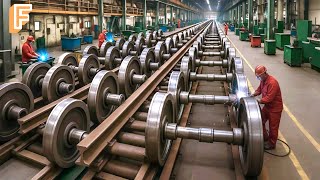
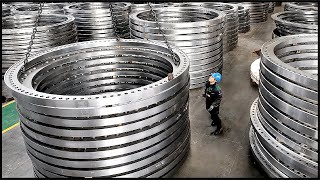
A train wheel weighs several tons, yet it rolls smoothly over the rails for decades. A single rail stretching 330 ft and weighing more than 13,000 lb can withstand tens of thousands of heavy loads without bending. How does the steel industry create such extraordinary strength?
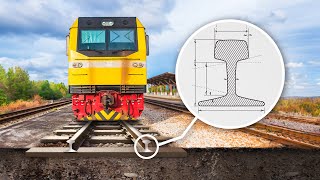
Few people realize that to forge a rail capable of withstanding such immense pressure, metallurgy must follow a long and complex chain of processes. Iron ore is pulled from deep underground, blended with coke and other additives, then fed into massive furnaces at extreme temperatures. From there, the glowing molten steel is refined, rolled with inch perfect precision into its distinct profile of head, web, and foot.
Next, it underos heat treatment and is welded into continuous lengths stretching hundreds of meters before facing rigorous inspections with lasers, X-rays, and ultrasound. In this film, we'll step inside modern steel mills to witness how raw ore is transformed into resilient rails. [Music] The rail industry is not only a vital link in transportation but also a massive economic sector.
The global rail steel market was valued at about $15 billion in 2023 and forecasts suggest it could reach nearly 20 billion by 2032. These figures reflect the scale of investment flowing into railway networks, especially in regions with rapidly expanding infrastructure such as Asia and even in the United States where upgrading more than 140,000 m of track is considered a strategic priority. Do you believe rail will remain a dominant mode of transport in the future or will it give way to new technologies?
From a production standpoint, the scale is even more striking. The world produces around 2. 1 billion short tons of crude steel every year.
In the US alone, steel mills maintain outputs in the millions of tons annually. With a significant portion shaped into rails for both domestic use and export, these rails are no ordinary product. They must endure for over 20 years while carrying the immense repeated loads of passing trains.
In many ways, each rail acts as a lifeline of modern infrastructure, ensuring stability, safety, and efficiency across the rail network. The journey of a rail doesn't begin in a factory, but deep within the earth. Its most important ingredient is iron ore.
And to reach it, massive open pit mines are carved into the landscape. Here, hydraulic shovels as tall as three on the clock. Each scoop can lift dozens of tons of rock in a single motion.
But before the machines can move, engineers must first drill holes that plunge dozens of feet into the ground. Precision down to the inch is required because these holes will be packed with industrial explosives. And the blast itself is anything but random.
Every charge is calculated with care so that thousands of short tons of rock are fractured. Yet the ore inside remains intact. Once the dust settles, the trucks and shovels move back in, hauling ore to the primary crushing station.
In certain geological areas, mining is done underground. Inside reinforced tunnels, ore is scraped out, loaded onto conveyors or small rail cars, and carried to the surface. The machines provide the muscle, but people remain the brains of the operation.
They calculate explosive loads, guide the machinery, monitor safety, and inspect every load of ore. Each ton that emerges from the mine is far more than just broken rock. It is the foundation for steel and ultimately for the rails that will carry trains safely for decades to come.
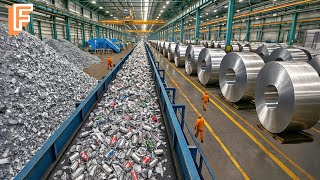
Once the ore is hauled out of the mine, it cannot be used right away. The massive rock blocks must first go through an essential step, crushing. Inside the processing plants, powerful steel rollers and hammer mills operate continuously, breaking down boulders weighing tens of tons into small, uniform particles.
The size of these particles is no accident. It is tightly controlled. If the ore pieces are too large, they won't fully melt in the furnace.
If they are too fine, the mixture becomes unstable during blending. Only when the ore reaches the precise size required can it be moved to the next stage where it is mixed with coke and flux materials. In enormous mixing chambers, giant paddles churn relentlessly, ensuring every grain of ore and additive is evenly distributed.
This stage may seem straightforward, but it is critical. It guarantees that the chemical composition of the mix is balanced, laying the groundwork for steel with the strength and durability demanded of a rail. From these carefully prepared particles, the transformation towards steel begins.
A process that will eventually yield rails strong enough to support the weight of trains for decades. [Music] When the ore has been finely ground and blended in the right proportions, the journey moves into its most critical stage, steel making. This is considered the very heart of the rail production process.
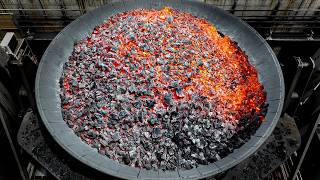
Inside the mills, giant electric arc furnaces and towering blast furnaces roar at temperatures above 2900°, hot enough to transform iron ore and additives into a uniform stream of molten steel. Automated feeding systems measure each batch with pound level accuracy, while thermal sensors and spectrometers constantly monitor the chemical composition. Heat resistant robotic arms stir the mix and skim away impurities that rise to the surface.
At this stage, alloying elements like manganese and chromium are introduced at just the right moment, enhancing the rail strength, resistance to wear, and ability to endure extreme loads. A modern electric arc furnace can melt more than 150 tons of steel in less than an hour. But this power comes at a cost.
The steel industry alone emits nearly as much CO2 each year as the entire aviation sector. It raises a difficult question. How can we keep building the infrastructure the world needs while reducing the industry's impact on the environment?
The result of this stage is molten steel of the highest standard, ready for the next transformation. Only when temperature and composition are kept under precise control can these steel backbones be created. Strong enough to serve the rails that will carry trains for decades.
[Music] After leaving the furnace, the molten steel is cast into billets and sent directly into the reheating area. This stage is critical for stabilizing the metal structure before rolling begins. Inside massive heating chambers, the temperature is maintained at optimal levels, typically above 2200°.
High-owered burners work in tandem with infrared sensors that constantly scan every point on the billet surface, ensuring the steel does not cool too quickly. Even a slight drop in temperature could cause the surface to harden, leading to cracks or deformation during rolling. Once stabilized, the billets move on to the rolling preparation line.
Here, enormous heatresistant rollers driven by hydraulic motors and heavy duty gear boxes begin shaping their length and cross-section. The system is programmed to fine-tune both pressure and rotation speed for each roller pair, distributing force evenly and preventing localized stress. What makes this stage remarkable is the seamless integration of mechanics and electronics.
A central control computer collects real-time data from dozens of sensors and instantly adjusts the process. Every movement aligns perfectly like the gears of a precision clock, producing billets that are elongated, flattened, and ready for the final shaping process. As soon as they leave the reheating furnace, the glowing steel billets are fed directly into the rolling line, the final stage of shaping before cooling.
On a system of heatresistant roller tables, the billets enter the roughing mill where massive alloy steel rollers with large diameters and smooth machine surfaces press them under thousands of tons of force. The thickness is drastically reduced while the length is stretched, preparing the billets for precise shaping. Next, the billets pass through intermediate stands where the profile gradually takes shape.
Here, the rollers are arranged in alternating positions, compressing and twisting the steel to evenly distribute stress and eliminate dimensional errors. In the finishing mill, rollers with specially engineered grooves begin sculpting the classic eyes-shaped cross-section of the rail, a design that delivers remarkable strength while keeping weight manageable. Between each rolling stage, high-pressure water jets blast the steel, cooling the surface, removing oxide scale and maintaining temperature stability.
Along the line, laser sensors constantly measure height, width, and straightness, sending real-time data back to the central control system, which adjusts roller gaps, and speeds with pinpoint accuracy. One of the standout features of this process is the ability to rapidly swap out roller sets, allowing mills to switch between different rail profiles without shutting down production. This stage is decisive.
It locks in the geometry of the rail and ensures every piece meets the required standards before moving on to cooling and heat treatment. Under the intense heat carried over from the rolling process, the steel rails still glow red and hold significant internal stresses. Cooling and heat treatment are the critical steps that stabilize the backbone of the product.
Immediately after leaving the rolling mills, the rails pass through a high-pressure water spray system where a dense mist envelopes their entire surface. Both the speed and volume of the water are tightly controlled to ensure even cooling along the full length, preventing warping or cracking. After this rapid quench, the rails enter the heat treatment area where reheating furnaces are precisely programmed to perform processes such as quenching, tempering, or annealing depending on the desired mechanical properties.
The combination of immediate cooling and subsequent controlled heating not only enhances strength and durability, but also ensures that the rails retain their distinctive eyesshaped profile with sharp edges and clean lines. This stage is what guarantees that the finished rails can withstand the enormous repeated loads of railway traffic while maintaining long-term stability. By carefully balancing temperature and time, engineers give each rail the resilience it needs to serve reliably for decades on some of the most demanding infrastructure systems in the world.
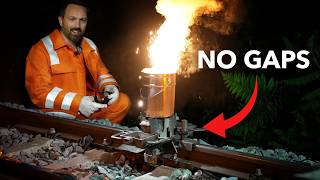
Fresh from heat treatment, the rails move directly to the welding line where individual sections are joined into continuous lengths. Guiding rollers work in tandem with laser sensors to ensure the rail ends align with absolute precision. A high power arc welder unleashes intense heat, melting the steel edges, while hydraulic pressure forces them together into a seamless bond.
Immediately afterward, an automated grinding system smooths away any excess material, leaving the weld surface perfectly flush with the rail body. The entire operation is overseen by a central control system which constantly fine-tunes variables such as temperature, pressure, and timing. The result is a joint so strong that its durability matches that of the solid steel itself.
This process of long rail welding transforms shorter segments into continuous tracks stretching hundreds of meters. Rails that will carry trains at high speeds with minimal vibration and with strength built to last for decades. [Music] The finished rails move into the quality inspection area where every detail is scrutinized with precision.
Optical sensors and high-speed cameras scan the entire surface, capturing images at a level that can see through to even the tiniest scratch. The data is then processed by advanced image analysis software, detecting any deviation in shape, color, or texture. At the same time, ultrasonic devices and X-ray scanners probe deep inside the steel, ensuring there are no hidden flaws such as internal cracks or gas pockets.
To complement these scans, randomly selected samples are put through rigorous mechanical tests. Powerful machines stretch, compress, and press against the steel, while hardness testers measure resistance to deformation. All results are carefully recorded and stored, allowing every rail to be traced back to its production batch.
Only those that meet the full range of criteria earn the stamp of approval, confirming they are fit for service. Once certified, the rails are cleared for packaging and distribution, ready to be shipped out to construction sites where they will become part of the railway lines of tomorrow. [Music] From the factory, the rails are transported to the construction site on oversized trailers, tightly secured to prevent shaking or bending.
Once on site, the steel sections are unloaded by cranes in specialized forklifts and placed in the designated staging area. From here, the work that demands human skill and experience begins. Installers follow structural drawings to position each rail using laser levels and surveying instruments to control alignment and slope.
Temporary joints are first fixed with bolts before being welded or permanently tightened. Throughout the process, workers communicate constantly via radios to synchronize their actions and ensure perfect connections. Machinery mainly assists with lifting and holding the rails, while the fine adjustments, alignment, and finishing depend almost entirely on the skill and coordination of the installation team.
It is this meticulous work that determines the stability and safety of the entire rail system for decades to come. [Music] Beneath protective coatings and solid welds, every steel structure is the result of hundreds of hours of work. Combining the power of machines with the hands of skilled workers from the mind to the construction site, each stage contributes to creating the backbone of bridges, factories, and towering skyscrapers.
Looking back on that journey, steel reveals itself as more than just a material. It is the foundation of modernization. If you'd like to discover more impressive manufacturing processes like this, don't forget to like, subscribe, and share the video.
And what's your take on today's rail production technology? Leave a comment below. We'd love to hear your thoughts.