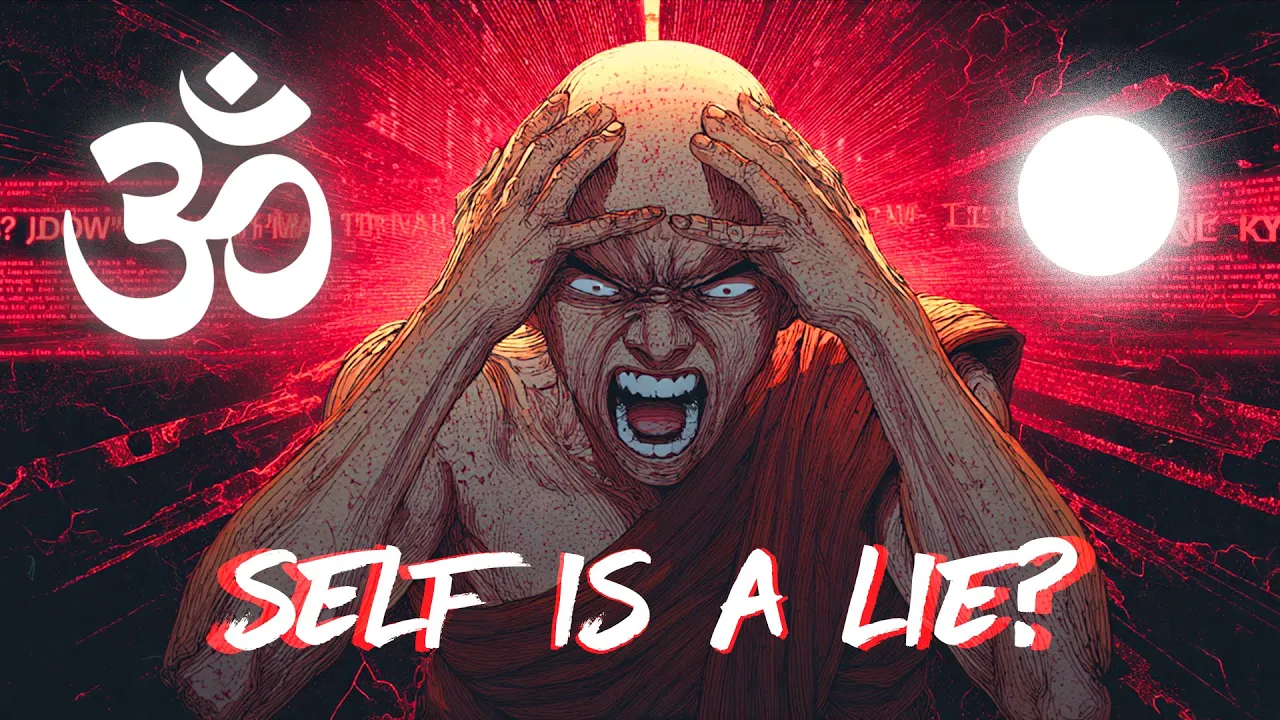
The Vanta philosophy of India has since the ancient rishies who composed the upanishads thousands of years ago up to modernday teachers of the same tradition maintained one central belief the self or atman. But what is the atman? The teachers of the vanta have always believed that behind our bodies and even behind our mind there is an observer an underlying awareness.
This awareness is eternal, everlasting and even transcends our body after it dies to then go on and inhabit another body just like how we wear new clothes after taking off the older ones. This underlying awareness as per the teachers of Vedanta is the atman. Shockingly however there is another tradition also born in India which has always denied this very belief.
This tradition began with Goautam Buddha over 2500 years ago. The Buddha is believed to have said that there was no such transcendental everlasting self. Indeed, this teaching of his was to be called anatman, literally no self, in direct opposition to the Vedanta philosophy.
And so we have two long and wellrespected traditions, both of them with deep roots in ancient India, which seem to say the complete opposite thing. Well, what is it then? Who do we believe?
Is there a self? An eternal underlying awareness behind the body and the mind? Or is there no such self?
Does this mean we must reject one of these two traditions? Or perhaps is it possible that both traditions are correct from their own perspective? Is it possible to accept both the Vantic Atman and the Buddhist Anat?
In this video, we will dive deeper into the philosophies of both Vedanta and Buddhism. We will take you on a journey from the time of the opanishads over 2,500 years ago to the Buddha to the philosophy of his followers a thousand years later then to the spread of ada vanta across the Indian subcontinent and finally to modern-day saints like Sri Ramak Krishna Paramahamsa. We will describe both the Vedantic and the Buddhistic position on the existence of the atman in detail.
Then in homage to the Buddha's teachings of the middle path, we too will try to find a middle path between these two philosophies. A solution to this question which may be acceptable to both traditions. Later in this video, we will also answer a controversial question.
Was Goda the Hindu philosopher who Adi Shankrara called his supreme guru actually a Buddhist? The teachings of Vanta are most clearly expressed in two texts. The opanishads and the Bhagat Gita.
In fact, the very name Vedanta which means the end of the Vedas come from the fact that this is the philosophy based on the opanishads. The texts which are located at the end of the Vedas, the holy scriptures of Hinduism. The teachings of the opanishads would be well known to our regular viewers.
So we will only summarize them here. Doonyish tell us that behind our bodies and minds there is an eternal observer the self atman. Indeed behind the whole observable universe there is an underlying consciousness in which this universe appears.
This universal consciousness is called Brahman. What then is the relation between atman and Brahman? Different schools within Vedanta disagree on this central question.
But the most popular and influential school within Vedanta which is known as Advea Vedanta says that atman and Brahman are ultimately the same. They are not two or Adeta in Sanskrit. Hence the individual self is ultimately the same as the universal self.
There is no ultimate difference between the consciousness which observes the life of a single individual and the universal consciousness which manifests this whole external universe of objects. To establish this teaching of the self, the philosophers of Ada Vedanta like the 8th century Hindu sage Adishankara rely on some great sayings. Mahavakya from the opanishads.
They recognize four of these sayings. All of them found in different opidic texts as follows. One you are that the adantins interpret this to mean you the individual self atman are that the universal self brahman.
Twoham brahasmi I am Brahman. Here I is interpreted to mean the atman. Threeam Brahma consciousness is Brahman.
Four I am atma Brahma. This self Atman is Brahman. To conclude this section we should understand that upanishads which contained all of the above statements were the output of spiritual visions.
The rishies the ancient sages who composed the oponyish actually experienced these truths. They came face to face with nameless, formless, pure consciousness and realized that this pure consciousness was at the foundation of both their own being as well as the whole universe. But later vantic philosophers thought they may have had their own spiritual experiences primarily only interpreted the experiences of the rishies and created philosophical systems on the basis of their interpretation.
Hence we should understand that the tradition of advant is only one interpretation of the spiritual experiences recorded in the upanishads. After attaining enlightenment, Goautam Buddha traveled across northern India for over 40 years spreading his practical message which revolved around the removal of suffering. His teaching was based on recognizing three aspects of experience.
One duka everything is suffering. This is the recognition that everything in life is marked by suffering by an inherent dissatisfaction. This led to the conclusion that nothing in this world can provide us with true happiness.
And why is that? It is because even those things which seem to provide us with happiness won't stay with us forever. This leads us to the second aspect of existence two anita.
Everything is impermanent. The Buddha argued that there is nothing which is transcendental or everlasting in this world. In fact, by ana the Buddha also meant everything changes.
Nothing ever stays the same. We can see how the first and second aspects are directly related to each other. Everything in life is unsatisfactory because any satisfaction we derive from worldly pleasures will not last.
The duka which is inherent in the world must be realized when we witness the truth of our nitya. When we eat something really delicious or when we meet a romantic partner whom we find exciting, we know that we can't just go on eating forever and that initial excitement of the lover will inevitably fade away. But most of us live in ignorance of this truth which is why we fall for the trap of desires again and again.
The enlightened person under the Buddhist view considers all desires to be unsatisfactory because they impermanent and hence unable to cause permanent happiness. Hence the enlightened being ceases to desire anything at all. But then we must ask if everything is impermanent what is the true nature of the world?
What is the nature of our own self? The observer who looks outside himself and realizes that everything is impermanent. Anatman everything is without a self.
Anatman is in fact a direct outcome of the second aspect of existence. Anita Anatman is the principle of impermanence applied to ourselves. We too are impermanent.
Hence there is no permanent self atman in this impermanent world. We are just as impermanent as the things as we observe here. Now we must observe that it is only this third aspect of existence anatism seem to differ with each other.
Even vantic texts agree that everything in this world samsara is full of suffering. In fact Krishna even repeats the first two aspects discussed by Buddha in the famous verse of Bhagat Gita. Imam propy having come to this world of impermanence and suffering worship me.
Here we see Krishna and the Buddha both agree on two aspect of existence that it is full of suffering and impermanent. Where they appear to differ is only in the Buddha's teaching of an atman. But what really is this teaching?
Did Buddha really tell his followers that there was no self? This requires us to investigate the Buddha's teaching in greater depth. A typical Buddhist response to the Vdantic self is that this whole belief in a self is just a manifestation of clinging to samsara.
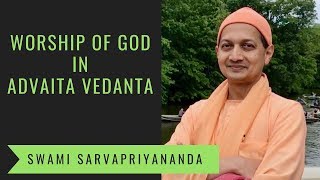
But the whole point of Buddhism is to attain nirvana to go beyond samsara. So at least apparently it would seem as if the Buddhist belief in non-self is the complete opposite of the vdantic belief in the self. This was recognized by one of the most learned monks of the Ramachrishna order Swami Sarvapanandha in one of his talks on the vendantic self and the Buddhistic non-self.
But in this lecture, Sarva Priyanandha also questioned the typical idea of the Buddhist narrative and asked, did Buddha ever say explicitly that there is no self? In fact, one finds as one reads the earlier texts of the Pali cannon which records the Buddha's teachings to his followers that the Buddha chose to remain silent on such questions. This silence is found in an important early Buddhist text.
The shorter discourse with Malung Kaputa. In this text, a monk by the name of Malung Kaputa wonders to himself, is the world eternal or not? Is the universe finite or infinite?
Is the soul the same as the body or is it different? Does the Buddha exist after death or does he not? The Buddha has taught us the way to remove suffering.
But he has not told us the answer to any of these important questions. I shall go and ask him these questions. And if he cannot answer them, I will leave the Buddhist order.
And so Malunka goes to the Buddha and asks these questions. But the Buddha refuses to answer them. Instead, he replies, "What Malunka did I ever say to you?
come laid the spiritual life under me and I will declare these things to you. Thus Buddha refused to answer any of these questions and reminded the monk that he had never even offered to answer these question. All that the Buddha had ever taught was suffering, its origin, its removal and the path to its removal.
The four noble truths. Later in this text, the Buddha also gives his famous metaphor of the arrow. The story goes as follows as told by the Buddha himself.
Suppose a man was struck by an arrow thickly smeared with poison. His friends and relatives would get a surgeon to treat him. But the man then said, "I won't extract this arrow from my body as long as I don't know the cast of the man who wounded me, his name and clan, whether he is tall or short, the color of his skin, and of what village or city he comes from, whether the bow was straight or curved, and so on.
" That man would still not have learned these things, and meanwhile, he would die. This story narrated by the Buddha is intended to be a direct response to Malonga who is none other than this wounded man. The wounded man has been hit by a poisonous arrow.
His first response should be to remove the arrow from his chest and save his life. Instead, the man questions, who shot the arrow? Why was the arrow shot?
And what is the poison inside the arrow? Similarly, Malunka and all of us today live in a world which consists of suffering and impermanence. The poisoned arrow.
Instead of removing the arrow by removing suffering from our lives, we ask ultimate questions about existence like who created the world? Is it eternal? And also, is there a self?
For the Buddha, then a person obsessed with the question, is there a self or no self is clinging to this desire for ultimate answers about the universe. What is more important instead is to abandon this clinging to stop this questioning and actually experience the removal of suffering in our lives. The Buddha after narrating the story also tells Malunga why he has not agreed or disagreed to any of these views.
He says and why haven't I declared these things? Because they aren't beneficial or relevant to the fundamentals of spiritual life. They don't lead to disillusionment, dispassion, insight, awakening, and extinguishment.
And what have I declared? I have declared the four noble truths. This is suffering.
This is the origin of suffering. This is the sessation of suffering. This is the practice that leads to the sessation of suffering.
And why have I declared only these things? Because they are beneficial and relevant to the fundamentals of the spiritual life. So malunga, you should remember what I have not declared as undeclared and what I have declared as declared.
Here we can see that the Buddha is in fact telling Malungaputa not to be distracted by the questions about the nature of the universe and about the nature of our own self including the existence or nonexistence of the atman. Instead he is telling Malungaputa to focus on the removal of suffering in his own life. But importantly, the Buddha also says that believing in any of these ultimate positions about the universe known as metaphysical beliefs does not help us in living a spiritual life which is what actually matters if our ultimate goal is enlightenment.
What does this mean? The Buddha seems to imply here that having either the belief that the self and the body are different or that the self and the body are the same would both be problematic. If we believe that we are an eternal everlasting self, we will learn to believe that we are actually immortal.
We don't die when our bodies die, but we live on in the self. This feeling of immortality according to the Buddha is actually just us clinging to the world. This is criticized by the Buddha as a form of eternalism, a clinging to the desire of external existence, a fear of death.
But on the other hand, if we were to vemently deny the self and constantly tell ourselves that there is no self or even that there is nothing in the world, this only reveals another kind of clinging. This was criticized by the Buddha as a form of annihilationism, a clinging to the desire for nonexistence, which is still a desire, a desire for escape from the world because one does not wish to stay in it. The Buddha instead taught the teaching of the middle path or the middle way.
This teaching was to become an essential part of Buddhist philosophy down the ages. As we will see in the teachings of one of the greatest Buddhist philosophers, Nagarjuna, the middle path according to the Buddha is the way that avoids two extremes, both of which only represents opposite desires. Here the Buddha would say that to attain enlightenment, it is essential to take the middle path between the opposing views of eternalism and enhilationism.
Hence we must not have either the desire for eternal existence or the desire for non-existence. We should have no desire at all and be completely neutral towards our existence. This complete neutrality to existence according to the Buddha and later Nagarjuna can only be achieved by the renunciation of all views about the world and even about ourselves.
These philosophical views like the existence of the self do not help us in our spiritual life. They make us cling to the world and to a possible immortality even when we know that everything that is born must die. The only reason for having any views whatsoever then is if they help us advance in our spiritual life.
We have seen that the Buddha remained silent for many philosophical question. This tells us that knowing the answers to these questions will not help us. Now some of you may ask the Buddha has given at least some answers.
He has told us duka anitya anatman suffering impermanence nonself. Aren't these also philosophical positions? Yes, that's correct.
The Buddha told us about these three philosophical truths and only these three because they help us progress towards enlightenment. While duka and anitya teach us not to cling to this impermanent world which is full of suffering. The third aspect an atman teaches us not to cling to ourselves to recognize that we are subject to birth and death.
But then you may reply isn't an atman something that the Buddha denied by his silence to Malunkia. Doesn't the middle path mean that both the belief in the self atman as well as the belief in the non-self anatman must be denied? This leads us to an important issue related to the Buddhist doctrine of nonself.
It can be argued that an atman is simply a denial of the self in terms of belief. However, an atman does not imply the opposite belief, the belief in no self. In other words, the Buddhist doctrine of no self is just a reminder to us that there is no single underlying ego behind us which will live on after we die.
The belief in such an ego would after all only increase our desires, our self-worth, our sense of grandeur about ourselves. But on the other hand, if we believed that there is no self or nothing in the whole world, we would in fact believe in nihilism, a materialistic world where nothing exists after death. And in fact, nothing matters.
This perspective also would not help us spiritually. Why would we do things like meditation and other spiritual practices if we don't exist after death? Despite all the philosophical deaths we have discussed here, the conclusion is simple.
An atman is not a belief in no self, but instead a belief in the middle path between these two positions, the denial of both self and no self. An atman is the Buddhist silence and not a materialistic denial of life after death. The philosophical depth of Buddha's middle path was brought out by the great Buddhist philosopher Nagarjuna in his teachings.
Hence, Nagarjuna became the founder of the Madiamika path of Buddhism where Madiamaka literally means the school which follows the middle path. According to Nagarjuna, everything in the world including ourselves were characterized by emptiness. Shunata.
But what does it mean for all things to be empty? We would be incorrect if we were to interpret shunya as nothing. This would go against the Buddha's middle path and imply a turn towards nihilism.
The view that nothing truly exists. Nagarjuna cautions us against viewing shunyata as nothing. Nagarjuna explains shuna instead as that which lies beyond the realm of all logic.
He uses a logical technique known as chhatushkoti a four cornered system of argumentation. In ordinary western logic in response to questions like does the self exist? We respond either yes or no.
But in the chhatushki we have four possible responses. One, the self exists. Yes.
Two, the self does not exist. No, the self both exists and does not exist. Yes and no.
The self neither exists nor does not exist. Neither yes nor no. According to Nagarjuna, the ultimate truth of all existent things, Shuna is beyond all four options.
Hence, even on the issue of the self, the Buddhist does not just say the self does not exist, but actually denies all these four options. Nagarjuna's logic is in this sense just another way of explaining the Buddha's silence. But then what exactly is ultimate reality?
The Indian philosopher TRV Morti in his book the central philosophy of Buddhism interpreted Nagarjuna as implying that there is an underlying essence of the world which is beyond the confines of rational logic. Hence we can say absolutely nothing about that ultimate reality not even that it exists. Most shockingly the logic of nagarjuna is used by gaapada the founder of advanta tradition in his commentary on the manduka opanishad the manduka karika in a passage in this text ga writes as follows by asserting that the self exists does not exists exists and does not exist or again neither exists nor does not exist the nondiscriminating man does certainly cover it the self up through ideas of changeability, unchangeability, existence and non-existence.
This is shockingly similar to Nagarjuna's own thinking just stated in different terms. For Nagarjuna, the underlying essence of all things, emptiness is beyond all logic. Similarly for Goda it is the self atman which is beyond all logic even the logic of existing or not existing.
Hence saying anything at all about the self would be incorrect. The self is ultimately anva ineffable. This is because the notions of something existing or not existing are only seen in empirical reality.
In the absolute reality, however, where concepts, notions, and even language do not exist, nothing at all can be said about the self. Here we see a return to the Buddha's silence in the earliest philosopher of Ada Vedanta. Over a thousand years after God, Sri Ramakrishna recognized the importance of the Buddha's silence.
In a passage from the gospel of Sri Ramakrishna, we find the following discussion. Narendra the future Swami Viveananda said he the Buddha could not express in words what he realized by his tapasia spiritual practice. So people say he was an atheist.
Sri Ramak Krishna he was not an atheist. He simply could not express his inner experiences in words. Why should the Buddha be called an atheist?
When one realizes one's swupa, the true nature of oneself, one attains a state that is something beyond ai is and nasti is not. The experience of the Buddha is beyond both existence and non-existence. It is fascinating to observe that Sri Ramach Krishna without any formal study of Buddha's philosophy understood the Buddha's silence so effectively and even related it to the question of self and no self.
The truth is nothing at all can be said about the self's existence or non-existence. The ultimate truth is beyond such concepts. Enlightenment lies between is and is not.
Where does this leave us as spiritual practitioners? Should we believe in the self or no self? Through this overview of Vantic and Buddhist philosophy, we have developed one takeaway.
It doesn't necessarily matter what you believe. Whether you believe in the self or not, spiritual practice still remains possible. If you believe in the self, then you can understand the Buddhists no self doctrine as a warning against the ego.
The ego, our sense of I, is the empirical self associated with our name and form, our likes and dislikes. The self of Vanta, however, is the ultimate self beyond all names and forms. So importantly, both Vedanta and Buddhism are united in being against the identification with the ego.
And so this implies that regardless of whether we believe in the ultimate self or not, our first step should be to get rid of the empirical self, the ego, which surely dies with our bodies, whether or not there is an ultimate self which lives after our death. This emphasis on first getting rid of the ego instead of worrying about questions like the ultimate self would be in line with the practical teachings of the Buddha. Even the Vanta philosophy as we have seen agrees that the ultimate self is beyond the understanding of ordinary logic.
So let us focus on practical spiritual progress and leave questions about the ultimate nature of reality for later. What do you think about self and no self? Do you believe in either of these positions?
Let us know in the comments below.