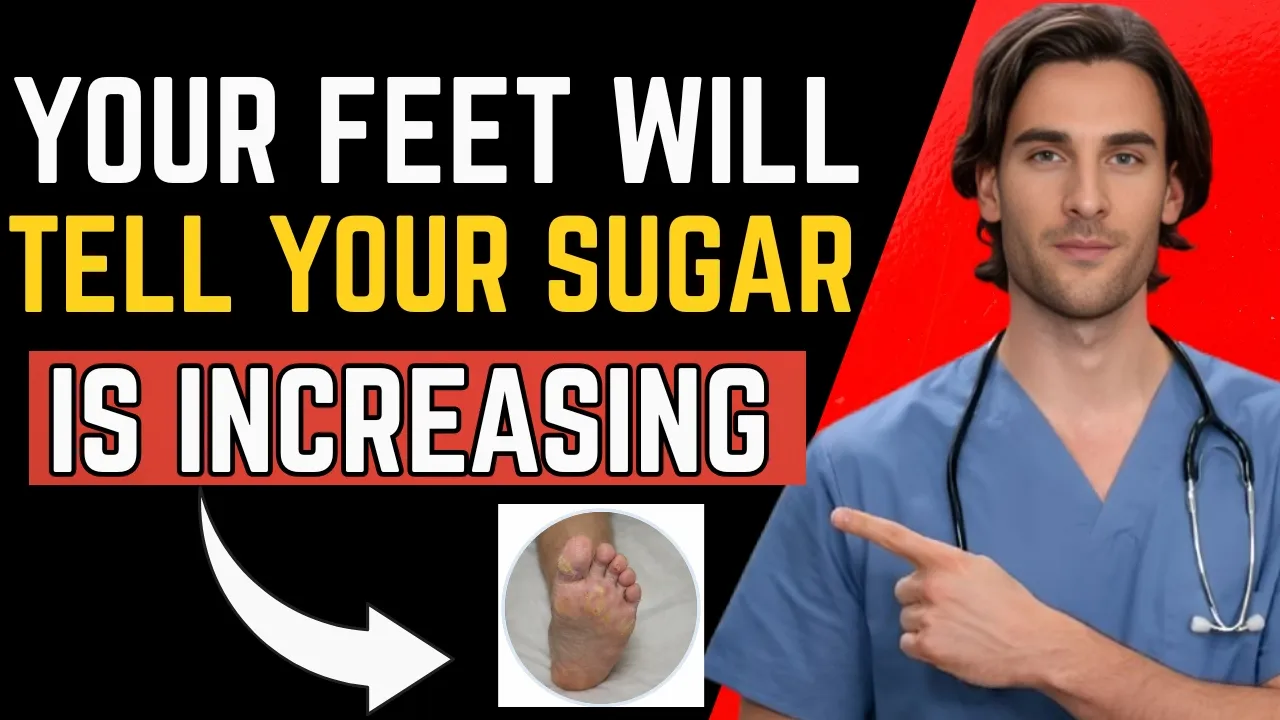
Most people believe that diabetes can only be caught by a blood test. You go to your doctor, the lab work comes back, and that's when you find out. I understand why people think that.
For years, that's what most patients told me, too. My name is Dr Ethan Parker, and I've been practicing medicine for over 20 years. And what I've learned, what I see confirmed in my office every single week, is that your body starts warning you about high blood sugar long before any lab result ever would.
And the very first place your body speaks up, your feet. The reason I'm making this video today is because of how many patients I've seen walk into my office, or worse, walk into an emergency room, who had every warning sign for months, sometimes years, and never knew what they were looking at. Today, I'm going to change that for you.
Just last month, I sat down with a patient, a 67-year-old man, retired, healthy lifestyle, felt fine. He came in for a routine checkup, but before we did any blood work, I asked him about his feet. He told me, "My feet have been a little numb for a while.
I figured it was just age. " He had four of the nine signs I'm going to show you today. His fasting blood sugar came back at 214.
He was diabetic and had been for over 2 years without knowing it. So, today, I want to show you exactly what I showed that patient. Nine signs that were already on his feet, and on millions of feet right now, that almost nobody recognizes for what they are.
For each one, I'll tell you what most people assume it is, what's actually happening inside your body, and one simple daily habit that can protect you. The American Diabetes Association estimates that one in five Americans with diabetes don't even know they have it. That's over 8 million people walking around right now with a silent condition, quietly damaging their nerves, their kidneys, their vision, and yes, their feet.
The good news, a $12 blood test can catch this early. But first, you need to know what to look for. So, let's get into it.
Sign number one is something almost every patient has already experienced, and every single one of them has explained it away. Tingling, numbness, that pins and needles feeling in the feet. My patients almost always tell me, "Dr Parker, my foot just falls asleep sometimes.
I was sitting with my legs crossed. " And yes, that happens to everyone occasionally, but I always ask them, "Is this happening regularly without a clear reason? " Because if the answer is yes, we need to talk about what's actually going on.
Frequent, recurring numbness or tingling in the feet, what doctors call peripheral neuropathy, is one of the earliest signs that blood sugar has been elevated for some time. The extra sugar in your bloodstream begins attacking the outer protective layer of your nerves. It's a slow process, which is exactly why most people miss it.
I use this analogy with my patients all the time. Think of your nerves like electrical wires. Every wire has a plastic coating around it.
That coating is what allows the signal to travel cleanly from your brain to your foot. When blood sugar stays high, it's like an acid slowly eating through that coating. The wire still works for a while, but the signals start getting fuzzy.
And that fuzziness, that's the tingling you feel. According to the American Diabetes Association, peripheral neuropathy affects nearly 50% of people with diabetes. It is the single most common complication, and it almost always starts in the feet.
Which means right now, tens of millions of Americans are experiencing this tingling and writing it off as nothing. Don't be one of them. My daily recommendation for every patient over 60, a 20 to 30-minute walk every single day.
Not a jog, a walk. Movement is the best thing you can do to keep blood flowing to your feet and protect those nerve endings. And start reducing added sugar in your diet today, not next month, today.
Sign number two, and this one my patients describe as the most distressing of all, because it doesn't hit them during the day. It hits them at night when they're alone and trying to sleep, and there is nothing to distract from it. A lot of my patients chalk this up to being on their feet all day, or the summer heat, or just fatigue, and sometimes that's exactly what it is.
But when a patient tells me their feet feel like they're on fire, especially at night when they're lying down, I take that very seriously. Burning in the soles of the feet, particularly at night, is a classic early sign of diabetic neuropathy. What's happening is this, the nerves in your feet have been damaged by excess sugar, and now they're sending incorrect signals to your brain.
Your brain receives a heat message even though nothing hot is touching your foot. The nerves are misfiring. Think of it like a fire alarm with a faulty sensor.
The building isn't on fire, but the alarm is going off anyway because the sensor is damaged. Your nervous system is doing the same thing. The burning isn't coming from outside your body, it's coming from inside damaged nerve tissue that is crying out for help.
Research published in the journal Diabetes Care found that burning foot pain is one of the first reported symptoms in patients later diagnosed with type 2 diabetes, often presenting 1 to 3 years before formal diagnosis. Two habits I recommend for this one. First, drink at least eight glasses of water a day.
Proper hydration helps your kidneys flush excess glucose and supports nerve tissue. Second, add more fiber to every meal. Vegetables, legumes, oats, fiber slows the absorption of sugar into your bloodstream, which is exactly what those damaged nerves need.
Sign number three, and I need you to pay very close attention here because this is the one that stops being uncomfortable and starts becoming genuinely dangerous. This is the one that sends the most patients to the emergency room. They come in and say, "Dr Kent, I had a little blister from my shoe 3 weeks ago.
It still hasn't healed. " They waited, they assumed it would close on its own. Most small wounds do heal on their own, but not when blood sugar is elevated.
When blood sugar is consistently high, your body loses its ability to heal efficiently. The blood vessels throughout your body, including the tiny ones in your feet, begin to narrow and stiffen. This means that oxygen, white blood cells, and the nutrients that repair tissue simply cannot reach the wound fast enough.
The wound sits there, open, vulnerable, and slow to close. Imagine trying to water a garden, but your hose has a serious kink in it. The water is there, but it's not getting where it needs to go.
That's exactly what high blood sugar does to circulation in your feet. The healing ingredients exist in your blood, and they just can't reach the wound. And an open wound that won't close is an infection waiting to happen.
The Centers for Disease Control reports that diabetic foot ulcers are the leading cause of non-traumatic lower limb amputations in the United States, over 100,000 per year. Almost all of them were preceded by a small wound that was ignored. After your bath or shower tonight, sit down and look at both feet carefully.
Look between every toe. Look at your heels. If you see any cut, blister, or broken skin, clean it with mild soap and water, apply an antiseptic, and cover it.
And if it hasn't improved in 48 hours, call your doctor. Not next week, 48 hours. Sign number four, and this one is hiding in plain sight.
Most people walk past it every single day without realizing what they're looking at. It's visible, it's been there, and almost nobody connects it to blood sugar. Patients see their feet turning darker or more reddish, and they tell me, "I think it's just sun damage, or I've always had dark skin on my ankles.
" And that may be true, but there is a specific pattern of discoloration, particularly around the ankles, that I look for when assessing blood sugar risk. When circulation is compromised by high blood sugar, the lower legs and feet don't receive enough fresh oxygenated blood. The skin changes color as a result.
You may see darkening, deep red, or even a bluish tint around the ankles. This is your skin telling you that blood flow to that region is inadequate. In some patients, the skin also becomes thinner and more fragile in those areas.
Another sign that the tissue is not being properly nourished. I always explain it to patients this way. Think of your blood as a delivery truck carrying oxygen and nutrients.
Your feet are at the end of the longest delivery route in your body, further from your heart than any other part. When the roads narrow because of damaged blood vessels, the deliveries stop arriving on time. The skin, starved of fresh oxygen, changes color.
It's a distress signal you can see with your own eyes, if you know what you're looking for. A study in the Journal of the American Academy of Dermatology found that these skin changes are detectable, on average, 18 months before a formal diabetes diagnosis. The daily habit here, 5 minutes of ankle circles, toe raises, and calf stretches every morning.
Even that small amount of movement gets blood flowing into your feet. And if you can't exercise, elevating your feet slightly while you sit can make a meaningful difference. Sign number five, and this one surprises my patients the most because it looks completely harmless.
In fact, most people have had it for years and never once connected it to blood sugar. Dr Kent, "My heels crack every winter. It's just dry skin.
" I hear that constantly, and yes, that's extremely common. But when your heels are cracking badly in the middle of summer, or no moisturizer seems to help no matter how much you use, that's a completely different story. Diabetes affects the autonomic nerves, the ones that control automatic functions you never have to think about.
One of those functions is regulating moisture and sweat in the skin. When these nerves are damaged, the sweat glands in your feet stop working properly. Your feet lose their natural moisture from the inside out.
No amount of lotion fixes the root cause. Think of your skin like a wall that needs to stay sealed. When those autonomic nerves are damaged, the mortar between the bricks starts crumbling.
Cracks appear and those cracks in the skin of your feet are not just cosmetic. They are open doors for bacteria and infection. In a foot with poor circulation, that infection can become very serious very quickly.
I have had patients come in with cracks so deep in their heels they were bleeding and they told me they had been putting lotion on it for 2 years with no result. That's not a skin problem, that's a nerve problem. The American Podiatric Medical Association identifies chronic hard to treat heel cracking as a significant indicator of autonomic neuropathy in seniors, a condition directly linked to long-term elevated blood sugar.
And autonomic neuropathy is not a minor inconvenience. It is a sign that the nervous system is under serious stress. Moisturize your feet every single night before bed.
A good lotion or pure coconut oil works well. Apply to the sole and heel thoroughly, but never apply moisturizer between your toes. That trapped moisture breeds fungal infection and drink eight glasses of water daily.
Your skin needs hydration from the inside as much as the outside. I want to pause here for just a moment. We've been through five signs so far and I want to ask you something directly.
Have you noticed any of these signs in yourself or in someone you love? A spouse, a parent, a sibling? If the answer is yes, even one sign, go to the comment section right now and type the word yes.
Just yes. Capital letters. That's all I need.
I read every single comment on this channel. Everyone, if you have a question, ask it. If you're concerned, tell me.
That's why I created this channel, not to talk at you, but to talk with you. And if you're finding this useful, hit the like button right now. It takes 1 second and it tells YouTube to show this to more seniors who need it.
All right, let's keep going. Sign number six. And this one is more serious than most people realize because it's not just about your feet, it's about what's happening to your kidneys at the same time.
Almost everyone I've seen with this tells me, "I sit at my desk all day. " or "I stand on my feet at work. " Occasional swelling from activity is normal.
I want to be clear about that. But if your feet and ankles are consistently swollen and you're leaving deep sock marks every evening, that changes the picture. High blood sugar affects the kidneys, then the kidneys control your body's fluid balance.
When kidney function is impaired by years of elevated glucose, fluid accumulates in the lowest part of your body, your feet and ankles. This swelling, called edema, is a sign that your body's filtration system is under stress. Think of your kidneys as the filtration plant for your body.
Every drop of blood passes through them to be cleaned. When high blood sugar damages those filters, the system backs up like and excess fluid has nowhere to go except downward. Gravity does the rest.
The fluid pools in your ankles. You press your finger into the swollen area and the indentation stays there for a few seconds. That's called pitting edema and it is not something to ignore.
The National Kidney Foundation reports that diabetic kidney disease affects approximately one in three adults with diabetes and lower extremity edema is frequently the first visible sign that kidney function is being compromised. When you rest, elevate your feet above the level of your heart, even a few inches on a pillow. This helps pull that accumulated fluid back toward the center of your body and reduce sodium in your diet.
Salt causes your body to retain water, which makes edema significantly worse. Read labels. Many canned and processed foods are loaded with sodium and if the swelling is new, persistent or getting worse, please bring it to your doctor's attention at your next visit.
Don't wait for it to become a bigger problem. Sign number seven is the one I see most often misdiagnosed. Men especially and by the time they find out what it actually is, they've been living with it and masking it for years.
The majority of my senior patients are male and what I hear almost without exception is this. "I've been taking ibuprofen for the foot pain for months. I figured it was arthritis, maybe an old sports injury.
" I've heard this story dozens of times and sometimes that's exactly right. But sometimes the pain has a completely different origin, one that ibuprofen will never touch. When nerves are damaged by chronic high blood sugar, they don't always go quiet.
Sometimes they become hyperactive. Instead of going numb, they start firing random intense signals your brain interprets as severe pain. Patients describe it as stabbing, an electric shock or a hot needle through the foot.
This happens most often at night when there are no other sensory distractions. Think of a car alarm damaged in a fender bender. Every few minutes it starts screaming for no reason.
Nobody is breaking into the car. The alarm is just broken. That's what a damaged nerve does.
It sends alarm signals to your brain when nothing is actually happening. The pain is completely real, but its source is nerve dysfunction, not injury. And taking ibuprofen doesn't fix a damaged nerve.
What it does is mask a signal your body is desperately trying to send you and masking signals is the last thing you want to do when your nerves are asking for help. A landmark study in the New England Journal of Medicine found that painful diabetic neuropathy affects approximately 25% of people with diabetes and is frequently mistaken for arthritis, tendinitis or age-related joint pain. Every morning, 5 minutes of gentle foot and ankle stretching before you get out of bed.
Flex your feet, circle your ankles, pull your toes back gently. Get blood moving before you put weight on your feet. And every night before bed, give your feet a gentle three-minute massage.
Light circular strokes along the sole and up the ankle. Your nerves will thank you. Sign number eight is the one that tells me how far things have progressed.
When I see this in a patient, I know the damage is not early anymore and almost every single time the patient's first reaction is, "Doctor, I've had that my whole life. " They say, "I've always had cold feet, Doctor. Kent my wife has stolen the electric blanket every winter for 30 years.
" And I laugh with them, but then I ask, "Are your feet cold in July? Are they cold under three blankets? " Because that's when I become concerned.
Cold feet that persist regardless of the temperature around you, cold in summer, cold under heavy blankets, cold even when the rest of your body feels warm, are a strong indicator of significantly compromised blood circulation in the lower extremities. Your blood vessels have narrowed or stiffened to the point where warm blood simply is not reaching the tips of your feet in sufficient volume. Think of your blood vessels like a heating system running pipes to every room in your house.
When those pipes narrow from blood sugar damage, the heat doesn't make it to the far end. The room stays cold no matter how hard the furnace works. That cold is not about the weather, it's about the pipes.
The American Heart Association identifies peripheral artery disease caused by narrowed blood vessels as affecting over 8 million Americans with diabetes being the single largest risk factor. Cold feet are one of its earliest and most consistent symptoms. The best response here is a 30-minute brisk walk every single day.
Not a stroll, a purposeful arm swinging walk. This forces blood circulation into the feet and lower legs, strengthens blood vessel walls and over time can reverse some of the early narrowing. Start with 10 minutes if 30 feels like too much.
The important thing is to start today. Sign number nine and this is the one almost nobody ever talks about, the one I have never seen covered in a patient brochure, the one most people walk right past, including many doctors. But once you know it, you will never unsee it and I almost never have to bring it up because patients rarely notice it themselves.
But during a foot exam, when I look at the lower legs and the tops of the feet, sometimes there's a visible absence of hair in those areas. The patient looks down and says, "Huh, I never noticed that. " And that is exactly the problem.
It's a quiet sign, easy to miss, but it matters. Hair follicles need a steady supply of blood and oxygen to function. When circulation is significantly impaired by long-standing elevated blood sugar, the follicles in your feet and lower legs slowly stop receiving what they need.
Over time, they stop producing hair entirely. That hair loss is a visible marker of blood vessel damage that's been progressing in many cases for years. Think of hair follicles like small plants in a garden.
When the irrigation pipe narrows or blocks, the plants don't die immediately. They just gradually stop growing. The absence of growth is your body sending a message about your blood vessel health.
A message you can see every time you look at your legs. Research published in Diabetes, Obesity and Metabolism found that hair loss on the lower extremities correlates significantly with peripheral vascular disease in diabetic patients, a reliable and frequently overlooked sign that physicians are specifically trained to check for. Right after this video, look at your lower legs and the tops of your feet.
If the hair is significantly thinner than the rest of your leg or absent entirely, schedule a blood glucose test this week. Not this month, this week. Approximately $12 at any certified lab covered by Medicare for most of you.
$12 can change the entire trajectory of your health. We've covered a lot today. Nine signs, nine chances to catch something before it catches you.
And I want to be honest with you about something. One of the hardest parts of my job is sitting across from a patient who has had every single one of these signs for 2 years and is only just now finding out why. Not because they didn't care, they cared deeply.
They just didn't have the information. You now have that information and I want you to do one thing with it. Just one thing.
Tonight before you go to bed, sit down and look at your feet. Take 30 seconds. Look at the skin.
Look between the toes. Feel for numbness. Check for any wound that shouldn't be there.
30 seconds. That's all I'm asking. And if you see or feel anything on this list, please call your doctor tomorrow, not next week, tomorrow.
Because the earlier you catch this, the more completely it can be managed in most cases through a change in diet, a daily walk, and a conversation with your doctor. You worked hard for the life you have, for your independence, your health, your ability to do what you love. Don't let something as manageable as blood sugar take any of that from you, just because nobody told you what to look for.
Now you know. If you found this useful, share this video on Facebook right now. Tag someone you care about and a family member, a friend, a neighbor.
You might be giving them something they didn't know they needed. And if you want more conversations like this one, I post a new video every week on this channel. Topics that matter for your health after 60.
Things I talk about with my patients that most people never hear outside a doctor's office. Subscribe and bring someone you love along with you. I'm Dr Ethan Parker.
Stay aware, stay proactive, and take care of those feet. I'll see you next week.