[Narrator] Beneath the waves, lives a mysterious creature, older than the dinosaurs. Octopus! So incredibly alien.
Changing color in an instant. Shapeshifting into almost anything. They are the planet's true masters of disguise.
Now we're discovering, they are one of the most intelligent beings on the planet. Two years immersed in their world, reveals they use tools. -I felt completely shocked at the level of sophistication that I was witnessing.
[Narrator] Think creatively. Communicate with other species. And maybe even dream.
-I wonder sometimes if the octopuses are dreaming about me, wondering what I am, who I am. [Narrator] We're just beginning to understand what they have to tell us. -I have just had a conversation with an octopus.
[♪ theme music plays] [Narrator] The island of Sulawesi. 3000 miles of lush, densely forested coastline. But beneath the water, things look very different.
A few scattered reefs are the only refuge in an underwater desert. Any animal going out in the open, is vulnerable. To survive here you need brawn or, brains.
This is a coconut octopus. At 18 months old, she's already halfway through her short life. Like all octopuses, her mother died after she was born.
She's been alone her whole life. Every single thing she's learned about the world, she's taught herself, and with astonishing speed. Most importantly, how to hunt.
As she crushes her crab with her powerful bird-like beak, the succulent scent of her meal attracts attention. She could lose her dinner, or her life! There's nowhere to hide.
But even in her short life, she's learned how to make a run for it. Clasping the crab in two arms, she uses the others like feet. It's called stilt walking.
But she can't run forever, it's time to take cover. And she's not called a coconut octopus for nothing. [♪ playful music] She uses her propulsive siphon, like a leaf blower, to blast away sand clogging the shell.
Using an object to solve a problem is known by scientists as tool use. A sign of great intelligence. Just 0.
1% of animals are thought to use tools. Making a hideout earns her a place in this exclusive club. [♪ majestic music] Scientists believe we've barely scratched the surface of octopus smarts.
National Geographic explorer and animal psychologist Dr Alex Schnell researches octopus intelligence in the wild. [DrAlex Schnell] I really want to understand what's going on inside the octopus mind. But we're only just discovering how they're using that brainpower.
[Narrator] Alex suspects these octopuses are capable of even more advanced tool use. -I cannot wait to see the individual. [Narrator] Local expert Benhur Sarinda is here to help her research.
-Let's give it a go. -Let's let's try it. [DrAlex Schnell] I wanna learn if their tool use has a type of ability that we call future planning.
This is the ability to carry tools for future use, and it's a hallmark of intelligence. We've only ever seen it in chimpanzees and crows and humans. [♪ mysterious music] [Narrator] A coconut octopus.
But that's no coconut. This small female is using a clamshell, because it has a big advantage. Portability.
Even when you've got eight arm, two shells are a handful. But so worth it. [Narrator] A large shoal of hungry mullet, is a frightening sight for a fist-sized octopus.
[♪ anxious music] Her clam shells are the perfect safe house. [♪ curious music] Different type of shell, same genius tool use. And to Alex's amazement, she's not done yet.
When she finds the right spot, she starts work on a more permanent shelter. This octopus has a remarkable understanding of how these shapes fit together. She manipulates the shells to fit just so.
It's what Alex has been hoping to see! [DrAlex Schnell] Right in front of our eyes. She solves the problem of being so exposed in this desert-like landscape, bringing along her own shelter to use the next time that she might venture out.
[Narrator] With no parental training and short life spans, octopuses learn fast. Within months they have to master problem solving and possibly plan for the future. Octopuses don't just make simple plans.
They can devise complex and cunning strategies. When the tide turns here on this volcanic archipelago, the retreating Atlantic leaves behind tidal pools. And the churning water brings with it, a visitor from the deep.
Cut off in one of the pools is a hungry island octopus. Six months old, his hunting skills are all self-taught. He's about to take the ultimate risk.
Sally Lightfoot crabs. An octopus favorite. The turning tides now exposes one of their favorite things to eat, fresh algae.
Mmm, so mouthwatering. But to get to it, takes a leap of faith. [♪ dramatic music] The young octopus won't get as much as a snack by staying where he is.
He needs a plan. Muscles in his eyes change the shape of the lens, so he can focus out of water. And see the best way to the jumping crabs.
It's a dangerous journey. [Narrator] Sure, he's smart, but is he willing to bet his life on a strategy? [splashing] He's going for it.
He'll dry out and die in 20 minutes. One wrong move and he's truly cooked! [♪ Latin music] [♪ Latin music] [♪ Latin music] Finally, he makes it!
It's time for the next step of his master plan. Positioning rocks to make the perfect cover. [splashing] The trap is set.
[splashing] Well-earned brain food. The island octopus has thought up, tested, and executed, a killer hunting technique. [♪ upbeat music] Six months old, entirely self-taught, and already an accomplished strategist.
So how do octopuses come up with all these smart ideas, despite living such short lives? To understand that, you need to know them as individuals. Extreme diver, Krystal Janicki, has logged more than 600 hours in the freezing waters off Canada's southern Pacific coas.
[♪ mysterious music] It's a strange and otherworldly place to explore. The cold water is rich in oxygen and nutrients. Turbocharging life, and pushing it to extremes.
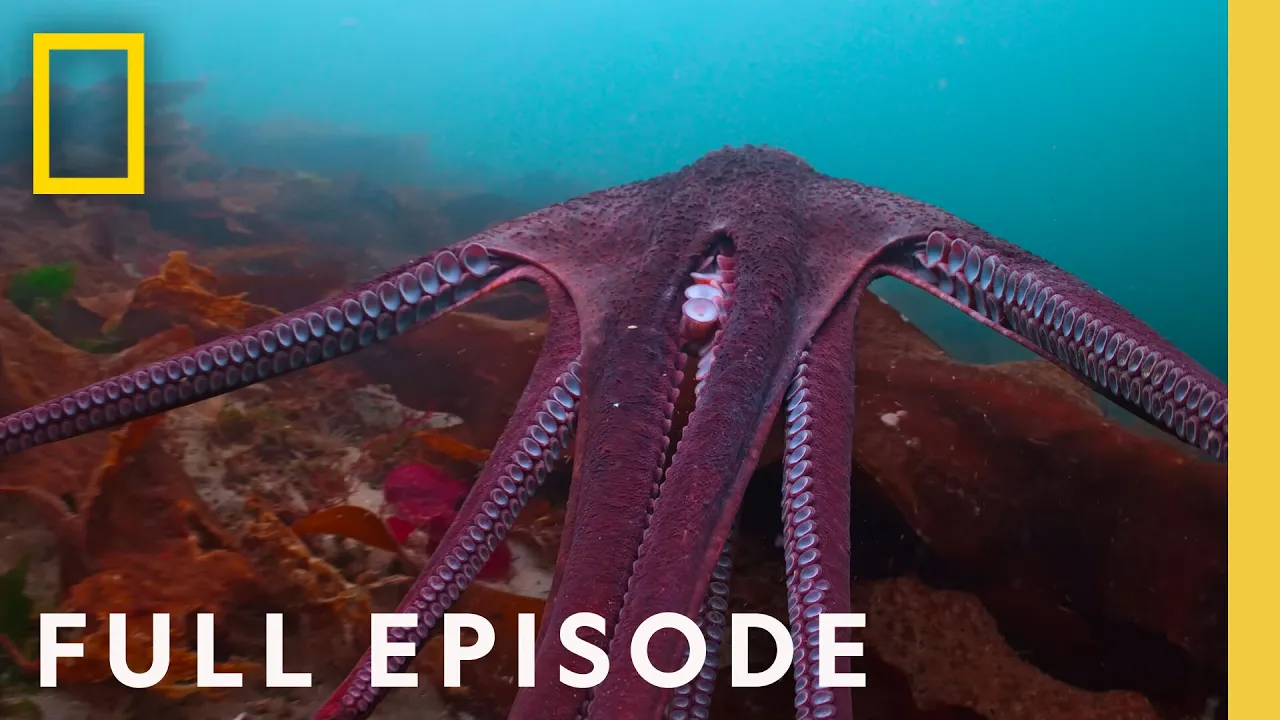
[♪ dramatic music] Lurking in the deep is a colossus. [♪ dramatic music] [♪ dramatic music] [Narrator] The giant Pacific octopus is the biggest octopus on the planet. [♪ dramatic music] It can reach up to 30 feet from arm-tip to arm-tip.
The length of a school bus. By diving with these giants for so many years, Krystal has begun to recognize and build relationships with individual octopuses. [Krystal Janicki] When you lock eyes with an octopus it's such a special moment.
[bubbles] I get a real sense that they want to connect with us, that they want to learn from us. They have such curious minds. Maybe they're not so different from us after all.
[Narrator] Krystal is a citizen scientist, and her face time with octopuss has led to a realization. Every animal has a distinct personality. While they're all smart, each uses its brain power in different ways.
The best way to see it, is to follow one on a hunt. To reach her full size, this giant Pacific octopus needs to eat at least 6 meals a day. [Krystal Janicki] It's amazing to think that she started out as a hatchling the size of a grain of rice.
These octopus have one of the fastest growth rates of any animal. [♪ rock music] [Narrator] Her favorite food, red rock crab is no easy catch. They're agile and fast.
But they're up against, a mastermind. Octopuses are hard-wired for learning. [Krystal Janicki] So they have such incredible brains, such incredible knowledge, and the way they learn and grow so fast, blows my mind.
[Narrator] When it comes to building neurons, critical brain connections for intelligence, octopuses have three times more capacity than humans. They're perfectly primed for new information. Every hunt is a chance to learn.
[Krystal Janicki] Over time, I started to notice how quickly they can problem solve and adapt on the fly. [Narrator] Using her taste-sensitive suckers, she feels for crabs hidden in the rocks. No luck with that strategy.
But a genius can change tack, fast. She flushes the crabs out into open terrain. [♪ upbeat music] Then all of a sudden, she's gone.
[Krystal Janicki] She disappears within seconds. [♪ mysterious music] And then I see her, tucked into the rocks. I'm not sure if she's searching for something or if she's hiding.
[Narrator] Her plan becomes clear. An ambush. [♪ dramatic music] She releases toxins that liquify the crab's insides, making crab soup.
Her tactic is creative, clever, but more importantly, it's her. [♪ emotional music] With no family to nurture or guide them, they seem to spend their short lives working out how they want to do something. The more they experience, the more they learn.
And all beyond human speed. One of the biggest questions is just how octopuses retain all this information. In the Caribbean, tucked safely in her den, this island octopus is sleepin.
She's earned it. [♪ soft piano music] She spends her days hunting in a complex world, full of obstacles, and enemies. To help navigate it, scientists believe that octopuses have an especially sharp memory for geography.
They might be able to build a mental map of visual landmarks. And remember what they touch and taste. Like a multisensory GPS.
This built-in roadmap points them to food. [♪ dramatic music] It's also a lifesaver. Barracuda are dangerous.
Like most octopuses, she fires ink to create a distraction. But it's her memory that provides an escape route. A direct path back to her den.
She might sleep for 4 hours. But her mind may not be entirely offline. It could be downloading.
[♪ cheerful music] [air hissing] DrC. E. O'Brien is fascinated by the secret of octopus sleep.
In particular, the role sleep plays in octopus learning. [DrC . E.
O'Brien] Over the course of 24 hours, the octopus spends about 60% of the time actually sleeping. I was very excited when I first saw the octopus sleeping, because it is a behavior that had only been observed in the lab before. [Narrator] To document her sleep, DrO'Brien places a small camera at the mouth of her den.
[DrC. E. O'Brien] I can tell she's asleep um, by the dilation of her pupils.
It becomes a very narrow slit. So for about 40 minutes, she'll be a very pale color, very quiet, very little movement, you'll just see her breathing. Then after about 40 minutes, she'll show something like REM sleep.
So very suddenly there'll be changes in color. [♪ magical music] You'll see movement of her mantle, her arms, her suckers. It really seems like when she's in that active sleep that she is experiencing dreams.
It reminds me of a dog when it's sleeping and it's moving its paws and its whiskers um, probably dreaming of chasing a squirrel or a rabbit. [Narrator] This similarity to a dog may be no coincidence. [DrC.
E. O'Brien] In mammals and birds, sleep plays an important role in memory consolidation and learning, so it's very likely that octopuses sleep for the same reasons. So it's possible that she's consolidating the memories of the new path that she took while she was foraging.
Remembering where a particular tasty crab was, or maybe a particularly nasty eel was. I wonder sometimes if the octopuses are dreaming about me. Um, maybe she's dreaming about my face sticking in her den, wondering what I am, who I am, why I'm there.
[Narrator] If octopuses really do dream, it could explain how they're able to retain so much knowledge, in such short lives. [bird cawing] But what if everything they know about the world isn't just remembered, but used as the raw material for brand new ideas? [Narrator] DrAlex Schnell and Benhur Sarinda have returned to the den of the coconut octopus.
The octopus has already shown Alex tool use, using a shell to hide from predators, but Alex hopes that if she's patient, she may get to see something even more astonishing. Creativity. [DrAlex Schnell] When we're looking for glimmers of intelligence, we traditionally focus on animals that are more closely related to us, but to find it in an octopus, that's so distantly related from humans, that would completely reframe the way we think about intelligence in the animal kingdom.
[Narrator] Her clam shell hideout is safely tucked into the sand. It's the perfect location. But you can't always pick your neighbors.
A mantis shrimp has moved in next door. The octopus would gladly eat her tiny new neighbor. But this standoff isn't as one-sided as it looks.
The shrimp may be small, but he's highly aggressive, highly territorial, and armed with the fastest punch in the animal kingdom. See that leg with the white club-like tip folded down in front? That's a defiant fighting pose known as the meral spread.
See that punch? Well, you can't, because it's as fast as a bullet. And 50 times faster than the blink of an eye.
A mantis shrimp's high-powered punch can kill animals much larger than themselves. It's brains versus prawn. Time to see what being one of the fastest learners on the planet gets you when your back's against the wall.
The octopus blasts the shrimp with water. But this tiny terror is just too fast. [♪ dramatic music] And his punch too painful.
Then, Alex witnesses something extraordinary. The octopus has an idea. [♪ curious music] She picks up the building blocks of her house, and repurposes them.
She's imagined herself a shield. [♪ dramatic music] [DrAlex Schnell] I just couldn't believe what I was seeing. I was screaming underwater.
Coming out of her den and grabbing that shell to use it as a shield, it was such a beautiful example of really complex intelligence. [Narrator] Taking a familiar object and reimagining it? That's behavior never filmed before.
-I felt completely shocked down there today at the level of sophistication that I was witnessing. It reshapes the way we think about the octopus mind and just what they're capable of. Scientists often look for answers in animals more closely related to us, like chimpanzees, elephants, and whales, but to get a bigger picture of how intelligence evolved, we need to look at diverse species, and the octopus is key.
[Narrator] Octopuses may have no parents to guide them. And live such short lives. But from the moment they're born, they use their minds, memory, and remarkable ability to innovate not just to survive, but to thrive in their underwater world.
Captioned by Cotter Media Group.