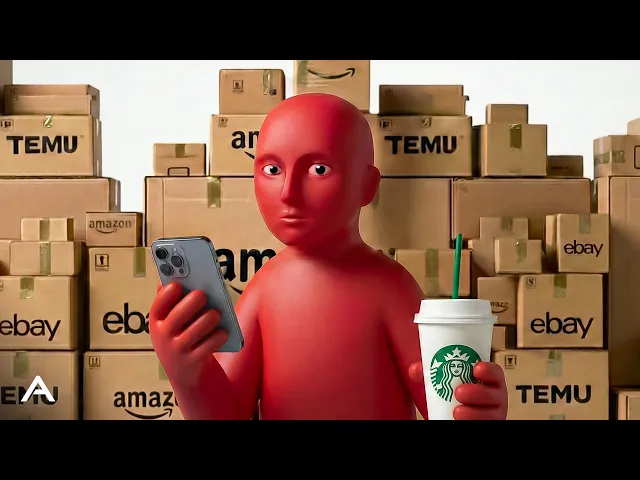
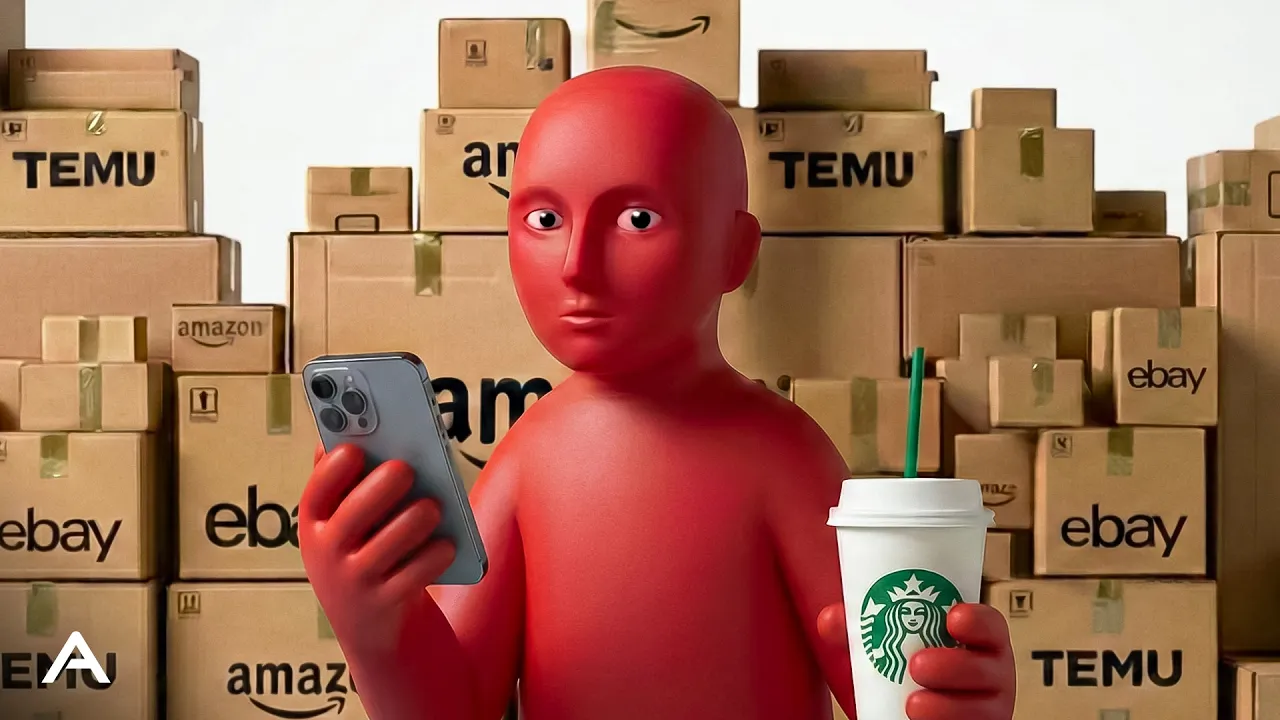
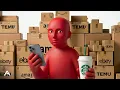
There's a strange feeling hanging over modern life, a quiet heaviness that follows us around like humidity in the air. You can sense it when you scroll through Tik Tok shop late at night or when you open a package from Amazon that somehow arrived only 6 hours after you ordered it. You can feel it when you walk into a store and everything looks shiny but also crappy, brand new, yet weirdly outdated.
It's the feeling that everything around us was made quickly, sold quickly, consumed quickly, and forgotten even faster. We live in the golden age of overconumption, hyperconvenience, and slop. The perfect conditions that have created what I call slopsumerism.
What happens to society when everything we produce is designed to last as long as a viral trend? What happens when people become addicted to [music] endlessly buying crap to fill the cracks in our lives caused by the very same system that we're funding? The word slop has been everywhere recently.
I've been using it a lot. It was originally used to describe random scraps of food thrown together and fed to pigs. slop eventually became a way to describe the terrible AI generated content that we've been seeing.
The absurdity of many AI images and videos had that same feeling of random bits and bobs of rubbish mashed together for quick, thoughtless consumption. It looked low effort, lowquality, and strangely hollow, like something produced at high speed for an audience that never really had any intention to look too closely at it. But the idea of slop has grown far beyond AI content.
People started noticing that slop describes a much larger pattern in modern life. Like this video that talks about thoughtless slop food bowls. Uh, people now use slob to describe almost anything that feels cheap, rushed, and disposable, like clothes that stretch out after a single wash cycle, cheap furniture, flimsy tools, novelty gadgets that are bought without much thought and tossed out just as quickly.
And unfortunately, this kind of slop has become way more than just products. It's become a system. It starts with creating the demand.
The average person sees hundreds of advertisements every single day. Every waking hour of your life, you're being nudged, poked, and pressured by a neverending wave of messages telling you that the next purchase is the one that is finally going to make you happy. That that the thing you own is now outdated and you need to upgrade it.
that your life would be so much easier, and you personally would become so much more attractive, more productive, and generally happier if you just added that one item to your cart. And this constant pressure creates a kind of background hum in your mind. [music] You might stop actively noticing the ads, but your brain is still absorbing the messages.
Your attention is constantly tuned towards desire, so it becomes a reflex. You start desiring things even when you don't really want anything specific. You're just stuck in a cycle wanting constant upgrades, improvement, [music] and novelty.
This is how the system builds you into a perfect consumer. It teaches you to chase the next micro hit of excitement that comes from buying something new. It teaches you to believe that satisfaction is always one purchase away.
And when this belief becomes normal, companies gain the freedom to lower quality without ever losing customers. You've already been conditioned to move on to the next thing already. Reality feels solid until you start paying attention to the things happening just outside of your field of view.
The systems watching, sorting, and shaping your life without ever announcing themselves. It's strange how much of our world is influenced by forces we never directly see. And once you realize how easily the smallest traces of your life can be captured and used against you, the whole picture starts to feel unstable.
Which brings us to something very real, very present, and very much worth paying attention to. Your name, your income, your family, even your personal struggles. Data brokers collect these fragments of your life and package them into lists that are sold to the highest bidder.
Some of these lists have genuinely disturbing labels like tough start, young single parents, and rural and barely making it. Categories that target the most vulnerable in society. We are all being sorted into boxes that predatory companies and bad actors can use to identify and exploit us.
This is one of the biggest tragedies of the modern algorithmic systems that we all live under. They're invasive and they're dangerous. Incogn was built to fight back.
Incogn automatically removes your personal information from the places that you can't see. Data brokers, people search sites, predatory directories, all the hidden corners of the internet where your identity is quietly being traded for profit. Doing this yourself could take weeks or even months.
But incognles automatically and continuously, keeping your data out of the hands of bad actors. And with their new custom removals feature, you can take it even further. Just Google yourself, find a site exposing your information, copy the link, and Incogn's privacy experts will work to have it removed, even from sites outside their automated network.
Your data shouldn't be their currency. It should be yours, so take it back. Go to incogn.
com/apperted and use the code aperture deal to get 60% off an annual plan and keep your information out of the hands of the people who want to harm you because they can't harm you if they can't find you. Now back to our story. The next cog in the system is convenience.
The truth is that nature follows the path of least resistance. Water flows towards the lowest point. [music] Roots grow where the soil is softest.
Animals choose the safest and simplest route to reach food. Every living system conserves energy whenever it can because doing so increases its chance of survival. And this shouldn't be a surprise.
Humans follow the same rule. If there is an easier option, we usually take it. We choose the escalator over the stairs.
We microwave dinner instead of cooking from scratch. We watch whatever the algorithm autoplays instead of searching for something new. [music] And none of this is laziness.
It's just how our brains are wired. Our default setting is to save energy, reduce friction, and conserve effort. And companies, well, they understand this deeply.
They know that the more steps something requires, the less likely people are to do it. They know that hesitation kills purchases. So, so they built an entire infrastructure designed to remove effort from the buying process, one-click ordering, saved payment info, autofill, sameday delivery, recommendation algorithms that send you push notifications at the exact moment your willpower is lowest.
You never have to exert energy. You never have to pause to think before you purchase something. You never have to confront the weight of a decision because the system makes every decision feel as light and as breezy as possible.
And this is the real power of convenience. If you're tired, stressed, lonely, bored, or distracted, ordering something will always feel like the easiest way to make yourself happy. It doesn't demand anything from you, and it rewards you instantly.
You don't have to walk to the shop to get something like you would have to in the past. And you don't have to wait weeks or even months before getting a delivery. Once buying becomes the path of lease resistance, it also becomes the default behavior.
But all of this convenience hides a growing problem. The third part of the perfect slopsumerism system, planned obsolescence. Planned obsolescence is the strategy of designing products with intentionally short lifespans.
Essentially, what you get is products that break sooner, decay faster, or just generally become dysfunctional long before they actually should. Products are also intentionally made to be difficult [music] to repair. So, once they go bad, the easiest choice becomes purchasing a new one.
People are buying more than they ever have before, yet they're getting less in return. There's a a quiet joke hidden in daily life. A sense that everything around us feels a little bit worse than it used to.
Uh clothes fall apart after a season. Appliances break too soon. Tools that lasted decades from previous generations, crack and malfunction after just a few uses.
Even established brands, the ones that once symbolized craftsmanship, have lowered their standards. Shirts are thinner. Zippers snag more often.
Shoes peel. The tag might still say the same brand name, but the object in your hands often feels different, cheaper, and [music] more disposable. And the numbers prove it.
Americans now buy around 68 new pieces of clothing every year, compared to around 12 pieces in 1980. Yet, they keep each item for only half as long. We are consuming.
You can follow me on this one. 60% more clothing, but each garment is [music] designed to fall apart faster or at least go out of fashion and end up in a landfill. Planned obsolescence pairs perfectly with convenience.
If buying something new feels effortless, you barely notice the moment where the quality slips. So what? Your shirt falls apart.
You can just order another. A charger breaks, just grab a replacement. A blender burns out.
Well, with one click of a button, you have a new one on the way before you can even process what happened. And the system depends on this. If products were durable, companies would make fewer sales.
And well, we can't have anything happened to the shareholder profits now, can we? So instead, products are designed to sit right on the edge of acceptable quality. Good enough to buy, but not good enough to last.
Planned obsolescence completes that loop. Demand pushes that you want. Convenience pushes you to buy.
Obsolescence pushes you to repeat the process again and again, each time without questioning why the object in your hands feels worse than the one that you grew up with. If you want to understand why society became addicted to buying slop, you have to start with the values beneath the surface. The worldview shaping our decisions, the beliefs shaping our habits, and the quiet cultural forces that whisper in our ears long before we even think about clicking a buy button.
Slop didn't just appear in our lives. It grew out of an ideology that shaped the modern world. That ideology is hyperindividualism.
[snorts] It's the belief that the individual self is the center of life. That personal fulfillment through personal achievement is the highest value and that everyone is responsible for building their own destiny. And on paper, sure, this sounds empowering.
It sounds like freedom. But when a society pushes individualism to the extreme, something shifts. People begin to prioritize personal gain over community.
Wealth becomes a measure of success. Status becomes a symbol of identity. And everything that symbolizes these things becomes important and almost sacred.
In this environment, material acquisition becomes more than just a hobby. It turns into the primary way that people [music] perform their identities. It's the clothes you wear, the tech you own, the brand you display.
These become the cultural badges that tell the world who you are and what you've accomplished. Sociologists have talked about a rise in narcissistic traits over the last few decades. A cultural pattern where more people report feeling special, deserving, and superior, even when those feelings are really built on shaky ground.
It's a symptom of a society that encourages self-focus at the expense of compassion. This dynamic is also woven into the architecture of capitalism. Market systems rely on individualist philosophies.
They rely on the idea that people freely choose what they want and that the market simply reflects those desires. If you choose something, that means you wanted it. If you want something, that means you should be free to buy it.
And if you buy it, that is proof that the system is working. This circular logic is what's keeping the engine running. The problem with this logic is that it ignores the emotional forces behind consumption.
Many purchases don't come from a genuine desire. They come from insecurity, loneliness, boredom, social pressure, impulse or habit. A society built around consumption creates those emotions and then sells the cure.
When emotional needs are hard to fulfill, the passion to connect gets replaced with the passion to possess because objects are easier to acquire and maintain than relationships, or at least the good ones. People don't always shop because they want an item. They shop because they crave a feeling.
When you buy something new, your brain releases dopamine. Boom, boom, boom. Creating a small wave of excitement.
The anticipation alone feels energizing. That package arriving feels rewarding. The unboxing feels like an event.
But once the moment fades, the object loses its shine, and that cycle just begins again. Shopping can then turn into a coping mechanism. It's a quiet attempt to fill a hole that the object itself was never designed to fill.
This is where addiction forms. It's not that people want more objects. People want more moments of anticipation, more sparks of pleasure, more emotional boosts.
The thrill of shopping drives the purchase more than the product itself. Many people don't even care about what they're buying. They care about the feeling that buying gives them.
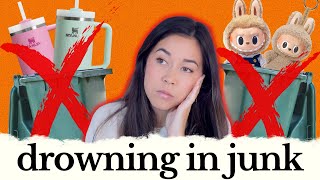
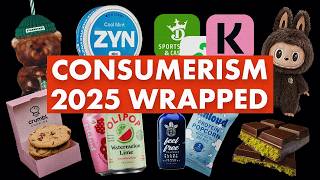
Nowhere is this more in evidence than in hype-driven slop mania. [laughter] I know, I know I'm using a lot of weird words in this video, but the words just perfectly describe the concepts in my head. Okay, so how would you describe the Starbucks barista trend or leoos?
Well, exactly. It's sloppia. You're going maniac over slob.
Back to my point, though. These cups were intentionally released in extremely limited quantities with each store only receiving about 2 to seven cups each. This scarcity was deliberate, by the way.
It triggered a psychological response that blended excitement, status, and FOMO. All of these had people lining up at 3:00 a. m.
in the morning to get a $30 cup with a Starbucks logo, where there's an identical looking cup just without the logo selling on Amazon for $2. As if the price wasn't crazy enough, some people were able to resell it for up to $500 for a cup that looks like you can't even wash it properly. And it works because the cup isn't the product.
The feeling of owning something special is it's a status signifier that you're dedicated enough to get the cup that you belong in the in [music] group. That's why almost everyone who got the cup made videos about it and then shared it online. This product launch was so good that it completely obliterated all of the negative press Starbucks has been suffering from recently.
[music] From the boycotts to falling profits and their unionized baristas threatening to go on strike due to terrible pay. All of that was completely overshadowed by people crying about not getting a plastic cup. Yep.
Meanwhile, those same underpaid baristas were forced to manage crowds of customers who were angry, impatient, and obsessed with getting that same little plastic cup. This dynamic creates a strange paradox. People develop emotional affection for brands, logos, and objects, but not for the workers producing or selling them.
A corporation can cultivate loyalty so strong that customers defend the imaginary brand over the very real people they can literally see behind the counter. This is why slopsumerism needs hyperindividualism to function because lowquality products cannot exist without workers being mistreated. You need to make people feel like they're only responsible for themselves and weaken the overall sense of community and camaraderie.
Which brings us to the next question. What does all of this actually cost us? What does it cost financially, socially, environmentally, and emotionally when an entire society is built on fleeting experiences and disposable products?
At this point, the shape of the slop cycle becomes impossible to ignore. You can see how psychology fuels it, how the system engineers it, and how culture defends it. But to understand why this problem matters, you have to understand the true cost implications of it both on us individually and collectively as a society.
Because slop doesn't just clutter your home or drain your energy. Slop takes something from you. It takes time, money, stability, peace, and in many [music] ways, your sense of self.
But let's not get ahead of ourselves. First, the financial cost. Americans spend an average of $18,000 each year on non-essentials.
That number includes impulse buys, subscription boxes, retail therapy gifts for yourself, late night delivery orders, and products purchased simply because the ads were persuasive enough. That's enough for a down payment on a house or a huge chunk off your college debt. The average person spends over $100 a month on impulse purchases, nearly $100 a month on subscription boxes, and more than $170 a month on takeout and delivery.
These expenses are not luxuries. For many people, they have become normal. When you look closely, it becomes clear that the majority of that money is not being spent on quality, but on convenience, repetition, and emotional comfort.
This lifestyle creates a financial trap. Even people earning six figures report living paycheck to paycheck. Around 60% of millennials making $100,000 or more say that they cannot build savings because the cost of living combined with the constant pressure to consume keeps draining their accounts.
When consumption becomes so easy, people stop noticing how much they're spending. With one tap, you can pay for anything you want without having to physically part way with the cash. You also now have buy now, pay later services like CLA and Afterpay that makes it even easier to buy things you don't need with money you don't have.
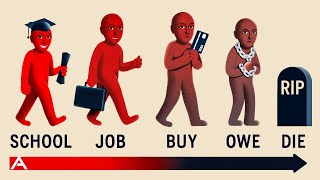
This dependence on buying keeps people locked into work schedules that exhaust them. If you always feel like you need more money to maintain your lifestyle, you can't slow down. You can't rest.
You can't step back from it. The cycle of consumption and labor becomes a self-reinforcing loop. You buy because work is stressful, but you have to keep working because you buy.
The machine keeps running because there's no time to question any of it. The environmental cost is even harder to escape. Slop is designed to be disposable, and it ends up exactly where all disposable things go.
Every year, Americans throw away around 81 lbs of clothing and textiles. Multiply that across the world and you get mountains of waste that grow so large they become visible from space. One of the most haunting examples is the clothing pile in the Atakama desert which grows by nearly 40,000 tons each year.
It's become a symbol of our global appetite for cheap, fast, lowquality fashion. The kind of fashion that lasts a few months and then sits in a landfill for centuries. And plastic waste, well, that tells us a similar story.
Americans throw away 26 million tons of plastic every year. Many of those plastics come from clothing because synthetic [music] fibers like polyester shed microlastics every time we wash them. These fibers never fully break down.
They settle into water, soil, animals, and eventually into our own bodies. A modern fast [clears throat] fashion shirt might only last 6 months on a hanger, but it'll stick around for 600 years in the earth. And behind all of this waste is something much darker, the human cost.
The labor that fuels slop is built on exploitation. Most affordable consumer products are made in factories where people work long hours, often more than 75 hours a week, for extremely low pay. Many of the workers are exposed to unsafe environments from toxic dyes to unstable buildings.
Factory collapses and fires aren't rare. They happen because companies prioritize profit and speed over human lives. For the consumer, the result is a cheap shirt or a trendy gadget.
For the worker, the price is much higher, sometimes the ultimate price. And slop depends on this imbalance. It depends on distance, on invisibility, on the idea that the person making the product is so far removed from the person buying it that the human cost becomes easy to forget.
When companies chase the lowest wages possible, they move production wherever regulations are the weakest. The system is designed that way. The harm flows outward and the profit flows upward.
The people at the top, the ones with the most wealth, also cause the most environmental damage. A single private jet flight by 1 billionaire can produce as much carbon in 90 minutes as an average person produces in an entire lifetime. Their consumption is extreme.
But because wealth shields them from consequences, the harm spreads to everyone else. Hyperindividualism magnifies this gap. Because when a society values personal gain above all else, it rarely questions the impact of extreme wealth on the world.
In [music] a system built on slop, the people who benefit most are the ones who consume the least in terms of necessity but the most in terms of luxury waste. The people who suffer the consequences are everyone else. So the question becomes, how on earth do you get out?
How do you break a cycle that's been so normalized? How do you step back from a culture that sells you the idea that buying is living? Well, the escape begins with choosing yourself over products.
It begins with remembering that your life is made of experiences, relationships, memories, curiosity, and creativity, not objects. Living simply is not a punishment. It's a reclaiming.
When you remove the noise of constant consumption, you create a space for peace and clarity. You create a space for love and connection. You create space to feel whole without needing something new to validate you.
Minimalism doesn't mean owning very little. It means owning intentionally. It means choosing items that last, repairing what breaks, and focusing on durability instead of novelty.
[music] It means resisting the urge to fill emotional gaps with purchases instead finding healthier ways to soo yourself. It means valuing time more than trends and valuing experiences more than displays. One of the strongest ways to break the cycle is to buy with intention.
Instead of grabbing the newest thing because it's easy, focus on objects that you know will stay in your life for years. Choose natural fibers. Choose products that you can repair.
Choose items that serve a purpose rather than signal a status. and learn to care for what you own. The more you maintain, the less you replace.
Another strategy is to shift your focus from products to experiences. Instead of giving people objects for birthdays or holidays, give them memories, share a meal, attend a concert together, or go on a small trip, write a letter, uh create something together. Experiences build connections in a way that objects can never match.
And advocating for the right to repair is also crucial. Many states have begun pushing for legislation that requires manufacturers to sell parts and tools, making it easier for consumers to fix their own devices instead of just tossing them away. Repair culture slows down the consumption cycle and it empowers people to keep what they own instead of discarding it.
Most importantly, question the narrative. Every advertisement, every trend, every drop, every seasonal release is designed to make you believe that excitement comes from buying. And you can break this spell by finding joy in things that cost nothing.
Go outside. It's free. Call someone you love.
Cook something, read something, create something, rest, wander, think, touch grass. There's an entire world beyond the checkout page, and it becomes easier to reach when you stop running on the treadmill of desire. Now, slop isn't going to disappear when you stop buying it.
The system will remain, but your relationship to it can change, and you can stop feeding it. You can stop letting it shape your identity. You can step out of the cycle and into a life that feels fuller, calmer, clearer, and more grounded.
Because the truth is always simple. A society addicted [music] to slop is a society that has forgotten what matters. But individuals don't have to forget.
And you can choose a different path. And when enough people make that choice, the balance and power begins to shift. Companies notice, standards rise, and communities strengthen.
And maybe, just maybe, the world becomes a little more sustainable, a little more humane, and a little bit less shaped by disposable living.