all right welcome to video seven of unit four we're talking about Oceanic Oceanic Island so how does Oceanic Oceanic convergence cause Islands during this video what I want to Mo you to most notice is essentially how similar Oceanic Oceanic convergence islands are to oceanic continental mountains once again it's primarily a naming issue okay so like um like Continental Oceanic convergence the volcanoes uh will form the islands and or volcanoes will form on the less dense plate of the less dense plate side of the boundary so in this case with oceanic crust it's going to be
that old younger warmer plate okay so you can always tell which plate is older and younger by the den by the um where between if you compare with the plate boundaries and where the volcanoes are you can always see that the volcanoes are forming on the less dense plate okay just like um just like Oceanic convergence you're gonna get a linear pattern of volcanic islands that are parallel to the plate boundary and the trench but perpendicular to the plate movement in this case the islands are going to be primarily mafic because once again it uh
the less dense plate is oceanic and so oceanic crust the less dense oceanic crust is going to produce less dense Oceanic mafic magma which will produce mafic um uh volcano side note I'm using less dense method because I'm comparing it to more dense mavic so in this case it's just comparing two mafix so it could have a less dense and a more dense nafic okay once again compared to a continental crust they're all more compared to Old Continental felsic rock it's all more dense okay um so naming convention an island in most cases is just
an underwater Mountain that is taller than the water is deep okay so what is essentially a line of volcanoes we call Islands because the very very top of the volcanoes are taller than the water is deep and then we get land at the surface so realistically if I took let's say uh oceanic continental Collision where I'm getting these volcanoes on the continents and I flood the continent right so let's say water sea level rises by 600 feet um sea level rises by 600 feet then those mountains which were on land would now become Islands because
the water is deeper and surrounding the volcanoes would now be ocean would be ocean same thing in Reverse if I took these volcanic islands and I drained the water we and like I made the water level super low we would now just call these mountains so it's just a matter of where the water is in in relative to the height of the volcano so once again I looked at this cross section before I have a trench so this is my Pacific Plate um this is my this is my Philippine plate I'm pretty sure Filipino Eurasian
plate I forget the exact location of this doesn't matter in some ways this plate is denser it subducts remember the trench and the plate boundary are running in and out of your screen and so I get a line of volcanoes that are run in and out of your screen okay so the the plate boundary and the trench are parallel with the volcanic island so the buff so I'd get a line them now once again this like Guam is just the very top of a volcano and in that case the top of the volcano is above
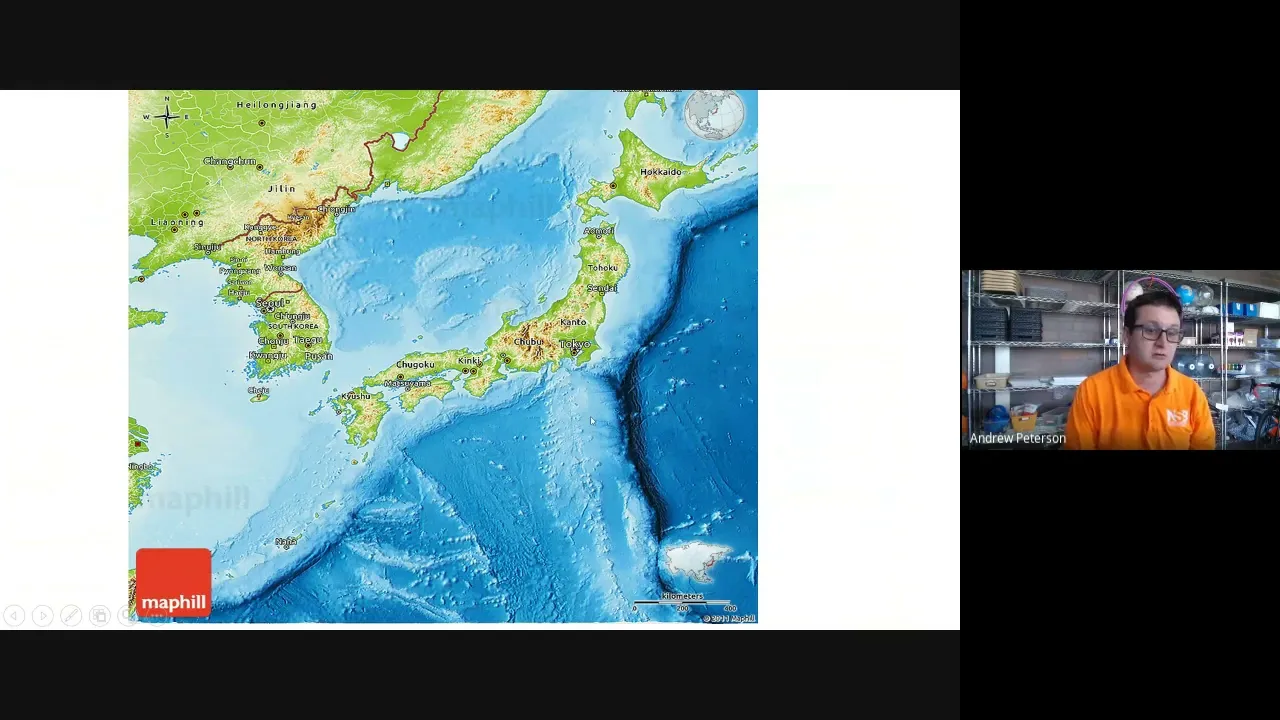
the water so we call it an island it's just a naming convention because once again we're not the greatest at naming things for multitudes of reasons I wish we were better but we're not okay so once again looking at our Japan example here so once again I have the Pacific Plate subducting under the Philippine plate and the Eurasian plate and I have the Philippine plate subducting on the Eurasian plate all these at this point are oceanic crust so Oceana crust oceanic crust oceanic crust so in general the Pacific Plate is the oldest and densest the
Philippine plate is like middle and then the Eurasian plate has the dense or the least dense oceanic crust as it subducts down I get these line of volcanoes that are um that are parallel to the plate boundary these line of volcanoes are now tall enough that they come above sea level and then we now call them um Islands so Mount Fuji in um in Japan is a very famous One Mount Fuji is actually a mountain it's just the very top of this much larger volcano that is in which if you were in Japan you would
call both in in makes the island but there's then also so tall it also makes a mountain on top of the islands but in theory there's no geologic difference between the island and the mountain on the island because it's one large continuous volcano okay one thing I want to point out about this is if I use my Island change to the South uh South and Southwest of the so if I use like here so I get these little Islands these little green dots that dot the water but please note that they're part of this longer
chain okay so I have all these little Islands but I'm just beneath the surface I still have this area of the ocean that is shallower okay so just beneath the ocean I get this line of um I get this line of what is shallow water in line so I get like here island island island island island island island island island island island but connecting them is a shallow water if I drop the water level it would be one Long Tall structure so even with like uh the the northern Island and these Southern islands of Japan
and if I drop the water level Japan wouldn't be these multiple Islands it would be this one Long Island um which is some low spots in between once again the water level is the determining Factor okay so um yeah so once again I just want to point out the amazingly similarities between oceanic continental collisions and oceanic Oceanic conversions so here where I have the oceanic subduct under the continental crust or Continental lithosphere I get magma Rising that produces a volcano here I get the same thing the volcano in this case is called an island well
the volcano in this case is called an a mountain so subduction causes a volcano subduction causes volcano line of islands because the volcanoes in the water line of mountains because the volcanoes are on land and once again these islands are connected all by shallow water it's just occasionally the land gets high enough that it's above the surface of the water and if I drop the surface of the water it would be one long high spot just like the mountains aren't continuously long spot lastly once again Trench plate boundary volcanic line volcanic line trench plate boundary
are all parallel in this case in and out of the screen well the plate movement is perpendicular to that


![UCF Professor Richard Quinn accuses class of cheating [Original]](https://img.youtube.com/vi/rbzJTTDO9f4/maxresdefault.jpg)