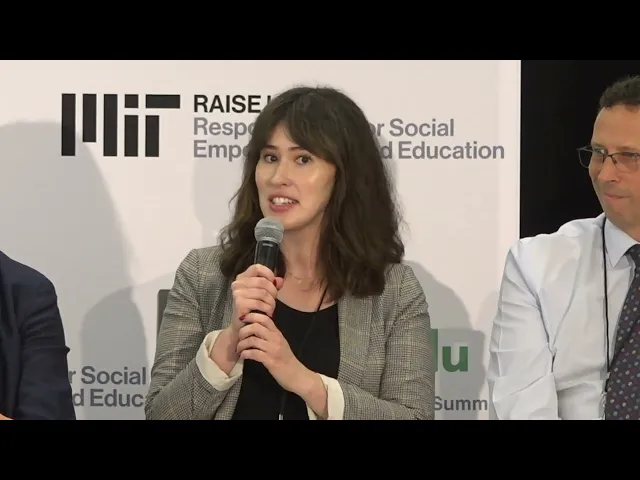
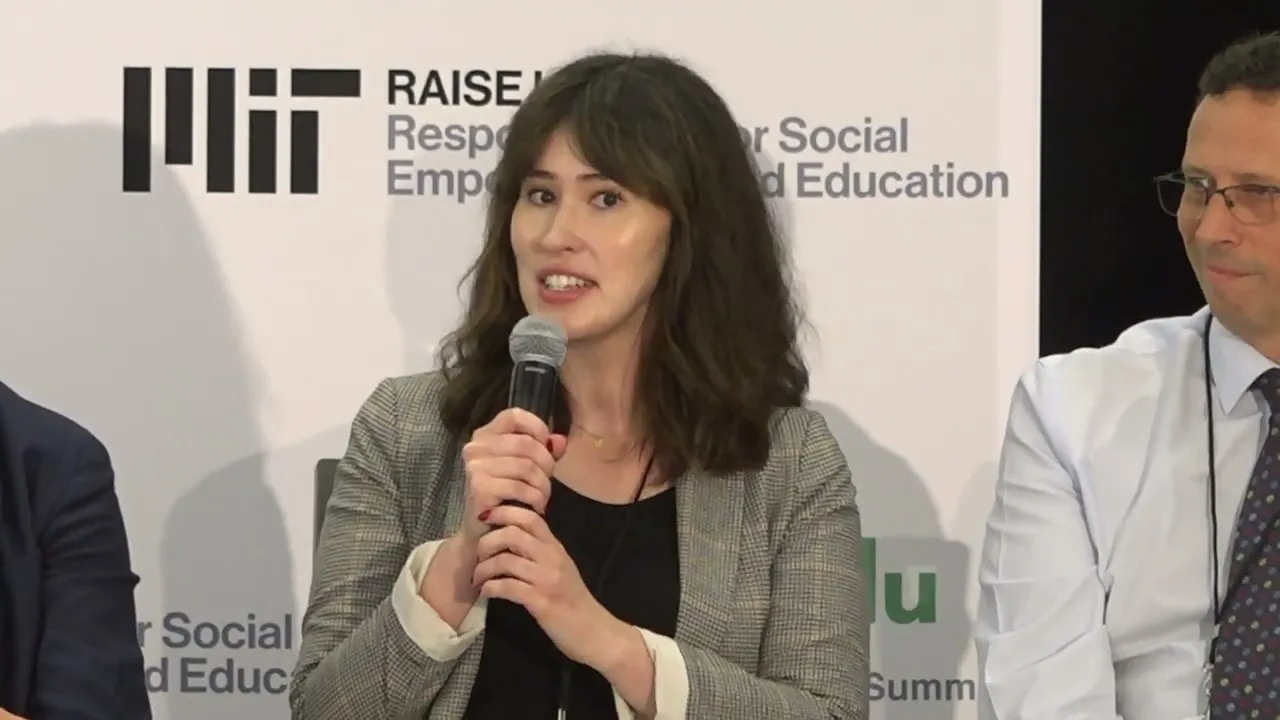
So we have a wonderful panel this morning on AI and education with a really great diverse set of panelists here who represent different roles, different countries, different perspectives. So I'm really excited about the conversation. I'll start off by asking each of you just to spend one or two minutes tops just to briefly introduce yourselves and to talk about what your experience over the last year has been with AI and education. So we'll start with Karen. Audio? There we go. Hi, everyone. My name is Karen Lang, and I am a curriculum developer for Technovation Girls. Technovation
Girls is an organization that runs a global challenge annually for girls where they have to solve a problem in their community and then make a mobile app to solve that problem. So I have been developing the curriculum, and a lot of our curriculum involves AI and the use of AI in solving problems. And I will pass it on to you. Hi, good morning. I'm Rob Hitchings. I'm vice principal of Dubai Heights Academy from the United Arab Emirates. We've been working in collaboration with MIT over the last four years on the [INAUDIBLE] project. So we've lots
of experience of doing various projects using AI in the curriculum. Hello, I am Heather Herring. I work at the Indiana Department of Education's Office of Digital Learning. In the past year, we have supported educators across the state in professional development related to AI, as well as a pretty large scale pilot that my colleague Matt White and I will talk about tomorrow. Hello, everyone. I'm [INAUDIBLE] Thompson, head of educational impact communication. I was past previously vice president of the Legal Foundation, where we supported and worked closely with MIT Media Lab, and I was a researcher at
MIT Media Lab 20 years ago. So it's fun to be back. I think a lot about and use AI in my everyday life right now. I'm really excited about some of the opportunities presents, and then I focus a lot about how we develop new AI applications as part of our legal portfolio. And I spent a lot of time speaking to educators and visiting schools to figure out ways we can support them. My name is Rosanna Wong. I run the managed schools in China and Asia, the Herald Education outside of Harrow on the Hill in UK.
And last year I started doing the curriculum for my schools on AI, and after finishing the digital curriculum, now we move on to AI curriculum. That's why I have a lot to learn from every one of you. Hello, I'm Nikki. I work at Google.org. There's a lot of ways in which I support our initiatives as a learning experience designer. Specifically, how many of you all have used Teachable Machine? So I'm creating workshops to make sure that more both teachers and students are able to use Teachable Machine to create their own machine learning classification models. I'm
also thinking about how folks in the nonprofit sector are using generative AI, so I'm working on a project with Goodwill, the Red Cross, Raven, thinking about what does it mean to have folks doing incredibly mission-oriented work using AI tools to support that work. So whether it's young people, whether it's folks in the nonprofit sector, I'm excited to use my experience as a software engineer and teach her to think about what those learning experiences are to get people both excited but feeling competent about AI and AI tool use. Great. Thank you. So as we talk about--
as we talk about AI in education, it means many different things to many different people. So I was just wondering if maybe a few of you could point out what do you think are some great examples that you've been a part of or seen recently that point the way forward for where you think AI in education is going. I can start. Hello? So earlier, Hal talked a little bit about constructivism and I think being at MIT and realizing the impact that Seymour Papert had on the constructivism moment and thinking about AI as a tool. So
what can students create with that tool that's personally relevant to them? And so when I was at the Computer Science Teachers Association Conference last week, I did a workshop on Teachable Machine, and it was amazing to think about how are we using AI in combination with physical computing for students to create something that's meaningful to them. And there was a teacher from Indiana that said last-- two years ago, students created, using Teachable Machine, a model where the classification could understand if someone was wearing a mask or not. And if not, they hooked it up to
some servos, and it would read-- the robot would reach into a box and pull out a mask. And so when we think about AI, we're really just thinking about a tool to create personally meaningful projects. And thinking about that I think is a really good lens to think about AI in education as just a tool for students to construct meaning. For me, AI and education has got three major strands to it. It-- not just for the students. It's for the teachers, but it's also for the administration. And as are within my school, we're looking at
ways that we can leverage the power of AI to enhance the experience for the students, develop the skills for the teachers to enhance the education for the students as well, but also for the administrators to find more efficient ways that we can use technology to leverage us. We all feel the fears and the benefits and the negatives around AI, but to me-- I'm a bit older than a lot of you in the room-- I look back when computers first came into education, and we were all concerned about the impact that was going to have on
education. Then we had the internet coming into education, and this I believe is still another tool that we can use to leverage and develop education further. From my point of view, AI and education can be several folds. First of all, even for school management and school campus management, for example, there's a lot of things related to AI, not only robotics but a lot of them. So we are actually looking into investing in how AI can be help in the entire infrastructures of school management and also AI inside of the classroom, outside of the classroom, student
performances, how to monitor student performances, gather data, data analytics, and all that thing. In the past, we use a lot of this on manually even if we use digitally but is not from an AI point of view. So I think we need to review the entire use of AI to what exactly-- to make education more effective inside and outside of the classroom. If-- no, no, you shouldn't feel obligated to answer this question. I'll have others, but if you would like to answer, please do. My next question is, as I talk to educators, many educators are
scared about AI. Many are confused about AI. Many are excited about AI. Many are all of the above. What should educators be doing to prepare themselves and their students for the future of AI? Play with it. I think that's the real best way to understand things, to experiment, to try it out, obviously, in safe ways. Don't share your own personal data and so forth. But I've had a lot of discussions around what AI could do and what it might become, but as soon as you try it out, whether it's a generative AI or you try
to do like teachable machines or something like that, you figure out what the limitations are and what opportunities are also. So it does require some upwards leadership I would say from educators. It is to say to school principals and so forth we actually need time and permission to try these tools because-- but it is the best way to try the boundaries of it. And then I would say also try to give more choice to students. There's actually many ways we can learn from how students are using these tools and what questions they ask and where
they find information and the way they experiment. So I think that would be my starting point. I think also another aspect I think experience is really great. Playing with the tools. It's definitely key but also going beyond the tools I think within the edtech space. There's such a focus on the tools themselves and not so much on the more unfun aspects, depending who you ask. I think ethics is fun, but not everybody does. But that's definitely a key component. So I think building a background on what responsible AI can look like in the context of
education but also beyond and getting familiar with-- reading terms of use. I know that's not fun, but it's definitely key, especially as more companies pop up and come out of the woodwork without a lot of testing. One thing I want to just echo what you said about leadership and I think that leadership is a very important point, particularly from a school setting level, and you need leaders who buy in that AI is possible, is needed, is-- it's functional. And I think that if we're able to have the leader and the middle leaders all buy in
and let them play with it and then don't just scare them. There's no right or wrong, but I think the most important thing is that once the teachers and educators feel that they have ownership on this one, and I think that things will be much easier than you impose something from the top to the bottom. And I'll just jump on that with playing with it and embracing it. So with Technovation, we encourage the girls to use generative AI in their ideation, in helping them to write scripts for their videos in the coding, so embracing it
ourselves, playing with it as a curriculum developer. I use ChatGPT to help me along. So we all use it, and so to show girls and young people it's OK to use AI and it's going to help you. Well, you had that great slide earlier that showed the different skills that businesses are looking for now. How do you think AI is changing the kinds of skills, dispositions, knowledge that they're looking for and how do we help prepare kids for a world where those things have changed? I can make a start on that question. I think everyone
agrees that's the most important and probably agreed for decades right now. But what's shifting is because AI can do much of the standardized assessments and be able to use it as a better benchmark for what our capabilities should be, I think we're seeing a shift now much more to that kind of skill set of creativity and curiosity and critical thinking. So I think that that question from a policy point of view, what are the key success parameters for education, will be important not because math and language is not important but because you achieve it better
by being curious and creative and a critical thinker and collaborative. So I think that shift will come right now but we require that kind of flexibility and more holistic thinking about what the education outcomes are. And then I think we can move that faster now. AI in education is here to stay, and I think one of the priority things that we have to do with our students is teach them to be appropriate users and the ethical kind of things behind AI as well as understanding about bias. When the internet-- I was a computer teacher for
many years, and I remember when the internet first came out, we always just took teaching our students not to accept the first thing that the internet gave us, what Google gave us. And I think it's repeating itself again, and we have to work on ensuring the students are ethical users and appropriate users of technology going forward as well as giving them those skills and that exposure to all the exciting apps and platforms that there are that involve AI. I think one thing that change-- you asked about what kind of skill set probably would change a
student with AI coming in. I think because we are living in a stage of information-- it's flooded with information. There's so much information-- you don't know which is which and which are important, which are less important. But AI will-- I think one thing that changed the mindset a lot of young students that they need to know how to ask question. Asking questions is not only know how to find a solution. If you want to find an effective solution, you need to know how to ask and so how information is being sourced and therefore how information
being classified and so on and so forth. I think this is a very new learning and new training for a lot of student, using if they know what kind of question they asked and therefore leading on to them to find the appropriate solution. I think it's also about students being learning how to take risks in a controlled environment so that they can learn to make mistakes but it's within a controlled environment where the teachers are there to support them and they understand. And that helps drive their innovation and their creativity as well. My colleague Scott
Osterweil labels that the freedom to fail, which we often don't have enough of in school. And I also think learning how to build your own machine learning model is a good skill to have, to not just accept the models that are out there and the data sets that are out there but to build your own data sets and then learn how to build a model so that you can create things on your own terms, not just what's out there. Actually, I quite like the idea earlier that I think, Cynthia, you talk about co-design. There was
something that the researchers are working, how to make it AI is a kind of platform where you can co-create rather than always given as it is. And this exercise not only critical thinking, but at the same time, you have ownership of what you need and what you don't need. But I don't know how the research will continue to go, but I think that this is exactly the kind of work that is important. Once both educators as well as students feel that they have a part to it, they're not just take it as it is and
will be very, very different. If you are-- there's a lot of development in AI tools in education, both for creative expression as well as for tutoring and everything in between. If you were to give advice to people working in technology at the intersection of AI and education, what advice would you give them? I think mine's not dissimilar to what Rosanna just said and what Dr. Brazell was saying about co-designing. So what are the participatory research methods so that you're involving learners, parents, policymakers, learning scientists from the get go in your research and in the design
of these tools. And ultimately a tool is only as good as an outcome, so how are you thinking about evaluating outcomes? I think when you look at the history of computer-aided assistants and intelligent assistants, a lot of those missed the mark because there was never clear benchmarks on what learning outcomes those computer agents were trying to support students in getting. And so first of all, we need to think about what is it that we're hoping to support students with, how are we evaluating those outcomes iteratively, and how are we using participatory methodologies to make sure
that from the get go the voices of students, parents, teachers, policymakers are in our technology that we're using. And so when we think about something like Google's Gemini, DeepMind is actually creating learn LM, which is specifically a learning-- large language model, specifically for education, and by including those voices in it from the get go, we've seen that both educators and students prefer the generative AI responses from learn LM over the responses from Gemini because that participatory design process was in it from the get go. I would also echo the co-design and involving both teachers and
students from the start, but also if you are a leader whether in a state, in a school, if you are going to implement an AI program in any way, shape, or form, go and see what it's like, especially if you're a state leader where you are not in a school building, not in a classroom. Go see what it's like. Go talk to those teachers, to the students, and see how it's actually being implemented, what challenges they're encountering, how is the actual program going, what would they change, what would they keep because they're the experts. They're
the ones using it in the room, and that's-- in Indiana, that's what we've definitely tried to do. And I can probably add on that, co-creation and the community. We encourage our staff to be out there much more than we were in the previously. 99% of expertise is outside the company. It's in networks. It's in conferences and partners. But also that not only you go to test things in schools and with children and educators, but actually you volunteer much more. So you're trying to be out there. We're creating a volunteering program right now where we are
saying how can we be helpful to schools to learn actually what the situations are, what questions they have. So it's much more about bringing the societal purpose closer to the staff no matter where you are in the organization. Talking about what advice I would give, and I think one thing that Hong Kong is now heading on looking into the curriculum on AI, particularly from the government point of view. And I like the simplicity of that curriculum. It's not a very complicated one, but there's three levels. One is that you must get the awareness right. You're
aware what is AI first. This is a building of the right attitude, how you see AI. So the whole program, the first part of the curriculum is talking about awareness. You know what is it first. Don't talk about it. Don't reject it. Don't say no to it but get it right. And the second level they talk about the content. Now they don't overwhelm people about AI as if this is only expert people know about it. Ordinary people will not understand it. So they make the content very simple, easy to grab, and therefore, the teachers will
not reject it. And the third level, they talk about ethical issues, a responsible AI. And so the first and the third, it's all about attitude. If you get your attitude right, the content will be there. And then how to use it. You know what is it and how would it impact your learning, and therefore what is your responsible attitude at the end of the day? So then you are now swimming into what AI means to you, and then you are selective in the content. And I think this kind of curriculum, once it go into the
classroom, go into the school, they will not be scared. And then it's difficult to manage. And I think that this is the right approach, and actually who constitute this AI curriculum for the Hong Kong government is a graduate from MIT. I would also jump in again with there's great tools and tutors and that kind of thing you can use an education, but to look beyond that to what can these young people build with AI themselves. So get them excited about not just using AI as a tool but maybe using it as a tool to build
something that will help other people. I'll take that as a prompt for my next question. I'll skip over one. So but generative AI is based on statistical averages. So how do we get kids to-- empower kids to do wonderful and creative things with tools that are based on averages? I would just say they're-- if they're the ones building it and they're using it for something that's meaningful to them, they will get excited about it. And they will build things, and they will impact the world. I think also teaching them that that's what it's based on
is probably the most beneficial in the first step so they can know what the limitations are before they even start using it. And I would add to that I think it's important to recognize that our whole education system is based on averages and averages that doesn't fit anyone at all. So just beginning to understand where data come from and how it's used to inform the content it delivers is a very good starting point. But education is about creating new things. It's not about learning about what exists. So I think AI is a great starting point,
inspiration for ideas, for connecting to what already exists, but in reality, you still need to create your own ideas to create value for something that's meaningful to themselves or others. So it wouldn't provide that, but it provides an easier entry point in my mind. I'm sure you've all encountered various misconceptions about AI along the way. Students and teachers, colleagues, how do you-- what are some of those misconceptions that you've encountered, and how do we think as a community how we might start addressing those? A lot of people when they first approach AI nueva-- they believe
that what AI-generated things are always right. it's correct. It's right. But this is the perception is that because it's machine, it cannot go wrong. And all the information there will be-- I think this is the kind of perception in my view although a lot of experts in AI, but I usually put a question mark into it. And until I totally understand how they generate information and how at the end of the generated AI come out will be there. But there was a general perception that whatever they said is that-- is right. I think the general
misconception we meet with AI and many other things in learning science is that you need to be an adult and very skilled to learn something like AI. Actually there's a lot of basic things to play with AI, to play with machine learning, to play with training a little robot to that even young children understand very, very well. So actually sometimes children understand that complexity, that experimentation much better than adults. So I think the misconception that you need to get to a certain point to start to learn about AI, I think would be great just to
say, well, let's start to figure out how to classify food and do small experiments even as a young child with physical materials is a great starting point for more advanced forms of computer science AI. I think one of the big misconceptions about AI and technology is the fact that it's going to replace humans and take their jobs from them. But I think what people have to understand is it's going to create different jobs, and that's what we have to train the students of tomorrow to be able to do those jobs. And I think on that
note, also considering that it's a new thing, we saw that a lot in the field from teachers across the state saying AI is new. AI is new. We know it's not. Teaching Machines by Audrey Watters is such a great book, and it talks about the history of the teaching machine and how far back it goes and shows that algorithmic learning is not new and personalized learning is not new. I think another misconception that we should talk about as passionate educators is the types of people who write themselves into or out of creating machine learning models.
Again, at CSTA, there was this great analogy of thinking about artificial intelligence as you could either be snorkeling, swimming, or diving. A lot of people think that they're just going to be snorkeling. They're just going to be surface level using artificial intelligence. But we need to make sure that every student knows that they can be part of diving. And so really proud to support the work of Technovation when we think about gender representation, when we think of racial representation. I met a gentleman earlier who's from Kazakhstan thinking about the language barrier of what does it
mean to make sure that machine language models and tutorials are available across languages, for diverse learners as well. So thinking about including everyone in this conversation so that it's not just a certain archetypal person who's ready to build machine learning models but that we all feel welcomed into these spaces so that the models are more accurate and the more inclusive and that it's really like a creative, collaborative process to invite all of these people into the design of machine learning models. I didn't have a chance to go to CSTA. I'm glad you brought that-- I'm
glad you brought up that metaphor. It's a wonderful metaphor here. So maybe expand. There's a lot of diverse sets of learners out there with different kinds of needs, diverse sets of swimmers with different kinds of needs and challenges. How do we think about AI helping to address those challenges or even enabling them to express themselves perhaps in ways that they weren't able to before? Well, I think it does help, but there's a huge challenge right now that might support the-- just talk about, that the way it's standardized, and so forth actually has not been trained
on the diversity of any kind of backgrounds, no divergence or race, ethnicity, and so forth. So there's a huge need to build up the more data and training models for AI to be able to make more informed suggestions for that work. But what we have seen and what European Union has been doing is actually recognizing a lot of different ways that students and children can access content in new ways. So if you're not necessarily a very proficient reader, you can get it read aloud or you can find information new ways. You can-- if you're not
able to express yourself in as easy as many others, you can create an image so you can create a sound, a piece of music. So it definitely opens up many of these different pathways to engage with knowledge to express ideas and content. But it's still not like-- we would hope that I would know a lot more about the learning science and how to actually learn and what the interest in the backgrounds. So I think that needs to be a research focus, but there seems to be a good application for easy entry points to education for
many more users. For us, we're a school of 70 nationalities, and I think there's a place for AI that can help those students with language and turning it from speech to text or text to speech but also in personalizing the learning of those students because for some of them, they're very bright students, but their English is holding them back from accessing the curriculum. So if we can leverage the use of technology in AI to improve their English immersion, then they'll be able to access the curriculum a lot quicker and easier and make better progress. On
one of the site visits that my colleagues and I went to at a school that was implementing an AI tutor within several classrooms at one grade level, there were students-- there was a really high Burmese refugee population in this particular area, and there were students that were not speaking really any English, but they were able to use this tool at the same time as the students who were much more proficient. So they were able to do this both simultaneously while also getting up to speed. And an additional example that comes to mind, I used to
be a pre-K teacher in a really large public school district, and I had several students who had speech delays. And in a really large public school district that was really under resourced, they saw a speech pathologist maybe once every two weeks at best. So I think there's a lot of tools that could definitely benefit students like that so they could get practice in between when they see their speech pathologist in those longer periods. I think in addition to using some off the shelf tooling, I wonder-- I think there's a really good way for teachers to
think about working with generative AI to understand IEPs, so to understand what IEPs look like in practice, to take a lesson plan or a unit plan and say, hey, this is a unit plan I'm working on, can you evaluate it using UDL practices, and making sure that those universal practices are already indeed in the lesson plan. And if they're not, the teacher doesn't have to think about how to align them. Generative AI can support with some of that filling the gaps. Similarly, I think when we think about young learners with developmental challenges, we also don't
think you by the hard work of parents and how often parents have to advocate for their students to get the support services that they need. And so what does it look like a parent to work with a large language model to think about how to role play a conversation to get more resources or to understand how to read their own student's IEP? I think there's really interesting ways to think about even existing foundational models supporting and coaching both teachers and parents to make sure these students are getting what they need. I want to pick up
on Heather's point. The history of edtech is that it's favored the high resourced areas instead of the low resourced areas. We've heard the digital divide for many decades now. The digital divide has changed a bit in some ways. It's changed from something that's primarily hardware or technology based to something that's more teacher resource based. So what are actually teachers doing with that when it's in the classroom. How do we-- how can we make it different this time? How can we help address those gaps that we have between the privileged and the low resource schools. So
with AI, we don't increase that gap but narrow it. That's a really good question. In Indiana, the pilot that I mentioned, we were able to reach a really large number of schools, and, again, we'll talk about it more tomorrow. But over 100 schools were involved in our pilot, which connected teachers and students with AI tutors and AI intelligent tutoring platforms. So I think focusing-- we focused on the academic impact data and also looked at which schools aren't maybe typically going to be able to buy this themselves and try to reach the largest number possible and
really focusing on the more under-resourced schools as well. So I think building it into policy up front, especially if you're offering grants, the schools with a lot of money, they're going to be able to pay for those things regardless, so really prioritizing the other schools. I think it's also about working with in partnerships and collaboration with companies and research and getting them to invest in the schools as well that don't have that infrastructure. We also need to make a conscious effort in supporting the low resource school, particularly the teachers. If the teachers are not ready,
it's sometimes very difficult that you go inside the classroom. So I think the support should go to supporting teachers with this kind of low resource school. This is one thing. And secondly, you did mention about parents. Actually I'm very concerned. And a lot of the parents, if it is a more educated parents, they probably know what AI is. A lot of the parents who probably are not that well educated, they know nothing about it. So they usually would be the stopper. They stop the student from doing this, and they disallow them to use it. So
I think-- I hope that at the end there will be research in how are you going to facilitate educator but at the same time facilitate parents to understand and so that it would not be blocking for a lot of opportunity for students, particularly for low resource families and so on and so forth. So I think there's still a lot of things we need to do in order to bring in equal opportunities for the wider community. I would also say to make as many of these tools accessible by making them free. So I know with Technovation,
we have girls that using ChatGPT and then they want to distribute it as an app, and then they run up against a cost. And then that just stops them dead right there. So for education, if these big companies can somehow make it accessible at least in the education realm so that kids can get excited and then see their dreams to fulfillment. I completely agree, but I just want to add some of the big studies we did in South Africa or other places was around free use of technologies and access to apps and so forth. So
unfortunately many of these resources come with a lot of advertising and data collection and non-privacy issues and so forth. So it actually looks like now most can find a mobile phone in many of the places the LEGO Foundation is operating, but the things they download are very unsafe, heavily advertised, not very high quality. So I think definitely the way OpenAI is going right now, where it's free and accessible, it needs to be built on policies that really fulfill the ethics of what you-- why collect data at all and which collected data do you need and
be transparent on that piece because there's so much exploitation of data right now in these applications. So some policy guidelines and maybe some ethics in the companies itself to be transparent on what data that exists in their remit. I have one more question, and then I'm going to open it up to questions from all of you. Maybe if people can queue up here and we can give them a mic to answer to ask questions. My last question has you all come from different sectors, and I know the audience here comes from lots of different sectors--
higher education, PK-12 education, technology. How do we think about the most successful collaborations between these different kinds of sectors, and what's needed in those collaborations? I'm a strong supporter for collaboration because I benefited from collaboration. As I said, we don't know a lot of things if we do not depend on other people. So what I did is that because I'm in K-12 education, so I have built an online platform for continuous learning for all educators free. We don't charge them. It's all free. Now that kind of platform will then allow share learning. A lot of
teachers who are teaching in K-12, they have a lot of problem. They cannot find a solution. So they can go into the platform and then share learn and even collaborative learning with universities like MIT or what other universities that come in. They can have lecture. They can have-- So we must have an open platform for learning together and not charging them. And then at the same time, of course, it depends on whether-- this is to me is the most important thing where we can pick up bits and pieces from different body's brain. And I think
if you're interested, get a QR code and then join in with this platform of online learning together. The most successful collaborations we have seen is to help educators and help schools. Sometimes we think about schools should be changing and educators should be changing, but the reason that they're not necessarily engaged as much as they should be or could be is because they sit between a governmental district ambition and a parent expectation. So the collaborations that are public private where a district commits to this is about testing and trying out these technologies with the aim of
curiosity and creativity to fill learning outcomes and they actually bring the public awareness with them to parents to say this is how schools should look like, these are types of environments where they work with the community, then it helps the educators to actually to be much more engaged and supportive because they're getting the frames around it. O and companies can then provide services that fit into that. But I think that's a misalignment of what education should be, what the outcomes should be that sometimes conflicts between what education is able to do. So that kind of
district level partnerships would be great. Anybody else want to answer that one? I think as my colleagues have been sharing I think just the intentionality from the get go. And so, for example, I'm out of Chicago and working with Chicago Public Schools to understand, hey, have you all seen any of the amazing AI curriculum that's out there for high school students. If you've seen it, what do you like about it, and what do you wish there also was? And we were able to set up listening sessions with CPS teachers that very next week and think
about what are the gaps in the ecosystem, how can we fill these, and will those gaps still exist in a year. So as a company, we want to support the gaps when they exist but also have a keen ear to the ecosystem to make sure once those gaps are filled we've moved on and supported innovation and resources somewhere else. Another huge thing is supporting academic research. So Google has academic research awards specifically to support academics in understanding how to make AI more equitable, more inclusive, and to really think about the historical disparities that folks that
have historically tried to access AI models and haven't been successful. And so I think being intentional whether we're working with academics, whether they're working with teachers, whether they're working with nonprofit partners from the get go, I think is a really great way to think about this kind of participatory co-design, which a lot of us have spoken before. I'll open it up to you. Any questions? Over here. I'll try to come-- out with a mic, maybe. Hello, mic check. Yeah. First of all, thank you so much for this wonderful panel. My name is [INAUDIBLE]. I come
from a completely different country, India. So I had a lot of success in the maker space network, 10,000 maker spaces, 10 million students impacted. One thing that I don't really hear in this particular room is how do you actually do programming in a resource-constrained environment. Just for context, the cost of this phone is more than a household income in my country. So Hong Kong also has so many communities. Indiana also has so many communities. How do you get these resources in a programming sense to the students, the teachers, and also the parents more importantly? That's
what's my question. Thank you so much. So the technologies are not that sophisticated in terms of teaching AI and other things, in terms of what's available. So actually later today, I'm reviewing a PhD dissertation at Tufts University who is getting a low cost smart device down to below $25 or something like that. So throughout a lot of different tests across three to four different countries, you actually are able to in local countries develop your own applications. So I think we need to get to much more local development of technologies and materials and help relationships between
institutions like MIT and other to support that kind of development. So we've set up partnerships between institutions across countries that help that knowledge transfer and set up local development and expertise. So I think that's one way of doing getting started, at least. I think we live in a world where we could have had-- a lot of us upgrade our devices quite regularly and then just ship the old ones in a drawer. And I think there should be more emphasis on recycling these old devices and sending them to areas that could use them. Great. Another question
over here. Thank you. Hi, everyone. Thank you so much. Everyone on this panel. It's been incredible to hear you all speak. My name is Nia Deming. I'm representing an organization called the-- We're based in Costa Rica, and we are a citizen participation laboratory, which means we're trying to find new and innovative ways to involve [MUTED] people in civic participation and education. We have created a curriculum called the Freedom Curriculum, which covers topics around personal development and empowerment, civic participation, and lastly, financial freedoms, and the phasing of this curriculum is that we're now ready to digitize
it and expand it digitally. We are so aware that AI should play a part in the development of our platform, but we are civic participation experts, not AI experts. So there was a few mentions of bringing transparency to different apps and platforms out there that use AI. I'd love to just pose that question to you on the panel. Where should we start thinking about how to integrate AI into the development of this platform? I just have a question to clarify. When you say platform, are you looking for support on a technical platform when you digitize?
And so you're thinking about how your engineers might use AI or just generally how you're going to think about using AI as you think about the building of the platform more holistically? Well, you certainly have something that AI doesn't have, and I think that's what I've been reflecting this panel. Can I generate a better response than I can do myself? And in many instances, it probably can, a general response. But the data you have and the insights you have on community, AI will not have that one. So obviously you need to get to a point
where you download your own training AI and want to train it if you want to get to optimizing that use of it, but I think the big thing I've seen being lifted here is not the content but how that content is delivered. So I would focus on how do you support easy, simple ways for educators to take that content, deliver interesting prompts in five, 10 minutes and then get to hands on learning activities or own projects and so forth. So you probably-- it's more the entry point to educators. What are inspiring easy ways for them
to get this to students in five, 10 minutes with a story based on this content and then help them to actually find local materials and so forth? So I think there's mostly an entry point unless you want to go to the data, but I don't think AI has a lot of that content you have right now. So there'll be fantastic stories to get out. I'm a software entrepreneur here in Cambridge, Massachusetts, also an alum from this great school. I feel like AI has been coming along for a long time, but what I haven't heard from
the panelists too much is how education AI and government and regulations come together because, like Bo mentioned, sometimes folks get for the sake of data, they're manipulated quite a bit. And should large companies and this community also interact with the government and have some guardrails there? That's a really, really good question. It really depends I think on the state because every single state in the US-- and that doesn't even account for other countries-- handles interactions between private companies and government agencies so differently. So I think, one, focusing on having one policy or at least one
general policy within a state-- within Indiana, we've seen a lot of schools try to develop their own AI policy. So they're reinventing the wheel continuously, and we're really trying to come alongside them and say, hey, you don't have to do that. We can assist you with that. We can work with you, we can bring you all together. So I think it's a balance of having some policies in place but also acknowledging that that can be quite challenging depending on the government agency. I would also say-- I would also say that school leaders don't have to
do this alone. Code.org has a set of AI policy implementations. The speaker from I2 also mentioned that they have frameworks and policy implementations. There's also a nonprofit organization called Teach AI that also has policy recommendations and so thinking about in addition to guidance from your state or your country also thinking about what are the frameworks in CS education and AI education that you can lean on and then adapt and localize to your own contexts. And just one other note, that's something we did with our AI guidance in Indiana. We pulled from Teach AI and code.org
because, again, the wheel does not need to be reinvented and it also points schools to use those resources rather than develop their own. Hi, within Dubai, there are 223 private schools, and we're governed by the KHDA, a local government authority. And they've recently acknowledged the role of AI has to play within education, and they're now going to be pushing out a mandatory training course for all teachers in Dubai that have to take an AI course. Different country perhaps a different response to what AI is, but if you ask me from a government point of view,
they don't need to be to overreact at this stage because the development is there. Sometimes if you overreact, and you need to back down at the end of the day. So I think that the wait and see, you see whether there is a need for policy to bend and to allow and accept some of the university, not on the high school level from Hong Kong point of view, and they disallow the student use ChatGPT for their schoolwork and something like that. But immediately they changed their mind, some of them. So I think it's something that
is still in the stage where they should wait and see and see unless it really created a very dramatic problems, and otherwise you just let it go and how things that they will manage themselves. I also think it's important to make sure that companies and governments are making sure that they're educating their policy makers. I see Hal in the back. I believe him and his colleagues use Teachable Machine to teach world leaders, world policymakers on AI-- what AI is. And so if we can think about making sure that we're not only teaching our young people
what AI is but we're teaching our world leaders and policy makers what AI is, then the regulations that come through, then the policy will be that much more informed. And so education can't just be limited to K-12 or post-secondary but really thinking about across sectors and these powerful decision makers making sure that AI fluency is true for them as well. We'll take one more question. Thank you all so very much. This is an amazing summit, an opportunity just to quickly introduce myself, [INAUDIBLE] Sneed here with the Ford Foundation for global fellow in gaming and AI
for education and workforce development. And I would love to close with this space of how we address historical disparagement or inequalities with a space that we know for traditional educational systems already have historical inequalities. So I think the question is through AI, how do we reimagine what education is, the traditional school, and really the qualification of what an educator is. I'd love to get your feedback on that. I think AI is already starting to do that. If you look at how a lot of kids learn now, they use these online tools. They're using AI tools
to teach themselves what they want to learn about. So I think that that's already happening, and I think, again, as educators, we need to embrace that and move forward with it and use these AI tools as the kids are already starting to do themselves. I also think there's this opportunity to reimagine education. No, the point of education isn't to know more, it's to do more, and I think a lot of communities that have been historically untapped and underutilized have these incredible skills. We think about critical thinking, collaboration, creativity. Those are the things-- those are the
durable skills that we'll need to anchor on, and I think historically, when we think about typical ways of measuring knowledge, things like the SATs that were so rooted in these esoteric, privileged knowledge sets, A, those knowledge sets are now accessible because large language models have been trained on them, but we're really evaluating skills instead of knowledge. And those skills have always existed. That talent has always existed. I think now that students can move, I really like Bo's slide about project-based learning and problem-based learning inquiry learning. If our schools are moving towards that as a method
of assessing, evaluating, amplifying talent as opposed to just raw knowledge, I think we'll see a naturally the amazing talent that exists in communities across the world, not just in elite spaces. I think that will be a natural transition, maybe not natural. We need to encourage that transition to make sure that talent really does rise to the top. I'll close with a quote from my colleague Mitch Resnick, who many of you know related to that-- to what you were just saying. He said we need to assess what we value rather than valuing what we assess. And
so that means of changing-- a lot of us the kinds of things that we value and that we should assess but instead the system seem to value the things that are easy to assess. So we really need to think about reconceptualizing what we're assessing and how we're assessing it and making sure that that's something that serves everybody, particularly the people who have been historically underrepresented. So thank you to all the panelists. Thank you for the great questions. And now it is time for a break. [APPLAUSE]