[Music] How did some societies travel the road to liberal democracy while others veered into fascism or communism? Barington Moore Jr. asks that question not as a puzzle about ideas or personalities alone, but as a puzzle of social structure.
His central claim is stark and capacious. The shape of modern regime springs from the configurations of landed elites, bourgeoisi and peasant classes, above all from the agrarian relations that bind them together or pull them apart. Political outcomes for Moore are the long-term product of who holds economic power, how land is organized, and which social actors form durable alliances at moments of crisis.
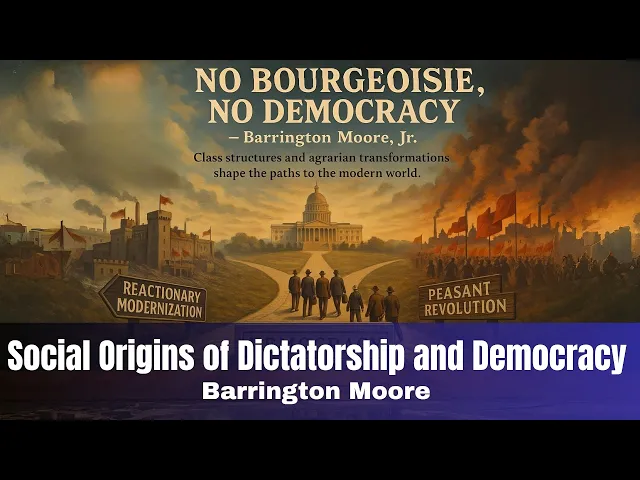
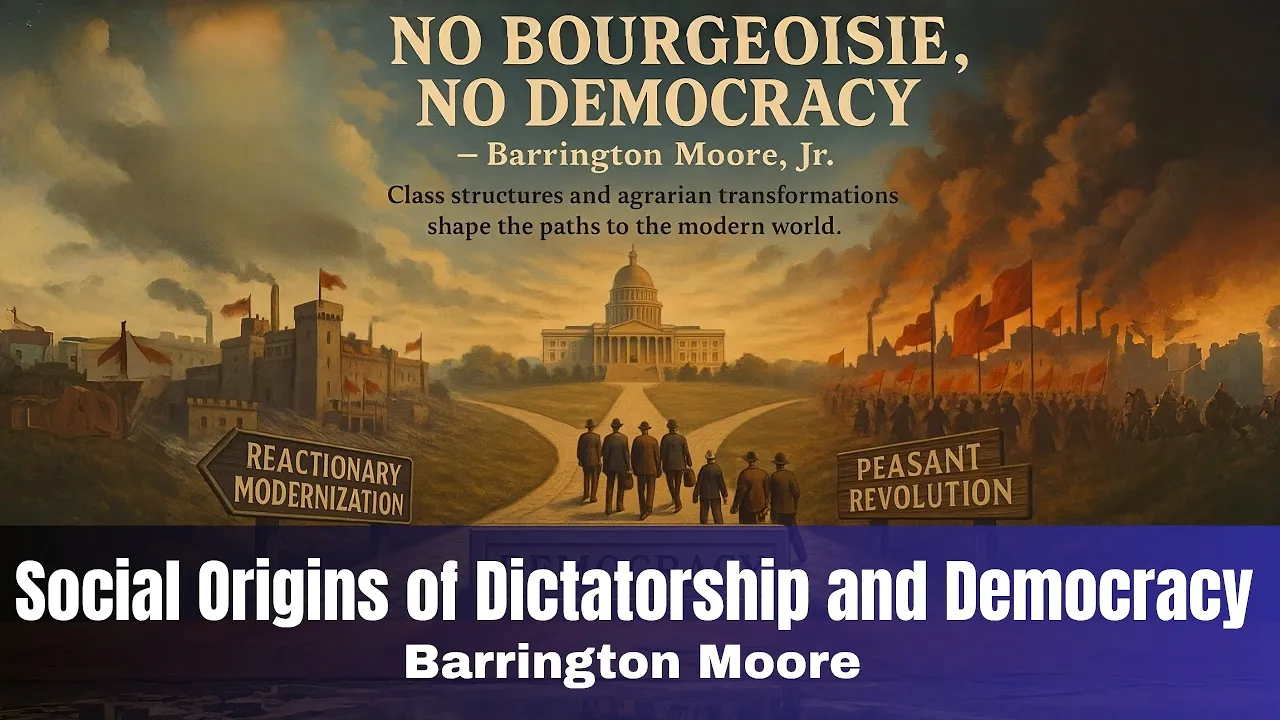
Moore crystallizes this argument in a shorthand that has become famous. No bourgeoisi, no democracy. That phrase captures more than a causal slogan.
It foregrounds a simple causal logic where an independent commercial and industrial middle class grows strong enough to challenge aristocratic privilege and align with reforming elites. The institutional space for parliamentary rule, legal protections, and plural politics becomes plausible. Where that class is weak, subordinated, or co-opted by landed elites, modernity often takes other non-democratic forms.
To make this case, Moore pursues a comparative historical strategy. He reads long social processes across eight national cases, England, France, the United States, Germany, Japan, Russia, China, and India, tracing sequences of agrarian transformation, elite conflict, and peasant mobilization. He does not offer a deterministic law so much as a set of pathways, routes to modernity shaped by the timing of capitalist development, the persistence or erosion of peasant communities, and the formation or failure of cross-class coalitions.
Why this matters for political thought and practice is twofold. First, Moore reenters class and agrarian structure at the heart of explanations for regime formation, reminding us that institutions do not emerge in a vacuum, but on a social foundation. [Music] Second, his comparative lens forces us to read variation to see why superficially similar economic changes yield very different political results when social alignments diverge.
Not a guarantee of where any society will end up, but a way to read the social currents that make democracy possible, unlikely, or impossible. Moore approaches his question with a comparative historical method. He reads long social processes across time, tracing sequences rather than isolating single events.
His causal logic is sequential. Agrarian change precedes shifts in social power which create openings for new political alignments. To show how pathways differ, Moore juxtaposes multiple cases and follows causal chains.
Landolding patterns change, class positions shift, coalitions form or fail, and crises convert those configurations into durable regimes. The method privileges thick description and process tracing over formal models or statistical generalization. It is a method built to explain how rather than to predict if.
At the heart of Moore's analysis are a small set of social actors whose relative strength and relation to land shape politics. First, the landed aristocracy, families and estates rooted in property and local authority, whose interests often center on maintaining social hierarchy and control over rural labor. Second, the bourgeoisi, merchant and industrial classes whose economic independence gives them an interest in legal protections, markets, and political representation.
Third, the peasantry, a mass of rural producers whose organization, livelihoods, and capacity for mobilization vary widely. Finally, the state or bureaucratic apparatus mediates extraction, security, what end? The capacity to enforce social order.
its expansion or weakness matters decisively in Moore's sequences. Moore's typology of agrarian systems is another analytic cornerstone. He distinguishes commercialized agriculture in which land is reorganized for market production and peasants become wage laborers or independent smallh holders from labor repressive systems where landlords retain coercive control over rural labor through forced labor, rents or tied teny.
A third dynamic is peasant dispossession where communal or small hold forms are broken apart by enclosure, monetization or market pressure, dispersing rural populations into towns or wage labor. These agrarian configurations determine the size and cohesion of peasant forces, the room for bourgeoa expansion, and the incentives for landed elites to accommodate or repress change. Read together.
Method, actors, and agrarian types. Moore's toolkit lets us trace why seemingly similar economic growth can feed very different political outcomes. It's a framework tuned to sequence, scale, and social positioning.
The order in which social transformations occur, who benefits, and who is mobilized when change becomes political. [Music] Moore organizes modern political outcomes into three broad routes. Patterned sequences shaped by agrarian structures, class balance, and the alliances those forces form.
Each route is not a law, but a probabilistic channel. Certain social configurations make some outcomes far more likely than others. The first is the democratic capitalist route.
Here, agrarian change, commercialized farming, enclosed lands, and a shrinking constituency of independent peasants helps create towns, markets, and an economically autonomous bourgeoisi. That bourgeoisi defined as an independent commercial and industrial class has a material stake in predictable property rights, contracts, and rule-bound governance. when it is sufficiently strong and when landed elites either split or are compelled to compromise, cross-class settlements can open institutional space for representative assemblies, legal protections, and plural politics.
England's long secession from aristocratic monopoly, the particular mix of frontier capitalism in the United States, and aspects of France's revolutionary settlement all illustrate variance of this path. Crucially, Moore treats the bourgeoisi as necessary but not decisive on its own. Its emergence raises the probability of parliamentary democracy, but sequence, timing, elite choices, and state structures determine whether that probability becomes reality.
The second route is capitalist reactionary. Modernization here proceeds, but usually under the shadow of entrenched landed power and an insufficiently independent bourgeoisi. Industrial growth is channeled through conservative elites and a powerful state that preserves hierarchy rather than dismantling it.
The state is mobilized from above to discipline labor, sustain order, and project national strength. Parliaments where they exist remain weak. In such contexts, the bourgeoisi may be subordinated, co-opted, or simply reluctant to press for liberal reform.
And aristocratic milit military coalition steer the polity toward authoritarian consolidation. Late 19th and early 20th century Germany and aspects of Mai and Imperial Japan offer historical illustrations of how industrialization combined with elite dominance produces reactionary outcomes rather than liberal openings. The third route Moore identifies is peasant revolutionary.
When capitalist transformation is minimal, the bgeoisi is feeble or aligned with conservative interests and a vast peasant majority endures extractive insecure agrarian relations. Uh the peasantry becomes the pivotal social force. Peasants rarely revolutionize without organization.
But where revolutionary parties or vanguards can channel rural grievances against rent, conscription or famine, mass mobilization can overthrow old regimes. The Russian revolutions and the Chinese revolution that culminated in 1949 exemplify this dynamic. Weak bourgeoa formations, high peasant density and acute agrarian distress, and revolutionary organizations that built rural alliances to seize state power.
Across all three routes, Moore's point is comparative and conditional. The presence of a strong bourgeoisi tilts the terrain toward democratic possibilities, but it does not guarantee them. A weak or co-opted bourgeoisi can facilitate reactionary domination.
And where the peasant majority is central and emancipatory channels are blocked, revolution from below becomes a viable canal of change. These are tendencies shaped by sequence, scale, and coalition. Guides for reading historical patterns, not predictions that erase contingency.
[Music] England and the United States are Moore's clearest examples of the democratic capitalist pathway. In England, a long uneven process of agrarian commercialization, enclosures, market farming, and the growth of towns gradually reduced the independent peasant estate and created a class of commercial actors with resources and interests distinct from landed privilege. Over decades, these merchants and manufacturers pressed for predictable law, property rights, and representative institutions.
crises and elite fractures, most famously the English Civil War and its long aftermath of settlement. Open spaces where bourgeoa pressures could translate into institutional gains. The United States, by contrast, mixes agrarian capitalism with frontier dynamics, land abundance, settler property relations, and accelerating market ties produced a powerful commercial and agrarian bourgeoisi that leaned toward plural politics in a federal institutional frame.
Both cases show how agrarian change can strengthen a middle class able to bargain with or compel elites. But neither follows a simple script. Timing, local institutions, and contingency shape the outcomes.
France illustrates Moore's argument about revolutionary rupture and coalition politics. There, the decline of feudal agrarian relations, fiscal crisis, and urban mobilization produced a dramatic break. Bourgeoa and peasant interests did not automatically align.
Instead, a volatile sequence of coalition building, radicalization, and state collapse produced a distinctive pathway to modern republican institutions. France's story shows that revolution need not be the exclusive instrument of peasants or bourgeoisi alone. It can be the product of shifting alliances under acute crisis.
And it demonstrates how the same underlying commercial and agrarian shifts can yield highly contingent, even violent political settlements. Germany and Japan are Moore's principal cases of the capitalist reactionary route. In late 19th century Germany, industrialization advanced under the shadow of strong landed elites, a powerful bureaucracy, and an influential officer corps.
The bourgeoisi existed, but was often subordinate or entwined with conservative interests. Parliamentary institutions were weak and vulnerable to elite pressures. Industrial growth was therefore channeled through state elite coalitions that emphasized order, hierarchy, and national strength.
A dynamic that amid shocks and political instability made democratic consolidation difficult and open space for authoritarian projects. Maji and imperial Japan present a comparable pattern. Rapid state-led modernization fused industrial expansion to centralized elite control, producing impressive economic transformation without the social disruptions that produce liberal political openings.
In both cases, Moore asks us to trace how modernization can be organized in ways that preserve older hierarchies rather than dissolve them. Russia and China exemplify the peasant revolutionary route. In both settings, capitalist transformation was limited.
Indigenous bourgeois were weak or compromised by existing elites and the peasantry formed a large often desperate social majority under conditions of state extraction, war, famine and fiscal crisis. Revolutionary parties and vanguard organizations were able to build rural alliances not simply because peasants were ideologically convinced but because parties addressed immediate grievances over land, rent, and coercion. The Bolevixs in 1917 and the Chinese Communists in the 1920s 1940s organized peasant networks, redistributed land rhetorically and practically and used peasant mobilization to seize and consolidate power.
Moore's reading emphasizes social density, agrarian distress, and the organizational work that channels rural grievance into revolutionary seizure. Across these cases, the same mechanisms keep reappearing. Timing matters.
uh whether agrarian change precedes or follows industrial growth shapes bargaining positions. Elite splits and the capacity of key elites to either accommodate or repress reform create openings or close them. Crisis moments, fiscal collapse, war, or economic shock convert structural tensions into political ruptures.
And external pressures, war, colonial domination, or global markets reshape incentives for elites and masses alike. Read together. The case narratives show Moore's central lesson.
Historical outcomes are not mechanical predictions, but contingent results of sequence, scale, and coalition. Tracking those mechanisms gives us a way to read why similar economic forces have produced such divergent political paths. [Music] Moore's work earned admiration for its historical sweep and its insistence that social structure shapes political outcomes, but it also faced strong critiques.
Many accused him of class reductionism, arguing that he treated social classes as mechanically determinative while neglecting the role of institutions, culture, and ideology. Others noted that he often underplayed international and colonial forces that profoundly shaped domestic possibilities. His country comparisons, though illuminating, sometimes compressed complex variation into overly neat templates.
Later scholarship built on and revised his framework. The skull shifted attention towards state structures and administrative crises, showing that state capacity and breakdown play crucial roles in explaining revolutions. factors that Moore's class-c centered approach did not fully capture.
Roocher, Stevens, and Stevens highlighted labor organization and workingclass mobilization, arguing that democratization often depends on the strength and alliances of labor movements as much as on bourgeoa interests. More recently, Asamoglu and Robinson reframed these questions in terms of institutions and incentives, exploring how political and economic institutions interact with social forces to produce divergent trajectories. Despite these critiques, Moore's core insight endures.
Class structure and agrarian relations matter deeply, even if they are not the whole story. His typology remains a powerful heristic for analyzing long-term social change. Best used in combination with institutionalist, state- centered, and global perspectives.
In conclusion, Moore gives us a map, not a prediction machine, for understanding political development. For further reading, start with Moore's social origins of dictatorship and democracy. Then turn to Scottpole's states and social revolutions.
Roo Shamayire Stevens and Stevens capitalist development and democracy and Asamoglu and Robinson's economic origins of dictatorship and democracy to see how his framework has been expanded and challenged. [Music] [Music] How did some societies travel the road to liberal democracy while others veered into fascism or communism? Barington Moore Jr.
asks that question not as a puzzle about ideas or personalities alone, but as a puzzle of social structure. His central claim is stark and capacious. The shape of modern regime springs from the configurations of landed elites, bourgeoisi and peasant classes, above all from the agrarian relations that bind them together or pull them apart.
Political outcomes for Moore are the long-term product of who holds economic power, how land is organized, and which social actors form durable alliances at moments of crisis. Moore crystallizes this argument in a shorthand that has become famous. No bourgeoisi, no democracy.
That phrase captures more than a causal slogan. It foregrounds a simple causal logic where an independent commercial and industrial middle class grows strong enough to challenge aristocratic privilege and align with reforming elites. The institutional space for parliamentary rule, legal protections, and plural politics becomes plausible.
Where that class is weak, subordinated, or co-opted by landed elites, modernity often takes other non-democratic forms. To make this case, Moore pursues a comparative historical strategy. He reads long social processes across eight national cases, England, France, the United States, Germany, Japan, Russia, China, and India, tracing sequences of agrarian transformation, elite conflict, and peasant mobilization.
He does not offer a deterministic law so much as a set of pathways, routes to modernity shaped by the timing of capitalist development, the persistence or erosion of peasant communities, and the formation or failure of cross-class coalitions. Why this matters for political thought and practice is twofold. First, Moore reenters class and agrarian structure at the heart of explanations for regime formation, reminding us that institutions do not emerge in a vacuum, but on a social foundation.
[Music] Second, his comparative lens forces us to read variation to see why superficially similar economic changes yield very different political results when social alignments diverge. Not a guarantee of where any society will end up, but a way to read the social currents that make democracy possible, unlikely, or impossible. Moore approaches his question with a comparative historical method.
He reads long social processes across time, tracing sequences rather than isolating single events. His causal logic is sequential. Agrarian change precedes shifts in social power which create openings for new political alignments.
To show how pathways differ, Moore juxtaposes multiple cases and follows causal chains. Landolding patterns change, class positions shift, coalitions form or fail, and crises convert those configurations into durable regimes. The method privileges thick description and process tracing over formal models or statistical generalization.
It is a method built to explain how rather than to predict if. At the heart of Moore's analysis are a small set of social actors whose relative strength and relation to land shape politics. First, the landed aristocracy, families and estates rooted in property and local authority, whose interests often center on maintaining social hierarchy and control over rural labor.
Second, the bourgeoisi, merchant and industrial classes whose economic independence gives them an interest in legal protections, markets, and political representation. Third, the peasantry, a mass of rural producers whose organization, livelihoods, and capacity for mobilization vary widely. Finally, the state or bureaucratic apparatus mediates extraction, security, what end?
The capacity to enforce social order. its expansion or weakness matters decisively in Moore's sequences. Moore's typology of agrarian systems is another analytic cornerstone.
He distinguishes commercialized agriculture in which land is reorganized for market production and peasants become wage laborers or independent smallh holders from labor repressive systems where landlords retain coercive control over rural labor through forced labor, rents or tied teny. A third dynamic is peasant dispossession where communal or small hold forms are broken apart by enclosure, monetization or market pressure, dispersing rural populations into towns or wage labor. These agrarian configurations determine the size and cohesion of peasant forces, the room for bourgeoa expansion, and the incentives for landed elites to accommodate or repress change.
Read together. Method, actors, and agrarian types. Moore's toolkit lets us trace why seemingly similar economic growth can feed very different political outcomes.
It's a framework tuned to sequence, scale, and social positioning. The order in which social transformations occur, who benefits, and who is mobilized when change becomes political. [Music] Moore organizes modern political outcomes into three broad routes.
Patterned sequences shaped by agrarian structures, class balance, and the alliances those forces form. Each route is not a law, but a probabilistic channel. Certain social configurations make some outcomes far more likely than others.
The first is the democratic capitalist route. Here, agrarian change, commercialized farming, enclosed lands, and a shrinking constituency of independent peasants helps create towns, markets, and an economically autonomous bourgeoisi. That bourgeoisi defined as an independent commercial and industrial class has a material stake in predictable property rights, contracts, and rule-bound governance.
when it is sufficiently strong and when landed elites either split or are compelled to compromise, cross-class settlements can open institutional space for representative assemblies, legal protections, and plural politics. England's long secession from aristocratic monopoly, the particular mix of frontier capitalism in the United States, and aspects of France's revolutionary settlement all illustrate variance of this path. Crucially, Moore treats the bourgeoisi as necessary but not decisive on its own.
Its emergence raises the probability of parliamentary democracy, but sequence, timing, elite choices, and state structures determine whether that probability becomes reality. The second route is capitalist reactionary. Modernization here proceeds, but usually under the shadow of entrenched landed power and an insufficiently independent bourgeoisi.
Industrial growth is channeled through conservative elites and a powerful state that preserves hierarchy rather than dismantling it. The state is mobilized from above to discipline labor, sustain order, and project national strength. Parliaments where they exist remain weak.
In such contexts, the bourgeoisi may be subordinated, co-opted, or simply reluctant to press for liberal reform. And aristocratic milit military coalition steer the polity toward authoritarian consolidation. Late 19th and early 20th century Germany and aspects of Mai and Imperial Japan offer historical illustrations of how industrialization combined with elite dominance produces reactionary outcomes rather than liberal openings.
The third route Moore identifies is peasant revolutionary. When capitalist transformation is minimal, the bgeoisi is feeble or aligned with conservative interests and a vast peasant majority endures extractive insecure agrarian relations. Uh the peasantry becomes the pivotal social force.
Peasants rarely revolutionize without organization. But where revolutionary parties or vanguards can channel rural grievances against rent, conscription or famine, mass mobilization can overthrow old regimes. The Russian revolutions and the Chinese revolution that culminated in 1949 exemplify this dynamic.
Weak bourgeoa formations, high peasant density and acute agrarian distress, and revolutionary organizations that built rural alliances to seize state power. Across all three routes, Moore's point is comparative and conditional. The presence of a strong bourgeoisi tilts the terrain toward democratic possibilities, but it does not guarantee them.
A weak or co-opted bourgeoisi can facilitate reactionary domination. And where the peasant majority is central and emancipatory channels are blocked, revolution from below becomes a viable canal of change. These are tendencies shaped by sequence, scale, and coalition.
Guides for reading historical patterns, not predictions that erase contingency. [Music] England and the United States are Moore's clearest examples of the democratic capitalist pathway. In England, a long uneven process of agrarian commercialization, enclosures, market farming, and the growth of towns gradually reduced the independent peasant estate and created a class of commercial actors with resources and interests distinct from landed privilege.
Over decades, these merchants and manufacturers pressed for predictable law, property rights, and representative institutions. crises and elite fractures, most famously the English Civil War and its long aftermath of settlement. Open spaces where bourgeoa pressures could translate into institutional gains.
The United States, by contrast, mixes agrarian capitalism with frontier dynamics, land abundance, settler property relations, and accelerating market ties produced a powerful commercial and agrarian bourgeoisi that leaned toward plural politics in a federal institutional frame. Both cases show how agrarian change can strengthen a middle class able to bargain with or compel elites. But neither follows a simple script.
Timing, local institutions, and contingency shape the outcomes. France illustrates Moore's argument about revolutionary rupture and coalition politics. There, the decline of feudal agrarian relations, fiscal crisis, and urban mobilization produced a dramatic break.
Bourgeoa and peasant interests did not automatically align. Instead, a volatile sequence of coalition building, radicalization, and state collapse produced a distinctive pathway to modern republican institutions. France's story shows that revolution need not be the exclusive instrument of peasants or bourgeoisi alone.
It can be the product of shifting alliances under acute crisis. And it demonstrates how the same underlying commercial and agrarian shifts can yield highly contingent, even violent political settlements. Germany and Japan are Moore's principal cases of the capitalist reactionary route.
In late 19th century Germany, industrialization advanced under the shadow of strong landed elites, a powerful bureaucracy, and an influential officer corps. The bourgeoisi existed, but was often subordinate or entwined with conservative interests. Parliamentary institutions were weak and vulnerable to elite pressures.
Industrial growth was therefore channeled through state elite coalitions that emphasized order, hierarchy, and national strength. A dynamic that amid shocks and political instability made democratic consolidation difficult and open space for authoritarian projects. Maji and imperial Japan present a comparable pattern.
Rapid state-led modernization fused industrial expansion to centralized elite control, producing impressive economic transformation without the social disruptions that produce liberal political openings. In both cases, Moore asks us to trace how modernization can be organized in ways that preserve older hierarchies rather than dissolve them. Russia and China exemplify the peasant revolutionary route.
In both settings, capitalist transformation was limited. Indigenous bourgeois were weak or compromised by existing elites and the peasantry formed a large often desperate social majority under conditions of state extraction, war, famine and fiscal crisis. Revolutionary parties and vanguard organizations were able to build rural alliances not simply because peasants were ideologically convinced but because parties addressed immediate grievances over land, rent, and coercion.
The Bolevixs in 1917 and the Chinese Communists in the 1920s 1940s organized peasant networks, redistributed land rhetorically and practically and used peasant mobilization to seize and consolidate power. Moore's reading emphasizes social density, agrarian distress, and the organizational work that channels rural grievance into revolutionary seizure. Across these cases, the same mechanisms keep reappearing.
Timing matters. uh whether agrarian change precedes or follows industrial growth shapes bargaining positions. Elite splits and the capacity of key elites to either accommodate or repress reform create openings or close them.
Crisis moments, fiscal collapse, war, or economic shock convert structural tensions into political ruptures. And external pressures, war, colonial domination, or global markets reshape incentives for elites and masses alike. Read together.
The case narratives show Moore's central lesson. Historical outcomes are not mechanical predictions, but contingent results of sequence, scale, and coalition. Tracking those mechanisms gives us a way to read why similar economic forces have produced such divergent political paths.
[Music] Moore's work earned admiration for its historical sweep and its insistence that social structure shapes political outcomes, but it also faced strong critiques. Many accused him of class reductionism, arguing that he treated social classes as mechanically determinative while neglecting the role of institutions, culture, and ideology. Others noted that he often underplayed international and colonial forces that profoundly shaped domestic possibilities.
His country comparisons, though illuminating, sometimes compressed complex variation into overly neat templates. Later scholarship built on and revised his framework. The skull shifted attention towards state structures and administrative crises, showing that state capacity and breakdown play crucial roles in explaining revolutions.
factors that Moore's class-c centered approach did not fully capture. Roocher, Stevens, and Stevens highlighted labor organization and workingclass mobilization, arguing that democratization often depends on the strength and alliances of labor movements as much as on bourgeoa interests. More recently, Asamoglu and Robinson reframed these questions in terms of institutions and incentives, exploring how political and economic institutions interact with social forces to produce divergent trajectories.
Despite these critiques, Moore's core insight endures. Class structure and agrarian relations matter deeply, even if they are not the whole story. His typology remains a powerful heristic for analyzing long-term social change.
Best used in combination with institutionalist, state- centered, and global perspectives. In conclusion, Moore gives us a map, not a prediction machine, for understanding political development. For further reading, start with Moore's social origins of dictatorship and democracy.
Then turn to Scottpole's states and social revolutions. Roo Shamayire Stevens and Stevens capitalist development and democracy and Asamoglu and Robinson's economic origins of dictatorship and democracy to see how his framework has been expanded and challenged.