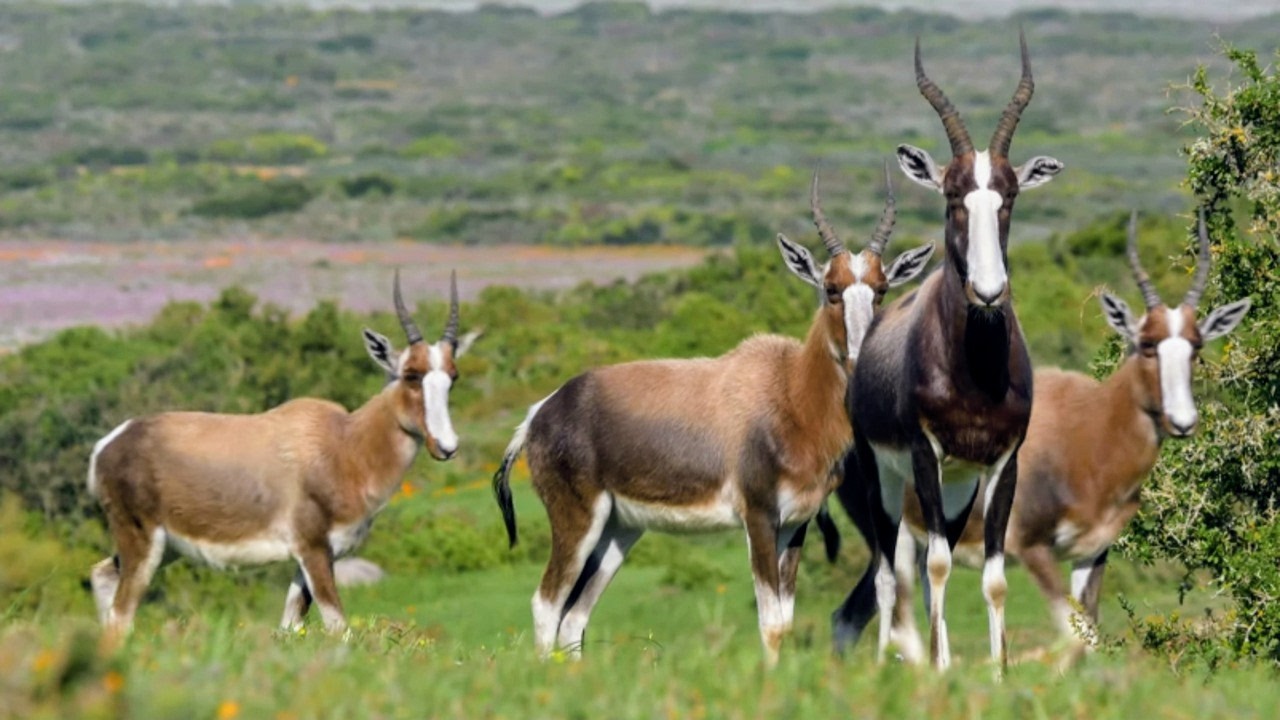
[Music] the Kalahari desert is one of the most implacable places on earth where life seems challenged at every moment, however it is precisely in these extreme scenarios that we can see the miracle of divine creation in action . this arid environment with unique abilities and strategies to [Music] survive the balance between animals, their adaptations and the ecosystem makes us reflect on the power and grandeur of the divine work it is as if even in the desert The Hand of God was present showing that even In the most adverse conditions, life thrives under his design [Music] every animal that lives in the Kalahari is proof of how nature guided by God finds ways to adapt and survive every detail of life in the desert reveals the Creator's precision and care By exploring the wildlife of the Kalahari we are led to reflect on how wonderfully complex and beautiful the nature created by God is. The blue wildebeest is one of the creatures that inhabits the arid Kalahari Desert to survive in an environment with little water it depends on migration in search of areas with fresh pastures and seasonal water sources when the rains arrive the wildebeest travels great distances to find better conditions often traveling in large groups this migration is essential not only for the survival of the wildebeest but also other animals that follow these large herbivores taking advantage of the same food sources this connection between species illustrates the interdependence of wildlife in the kalahari throughout the Every year conditions in the desert change drastically and the ability to travel great distances becomes the key to survival the blue wildebeest is a clear example of how nature shapes adaptive behaviors they have a unique ability to withstand long periods without water allowing they continue their journey even in the scorching heat this extreme resistance is a crucial factor for their survival in such a challenging habitat interestingly wildebeest migrations also help to revitalize the kalahari ecosystem by moving from one area to another they disperse seeds and fertilize the soil with its excrement this natural process contributes to the regeneration of grasslands maintaining the balance of the desert this dynamic between the wildebeest and the environment shows how even the most adverse conditions can create sustainable life cycles in the [Music] kalahari the oryx is one of the largest and most emblematic Kalahari mammals impressively adapted to face the scorching heat with its clear coat that reflects sunlight and the ability to regulate its body temperature it can withstand temperatures that would be deadly for other species.
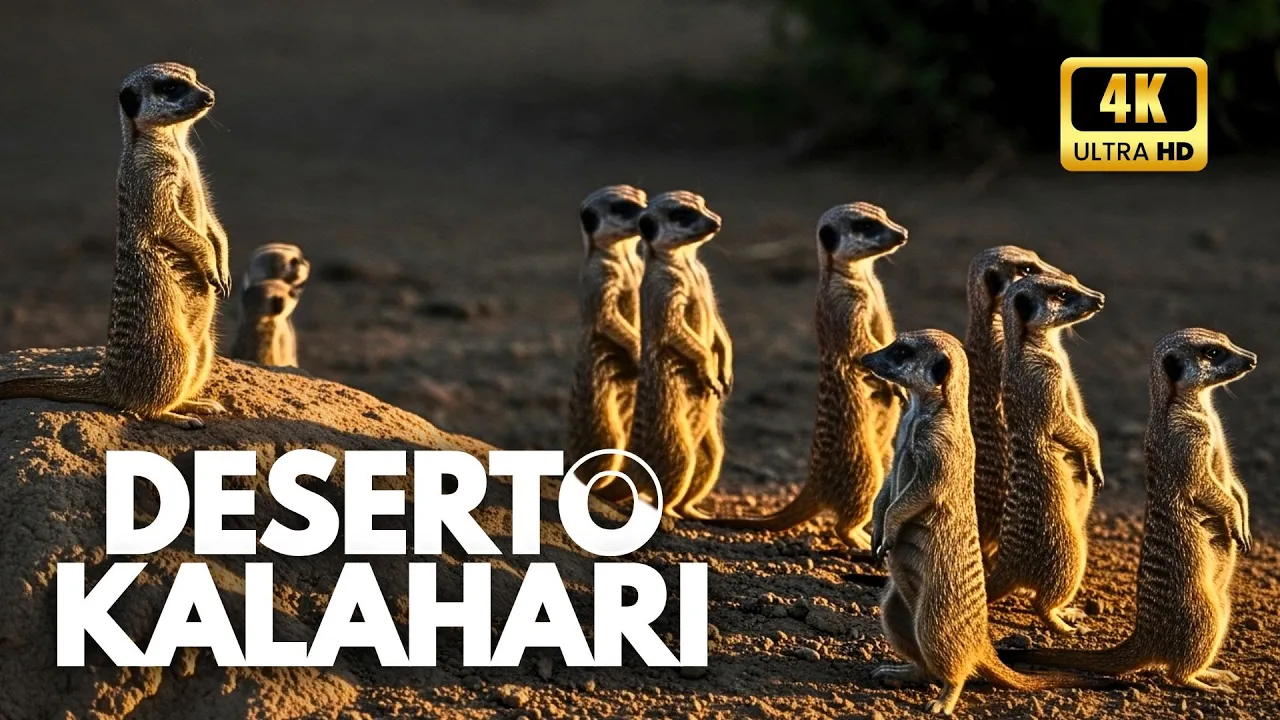
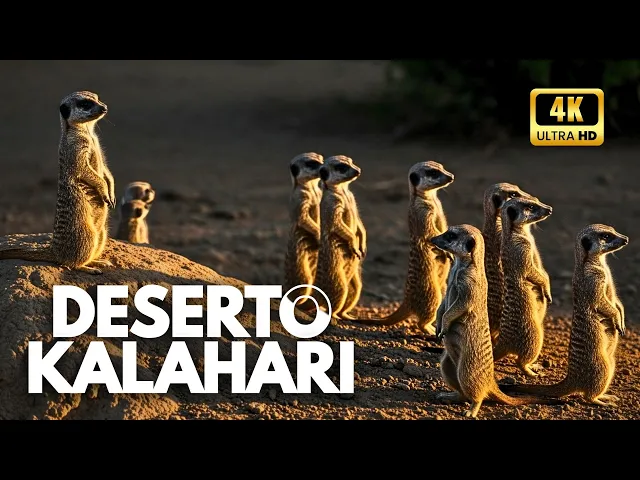
Furthermore, the oryx has developed the ability to absorbing water from succulent plants and its own metabolism, managing to survive long periods without drinking water directly, this ability is fundamental in an environment where water scarcity is constant throughout the hottest days, the oryx reduces its activity by seeking shelter in rare shades or resting in the early mornings and late afternoons when the sun is less intense, this energy saving allows it to conserve the few water resources that its body retains. Furthermore, the oryx can increase its internal temperature to prevent water loss through perspiration, a unique adaptation between Desert mammals, the oryx, are also capable of traveling great distances in search of food and seasonal water sources, making use of their incredible physical resistance. They form groups that collaborate in the search for these scarce resources, demonstrating the importance of community life, even in the regions most inhospitable on the planet their presence in the Kalahari is living proof of the resilience of [Music] nature the meerkat small and curious Kalahari mammal is a master in the art of group Survival These animals live in large colonies and depend heavily on their social interactions for face the harsh conditions of the desert While some members of the group go out to look for food, others remain on guard, alert for predators such as eagles and jackals, this division of tasks is essential to guarantee the safety and survival of the colony as a whole the meerkats' ability to dig deep burrows is also a crucial adaptation for escaping the extreme heat of the day and the intense cold of the night.
Burrows offer protection from extreme temperatures and are a safe haven for the pups and more vulnerable members. of the group In addition, the burrows are used as hiding places against predators and as places to store food, the meerkats are also excellent hunters of small insects, reptiles and arachnids, they have a diet that allows them to find food sources even in periods of scarcity, the combination of Social skills, protection in dens and a diverse diet make meerkats a remarkable example of how life in the Kalahari can thrive even in the most challenging conditions. Kalahari elephants are true drought-adapted giants capable of surviving in an environment where water is extremely limited.
One of their most impressive abilities is their ability to detect sources of underground water with their sensitive trunks, digging wells with their paws to reveal water for themselves and other species. This behavior is essential not only for their own survival but also for the surrounding ecosystems. which depend on wells dug by elephants during the drought, desert elephants also have a migratory behavior, moving between different areas throughout the year in search of water and vegetation, they are able to travel long distances even in arid terrain thanks to their incredible ability to storing water and nutrients, these journeys are essential to guarantee the survival of their herds in such an inhospitable environment.
In addition to their ability to dig, desert elephants also have the ability to reduce their water consumption during drier periods, conserving energy and resources, allows it to survive in places where other species would not have a chance the presence of elephants in the Kalahari is a true symbol of adaptation and resilience the Leopard is one of the most cunning predators in the Kalahari adapted to hunt in an environment where prey can be scarce thanks to its camouflage natural and stealth hunting abilities the Leopard is able to silently approach its prey ensuring a successful hunt its diet varies from small rodents to large antelopes which makes it an extremely versatile hunter during the day the Leopard usually rests in trees or in shady places To avoid intense heat, its spotted camouflage is perfect for hiding in the shadows of trees or among bushes. This ability to blend into the environment is crucial to its survival, both to avoid larger predators and to ensure that its prey do not detect it before attacking. Another important adaptation of the Kalahari leopard is its ability to stay hydrated from the blood of its prey, which reduces its need for water and allows it to survive long periods without needing to drink, a significant advantage in a desert where water is extremely his scant intelligence and cunning make him one of the most successful Hunters in the Kalahari [Music] the Kalahari desert beetle has developed a remarkable adaptation to survive in an environment with limited water resources during the rare cold dawns he climbs to the top of dunes and positions its body in such a way as to capture the tiny drops of dew that form on the surface the shape of its exoskeleton allows the drops to flow into its mouth, ensuring the hydration necessary for its survival this ingenious technique is essential in a place where water sources are practically non-existent In addition to its unique ability to collect dew, the dung beetle is also an excellent nutrient recycler in the Kalahari ecosystem it feeds on decaying organic matter helping to recycle nutrients back into the soil, in doing so it plays a crucial role in maintaining of soil fertility even in an arid environment this behavior contributes to the balance of local fauna and flora showing how even the smallest creatures play a vital role their ability to survive with so little water and their importance to the ecosystem show The incredible resilience of the Kalahari species, the scarab teaches us that even in extreme conditions there are always ways to adapt and prosper.
It is yet another example of how life adapts to circumstances, transforming scarcity into an opportunity for survival [Music] The Jackal of the Kalahari is a classic example of an opportunistic predator in an environment where food sources are scarce it has learned to be extremely adaptable by eating practically anything it finds whether hunting small rodents birds or taking advantage of carcasses left by other larger predators the Jackal keeps itself fed in a desert where life can be very harsh. Its versatility is one of the reasons it is successful in such a challenging environment during drought. The Jackal also uses its foraging skills to supplement its diet with insects, fruits and even roots.
He has a keen sense of smell for finding food and remains in constant movement, covering large areas in search of something to feed on. This strategy of continuous movement is essential in a desert as vast and inhospitable as the Kalahari. Furthermore, he is an excellent nocturnal hunter, taking advantage of the cooler temperatures.
mild night to hunt and conserve energy Another interesting point about the Jackal is its ability to hunt in pairs or small groups, this cooperative behavior increases its chances of success Especially when it comes to facing larger prey or defending itself from other predators adapted both to hunting alone or in a group The jackal is an example of how adaptability can guarantee survival in one of the most extreme environments on the planet the fenec also known as the desert fox is a fascinating small creature from the Calahari famous for its large ears, these disproportionate ears do not are only for keen hearing but also function as cooling mechanisms the large surfaces of the ears help to dissipate body heat an essential adaptation in an environment where temperatures can reach extreme levels during the day this unique feature sets it apart from other foxes making it a true marvel of adaptation to the desert, in addition to its functional ears, the fennec is a nocturnal predator. It hunts at night to avoid the intense heat of the day and feeds on small rodents, insects and eggs, its ability to locate prey in sandy terrain is amplified by its keen hearing that allows it to detect even the smallest sounds underground during the day it takes refuge in deep burrows to avoid the heat, staying hydrated with water obtained from its prey, the fennec is also an excellent digger using its front paws to dig quickly burrows where it can take shelter , these burrows offer protection against predators and the calahari's extreme heat . bird in the world and one of the species best adapted to the calahari, although it is not capable of flying, the ostrich makes up for this lack with an incredible running speed, reaching up to 70 km/h, which allows it to escape predators with ease, however, one of its adaptations Most impressive is its ability to survive long periods without water, the ostrich is able to obtain most of the water it needs from the food it consumes, such as leaves and seeds, drastically reducing its dependence on external water sources during the hottest periods of the day.
The ostrich also regulates its body temperature efficiently, minimizing water loss through sweating. This ability is essential in an environment where water is scarce and the heat is relentless. In addition, the Ostrich's large plumage offers protection against the intense sun, creating a barrier that helps keep its body cooler, another interesting aspect of the Ostrich's behavior in the cahari is its ability to detect threats from long distances with its large eyes, it is able to spot predators from more than 3 km away, giving it enough time to escape your keen vision and speed combined with its ability to retain water make it one of the most resilient species in the calahari desert [Music] the mongoose is another fascinating inhabitant of the cahari famous for its ability to face venomous snakes including the feared cobra snake, although small, the mongoose has a resistance natural to certain snake venoms, which allows it to hunt and feed on snakes that would be fatal to other animals, this unique characteristic makes the gusto one of the few predators in the desert capable of facing the cobra on equal terms in terms of hunting, the mongoose uses its agility and quick reflexes to avoid the bites of its dangerous prey, it is an active and curious hunter, always looking for new challenges, in addition to snakes, the mongoose also feeds on insects, rodents and even birds, making it a versatile predator, its varied diet allows survive even when food sources are limited In addition to its resistance to venom, the mongoose also lives in highly organized social groups, which provides it with protection and increases its chances of survival.
These groups work together to locate prey and ward off predators, which further strengthens its presence in the calahari with its unique abilities and social behavior the mongoose stands out as an an example of resilience in the desert the calahari tortoise is one of the most resilient creatures in the desert capable of surviving for long periods without direct access to water this incredible reptile stores the water in its bladder, using it little by little during periods of drought, this internal reserve allows the turtle to remain hydrated even when water is not available. Additionally, it consumes succulent plants and hides in burrows to avoid extreme heat, which helps to reduce moisture loss during the rainy season, the turtle takes advantage of this to replenish its water reserves, absorbing the moisture necessary to face the coming months of drought, its slow metabolism also helps it survive in an environment where food can be scarce for long periods, by slowing down its bodily functions, it is able to save energy and stay alive. In the most adverse conditions, the resistance of the Kalahari turtle is an example of the ingenuity of Divine Creation.
Just as it stores what is necessary to survive, we can reflect on the importance of preparing ourselves spiritually and physically to face the challenges that arise in our lives, trusting that God always provides us with what we need, the cape vulture plays a vital role in the Kalahari ecosystem, acting as a cleaner of nature, it feeds on the carcasses of dead animals, preventing the remains from being accumulate and cause the spread of diseases their function is essential to keep the environment healthy especially in a desert where resources are limited and decomposition can be slow due to the dry climate when feeding on dead animals the vulture also helps to recycle nutrients back on the ground, these Vultures have a keen sense of smell and vision, allowing them to locate carcasses at great distances, their ability to survive in such a hostile environment Depends on their tireless flight and the efficiency with which they consume large amounts of meat in a short time, the Cape Vulture is A true example of how each species has a Divine purpose even when its function seems less glamorous, the presence of the Cape Vulture reminds us that just as it plays a crucial role in the cycle of life, we also have a specific God-given purpose that many Sometimes it may not be immediately evident but it is essential to the balance around us [Music] The calahari chameleon is a master of camouflage adapted to survive in an environment where the ability to blend in with its surroundings can be the difference between life and death its ability to change color is not only to hide from predators but also to regulate body temperature by adopting lighter colors during the day it reflects heat keeping its body cooler in the intense desert sun this multifunctional ability changing color is crucial for its survival in such an arid environment. In addition to its camouflage, the chameleon has one of the fastest tongues in the animal kingdom, capable of capturing insects at a impressive speed this sticky tongue can extend up to twice the length of the chameleon's body allowing it to reach prey that are out of its immediate reach its diet consists mainly of insects which it hunts with precision using its binocular vision an adaptation that gives vision detailed in depth out fascinating aspect of the chameleon is its slow mobility Eber although this slowness is a disadvantage it is effective survival strategy moving around devar and Dee almost Elected to draw attention from predators and becomes practically invisible among the bushes and rocks of the cahari their combination camouflage, efficient hunting and stealthy movement makes it one of the animals most adapted to the desert, the peregrine falcon is one of the fastest hunters in the Cahari, capable of reaching speeds of up to 320 km/h in diving, adapted to hunting birds in mid-flight, it uses its vision This ability to fly at high speeds is one of the most impressive adaptations in the animal kingdom and makes the peregrine falcon a formidable predator even in an environment like the Calahari Desert where searching for food is a difficult task. difficult during its hunts, the peregrine falcon relies on its ability to identify its prey at great distances, its highly developed eyes allow it to see small birds such as pigeons and doves from hundreds of meters in height, once it locates its prey it enters into a vertical dive using gravity to gain speed and surprise its victim, this sudden and precise attack rarely fails Another factor that contributes to the success of the peregrine falcon is its adaptability, it is capable of hunting in different habitats and environments, from deserts to urban areas, showing an incredible ability to adapt in cahari, it stands out as an agile and efficient hunter, using the sky as its hunting territory and benefiting from its incredible speed to guarantee its meals, the cobra snake is one of the most feared reptiles in the kalahari, known for its highly toxic venom, adapted to live in extreme conditions, the cobra uses its venom both to defend itself and to capture its prey, its bite can quickly immobilize small mammals, birds and even other reptiles, facilitating digestion in an environment where meals can be rare, this predatory efficiency makes the cobra one of the main predators of the world.
kalahari In addition to its hunting ability, the cobra is also known for its characteristic defensive posture, when threatened, it rises, widens its hood and hisses as a way of intimidating predators and scaring away threats, this defensive comp is effective against many larger predators, such as carnivorous mammals, which often prefer to avoid confrontations with venomous snakes this combination of defense and attack makes the cobra a formidable survivor in the desert another fascinating aspect of the cobra snake is its ability to regulate activity according to the temperature of the environment during the day it hides in burrows under rocks avoiding extreme heat at night when temperatures drop it is more active taking advantage of the coolness of the night this thermal ability is essential for its survival in an environment as volatile as the kalahari Small rodents of the kalahari such as the jumping mouse are Masters of Survival in an arid and unforgiving environment one of their main adaptations is the ability to go long periods without drinking water they are able to obtain the necessary moisture directly from the foods they consume such as seeds and succulent vegetables this ability makes them incredibly resilient in an environment where water is scarce and often inaccessible. In addition to their adapted diet, these rodents are known for their elaborate burrows that they dig in the sandy soil to protect themselves from extreme temperatures during the day. They remain in the burrows to avoid the scorching heat and only come out at night when temperatures are lower.
This strategy of avoiding the heat of the day is essential to conserve energy and avoid dehydration. Another interesting tactic of these rodents is their ability to store food in their burrows for periods of scarcity, they collect seeds and other sources of food during the most abundant times and stores it in underground chambers for periods when the desert does not offer so many resources. This ability to plan and adapt to extreme conditions makes Kalahari rodents experts in survival.
The Kalahari scorpion is one of the most resilient inhabitants of the desert, capable of surviving extreme temperatures of both heat and cold, its natural armor made up of a thick carapace not only protects its body from predators but also helps conserve moisture, a precious resource in the arid environment. Furthermore, the scorpion is a master of nocturnal hunting leaving its burrow at night to ambush prey such as insects and small rodents during the day the scorpion hides under rocks or in burrows that it digs where temperatures are much lower than on the surface of the desert this allows it to conserve energy and avoiding the scorching heat, its ability to remain inactive for long periods is also a crucial adaptation when food is scarce, the scorpion drastically reduces its activity and can go weeks without eating until conditions become more favorable, another fascinating aspect of Scorpio is its effectiveness of its venom it uses its tail and stinger to capture and paralyze its prey with a precise sting, this venom, in addition to being a hunting tool, also serves as a powerful defense against larger predators, this combination of resistance to extreme weather, hunting and defense skills makes it the scorpion, one of the most resilient Survivors of the Kalahari, standing out as a true expert in the art of living on the [Music] limit, the Kalahari sand snake is an expert at burying itself beneath the sandy surface of the desert, using this ability both to protect itself from scorching heat and to seek out its prey with undulating movements, it moves quickly beneath the sand, which allows it to approach prey without being detected. This stealthy behavior is essential for survival in an environment where food is scarce and predators are abundant.
In addition to its natural camouflage, the sand snake has a powerful venom that it uses to quickly immobilize small mammals and lizards, its ability to capture prey efficiently even in such adverse conditions makes it a successful predator in the Kalahari, it also regulates its activity according to desert temperatures being most active at night and early in the morning the snake's ability to adapt to desert conditions reminds us of the need to always be prepared to adjust to changes in our lives trusting God to guide and strengthen us to facing the challenges that arise along the way, survival in the kalahari desert shows us that even in the most difficult situations, God provides the necessary resources for life to continue, just as he takes care of the animals in this vast desert, he also takes care of us on our personal journeys, each strategy of survival that we see in these creatures is a reminder that God does not abandon us even when we face our OBS the ingenuity and adaptation of animals we learn valuable lessons about faith perseverance and trust in Divine Care God in his greatness shows us that there is always a solution a path even when everything seems difficult that we can be inspired by creation and remember that just like in the desert, God will provide us with what we need.
![TURKEY: Untamed Land [Full Documentary]](https://img.youtube.com/vi/Aweu7OgtXOY/maxresdefault.jpg)