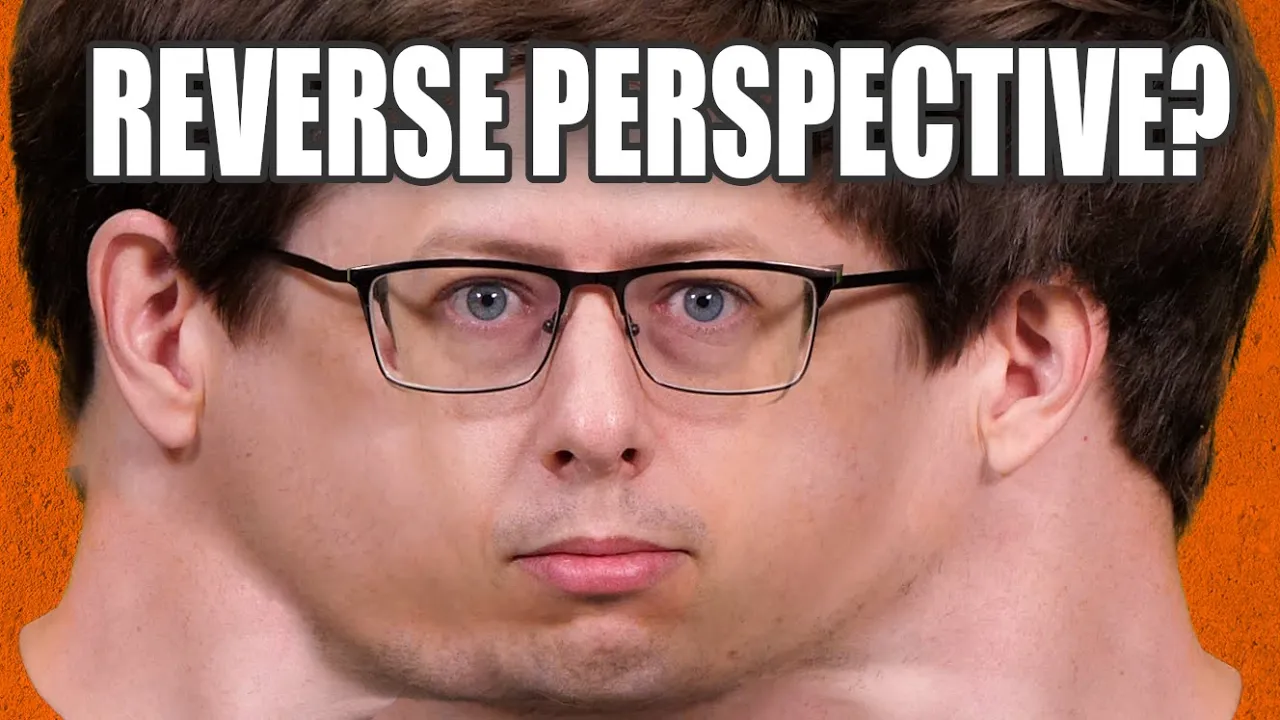
Got a question for you. If cameras are so good at seeing stuff, why can't they see around stuff? You might think it's impossible for the camera to see me back here, but it's not.
With the right kind of camera, in theory, you should be able to see around walls. And to prove it, I built one. It's a very weird camera.
It can only see one pixel, but it can make full images. And it can do a lot more than see around things. We can make it behave like any lens, including crazy lenses that would be almost impossible to make.
And I know I say it every time, but this thing was so painful to get working. If anything is off at all, you just get crazy images out of this. And a lot of stuff was off.
I also hope we can get some nice portraits of my wife's face. I'm really interested what her face would look like if we could see around it. [music] I'm not sure if that's going to be flattering or not, so no promises.
So, let's get into it. I think everything will make a lot more sense if we first talk about how normal cameras work. So, imagine that I have a box and inside my box we have a little ant.
And then outside the box there's stuff. And then imagine we poke a little hole in our box. And if our little ant looked out of the hole, it would just see some little tiny part of what's out there.
And if our ant walked down the box to a different spot and looked out, it would see some other little tiny part. If you think about it, the ant walking from one side to the other, it would see every point that's out there. And this is how cameras work.
Instead of an ant, there's some kind of sensor or film. And whatever's out here, if there's light on it, the light bouncing off it will go in and hit this sensor at different points. And the sensor measures at every point on it how bright the light is that's hitting it.
And this is all a photograph is a bunch of points that are light or dark depending on how bright the light was that hit that spot in the camera. This is called a pinhole camera. And the big downside is that not very much light can get through this little tiny hole.
So if you think about what the camera is actually doing, you can start coming up with other ways of achieving the same thing. For example, you could take a tube and if you looked through it, you sort of see just one point way off in the distance. If I systematically moved the tube around and kept track of what it saw, I could recreate an image of everything that it saw.
This is basically what I want to do. What's really cool is you can make this tube act like different lenses. If I moved it over a really big angle range, I could get a wide angle view.
If I move it over a really small range, I get more of a zoom lens. So, where things get really interesting is if you can move this tube around in space and change its angle, you can make it act like some very, very strange optics. This is the key to seeing around walls, but one step at a time.
Now that I'm thinking about it, moving a sensor around to collect all the points in an image is going to be kind of hard because of time. If I was scanning out an image as a series of rows, there's going to be thousands of these rows. Unless I'm going really fast, it'll take forever.
And if I make a gantry go really fast, it's going to vibrate, which will ruin my image. And I spent a long time thinking about how I could do this. And I came up with something that I think will work.
So, I'm going to put the sensor on an arm that spins. The sensor can move up and down the arm to change where it is in space. And it can also change the angle that it's pointing in.
This is a very simple mechanism that will let us move the sensor around and change where it's pointing. This is nice because once I get that arm accelerated and going, I'm not going to have to slow it down. It just is going to spin real fast till I'm done.
So, there won't be accelerations causing vibrations as long as I have it balanced really well. There's a few other nice things about this design, but it'll be a lot easier to describe once I get it made. So, let's make some stuff.
[music] as is my custom. If there's any possible way to make the metal parts on the water jet, that's what I'm [music] doing. I have a number of hybrid parts that I 3D printed and then postmachined, which is way faster than machining them from [music] scratch.
And despite my efforts to avoid it, I still had to machine some metal parts. [music] Somewhat shockingly, all the hardware went together and pretty much worked. [music] reality turned out to be a bit more complicated than my stick figure drawings.
So, let me give you a tour of how this thing works. So, this entire arm is the part that spins. And on this end is the photo detector.
It's on a little cart that can move up and down this rail. And then on the cart, we have the photo detector, which is looking sideways at a mirror that we can precisely control the angle of. This lets us control what angle we're looking out at with the camera.
I'm using a mirror because it's a very light, easy thing to move, especially when it's on the end of a spinning arm that's going to be experiencing really high G forces. And of course, this is a big heavy thing on the end of an arm. If we spin it around, it's not going to be balanced and it's going to vibrate like crazy.
So, on the other end, we have another cart with a little steel weight that weighs the same as the photo detector. And this moves to the same position as that's moving to. So, no matter where we move it, it's always balanced.
Another sort of complication with the design is that everything is spinning. If we run wires from something that's sitting still to this, they'll just twist up and break. So, the motor drivers, the computer, the microcontroller, they're all spinning, too, which makes it really easy just to run wires to whatever I want.
And then down here, there's a giant motor that spins everything. And it's not spinning. It's sitting still.
And I wanted to control it with my main computer. I didn't want to go wireless. So, there's a very special device right here called a slip coupling.
It has wires that come out of both ends and you can spin the wires and they'll never get tangled. And then the last piece is this. This is an encoder.
It's a sensor that lets me measure the exact rotation of the arm as it spins. If I don't know exactly where the arm is, the image will not possibly look good. I also really like this wooden post.
I spent a while thinking of complicated welded or sheet metal things, but I thought, you know what? This is one of those cases where a chunk of wood is perfect. And that's basically it.
Before we can start taking pictures, we need some software. So, I hacked some code together, and here's how it works. The software starts by asking us what kind of picture we want to take.
Wide angle, zoom, something really strange. Then, it uses that to calculate how it needs to move the sensor in the mirror to achieve that. Then, it controls the motors to spin the arm up to constant speed and precisely moves the camera sensor and the mirror along the path that it calculated.
[music] As it does this, the light sensor is measuring how bright whatever it sees is at about 10,000 times per second until all the motors are done moving. I made this little laser tool that screws onto the photo sensor and shines out so we can see where the sensor would be looking. So, I'm going to run the camera with this in it so that we can see the shape that it's measuring.
It's systematically spiraling from inside out. Wherever the laser is pointing is where the camera would [music] be measuring. The dots being far apart is an artifact of the camera that's filming.
the sensor would be getting more like 10,000 [music] dots per revolution, which basically gives you a giant graph of how bright whatever it saw was across time. [music] And we have to somehow convert this into an image, which thankfully isn't that bad. Imagine the camera is taking a picture of a wall that was half white, half gray.
And the camera traces a circle starting at the top. It [music] sees white, which would look bright, but then when it crosses to the gray, it would look dark. Then when it crosses back to the white, it would look bright again.
By itself, the graph isn't very useful. But if we keep track of where the camera was pointing, then we know that this measurement corresponds to the top when it went from light to dark corresponds to right here and so on. [music] So if we make a blank image, we can use this information to calculate where any given measurement would fall in this image and set it light or dark depending on what the camera saw.
If the camera had done a full scan instead of a circle, we'd have a picture of the wall. All righty. So we've got beta hardware, electronics, and software.
What are the odds this works on the first try? There's really only one way to find out. Looks like it's doing the right thing.
[music] All right. So, it technically kind of worked. We got data.
It's just not the data that I was hoping for. It is very noisy. I think this is because our sensor isn't getting very much light.
So, let me show you what I mean. This is the photo detector, which the whole camera is built around. It looks out at some distant point and measures how bright it is.
The heart of our sensor is a device called a photo diode, and it has a little surface on it that measures how much light strikes it. We put the photo diode into a kind of box that we can attach a lens to the front of. If we imagine the photo diode is looking at a point right here, any light from this point would get focused down onto the photo diode, which lets it collect a lot more light than a pinhole camera like I showed earlier.
This design does have a problem, which is that the sensitive area of the photo diode is pretty big, which means it'll collect light from where we want it to, but light coming from other spots will also hit the sensitive area, which is no good because we're not measuring a single point. We're measuring a big area, which will just give us a blurry image. So, I have a metal plate in front of the photo diode with a tiny little hole in it.
That way, only light coming from the exact spot that we want will be seen by the photo diode. But the issue we're having is even with the lens, not much light is reaching the photo diode. So, normally if you're not getting enough light with your camera, you hold it very still and you take long exposure.
But I'm whipping the sensor of my camera around at meters/s. If I try to take long exposure, it's going to be measuring an arc, not a point. We just have to deal with the fact that we're getting a small amount of light.
So, let me show you why that's a problem. When light goes into the photo diode, it puts out an electrical current proportional to how much light it's seeing. So, more light, more current, less light, less current.
[music] And the output from my photo diode looks like this. There's so little light, there's almost no signal. So, we have to put it through a special device that amplifies the signal so that a computer can read [music] it.
Our signal is so small, we have to boost it by 10 million times. And because this is real life, our signal isn't perfect. There's noise in it.
And that also gets boosted by 10 million. This is our problem. And a big part of the problem here is that I tried to make my own trans impedance amplifier.
I spent way too long on this. I spent weeks trying to make this work. And ultimately, I realized the thing that I already knew that some things are just worth spending money on.
And this is one of those things for sure. All right, so it's a new day. We got ourselves a new amplifier.
[music] Let's see what this thing can do. [music] I can't call this picture good, but it's so much better than before. It's not just noise.
[music] We can actually see stuff. I'm not sure what that stuff is. We have to figure out why it doesn't look like the stuff that we expect it to look like, but this is a really good start.
The other big question is why is the center blank? The blank center turned into the wildest of goose chases. It really seemed like a low-level software problem, but I could just not find it until I noticed something.
You've got to be kidding me. So, those pins would [music] sometimes touch and they're really not supposed to. That's a week of my life I'm never going to get back.
[crying and snorts] I don't know how it didn't just burn everything up. And after all that, the images aren't any better. [music] They just have the middle.
I'm not even sure how long I spent trying to fix all the issues, but it was a long time. I'll spare you the details. It was basically a never- ending game of Medusa whack-a-ole where you fix a problem and two more appear.
Try number [music] 137. The thing I've learned over the years is that there's a finite number of issues and eventually it works. [music] Yes, finally.
There's the wall. There's the wall. We took an actual picture of the wall.
Who needs drugs when you have engineering? I had no idea you could be this excited about a picture of the wall. That is so good.
I guess now that it's working, we should get some pictures that are a little more interesting. [music] I'm having a lot of fun taking pictures, but I built this thing to take unusual pictures. So, let's see if we can do some of those.
First thing I want to try to do is eliminate perspective. The way a camera and your eyes see the world is through a sort of expanding cone, sometimes called your field of view. This is why stuff that's further away looks smaller.
It takes up less of the total area that your eye can see and why things look huge when they're right up against your face. All the photos we've taken with the camera so far have a field of view like this. But since we have control over where our sensor moves and points, we can make [music] it always point straight out so it sees a field of view that doesn't expand or contract.
Then everything should occupy the same field of view no matter how far away it is. In other words, there shouldn't be any perspective. I have two foam heads that are the same size.
On a normal camera, the one that's further away looks a lot smaller. These should look the same size to the camera. [music] This is so awesome.
This head could be 100 ft behind the other head and it would look the exact same size. That's not normal. It's an orthographic projection in real life.
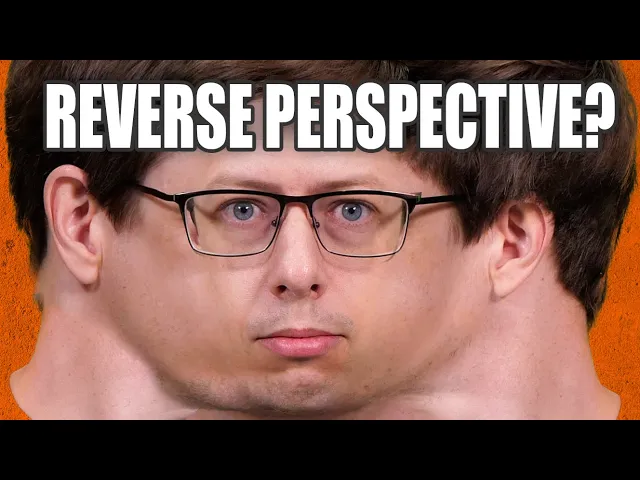
It's just so cool. Another weird lens we need to try is reverse perspective. The idea behind this is really simple.
So, all we should have to do is take the expanding field of view that cameras see and reverse it. It's essentially a giant lens with a negative field of view. Things that are close to it will appear small and things that are far away will appear large.
At least in theory. We've got Mr Crown behind Mr wig. If this works, he should look bigger.
[music] Isn't that amazing? Crown Man is way behind him, but he looms large over Wigman. I don't know [music] why it's so satisfying, but you have this weird theoretical thing, and then seeing it actually come out in an image is just the best thing ever.
I like his little pinched face. The main thing I've wanted to see this whole project is if I can look around an object. So, I have to warn you that this one is pretty weird.
So, if we look at a normal camera from the front, the expanding cone that it sees, it's coming from one point. I want to take this point and turn into a ring that's seeing sort of an expanding cone at every point on it. This would basically be a camera with a giant lens.
That's a ring. I told you this is going to be kind of crazy. If we sliced this imaginary camera in half and looked at it from the side, this is what the field of view would look like.
And what's really cool is you put something in front of the camera up to a certain size, it can see around it. Which means if I was hiding behind something, it could see me. The big question is, what is it going to look like?
Will it make any sense at all? So, let's find out. All right.
And I have to stand very very very still. It is really hard to stand this still. I should have used a chair.
[music] I'm pretty sure I moved. I guess we'll see. [music] This is [music] way better than I was expecting.
I I didn't I just I didn't expect it to be so clear. I kind of look like a Neanderthal or like I something really heavy hit me in the dome. I was expecting [music] this to be just totally messed up where if you squinted at it, you might see a face.
This [music] just comes out of the camera looking normal. The thing that's hard to make sense of is this sort of rabbitier looking thing [music] in front of me and that's the barrier. So, as the camera goes around, it would see around it in some spots and not in others.
At the bottom, it was always blocked, but it would start to become unblocked and see me from [music] the side. Then it would go up and it would be blocked by the corner again. Then it would come over the top and it would be unblocked and it would repeat.
I'm pretty happy with this. This is really cool. The pictures I've been getting out of this camera are really cool, but they're all black and white, which is kind of I don't know.
It's left me unsatisfied. It's the 21st century. We [music] have color photographs, right?
But the way that it works with a photo detector, it just sees how bright stuff is black and white. But when a digital camera takes a color photo, there's actually [music] three sensors for every pixel in the image that measure the red light, the green light, and the blue light. Turns [music] out that just collecting those three colors allows you to recreate a full color image.
And the reason this works is due to the specifics of how your eyes see color. I'm not going to get into those weeds right now, but [music] we should be able to do basically the same thing with this camera. So, I made three little color filters, red, green, and blue, that we can attach onto the camera.
So, we take three pictures with all three filters. We should be able to combine them and get a color image. Let's see if [music] we can do it.
It actually works. You see the images coming in, they look terrible, and then you stack them, [music] and this is like bam, color photo. I think this is my favorite thing I've done with this camera.
I don't know why. It's [music] has all these imperfections and flaws. The images don't line up exactly right, but it's all real.
I didn't do this in Photoshop. This is the camera making real garbage. It's authentic [music] garbage and I love it.
And then I did a lowresolution photo and I actually like that one more. It's like a pixel art view of my scissor lift. It's just so cool looking.
[music] I hope I explained this thing well enough that you generally understand it, but I know I glossed over a lot of stuff like how does it take millions of sensor readings and turn that into an image. The basic unsatisfying answer is math and science, which I've spent a lot of time learning. It's what enables me to make stuff like this.
So, if you want to learn technical stuff so you can make stuff, too, you should check out this video sponsor, Brilliant. I like to describe Brilliant as a tool that's really good at [music] teaching you technical stuff. It works by taking complex topics and breaking them down into a series of bite-sized lessons.
So, if you want to learn linear algebra, which is really useful, it's actually the math that I use to convert [music] measurements into pictures, Brilliant has a whole set of lessons on this, which first teach you theory, but then have you solve actual [music] problems, which are also interactive, so you're learning and doing, which is just [music] the best way to learn. Another important part of learning is being consistent. I try to spend at least 30 minutes a day learning something new.
It's actually how I've picked up a [music] lot of my skills and Brilliant is designed for this. The lessons are the right size for you to do one or two a day. If you make a habit of doing this, you will be shocked how much you learn.
So, if you want to expand your technical skill set, you need [music] to check out Brilliant. I've used it a ton. It works great.
They literally have thousands of lessons across programming, math, machine learning, all kinds of stuff. And you can try [music] it for 30 days for free. Just go to brilliant.
org/stuffmade or stuffmade here or scan the QR code or click the link in the description and you'll also get 20% off an annual premium subscription. [music] And that's it. Thank you Brilliant for sponsoring this video and I hope you go out and learn a bunch of stuff because it's really useful.
I know this thing makes worse pictures than a camera that even costs probably $2, but [music] I just cannot help but love it. When I'm using this thing, I feel like I'm making actual art, which [music] I do not feel like with a normal digital camera. I think it's because it is so hard to use.
It makes the pictures less cheap. And one thing I haven't done with this yet is try to take a portrait of a person. So, I'm going to get my wife if she'll let me.
We'll see if we can get a portrait seeing around her head. It might be so ugly that she won't let me post it, but we'll have to see. Welcome to my photo studio.
What do you think of my camera? Looks more like a llama or a giraffe. It does kind of look like a llama.
Would you ever guess this is a camera? No. What would you have guessed that this is?
[music] a llama. It even has nut and bolt eyes. You probably feel just like the first people who ever saw a camera felt.
What the heck is this pile of junk? And then [music] they're amazed. They said, "Why did I ever doubt you?
" "Oh, I'm so proud of you. You're the best. " And that's what they said to the photographer.
I think they [music] said, "Looks like a llama. I'm going to be trying to take what what you might call a non-traditional portrait of you. All I need from you is for you to sit very still.
Right there. All right. Sit still.
I know you want to say stuff, but don't sit still. You look just like one of the old settlers getting their picture taken. I don't know if I'm ready.
Here it comes. It's like I have a beak. [panting and gasps] I've heard the camera adds 10 lb.
[laughter] That's what it definitely does. It's not that it added 10 lbs. It's that it's seeing you from five sides [music] at once.
It's your face. It's the top, bottom, sides unfolded like [music] a map. You would think seeing a woman from all the sides at the same time would be like really beautiful, but [music] my eyes are like pit of despair.
Looks like I've seen some stuff. You know, you kind of look like Thomas the Tank.