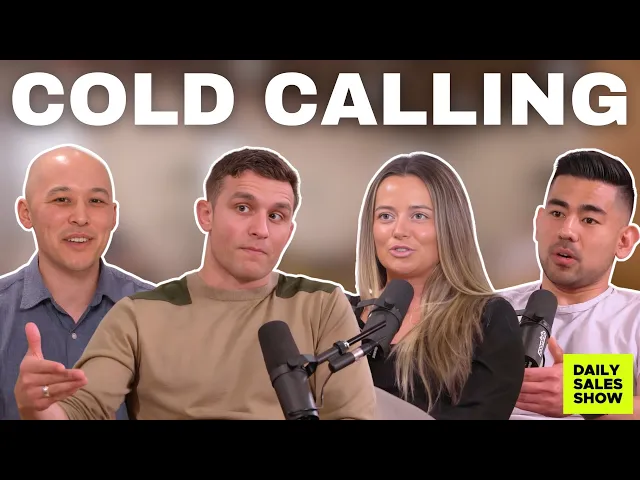
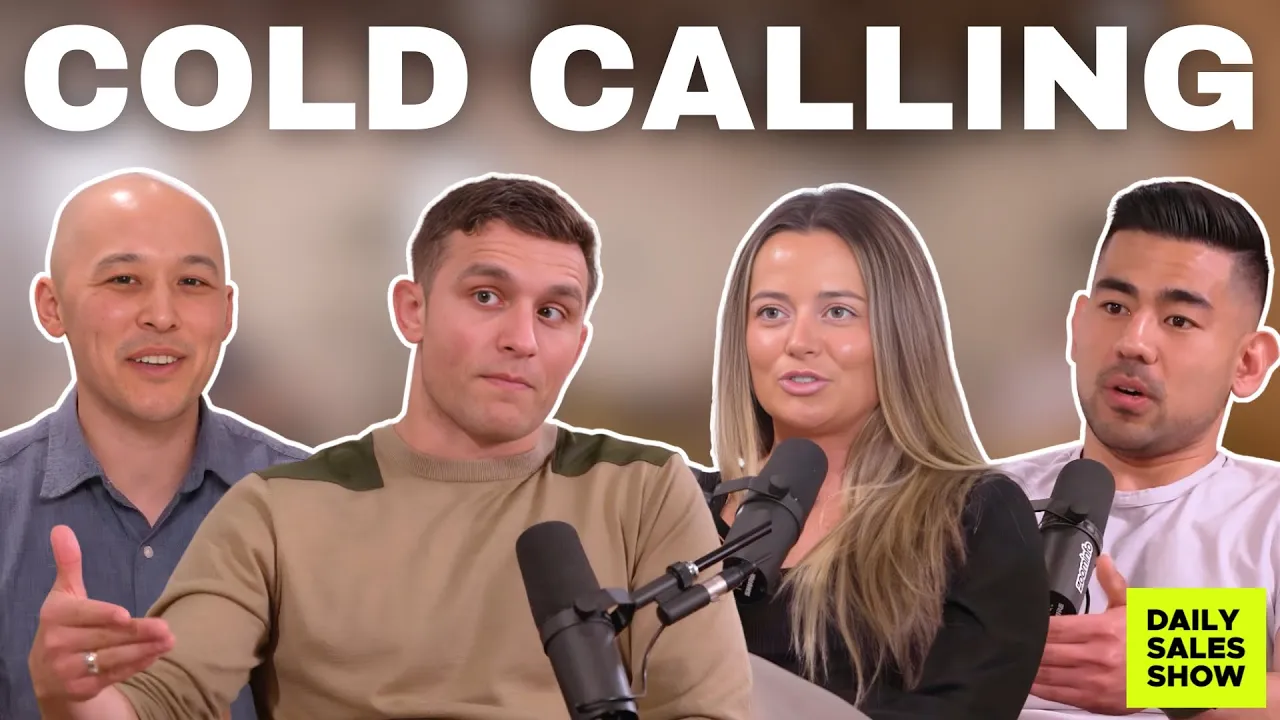
So, we're going to do a cold calling master class. So, we're going to talk about everything you need from when to pick up the phone, what to do when the prospect picks up your openers, your hooks, and how to ultimately close and get the meeting and and get the person to land. So, cold calling, this is still a productive activity for them to do to book meetings.
That it takes 1 hour to make 40 cold calls. If you can make 200 cold calls in a week with 1 hour a day and you're good on the phones, that can usually yield you at least two meetings if you're solid. Where else in sales with 1 hour of time per day can you generate two extra meetings per week?
And there aren't that many other channels that can do that. So, you might as well add the extra hour to do the cold calls. Is there anything that you do to get the right energy or get into the right mindset when you start to cold call?
Like it is so nerve-wracking and even now I go through a few days where I don't cold call and I get to that Friday, right? Cuz I really want to post a cold calling video and I still have the nerves. I'm like, "Oh my god, like this never gets old.
" So, first off, give yourself some grace because it's always hard to just start cold calling. But for me, standing up, it's the littlest thing that you can do that honestly makes a great difference because like power stance is a real thing. I feel like not a lot of people are going to want to hear this, but cold calling consecutively and just sticking to it for 30 minutes every single day, no matter how many calls you get through, it doesn't have to be a whole lot.
It could just be 10 that you focus on every single day. And being consistent is automatically gonna make you more confident because the second you pitch someone, I always find that if I go through 30 calls and I get a million voicemails and then I pitch one person, I'm so nervous for that call, but after it's like this exhilarating feeling where you get the energy and it's like that adrenaline rush that you do want to keep going. So my tip is just stand up, be confident, and do it every single day, even if it's just 30 minutes.
So you two, if we could quickly rattle off, what is something that you have done or continue to do to get in the mindset? We'll start with you, Nick. What is like your routine?
How do you get prepped? I've got two mantras that I lean on really heavily when it comes to cold calling. The first, I think it actually echoes one of the things you shared, Sarah, which is you don't have to feel good to get started, but you do have to get started to feel good.
I don't care how long you've been cold, you've been you've been doing it for so long, and you still have that anxious feeling in your stomach. I've been making some cold calls recently prospecting my own sponsors and I get that really anxious, nervous feeling. It will not go away.
And so, you've got to be able to separate how you feel inside from taking action. There is zero prerequisite that you feel like making cold calls in order to actually go take action. The other thing that I remind myself is that my success in sales is going to be determined by the number of uncomfortable conversations that I'm willing to go seek out.
And no doubt cold calling is the best and the fastest way to your point to go have those uncomfortable conversations. And you got to do it. And once you actually start taking action, you get in the groove.
Once you have that first pitch, you feel good. And then you can get going. You got to get started though.
That is the most important thing. I love the act of separating how you feel about something from your behaviors. Those don't have to be connected.
We can separate those. I love that. Arant, what about you?
Your first five dials are always your worst five dials. Yeah, always you will not feel good until probably your first usually your second connect. And so it all becomes a game on how do you hack getting started?
And so I believe that you need to give yourself sticks until you respond well to carrots. And so the way that I do that is I do something called habit stacking which is from atomic habits. And so I take the thing that I want to do and I put it behind the thing that I need to do.
For example, you walk into the office, you walk into the sales floor, you talk to your co-workers, you check your inbox. I'm not allowed to do any of that stuff. The night before I'm preparing all my research, I'm preparing my $40 dials for the next day.
When I walk in, I'm not allowed to open my inbox until I hit my 40. And if that means I literally stare at my computer and the blank desktop for eight hours straight, that is what will happen unless I make my cold calls. And so you have to force yourself to start.
And then eventually you start to realize it's similar to cold plunging. Those first few cold plunges, those first few minutes, they sucks so bad. But then you start to realize once I get to that third minute, oh man, I feel great.
And then your body naturally just realizes, oh, I'm supposed to do this thing first. Let's dig into some more tactical things around the mechanics of the call. How do we actually chunk the call into parts?
And typically the way we look at this is intro, hook, and close. So your intro, your first 60 to 90 seconds, your hook, what happens in the middle part of the call, having dialogue with the prospect, finding a problem, etc. , and the close, securing the meeting.
So let's talk intro. Nick, I want to kick this first question your way. What are the most common mistakes that reps that you have worked with, seen, mistakes you've made yourself when you think about the first 60 to 90 seconds?
Cuz that's where 80 plus% of cold calls tend to fail in that first 60 90 seconds. What are some of the common mistakes that you see in here? So, let's put ourselves in the prospect shoes for a second.
Most prospects, myself included, get dozens of cold calls a day if you're a senior level prospect from all different types of salespeople. You've got the sales people selling your extended car warranty, refinancing your student loan debt. There's all like the garbage telemarketers.
And then there's what I think you are if you're a salesperson, which is you're probably making a wellressearched or at the very least pretty well targeted cold call. And there's context for why you are making that cold call. Whether it's you found a trigger, a piece of of research that made you say, "Hey, I should call this person.
" Or they're very tight in your ICP. I think a lot of sales people fail to make that abundantly clear to the prospect upfront. So what they'll do is they'll get themselves lumped in with most other sales people by opening with, "Hey Jason, this is Nick Sigilski.
How are you doing today? " And we both know that I don't really care how you're doing. I'm trying to sell you something.
And so we're already leading with it's just disingenuous. I'm lying. I'm like, "I don't care how you're doing.
" And you know that. Or I'll say, "Hey, did I catch you at a bad time? " When we're literally making a cold call it is a bad time.
So, I always use like a what I call a tailored permission opener where I might say something like if I call Sarah, I'm like, "Hey Sarah, I just finished reading your job posting about the new AES your team is hiring for, "My name is Sarah and I know I'm calling you out of the blue. Do you mind if I get half a minute? I'll share why I called you specifically.
" And then you can tell me whether or not it's worth a chat. And what I'm doing there is I'm actually leading with the context. I saw you were hiring for those AES.
And that gets them to sit up and say, "Oh, this is not just like a random telemarketing call. This is a targeted, intentional cold call. Yes.
So, I think a couple things to double down on there and highlight is I think we can all agree here, prospects don't pick up cold calls on purpose. Like they thought you were someone else. Yeah.
So, context, that word is really interesting because you're really trying to show them that you use the word telemarket. I use this when I train reps. You're trying to shift from telemarketer to respected peer.
And the way that you do that is by adding context and researching. Right. Armand, you have one that I'm a big fan of.
I I teach this to reps and give you credit, of course, the have you heard our name tossed around opener. What does that sound like? Life insurance, which is a riveting career.
And they start by having you call like your mom, your uncle, and then you run out of people then like you can't get your family start. So that's when most people quit. And I was like, "Okay, I'm going to go cold.
" And so I started calling all of the partners of the law firms in downtown Los Angeles, right? And these folks are like, all of them are making seven figures. All of them get peppered with cold calls if you can even get to them and not get past their gatekeeper, all that stuff.
And I have never been so eviscerated in my entire life on the phones. I made $800. Four weeks in a row, $800, $200 a week, zero meetings.
And it was because every single time I was 19 years old, I pick up the phone. Hey, it's Arman from Northwestern Mutual. How's your day going?
Or did I catch you at a bad time? And it's like they could smell it. They could smell it in my tone.
They could smell it in my opener. It's because one, my tone sounded like everyone else. And then two, I was using the same pleasantries that they had heard from 300 other telemarketers, right?
And so I almost quit. And this guy named Brandon Matloff walked by who is a seven figureure insurance producer and he's, "Hey kid, no one's going to book a meeting with you for that thing. " And I was like, "Thanks.
" And he's, "I work with a bunch of people in that office. " And I'm like, "Okay. " And he's just say you work with a few other partners in the office.
It's Arman from Northwestern. Have you heard my name Tossone? And I was like, I haven't worked with them.
He's like, that's why you're going to bring me along. And so I was like, yes, I'll do it. So I pick up the phone, drop my voice down a couple notches, just like him.
Sound a real swave. And I was like, hey Jason, I work with a few other partners in the downtown LA office of Scatteren. It's Armand from Northwestern.
Hey, have you heard my name tossed around? And he goes, "No, I haven't, but how can I help you? " And I'm like, "Oh, now you're nice.
" And the reason for that is I open like a peer and even if he isn't interested in what I have to offer, he's not going to be a complete jerk because I work with other people of his stature. In other words, I've established that I'm one of his peers early on in the process at the front of the cold call. Besides the words that you say, I want to talk about tonality because this is something that honestly I find very hard to teach, but it's very easy to call out.
And there's this mode, you almost transform into a different human being. And there's this customer service voice that you use. Hi Armand, it's Jason with Outbound Squad.
How have you been? And you transform into a different human being. So I want to kick this question your way Arman real quick.
Pointers on tonality. If someone is trying to sound more like themselves and really break through as a human being, what advice would you have for them? The two most common culprits are number one, uptones, and then number two, talking way too quickly.
Yep. The higher up you go in the chain of command with executives, the slower they talk. Right now, I'm intentionally talking very slowly.
And the reason for this is I need time to compose my thoughts. Otherwise, I'm going to start stammering and start using ums and a's and all the stuff that sound really nervous, right? But if I slow it down, I give myself time to think.
That's number one. Number two, a lot of times when they're when people are unsure or if you're asking a question, you'll end in an up tone. And it's okay to end with questions in an upton or if you're leading to a point, but most of your sentences, if you listen to your conversations with friends, end in down tones.
And that has nothing to do with having a high pitch voice or a low pitch voice. So, if you can do those two things, if you can slow down and if you can notice some of your uptones and maybe have your friend record you, you'll spot the differences and you can just start to calm down a little bit on the cold calls. We just had Chris Boss on our podcast, but one thing Chris shared with us is if you want to get a down tone out of yourself, you tilt your chin down.
And if you tilt your chin up, it'll actually help you get the up tone. So, if you want to have an up tone when you're asking a question, tilt the chin up. If you want to have a down tone, tilt your chin down.
Let's talk about what's next. So, we do a permission-based opener or the have you heard our name tossed around opener. Let's talk about what to say next.
The common mistake that I see here is people get into product speak and they start talking about their solution and there's no context provided to the prospect. So, Nick, I'll kick this question your way. Okay, I did my promotion based opener.
Prospect hands me the mic. What should come out of my mouth next? What's the approach here?
I think a lot of sales people get taught, I think this gets caught taught a lot in like high school and college, the idea of a a value proposition where you're talking about the great things that you can do, the great things that you bring to the table, the great things about your company. And the problem I think with a value proposition is again, put yourself in the shoes of the prospect. We've interrupted their day and even if we led with some context, they don't really know what the heck's going on, right?
They opted in. All right, Nick, go ahead. You've got a minute.
What I want to do is I want to use what's called a problem proposition because I want to make it very clear to the person that I'm talking to the types of problems that we can make go away rather than talking about the great things that my company does. The reason for that is if I give a value proposition, it is now on my prospect to figure out how that value proposition actually connects to any of the things going on in their life and the problems that they might want to make go away. So I need to do that work for them to reduce the cognitive load that I put on the person that I am calling out of the blue and just tell them here's the problems we might go away for me when I'm selling law firm billing technology which is what I used to sell for a long time I would say something like they say all right Nick go ahead you've got a minute I'd say great thank you Jason look Jason the reason that I called you is I talked to a lot of CFOs of insurance defense law firms and most of the folks that I talk to tell me that they're really frustrated with all of the deductions rejections and appeals that they get on e billills that they have to send the insurance companies that they end up billing on behalf of the clients they work with.
Look, I know I'm totally calling you out of the blue, but that's a problem that we make go away for about 300 different law firms in the US, and I'm wondering if you might be open to learning more. I'm not cold calling you out of the blue. Hey, I talked to people like you, CFOs of insurance defense law firms.
Here's the thing that they tell me they're frustrated with, frustrated, anxious about, concerned with, angry at their wits end with that helps orient around a problem rather than a solution. Hey, we make that go away. And what I'm doing here is I don't expect them to be like, all right, sure.
I expect them to be like, how do you do that? How do you make that go away? And now I have consent again, permission again to move to the next stage of the cold call, which is having a conversation around how we might be able to make that work.
So, love it. And just because the people here on the show are wanting it, can you give your opener real quick? So if I'm selling to law firms, I don't want to do too much research.
I don't want to look up every single law firm. I just want to look up something that's relevant to what I'm selling. So what I would usually do is if a law firm had won a case recently, which often they'll announce on their site, they want to brag about the things they've done.
But when you win a case, usually that means you have to collect money. And that has some implication for billing. I might call Sarah and say, "Hey Sarah, I just finished reading about the big Acme case you all won.
Look, my name's Nick Sigielski and I know I'm calling you totally out of the blue. Do you mind if I take half a minute? I'll tell you why that case win prompted me to call you specifically and then you can tell me whether or not it's worth a chat.
Sarah goes, "Okay. " And then I might include then when I give that problem proposition is a quick attachment of, "Look, usually when I talk to law firm CFOs and they win a case, that means they have to collect money. " And a lot of the insurance defense law firm CFOs I talked to tell me it can be really frustrating having to bill these clients only to get deductions and rejections and appeals from these insurance companies because the bills aren't in the right super convoluted format that they have to send them in.
And I'm calling you about something that I think can ease a lot of the frustration related to that. We do it for about 300 different law firms in the US and I guess I'm wondering would you be open to learning more when I'm not cool calling you out of the blue. Sarah, same to you if you could because the people are wanting to hear again an example of a permission based opener that you use.
And then what does that next part when the person says yes? What's an example of what you might say there? Hey Jay, it's Sarah over at Paro.
You're going to hate me. This is a cold call, but I was wondering if you just had 27 seconds to chat. They say yes and I say great Jay.
The reason I was giving you a call, I was actually at a networking event yesterday where I met Nick Sagleski. I'm recommended I reach out to you. The reason for my call is it'd be super ignorant of me to tell you exactly how I could support you with some of the things I just mentioned right this second, but I was wondering if you had an extra 30 minutes tomorrow or Friday at 2 p.
m. and I go right for the hard clothes. Is that similar to Nick and that these are common problems that you hear?
Yeah, my X or Y is Yeah, sometimes it could be a common problem. If I do ask a question after my actual pitch and I don't hard close, my first question is always, what are your top three sales challenges at the minute? and all of a sudden you get a wait a second like why are you asking me that question but I almost always get an answer which is awesome because you could just use that to then say that's exactly why we should meet like a lot of prospects right now they're saying the biggest challenge right now on my sales team is finding really good sales talent and we're a recruitment agency so I'm like great that's exactly why we should meet because I want to tell you exactly how we could help you find great quality talent in the market right now so yeah that would be my X or Y Arand again give the people a taste if if there's a different intro that you will sometimes use.
Give him a taste of that and then what would happen next? To value prop first 60 seconds of cold call. So you'd open with the heard the name tossed around opener and let's assume that we're using the same life insurance example.
Very similar problem prop you'll hear that Nick used. It's Arman at Northwestern. Have you heard her name toss around?
They could say yes or no. It doesn't matter. Same exact thing happens afterwards.
The reason for my call is Yeah. Typically, when I'm talking to other Scatteren partners, they all have the this sort of weird blessing but horrible problem where you make so much money that you give away half of it every year around tax day, which is coming up in a couple weeks. And I I can't do much to help you out this year.
But the reason that I'm reaching out is I've helped other Scatteren partners do things like investing in certain types of vehicles and whatnot to make sure that you you keep most of the money that you've made throughout the year. I think you're probably going to have all that stuff taken care of to be honest with you, but would you be completely against me dropping by your office when I'm there next week if for no other reason to put a face to the name? And so there are a couple pieces of that.
So number one, lead with the problem. I want to trigger them a little bit. Bring them back to the memory of tax day when they literally had to give away half their paycheck.
triggering problem a minimum amount about my solution so that they know I'm not like a financial guru who's going to try to give them like Bitcoin like off in Scotland type of like moneyaundering tactics and then a push away before I ask the push away the before the ask is you're probably going to have this all set or my guess is you have this totally taken care of or you're never going to buy this thing right but would you be open to learning more just so you can get a sense of how I've helped other people like you. And again, most people will not say yes. Very rarely after any of these will someone say, "Yes, I'm it.
" But I've used the context and the familiar thread to show them that I've helped other people like them, which will make the next objection land softer. We have permission based opener or a happy herder named Tossan opener. You call it a problem prop.
We all really agree on this part where this is the part to nail in the cold call. If you can get in their language what you hear most in common from the peers that you speak with. If you're an account executive, pay really close attention to in your intro calls.
What do people tell you is the reason they want to talk to you. If you're an SDR and you maybe don't have some of that information, listen to recordings of sales calls with your account executive. If you nail this part, in my experience, I'll get responses like, "Wait, yeah, we're dealing with that.
Who are you again? What do you do? You want to get responses like that where people feel like you're a fly in the wall of their virtual meetings.
Let's talk about what to do next. So, we have the intro. What I want to get into now is the hook and the close.
I want to kick this question your way, Sarah. I think we may have differing opinions among us on this part. I'm a very big proponent of if you don't have pain or something frustrating, the person's just not going to be very motivated to show up to that meeting.
Is that similar or different to your approach? I think like sometimes if they don't have a pain, it's creating that pain and like teaching them that there actually is a pain even though they don't think there is. So I think sometimes if I actually get into the questioning part, I don't hard close and I start asking them some questions and a lot of the time I'll get we're actually all good.
We have a great internal team. Like we hire the best people ever and that's where I'm actually like oh my god I'm so stuck. Like I don't know where to go from here.
And typically what I'll say is it sounds like you guys are honestly a really welloiled machine. Like you just said like you've used an agency or you've used your internal team. If you could wave your magic wand and improve one thing, what would it be?
And I almost always get an answer from that. And it's just really listening on that call of like how can I turn this around and create a pain point. You won't always every single time, right?
Because a lot of the times you'll get everything's great, everything's dandy click, right? So give yourself some grace. But I think it's just like finding any single way that you could just open ask an open-ended question that's going to give you an answer that you can build off of.
So that's one really big thing that I do. And you can ask that for any industry, no matter where you're calling from, and use whatever they say to actually say, "Yeah, that's something that we could actually help you improve. " And then they start thinking, "Oh, maybe I do have a painoint or maybe that is something I could improve that I didn't think we actually could or that I thought was a problem.
" Um, so I think it's just like you have to create something even though there's not a pain. Uh, I think a a pain or sometimes a large aspiration. I'm thinking of some clients that I've worked with.
It's not always like a big problem they're hiring me for. It could be we need to double this thing and we need to do it really quickly. I like this pros and cons approach to that objection too where if someone was like, "Hey, we're hiring.
We do all of that internally. Hey, that's great. Sounds like you're totally taken care of.
" Usually what I hear from sales leaders is that they love that it's really quick and they don't have to work through a third party. But one of the things we oftentimes hear is that HR doesn't quite have the same hiring style or preferences that you do and sometimes you get people that are a little bit of a waste of time. How does that compare to your experience?
Yeah. One of the things I learned this from the folks at Zoom Info actually. They call it customer voice.
I don't know if they came up with that or not. It's speaking through the lens of what you hear other people like them talk about versus saying you're doing it wrong. We can do it better.
But it's really easy to get into that mode and almost take the objection personally. Yeah. From the prospect.
Nick, active listening. Like the middle part of the call. Yeah.
Like where you're asking questions and just being able to shut up and listen and like really listen. Do you have any advice? My nature is to always want to like talk.
Like I love talking. I really love it. The biggest thing that has helped me is this cup of water.
Historically, my tendency is to listen with the intent to respond as opposed to listen with the intent to listen. And I'll hear somebody say something and I'm really excited to be like, "Oh my gosh, it's really interesting because we can help with that. " And boom.
What I do now is somebody finishes talking and I force myself to take a quick sip of water. And what this does is it has it's it's an artificial pause that I create for myself. It works really well on Zoom meetings.
We're talking about cold calling today, but it works really great on meetings also because it shows, hey, I'm going to take a second before I respond. So, that's honestly been my biggest thing. Um, I'll even put my phone on mute sometimes because it forces me to take myself off mute before I talk.
Whatever little quirks you guys watching have, if you find yourself cutting off a prospect in the middle of a cold call, these are just little habits that you can create to to help. Uh, Arman, middle part of the call, we've gotten a chance to do our problem prop. Mhm.
What advice do you have for creating dialogue, asking questions, like really creating intrigue to really set up the close for the call? Yeah. So, I'll tie together two of the things that both of you all have mentioned, which is number one, Jason, you talked about if there's no pain, how do you unpack it?
And Sarah, you had some tactics around that. And two, Nick, you talked about active listening. And my goal with the first 60 seconds is actually to sprint to the first objection.
I want to get to the first objection because a lot of cold calls don't even get to an objection. They just end in a brisk hang up or a quick noted, and you might not even get to the pitch because you screwed up the first 60 seconds. So, if I can establish myself as a peer, my goal is to start with the first objection and that usually begins a conversation, right?
The way that you turn an objection into a conversation is I call it splitting objections and it's part of the Mr Miyagi method. If you say, "I'm not interested. " I could return with a pitch, but that's both of us talking at each other now and you're going to win because you're going to hang up.
Instead, what I'm going to do is I'm going to try to Miyagi with your objection. You define that. Have you seen Karate Kid?
No. You're making us old. Uhoh.
We're total boomers, dude. Miyagi. Karate Kid.
Miss Miyagi. Cobra Kai for you new folks, but there are three steps of it. And the whole premise is there's this premise in Karate Kid where I can't believe I'm explaining this.
There's this premise in Karate Kid. Let them jealous. Is that the movie?
No, that's Kung Fu Pad. My goodness. Someone throws a punch and there's this sensei called Mr Miyagi and you don't counter the punch.
You don't block the punch. You wax the punch off and then you wax it on. You redirect the momentum of the punch.
And that's what you have to do with objections to create conversations. The first thing you're going to do is agree with the objection. So if someone says, "I'm not interested.
" I'm going to say, "Hey Nick, I totally get that. Honestly, you probably would have called me if you were. This one's on me.
Sit for a second. " Now Nick is going to take a breather. That's step one.
Number two is I want to split the objection. People tend to be more open to conversations when you one demonstrate you were listening and then two give them options to grab onto. And so after I say that, I'll be like, "Hey, just so no one calls you again, could you give me a sense?
Is it because you have something in place, you're doing this in house, or I just totally caught you off guard and you hate getting cold calls? It's got to be one of those three things. Or they'll give me a fourth.
But if I just said, "Why aren't you interested? " Now it's a confrontation. All of a sudden, Nick is, "What's going on?
" What I did is I agreed with it and I'm like, "1, two, three, which one is it? I'm hearing you out. " And now they're going to share their actual situation because I've removed the pressure of the sale and I've demonstrated that I understood one of the three situations that they're in.
And I said, "Just so no one cold calls you again, could you give me the actual reason and that will give me the real reason that allows me to have a conversation and then use their actual solution to uncover some pain from there? " I love the Mr Miyagi framework. When you give a multiplechoice, you're making it easier to answer and executives especially appreciate nothing more than like ease of communicating with you.
Yeah. So, I think like reducing friction, giving options. The other thing that you're doing too is you're demonstrating like I've done this before.
And when you can almost read the prospect's mind, that's when you get people to really lean in. If before the call you think about what are the common priorities that the prospect might have. That's the problem prop or your opener or reverse pitch that I call and then think about what the current solutions are and then the problems associated with those.
So think about what is the thing that your prospect really wants to do. How do they get the job done now and what are the problems? It sounds like what you're doing is maybe after that initial problem prop if they ask you more when you actually have a little bit of back and forth and forth, what you're doing is you're almost piling on to the problem and being like, "Yeah," they say, "Yeah, that is frustrating.
Our bills have been getting rejected and there's been a lot of issues. " What you're doing is you're being like, "Yeah, a lot of the CFOs I talked to, they're either doing it this way or this way. " And you're basically giving even more context around the problems and the sort of halfbaked solutions that you're seeing from folks as a way to demonstrate your expertise in that problem space and also encourage them to share more which should solidify your ability to land and secure the meeting.
Is that how you're doing it? I'll give you a really practical example. Here's the way it sounds.
So I have a client that sells into contact center leaders in like Fortune 1000s. Yeah. So they'll say their reverse pitch.
Hey, a lot of the contacts lead center leaders I talk to, the number one priority they have is reducing cost to serve. Yeah. So, they have FAQ pages, they have chat, but people look for the phone number and they decide to pick up the call anyways and you want to reduce call volume.
Yeah. How does that align with your priorities? Yeah.
Yeah, that's definitely Hey, I'm really curious like that FAQ page. A lot of times what we hear is that people have reworked it with their digital team a bunch of times. They put all of this effort, hundreds of thousands of dollars into it and then people just call in anyways.
How's that compare to your experience? And you just get them talking about it. And if you nail that part of it, I've talked about how they've tried to address the problem and the problem itself.
And then that becomes the reason for the close. That is the exact problem that we've solved for companies like Nordstrom and several other retailers. How about we unpack this a little bit more when I'm not cold calling you in the middle of your day?
Do you got your calendar handy? So you can just like seamlessly transition from you want to do this thing, you've tried to solve it this way and I've done that in two minutes and then I get to segue and what I want to get to now is the close. I think the purpose of the close is get off the phone.
You should be the one to suggest a next step. I think sometimes people get stuck because you don't know where to take the call next and it naturally fizzles out and the person says send me an email. So, how do you transition, Sarah, when you know you've got the prospect hooked and you've had some good dialogue?
How do you transition into asking for the meeting? So, big believer in hard clothes. However, I think where a lot of people get stuck, just to emphasize what you were just saying, is SDRs ask so many questions and sometimes they ask really good questions, but they keep going and I'm like over behind them and I'm like, "Close for the meeting.
Close. " I'll literally write it on a big sheet. I'm like, they're just asking you so many questions.
But I think right when you ask them a question and they come back with something, I'm a big believer in saying that's exactly why we should meet. How about we meet tomorrow at 2 or 400 p. m.
Eastern time and I could walk you around exactly how we could help support you with. So I think it's just also making it as easy as possible for the prospect to say yes to you as well. So that's why I always like giving two days and two times.
So like tomorrow or Friday at 2 or 4:00 because a lot of these times I'm calling a lot of CEOs, CRO's, CMOs and they're not always necessarily at their desk or they're doing a million things at once. So if you could give them a day and time where they can at least picture in their head their diary or their calendar, you just want to make it as easy as possible for them to say, actually, you know what, I do have a gap in my calendar tomorrow at 4:00. Yes, definitely.
Let's do that now. Just so I'm best prepared for this meeting tomorrow at 4:00. what would you like me to tailor it to based on what we said today so I could best prepare for that meeting.
The second question is who else would you like to add on to that meeting? Because let's try to get as many decision makers as we can on one call so you could kill two birds with one stone. And last but not least, make sure the email is right that you have.
I have so many SDRs and me as an STR as well thought I had the right email and I didn't just because you typed it in wrong or maybe they didn't get it wrong emails. That's everything I put into the clothes just because you have them. Get as much information as you can while you're there.
I think one thing to highlight there is the easiest way to transition it is to just summarize what you heard. Here's what I heard and we can help you with that. Let's meet.
This is exactly why we should meet. And I say those exact words and they're like, "Oh my god, yeah, we that's exactly why we should meet. " Let's talk confirmation real quick, Nick.
So, we've transitioned. We've set the meeting. What about calendar invite?
Do you recommend sending the calendar invite live while you have them on the call, waiting until afterwards? I think in a bestcase scenario where you've got a prospect who's going to sit and wait for you to send a calendar invite. Of course, I would like to be able to say, "Cool, Sarah, I just sent you a calendar invite.
Just so I know we're good for that time. Would you mind hitting accept on it? We're going to put some work into prepping for this thing.
" If you send a calendar invite to someone who you have not had email interaction with, it doesn't hit their calendar unless they accept it from the email. So, if you don't get them to accept on there and the email gets buried, the meeting doesn't even show up on their I think what you should do is cite what you just said where it's like, "Hey, I know Gmail just had a change where you and I had corresponded before and sometimes it won't show up on your calendar. So, we literally it will seem as if I didn't do my job and dropped the ball if you don't hit accept because it won't show up on your calendar.
" Yeah, I like that. Then I really love what you said, which is I feel like so many sales people feel like they are inferior to their prospects or they're bothering their prospects. They agreed to a meeting with you on the phone.
And if they haven't accepted it, yeah, you absolutely should call them again. I talked to so many sales people who are afraid to call their prospects because they're worried about interrupting them. Oh, I'm just going to email them again.
I'm call them again. I love that. And you're not an inconvenience or an interruption there.
Wow, this person's a pro. I love that. Another quick pro tip, get the optin to text them.
Yeah, I've been doing that. It's By the way, is this your cell phone? I'm assuming you might have to shoot you a quick text if anything comes up and do it via text instead of playing phone tag.
Arman, because we have 2 minutes left. Do you have a quick tip to add anything different from these two on just it could be in the cold call in general or just buttoning everything up to make sure that the person shows up. I'll give you two whether they say yes or no to your meeting.
The first one is if I hear an SDR on the phones that hears a prospect say, "Hey, just send me an email. We'll coordinate times, I'll go like this in front of them. " And what this means is I'm holding a baby.
And that means don't drop the baby. First thing, I promise you, you will get 10% more meetings just from this tactic. If someone doesn't have their calendar or they get overwhelmed because you suggested times, always do not ask.
Send a placeholder. tell them you're going to send a placeholder. And so what I'll usually say is I'll say, "Hey, Jason, totally get it.
I know you're probably running between meetings. I'm going to send a hold for like next Thursday in the afternoon so it's out of the way. That's probably going to be an incorrect time and I'll follow up with a few other times that also work.
If that hold works, would you mind just accepting it or picking another time if it doesn't? " So that's number one. Number two, I learned this from Mark Costco, the exit.
If you get hit with two or three objections, you're going to leave with a meeting. Here's how you do it. You say, "Hey, Jason.
Honestly, I really appreciate you just having this conversation with me. I don't think this is relevant for you guys right now, and I appreciate how much you've shared with me. If it's okay with you, in 3 months, I would love to put a reminder on both of our calendars for me to touch base with you again for 5 minutes and see if anything's changed.
Can I send you that calendar invite for July or August? " And that is a way to get back on someone's calendar and leave with grace and exit a cold call on good terms. Love it.
We can end there. Thank you everyone for the participation today. Awesome.
Thank you. Make sure to connect with these folks on LinkedIn. Appreciate everyone's time.