welcome to the first session on commodity derivatives and risk management before we go into more details of what exact Amada T derivatives and how this commodity derivative contracts can be used to manage price risk let's understand what is a commodity how do we define a particular asset to be a commodity let's go to the definition which is normally given in textbook that is commodity by definition is a good which is produced by many producers companies and firms without any qualitative difference and the producer cannot be identified by examining the goods here I would like to
stress open the set of words that is without any qualitative difference let me pose a question to you let's say you go to your inner neighborhood grocer and ask for a packet or for 1 kg of sugar and when the grocer delivers you their packet of sugar merely examining the packet would you be able to tell which a sugar miller in India has produced this particular packet of sugar according to yzma that is your indian sugar mills association India has 211 sugar Millers and this particular packet which you were holding in your hand could have
been produced by any one of the Miller so that is where you know a commodity you know derives its definition that it is a good which is produced by many producers and companies and firms and we cannot distinguish the produced by merely examining that particular product or the underlying underlying asset which we are holding in our hand or which we are you know which we are examining similarly you know the same thing is applicable to in a Moodle may be rice maybe almonds cashew nut raisins maybe many things which we buy from the you know
from the neighborhood shops we will not be able to say which is who is the producer of that particular commodity by merely examining that you know product which we are holding in a hand taking that example to further a turn of steel or gold are produced anywhere in the india or world can be treated as a commodity or a term a copper or rubber produced anywhere in the world can be treated as a commodity let's say you know let's let me ask some a question to you there are six pictures of different commodities or different
items given here a picture of a car different you know different sizes of diamond and different shapes of diamond and you have a steel rod here you have a you know bar of two bars of gold you have a bar of copper and you have a gold chu ality if I ask a questions can you identify which set of commodities which set of items can be crude as commodities will you be able to do so okay let's go to the answer okay a car can never be treated as a commodity similarly the necklace or jewelry
piece will never be treated as a commodity because this jewelry piece will always be you know marked with the names with the name of the trailer who has manufactured this particular jewelry besides these two others can be treated as a others can be treated as commodity because by physically examining these you know assets will not be able to tell who is the producer of this particular in this commodity now the next question is that you know why should we will learn about commodities or commodity derivatives at this point of time human beings have traded commodities
since it's you know since the beginning of the mankind what is so new about you know commodity trading or commodities of commodity trading the new dimensions which you know which has prompted us to learn more about commodities are that commodity derivative contracts have started getting traded incommode in exchanges commodities are traded you know in the local market in the spot market from from time immemorial as mentioned however commodity derivative contracts are started getting traded and commodity exchanges and commodity prices are increasingly becoming volatile so let's you know let's go to this particular link this link
indicates the commodity spot price indices for three you know underlying commodities one is a commodity oil index and the second one is a commodity food price index and third one is a commodity metal price all these indices you know has been have been benchmarked to the value of 100 in the year 2005 that is the base year has been equated to hundred value and the base year is 2005 and analysis of this particular thicker or picture we can you know it is very clearly visible that the commodity prices has remained almost you know stable since
1992 daily probably maybe in January you know it would 2004-5 but subsequently you can see a great deal of volatility in all these three indices the second picture or the second graph represents the annualized return volatility of these three indices and as can be seen that the volatility of these return volatility of these three indices as increased as the years have gone by and from where have I collected this data the data sources from International Monetary Fund and the link to the International Monetary Fund is mmm you know it's given here so while we need
to understand about commodities or commodity derivatives is that commodities prices are increasingly getting volatile volatile and to mitigate the price risk associated with these commodities commodity contracts commodity derivative contracts are nothing available in commodity exchanges in fact earlier many countries did not have a commodity derivative exchange organized commodity derivative exchanges with in a progress of time with you know volatility of commodity prices increasing you know day by day almost all major commodity producers of the world have started their own commodity exchanges so that is the reason why it becomes you know it is quite important
for us or even congee for consumers and producers of commodity to understand what factors are contributing to the volatility and how commodity price risk can be mitigated the second aspect which or the the second set of aspects which has made it made commodities more and more interesting of late is that commodities are emerging as a new asset class many investors are interested to hold commodities in their portfolio because commodities tend to exhibit negative correlation with most other asset classes like you know which we normally hold in our portfolio like our equity bond and real estate
so almost all these in a financial asset classes tend to have a negative correlation and there are many research studies which are corroborating to this negative correlation and commodity investment also provide an effective hedge against inflation that is whenever inflation rises commodity prices also increase so this two combination you know these two facts that is you know commodities exhibit negative correlation with most other asset classes as well as commodities are his an effective hedge against inflation are contributing towards many investors interest getting interested in investing in commodities or adding commodities to their portfolio however commodities
in you know in its you know actual form that as real underlying assets cannot be held directly by investors so normally CIM investors have started investing in commodity derivative contracts that is your commodity futures and options to benefit from the diversification of portfolio and they are adding this commodity derivatives to their portfolio now let's spend some time in understanding what exactly is a derivative I'm sure all of you must be knowing what is derivative because this particular subject requires a prerequisite of understanding or financial derivatives such as options futures and options however at this point
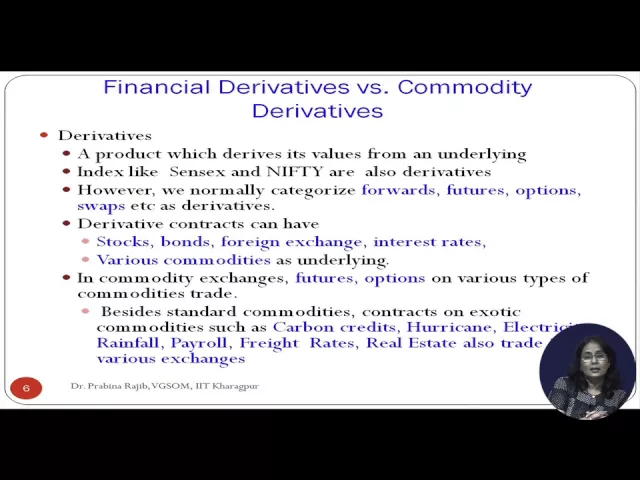
of time I would like to you know briefly take you through what is the difference between financial derivatives and commodity derivatives let's understand what is a derivative a derivative is a you know contract which derives its value from an underlying and to be very very you know simplistically if we can put it in an index popular index indices like Sensex and nifty can also be treated as derivatives because they decide their value from the surprises of the underlying companies which constitute these two indices however we normally do not categorize these indices as derivatives we categorize
derivative contracts or financial derivative contracts as we normally categorize forwards futures options flux swaps etcetera as derivative contracts and when we are talking about financial derivative contracts those derivative contracts are stocks bonds for an exchange and interest rates as underlying and commodity derivative contracts as we have discussed earlier commodity derivative contracts have commodities as the underlying and what do you mean by what what are the different types of commodities on which we have commodity on we have from commodity derivative contracts available that we'll discuss little later in commodity exchanges futures and options and various types
of various types of commodity contracts are trading such as you know gold silver agricultural commodities and many other different types of commodities which are available for trading in many commodity exchanges all over the world besides standard commodities commodity contracts on a exotic commodities such as carbon credit hurricane electricity as rainfall payroll flat rates real estate except they also have started trading in various exchanges and giving in or giving different opportunity to diversify their portfolio so a lot of investors a lot of traders are you know entering into these trading in these commodity contracts to you
know on some extra return which helps them in you know getting a better return from their portfolio having discussed what is the difference between commodity commodity a commodity a commodity derivative and financial derivative I would like to spend some time on understanding what is the difference between a commodity sport exchange and commodity exchange so when we use the word commodity exchange we normally mean it's a exchange where derivative contracts such as futures and options on a commodity straight in India we have two you know well known commodity exchanges that is your mcx and NZXT India
globally as I said mentioned as I mentioned earlier that is almost all country has now you know have now commodity exchanges somewhat the important of popular commodity exchanges are seeing me that is Chicago Mercantile Exchange DoCoMo Tokyo Commodity Exchange and the Intercontinental exchange and sancai futures exchange and one thing I would like to point out here is that in Chicago Mercantile Exchange not only commodity contracts trade also financial contracts trade in this in this particular exchange now let's focus our attention towards under standing what is what is a spot exchange or a spot market in
a spot market buyers and seller exchange goods for immediate delivery which does not happen in case of a commodity exchange in which buyers and sellers enter into a contract where the underlying asset or underlying commodity is supposed to be delivered at a future point of time in a spot exchange buyers and seller exchange goods for immediate delivery let's say buying two cases of potato from our neighborhood shop can also can be treated as a spot market and a farmer which is selling probably 200 quintals of potato to a whole sir a wholesaler in a local
Mundi is also treated as a spot market transaction earlier in India the spot market or wholesale market transactions were predominantly done on on face to face basis where buyers and sellers used to congregate at a local Mundi or local wholesale wholesaler wholesale market and the price were negotiated upon and between the buyers and sellers and they were in the commodities were exchanged commodities were exchanged as well as up you know subsequently price exchange was you know was happening between the buyers and sellers however with the advent of Technology Internet technology lot of this wholesale market
some undies are using a auction platform and bringing in buyers and tell buyers and sellers from far by faraway places and you know buying and selling is happening between these buyers and sellers so but this even if these markets have used our-our-our using you know online trading facility this are still providing a platform for for exchanging the underlying goods which are treated as a sport transaction in this context I would like to share the development happening at two spot exchanges online spot exchanges that is your NC x e markets limited and rusty rusty market services
Private Limited these are the two exchanges spot exchanges which are using online technology yuxin platform to bring buyers and sellers and providing a better facility to you know buyers and sellers so that each buyer has access to more number of sellers and vice versa and those who are interested to learn more about these two spot exchanges and how this to spot exchanges are using technology to you know bring more buyers and sellers to this common platform they can spend some time the links are available in these two I have given the links to the respective
websites as a hyperlink tool to these bullet points in a nutshell what I would like to share about this vortex the spot exchanges are you know spot exchanges are providing an e auction platform in this auction platform a seller solicits bits from the buyers and sells the underlying goods to the highest bidder and similarly a buyer solicits bits from the seller and buys the unwise the underlying commodity from the lowest bidder so it is nothing new you know traditionally these wholesale markets or mondays used to do the same thing but probably the participation was limited
to the local buyers and look local people local traders with the facility with the online trading facility now this spot exchanges are reaching out to more buyers and sellers in this context I would like to mention one interesting aspect how Food Corporation of India is using the inside X e market platform to to undertake its open market sell scheme Food Corporation of India sells which sells week to bulk consumer and traders as part of its open market a cell scheme through auction platform of the inside X and using this platform in a food corporation in
India announces that it intends to say let's say extensive with enough from a specific go down on such and such date and the panels and the buyers who have been you know who have been approved by the incidence can beat for those those whatever you know amount of who eat food corporation India has announced and accordingly put corporation India sells the wheat to the highest bidder so to summarize what we discussed till now to summarize what we have discussed till now is that spot exchanges are exchanges where or markets where buyers and sellers meet or
buyers and sellers come to our online reaction platform for trading on the commodity for immediate delivery however commodity exchanges offer derivative contracts on futures and options where buyers and sellers can use these contracts for delivering the goods or buying or selling the goods at a later point of time now let's go to the historical perspective of commodity exchanges are the commodity exchanges new commodity exchanges are fairly new what we are seeing in terms of you know mcx and cedex etc commodity exchanges are fairly new however globally commodity exchanges are therefore you know substantial period of
time as this particular you know slide indicates the earliest recorded futures exchange is Dojima rice market of Japan which is we started in the year 1730 which offered futures contract to own rice you have Baltic exchange starter from setna 1744 you have Chicago Board of Trade starting from 1849 you have Argentina Argentina's Volz are these cereals starting from 1854 you have London Metal Exchange which started its operation in 1877 so and so forth other exchanges are also mentioned and one interesting aspect is that some of these exchanges may not be available in by the same
name because other exchanges have acquired them however Baltic Exchange and London Metal Exchange are still operational laughing futures and option contracts on different types of underlying and they still operate in their own name historical perspective of commodity exchanges in India and though we are talking about multi commodity exchange and incidents very recently India had a very very long history of commodity derivatives trading Bombay cotton exchange started in the year 1893 and it offered futures contract on cotton it seems by 1939 there were around 300 commodity exchanges in India some of the you know some of
the important ones I have just listed here these are you know Gujarat Boppity Mun Delhi Calcutta Hessian exchange Limited East India jute and Haitian Limited Indian paper and spice trade association so all these 300 commodity exchanges we're operating in isolation they had their own rules and regulations pertaining to contract specifications marginal system the trading and settlement rules so Government of India felt the necessity of harmonizing the rules and regulation of commodity derivative trading and in the year 1952 Government of India enacted a forward contract Regulation Act of 1952 and it instituted a regulatory body called
forward market commission and this commission became the regulator of the all commodity exchanges operating in India at that point of time however because of various reasons historical various regions prevailing at that point of time comment of India brought in a comprehensive ban on trading of all agricultural commodity derivatives in the year 1969 the predominant reason which are cited in research papers and websites that commodity derivatives were perceived to be you know increasing the volatility in commodity commodity prices so Government of India decided to put a comprehensive ban on commodity derivative trading however it did not
scrap the forward contracts Regulation Act of 1952 or it did not you know do away with the forward market commission forward market commission remained as a regulator of commodity derivatives market whatever derivative trading was happening in whichever exchanges from 1950 in 1969 till you know till forward market commission got merged with SEBI in 2015 during you know the since first mint independence Government of India has a Government of India appointed many committees to look into various aspects of commodity derivatives trading some of these committees are soft committed down to Allah Committee Khusro committee Capra committee
expert Committee on national agricultural policy at this point of time I would like to mention that capella Committee and expert Committee on national agricultural policies give recommendation regarding restarting of commodity derivatives trading in India and based on these recommendations Government of India brought in regulations to create national label multi commodity exchanges based on those regulations in the year 2003 NMC and in Sodexo and multi commodity exchanges come came into picture and subsequently Indian Commodity Exchange Limited was came into into operation in the year 2009 however as of today majorette e of market shares are owned
by majority of market share in commodity derivative is with multi commodity exchange and national commodity derivative exchange as I mentioned earlier forward market commission merged with sabia that is security Exchange Board of India in the during September 2015 and from September 2015 security Exchange Board of India is big has become the regulator of India's commodity derivative market besides this national commodity derivative exchanges India also has certain regional commodity exchanges for example the medibot Commodity Exchange offers contracts and castor seed you have Raj codes it's an oil and bullion Merchants Association Raj code offers gas gas
to sate and you know the South Indian cotton Association Coimbatore offers contracts and cotton what is the major difference between and national level commodity exchange and regional commodity exchange is this common regional commodity exchanges can offer contracts for which they have been permitted by the regulator for example let's say the glitter has permitted commodity derivative contracts on 15 commodities in India National Mall map national commodity derivative exchanges like NC x MC MC x NC X etc will be able to offer contracts on futures contracts on all this 15 15 underlyings underlying commodities however regional commodities
have regional commodity exchanges have to get approval or license to offer contracts on each of the commodity in which they are interested to offer derivative contracts also one thing I would like to highlight here even though I am using the were using futures and options many times in the context of derivative come derivative trading in India come up as of now commodity market regulator have nots has not given sanctions to four options contract on underlying commodities we have in India currently only futures contract available for trading now let's focus on what are the different kinds
of commodity underlying which are offered by major commodity exchanges all over the world and you know this is one thing I would like to again stress upon these commodities are nothing peculiar this is these are commodities which are not only of these commodities are available in major commodity exchanges all over the world so in agricultural food category you have maximum number of contracts you have livestock and meat category these contracts are predominantly available at Chicago Mercantile Exchange with the rule only is available at Australian commodity exchanges well that is gasoline kerosene crude oil diesel ethanol
acceptor available almost all commodity exchanges in in the world metals gold silver platinum steels steel scrap copper lead zinc etc are also traded in many commodity exchanges all over the world however london metal exchange is predominantly known for you know base metals best commodity contracts on base metals and and are the non-conventional products like whether emission electricity ocean threat real estate water payroll etc are traded in many exchanges in the agricultural and food category and those you know commodities which are written in a red font that is Almonte chana dal jeera turmeric garlic coriander etc
these are contracts which are very very specific to Indian market and none are I don't think any other commodity derivatives in commodity exchanges in the world of for commodity contracts on this underlying and this source the vibrancy of our tests and our food habit and this is something a very very beautiful aspect of being in the being in India or being in the end that you get to test or you you your food preferences are quite wide and quite vibrant now in the next section we will start what are the value propositions provided by commodity
derivative exchange so to summarize what we have discussed for this particular session is that commodity derivative exchanges are different than commodity spot exchanges commodity spot exchanges in commodity spot exchanges buyers and sellers congregate our meet or come to online auction platform where the price is arrived for immediate delivery however commodity derivatives commodity exchanges of hers commodity contracts on futures and options and we also discussed historical development of India's commodity derivative market and also the difference between a national level commodity exchange and regional commodity exchanges as I mentioned in our next section we and if next
session we will discuss what are the value propositions what benefit commodity exchanges provide to traders