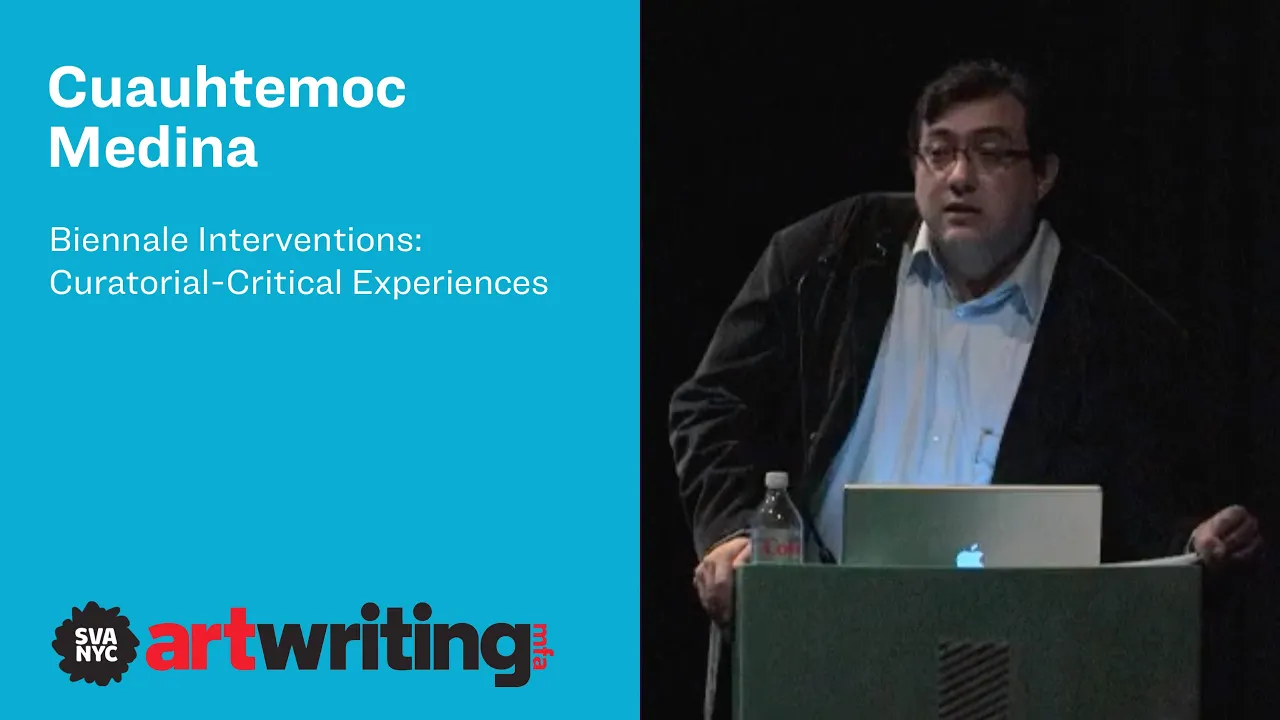
Welcome i'm i'm david levi strauss chair of the graduate program in art criticism and writing here at the school of visual arts this is the first event in our spring 2011 lecture series and it will be followed by critical historian johanna burton on february 24th our historian tj clark on march 1st and writer and critic lucy Lapard on april 7th quatemic medina who is based in mexico city is an internationally known curator he was the first curator of latin american art at the tate modern in london was a consultant on the 2002 sao paulo biennale
the 2004 liverpool biennale and the 2004 carnegie international and he Carried the mexican pavilion at the venice biennale in 2009 and scholar he holds a phd in art history in theory from the university of essex and is a researcher in the institute for investigations and aesthetics at the national autonomous university in mexico which is perhaps the world's largest uh history of art department and certainly the most prestigious in latin america but i've been most interested in Qualtemic for some time now as a writer he's written well and provocatively on the work of many artists including
francis elise melanie smith and graciela irbide and he's written brilliant essays on topics ranging from post-modern theory to musiology urbanism and globalization his monthly monthly column in mexico's largest circulation Quality newspaper reforma has made him the most well-known art critic in the region the 12th issue of eflux journal included his 11 theses on the contemporary or the contemporary in which he calls the institutions media and cultural structures of the contemporary art world quote the last refuge of political and intellectual radicalism and he concludes that quote it may be Well that contemporary it may well be
that contemporary arts ethical imperative is to deal with the ambivalence of the experience of emancipation if art has indeed become the sanctuary of revolutionary thought it is because it deals with the memory of a number of ambiguous interruptions with this we hopefully find an advantage to the constant Collision of perfume and theory that we experience in contemporary art events around the world please welcome guatemala medina [Applause] well first of all thank you for the invitation to david uh legislation all the work to get me here from annette at the sva uh critical program i am
going to talk today more In the position of a creator than than a another critic and that means i'm going to be talking from within uh two projects that i've felt the need to to explore and share with you in relation to the to the possibilities that can uh be open to working problem the the the least loved of all the art settings which is precisely the Biennial system what i will do in essence is go through a number of of arguments around two interventions one precisely the mexican pavilion at the very very nail in
2009 with the exhibition of teresa margolies's work and i will also go into discussing some of the of the peculiarities of a project that is just closing now that Lasted a year that took place in the city of murcia in the south of spain that was titled cannibal dominos or i mean in spanish domino caneva so i hope that i mean i can go through it it's not going to be uh academic uh lecture but more more more discussion of of certain moments of practice And and of course later on i'll enjoy a lot to
have the opportunity to discuss the cases with you so i'll start with teresa margolis hopefully this okay from what is left to what appears in 2009 i was commissioned to create teresa margolysis what else could we speak about an intervention for the mexican pavilion In the venice biennial the process leading to such project was not at all simple or straightforward for starts mexico doesn't have a tradition of which of visual and voice to venice lacking a permanent holding in the jadini a revolutionary country like mexico was not part of the so-called concert of nations That
is represented in the fancy neighborhoods of exhibition sites that were handed precisely in the first decades of the 20th century so the near continuity of the pavilion has to be negotiated each time which accounts for them for the fact that there have been only a few moments in the 1960s and just lately from 1997 where mexico has actually have A particular exhibition in that event in fact at the moment january 2011 the process of mexican participation hasn't been entirely defined for the show which is meant to open in four months time but this as you
will see has a certain normality into it i don't know which point audiences let alone professionals Are aware of the extreme heterogeneity of political and cultural structures and decision methods that make the venus biennial as a composite of different national official structures by no means there's a standard system to appoint creators or artists each country officially represented in the biennial either cultural agent either through cultural agencies Private organizations or ministries has either very transparent or very opaque methods to define who and how is going to have the task of producing the official invoice some of
those are actually designated from the top others involve very complex democratic systems like in canada where even the shortlist is built From proposals coming from professionals in the case of mexico there is no really a method to define who would go to venice in 2007 rafael sanerhamer sort of self-appointed himself i'm not going to go too much into that but basically the people working around los angeles managed to convince the minister to actually apply for a pavilion So that is what created the the need now of having a pavilion in venice it was a matter
of a very intelligent organization which ultimately was not such a such a bad idea so in 2007 there was a consortium of state and private institutions that joined under the leadership of the cultural section of the ministry of foreign affairs Of mexico that started a process that included looking for a building to set the exhibition and another process to define what kind of event would be sent to the italian event being mexico and given the lack of a structural organization behind the display by october 2008 there was still having a number of consultations Which could
be the way to arrive to define the envoy i was in fact part of that consultation and i openly argued back then that there was no room for the traditional ministerial commission that there was a need to have some peer structure no matter how half-baked to perform the designation my basic point was that the local mexican cultural authorities Didn't have enough legitimacy amongst the artists and members of the mexican world to have the possibility of making this decision without having a certain professional backing in any case i was very surprised that sometime in the middle
of december that's half a year before the start of the annual a letter from the ministry of foreign affairs arrived to my place inviting me amongst Other seven curators to make proposals for an exhibition that could include several artists and that was to be chosen precisely by a panel of colleagues creators and museum directors that method was in fact a great advance an official national representation an exhibition that was going to talk in an event as an as an official presentation of the Country was to be defined beyond the structures of ideological commitment coming from
the different stances of the mexican government it was probably the first time in mexican history that such space was open to a certain possible critical intervention in fact by that time during those early discussions i had already advanced to the officials Of the fine arts institute who had approached me what kind of artist i thought would work as a mexican representative in venice for me it was very clear that in fact it wasn't a no-brainer that teresa margolies would be the right artist to work with the reasons for for that were very clear to me
and in fact i stated them in the project i sent on the one hand As i had the opportunity to attest several times along the years magruders were still an artist i had troubles to be included in international exhibitions or collections of contemporary art around the world she was still polemic enough to merit the inclusion in an event like venice to actually break the ice and make it through Into a proper international reading of her practices the fact that i the fact that she has been working for already two decades with human remains both as
a member of the cemetery that is the medical forensic service collective in the early 90s and as a soloist from the year 1998 had not managed to establish the seriousness and depth of her intent At the same time ironically it was hard to imagine another artist which the local contemporary art circles in mexico would have found themselves more in agreement that would be a good candidate to stand for the artistic community she was in a country that is characterized by very partisan takes in relation to contemporary practice somehow The person that linked the different mafias
of the mexican world precisely because of the drawing and unique approach of her methodologies she enjoys a appreciation there was here again i need to bridge between two different sets of criteria local and international that call for the attempt to produce something In a context like venice but finally you will appreciate that through the presentation there was the nature and the political implications of teresa margolia's recent work which had abandoned the research of the life of the corpse as it was represented in the activity and the aesthetic of The mortuary where she used to work
to explore the pervasive presence of death in the urban and social landscape that made in my view absolutely necessary to think that she would need to be the artist to present my gorgeous work especially since the year 2004-2005 had actually become the main means in our small milieu of recording the tragic social conditions that have started to Prevail in the north of mexico particularly during the so-called war on drugs that president felipe calderon had launched as the central policy of his administration giving my critical stands towards the workings of identity and national representation in general
but now in particular the way those specific strategies Appear within the context of the global cultural structures but at the same time my personal need to combine that with an affiliation to specific modes of political implication i was convinced that structural such of national pavilions ought to be embraced in a critical way rather than walking away from them the ethical and social conflict involving my glorious art Was the only way i could envision myself taking part in such a type of venue in fact during our exchange of ideas via email that winter it happened to
be that we were located at that time in different parts of the world teresa described immediately in her own words why she felt it necessary to address the question of the way Death has become a pervading social condition in the north of mexico in the kind of event we were competing for and let me translate you a fragment from from a letter of teresa margolies around the 20th of december 2008 i am interested in talking about what is happening in the sinaloa state 100 1120 dead Just this year and december is not finished every month
are more corpses than the month before 1120 people most of them youngsters that are not there any longer and even if it is calling to say it they won't be in christmas with their families just integers just the memory that in those cases is immediately Transformed in revenge to revenge the brother the ghosting the friend the sun i am also working with the meaning of blood the question is who's cleaning the blood from the streets of the hundreds of executions of the bodies that are shot and left there that was the last work i made
in cranes in austria Clothes impregnated with blood salt in blood but not any longer inside the mortar during the process of necro of the necropsy but blood taken directly from the floor where once the body is taken stays like a trace like the last refuge of a person i don't need any longer to go to the moors because the bodies are just dumped in The streets and of course so in between different trips via emails and telephone calls and finally in a meeting we have in madrid in early 2009 michaelis and i worked a project
that we knew we had to be changing if we were selected that originally involved a selection of the different works she had been Producing in the previous years involving the strategies of exploitation and exploration of the way violence had inundated our country with corpses when we had finished writing that draft in january 8th i had to hand it just a few days later we still lacked a good title for the exhibition fortune is an ionic goddess As you well may know because i had just landed back in mexico city when teresa called me and asked
me to check that day's edition of la jornada newspaper so in the first page of la cornada i read this news item ambassadors should point out that there is no cows calderon president felipe calderon Instructed yesterday ambassadors and diplomatic staff to point out the reality of the country because it is not true that mexico in mexico the civil population is being massacred in the streets and that there is social cows he admitted that the number of people that killed is worrying and surprising but all Of the dead are clearly related to the struggle between the
criminal groups for territories and they also relate to the way they are losing against the police and the structures are weakening as a result he recommended to to to disseminate with pride that the country is leading a process of institutional recomposition And enjoys democratic stability it is not a fake perception he said there's a there's a there's a climate of peace and quiet in the cities of the center of mexico city mexico is enjoys democratic governability and is able to reach agreements end of quote i was taken aback in other days when a mexican president
dictated An ideological line when in spanish we say darlalina he would at least abide to a set of unwritten good manners and would keep in the dark when instructing his employers what to say he would actually describe what government officials were meant to think well away from the journalists so i grabbed the phone and called the artist and told her in a Rather defeatist tone look perez the president is instructing the ambassadors to silence information about violence in the country so it is unlikely that a project like the one we are doing can be chosen
my good feeling is that we should simply radicalize the project knowing that we will be working for the archive and then try to produce the show locally i mean at least we need to make sure That we leave the idea in the record teresa got angry in the other side of the line and i heard her saying no way where do they think they are what else could we talk about i stopped her terry that's it they don't have the title what else could we talk about so the possible reluctance one could Have been participating
in a biennial like venus had totally managed once we had a specific task it was not though only that one we wanted to state our revolution for the way mexico had become the test tube for the biopolitics of security and misery that surround the so-called wars of the illegal substances We have another motivation to work against the supposition that the president of mexico was in charge of defining the image of mexico which involved also which could be the role of something like a national culture in as much as it was and will be certainly one
of the elements of what we describe as diplomatic efforts calderon Was trying to instrumentalize the mexican foreign service so as to repair the national prestige that was being impaired by the tasty behavior of people they were killing themselves to control the roots of smoking drugs in the usa after a few weeks much to our surprise in fact the professional jury in charge of deciding about the projects Opted for us a panel of creators and museum directors had also the impression that this was the story that could convey what the country was and what could be
actually described of it from the advantage point of the type of practices that we for a decade have been working around and in relation to the question of contemporary art So in the next months the process of making this exhibition was surrounded by an important internal conflict already the day when i was [Music] told about the appointment i sent an email to my gorgeous that read like this my dear teddy after a very agitated process that included official fears and businessmen That were really concerned about the decision of the jury and a behavior that was
not particularly clean on the part of one of the candidates they finally acknowledged publicly that our project is the one chosen to go to venice i send you a big hug knowing that we have lots to do but once that we have finally gone beyond the temptation Of putting us in to silence almost immediately there is an answer very well we're still in the game it is a very difficult game with a very heavy backpack in our back writing down these notes i linger on the last phrase by teresa for what this backpack carried um
was indeed very complex in fact if you check the material published Around the mexican pavilion at the venice biennial you will see how the logo of the mexican foreign affairs ministry and the umex collection that launched the event at the beginning silently disappear by the time the publications occurred in venice both with view in silence with a certain naivete around the possible impact Of the public functions but we are making a force in the newspapers about that the artist and the curator decided to put that silence to good use as a means to force the
remaining cultural agencies to collaborate with them and complete the project i mean rather than rushing to claim the success of scandal we took on the divisions that existed Existed within the organized organizers so as to be able to pull out the show and still enormously surprised but also grateful that the local journalists were unable to read the signs of what was indeed happening that lack of information allowed us to work just fine this in a way now that process is well finished is somehow indicative of the difference between cultural work And whether you would necessarily
describe the role of a public intellectual for the creator the question of creating public steer is always secondary to opening the possibilities that the artwork would actually produce in that public sphere even if that noise has a different condition In any case by the time of the biennial no mexican official was manipulated this way officially present to represent the government which i think is a rather unlikely situation in one of these events not even the cultural attache in italy sometime also in the process two of the members of the jury a museum director Of the
tamayo museum and the head of the cultural section of the foreign affairs ministry had to quit their jobs in great part out of the conflict produced internally by the clash between this project and the official line traced by the mexican president so the mexican pavilion in venice in the vedic biennial was a case of a of an official Representation without representation the only reason it effectively took place was the fact that its process of selection was transferred to a professional panel and that the nation state different in what sometimes cultural analysts project is not a
homogeneous political entity it involves lots of cracks Different agendas different functions it's a malfunctioning structure so i have to argue before going into telling you a little bit about the project that despite the way mexican cultural institutions have suffered under the conservative administrations that have governed mexico in the last decade all through the Teresa margolies project i attested that the officials in places like the fine arts institute the national council of the arts the national university and even the patrons working in an organization called pac patrons of contemporary art tend to adjust their work to
the duty of turning professional decisions into Artistic production independently of this ideological ring which effectively still under the mantle of the presidential office one would need to say that it is only when something happens that the idea that that art and culture are ineffectual shows actually to be an ideological strategy of the right wing to naturalize even the temptation of attributing it Specific political and public powers similarly is it is only when our work manages to touch our nerve that the support of business general corporations shows its limits it's compassive nature let me put it
that way underscore the notion of philanthropy shows to be to be just a masquerade when it is a matter of taking sides in the absorbed ideological traps of our times so when political sovereignty appears The structure of interests that surround our activities become to a certain extent transparent that of course doesn't prevent us a certain space of maneuvering nonetheless and i will insist on that it is a matter of pride for this curator that during the participation of mexican the last venice biennial some of our colleagues working within the state Were the ones that managed
to convey the notion of what autonomy means in our field anyway at the end of the day it is the mere existence of those cultural structures that is always being put into question by the narrow minders and lack of political refinement of the way the mexican government and even the political opinion tends to Show in this what we call the process of democratic transition what was a stake beyond the rather absurd presumption of mexican administration during the year 2009 to contain the information of what was happening in the drug wars in mexico was the legitimacy
of cultural exportation margaritas project intervened In a significant state issue namely what is the aesthetic policy of the state to which extent matters what matters to citizens in relation to political sensibilities is what should be shown to the world or if that is just a matter of governance this is what i tried to argue in the category that was published About this exhibition quite rightly a catalogue was was paid with the taxpayers money i will go to this and then i will simply go and explain you what we did this spectral operation appearance and summons
to appear has taken position possession even of the rhetorical question that serves as the title of this intervention what else could we talk about is of course the retort to a reprimand The sentence encloses a visual reaction to the expectation of the mexican elites that for the sake of the national image or this or to safeguard the illusions of tourism we should maintain a contract silence about the discretion of society bent on a slaughter in such a noisy in moderate and public fashion they wish in reality the only thing liable to silence the obligation to
do and to speak out The present catastrophe will be the next one the worst of experience in history as a senior compulsion to disaster is that all too soon there will be something else to talk about the next massacre the future failed revolution the fresh cycle of economic collapse the renewed disappointment of democracy environmental cataclysms Galore another looming pandemic just as the mounting deaths resulting from the drugs battles was all that could smoother the outcry over the hundreds of women murdered in places like ciudad juarez so the only way to break the spell of the
beheadings in the north of the country was for mexico city to become the source of infection of a new strain of global influenza As happened in april and may 2009 stacking from crisis to crisis leading from one scandal to the next but no dialogue is being muted here the creator would simply like to share his delight in the fact that the world the word scandal derives from the greek scandalon meaning stumbling block as we shall soon see so let me just explain you the nature of that intervention after just discussing These issues that are behind
the scenes the choice of the venue was a 15 16th century palace the rota evangelist rota palace located more or less in between formosa and san marco it was a rather hidden hidden place they actually have been abandoned for a number of decades so the first decision tessa margolies did Was to actually leave everything exactly as it stood to prevent any process of cleaning or restoration so as to preserve the significance of the dead air and the dirt and the accumulation of abandonment of that place so when you would get into the show the first
thing you would find was this desk you would be careful you will actually Find a label and this was more or less the rhythm of the exhibition there was no nothing actually said there were just small labels that would give you enough information this was actually the place where the curatorial team had to be confined the artist created a policy of silence where creators indigenators the artists herself were forbidden or taking Anybody into the show of explaining the show to anybody of giving press statements inside the pavilion we had to be sitting basically in this
desk and there was a label that actually explained that this desk was made of concrete with water that had been used to wash dead bodies of people killed in the border between mexico and the usa so you would go through a staircase into the Into the palace and i know you've been to this kind of event people people normally come a bit excited from the street they come talking amongst themselves they come somehow in a festive mood people would walk inside and for three four rooms they would actually find nothing it was just empty and
just move here sometimes they would actually find the The floor wet sometimes not and eventually i'm trying to just reconstruct the sequence of what we expected people to experience they found a label on the wall and this text so they have finally sort of notice that they had been working in a space that involved a certain action Cleaning and they were explaining that the floors had to be had been cleaned with a mixture of water and blood from other people and this was an action that was repeated daily and that moment our expectations that they
would actually start to value or to be able to decode the bare indications of that of those actions there were the the they were buckets and and i don't know How you call the mobs in the in the rooms uh or sometimes you would be lucky you would actually see the action let me just show you a movie of one of those actions all right [Music] oh wow so just from a purely Technical point of view the artists actually worked so as to create an action that would be very contained and at the same time
very standard the people that mocked the floor especially during the opening weeks where basically volunteers coming from the north of mexico some of them artists that have been working with Teresa in the process of collecting the material she worked with others at least a couple people from specific activist groups that was not informed that was not conveyed probably she did it to the press and there was no interaction between them and the audience beyond their their work and as i was telling you it was i mean there was a There was a certain performance more
or less conventionally announced but that was something that some developed a long time by four o'clock every day sometimes people will find the cleaners other times they would simply not again just as a matter of chemical information the material the blood Was transported in a very specific way that takes a long time has devised she has basically she collects and she and her collaborators collect the blood and the dust with pieces of clothes they let them dry and eventually those clothes are are [Music] boiled very lightly a little bit like The way you would make
something so as to get the material back so all the process of transportation was done [Music] manually i mean nothing was actually transported in any organized way the creator and the artist brought stuff in there in the luggage this both because with the time and the situation we were experiencing there was there was No real attempt or or time to to make it an organized way but also because a long time margolius finds it important that there's this uh this is this very personal process and the [Music] the whole of this [Music] work intended To
eventually leave a layer although invisible of the people remains on the floor it was an attempt to add material right and to to to retrieve it so somehow this cleaning was operating in an inverse way let me go back to the to the powerpoint to show you a couple of things that process for those that see it involve Let's say half of the space of the of the palace in the in the first floor oops one of those failures uh and then there was a certain narrative with insight both the artist and the curator have
wondered to which extent they could actually have caught part of the rest of the of the work Something that we we don't know for sure but there were some interventions like this one that involved that a room that still had some plaster frames was used to display these clothes soaked in blood and dried that were along the time of the daniel being embroidered in golden thread with certain messages that the drug mafias live next to the bodies of people they Execute very nasty messages in fact margolius was interested to of course link the the polarities
of of gold and and blood in in a certain kind of allegorical reference to to what is happening in in relation to this to this process so there was this one that was the only one ready at the beginning that said to see to listen and to shut up there were also a number of Jewels that were made with glass that had been collected from places where people had been shot in their cars those jewels were used for display along venice but in the exhibition were always concealed in a safe that was in the wall
and just indicated through a label so as to prevent their presence as spectacle and finally there was a whole Room in the ground floor occupied by a big coating of of clothes they were full of mods that through a water pump and a number of aspersors were somehow being slowly washed along the time and that mod was also added into the mix that was used in the buckets the original plan And that's the explanation of the title recovery blood was to actually have the clothes with blood into those machines but there were reasons of conflict
in relation to the possibility of having troubles with the police the local police in relation to questions of hygiene that made there is a switch into using the mod uh that these these clothes that contain mods of places where people Have been killed as well and finally there was an intervention in the exterior you surely know that traditionally there's no no nothing in the regulations about this official pavilions in venice ha use the flag posts on the canals and they usually have the national flag along with the venice flag and today the flag of the
European union and she refused to have the mexican flag and instead she had just this cloth that was also red with blood there was some friction about about this particular work again out of the fear that this could cause some troubles with the local authorities i mean the the The concern was that because of the rain eventually there will be claims that we could actually uh be jeopardizing the the people in the in the boats that would be crossing beneath uh but that eventually that that piece stayed there finally there were a number of actions
in the street outside of the pavilion And there was no no no attempt to actually uh program them as as as something people could could witness you could either happened to encounter them or not the first one was the distribution of ten thousand cards to code cocaine that all of them carried this photograph of a corpse of somebody had been burnt As part of these drug wars and the the card was an object that teresa margolies decided decided to use again was she did a very very small addition some years ago she decided to use
this idea in a mass scale so as to distribute it in the parties of the venice biennial in the giardini so as to interpret the social The social spectacle of course the car has an ambiguous an ambivalent character because it pretends to be a tool of of drug consumption but it's also trying to link the user with the with the uh violence that that is a condition of of his or her pleasure there were showings of the jewels produced all around venice They were not programmed they were not accompanied with any explanation they were just
trying to somehow disseminate as glimpses uh um sort of uh of uh of a sample of of drug bearing bad taste and anyway all along there was this there were also a number of actions that were done In different places in venice including including the use of of of uh of the of these [Music] of these clauses in different in different ways and there's one that for certainly a second frauding reason i was really interested in showing you and i didn't include in my in my powerpoint Point set but luckily i have it um i
should have it here which was an intervention that was done before the exhibition in the in the giardini in the mix in the in the american pavilion and it was called embassy and it consisted on a private Installation that was later on painted in the in the booklet of the of the show all the american pavilion with the doors and windows covered with these clothes of plots those especially of people that were killed in ciudad juarez next to the to the border and somehow the the the image intended to document both the intervention and also
the fact That on the on the on the uh months when the but and there's no exhibition it is actually an official building in the usa that is completely uh abandoned and nobody's actually taken taking care so so as you could see i mean this was a an attempt to politicized rather than reject the Function of national uh of a national intervention of a national of the national representation of the pavilion and let me just move quickly because we don't have so much time to tell you about a different a different project okay i'm sorry
i'm trying to look for my courser I will try to discover rather quickly a completely different type of binaural intervention and it is what i been doing all the way from january to december 2010 in the program project in murcia as you probably are well aware the traditional format of the biennial is a festival which actually involves a number of different Participations of artists or different exhibitions happening at the same time and for a long time i was slightly obsessed with the fact that lots of these events around the world are promoted and ideologically constructed
with the argument that they are they involve a number of structures of dialogue Between the artworks and the communities but above all between the artists participating and my impression was that in a in generally speaking most of these events are on the contrary a collection of monologues where the interaction between artists is actually extremely low so i thought on a model of trying to actually create a project where the question of the Capacity of artists to discuss and intervene somebody else's work would be at the center of it even if it would involve the production
of structural interactions based on a certain level of violence or destruction and i was looking invited to do a very small biennium and i convinced the organization to take this model so the another title cannibal dominus consisted in actually inviting seven Artists along the year to produce new work on the basis of using just one space and then working on top or take departing from or destroying the work of the artist before in a sequence of anthropophagic or cannibalistic moves i was somehow trying to link in that structure both the fascination one has with Artworks
and exhibitions that involve a sequential structure for instance ron morris's project transformed continuously from 1969 and the number of experiments all the way from the from the surrealists that involve the attempt to create an inter-subjective space of production so this is what the first artist that initiated the series Produced and this was jimmy durkheim who as the initiator of this game had somehow the the opportunity of defining by implication the conceptual uh boundaries of the whole of the series and what do you need through a number of um of explorations of the of the region
of musia was to try to work in relation to the concept of the temple the classical concept of the temple Which is a space from which the whole of a city or civilization is built that involves the demarcation or what is a great secret against what is used by the uh by men given that the exhibition actually was going to take place in this former church the veronica's church in in spain he was tempted to precisely Work on the question of the transition of objects that would actually encode the different forms of activity and the
social environments of this region in relation of course to the obsolescence and to bring these objects into the exhibition space trying to make them operate inside without invoking an artistic procedure somehow trying to retain The condition of profane things so as you can see what durham did involve both a collection of objects that relate to to moments of of of uh production traces of different uh forms of of of refused objects but he also worked to create a certain kind of feeling of the space of this church basically in relation to the To the setting
of cables and pipes connecting some of the most important symbolic elements in in the in the church for instance this crypt where of course some of the gnomes are still buried from which he created broken lines into into the outer space and along that he also collected drawings and graffitis from the street that he copied In into the church so these bases this this project this this first installation was a month later intervened by spanish artist christina lucas who decided to work on the basis of the concept of going beyond these general ready-made aesthetics into
the trying to transit towards what she described as the popular Aesthetics of the ready mate so what she did was actually to perform a whole via cruces she said where these objects left by jimmy durkheim were underwent a number of different economical and practical transformations so she first did a number of actions all of them recorded in video in photography involving the near act of contemplating this uh this installation Then she actually desecrated it destroyed and recorded different actions involving the dismantling of the middle ham's show then she recycled in the sense of classifying the
material leftovers and then she asked the workers the installers helped her to transfigure to transform those elements Into useful objects basically benches and more centrally she took all these oil bowers so as to try to turn them into barbecue structures let me let me just go over she wrote a fifth stage where she vandalized them displaying them in a park so as to create an enclosure and the central action that she called sacrificed was a press conference turned into A barbecue which the artist forced the journalist to engage with her in a quick procore structure
she taken from the silence of the lamp of course she she would accept to answer their questions as long as they would accept her questions and answer them so that all that involved them a number of other stations that is of course her Peregrination back into the church she decided to take this photograph as representative of that and then she installed this whole thing creating a big cross of barbecues in the center of the space and a number of stations telling the story of an intervention along the wall somehow following the structure of the narrative
structure of a catholic Catholic church then another six weeks after in the in march the blues high quality foundation from new york arrived and what they did was basically a tabula rasa they took everything out on the basis of arguing that they were going to actually create a moment of amnesia and somehow i losing the the the film by chris marker sansole They made a film of their trip from paris into musia going through particular portable and leading somehow to the death of alternating benjamin and this region of of spain and the way they installed
that film it was also creating a certain section of the road as if they would actually have the end of their way into the church The next uh participant was kendall years the south african artist who somehow angry with what americans had done he actually told them that they had behaved just like the usa that would destroy everything and make a a road in in in the center he came to try to reconstruct all the objects that have been used by jimmy durham but he invited a a a performance a performer Is so as to
work in darkness into this show so as to decide how to install the objects they created and finally he did a performance that was done originally in complete darkness where she activated this this exhibition now the condition of the artist imposed was that that performance was not to be recorded by any means except the creator's writing of it as an event He only wanted a written memory of it i'm not showing you elements of that installation installation as you can see retrieved the the grills of the barbecues so as to make both cages and the
cross he brought a different uh rupestrian cave uh image to substitute jimmy durham's uh graffitis and in general he tried to evoke a certain animistic Intervention into that into the space by september it was the turn of tanya bruguera and tanya bugera departed from a very specific event in the 29th of september the spanish unions have called for a general strike to protest against the economic [Music] measures imposed by the socialist government So as to supposedly get out of the crisis so she started by making a number of political quotations in space as you can
see there's a there's a a number of murals that that involve things from bingo's racing feast for the iww in 1917 to a red flag carried by the the hands of the mona lisa and there were there were some specific Quotations to vera mahina's uh statue of the proletarian and the peasant in in moscow now mutilated in the style of jose clemente orozco's interventions in his own murals she also added a number of images that the students working with her somehow devised as what they would assume was the language Of of social realism and she
also with permission we made a piece by ken the years between title withheld 1993 which is this between that has a break inside us if it were the statistation of of strict violence so all that she made so as to call for audience participation She published ads calling people to to come during their general strike so they could paint freely and they will provide the material and this is what actually happened as you can see this is some views of the end result there were there was a significant amount of of of i mean voluntary
interventions and there were layers and layers of of Paint where people were both just having a try at the idea of painting in in a church and also alluding to very specific political questions that were produced by the general strike and by the by the uh specific uh contradictions of the of the of the spanish uh region so that in a way was like the artist delegating the function Of intervention to the to the to the audience in a in a very direct way because tania bruguera as a cuban was somehow implying the uselessness of
political art as a sagina with all these all these gestures and then there was an intervention of brazilian artist rivanni nuzbanda there was something ironical in the way in which ruger had preempted Participatory work and what rivanna did was to work departing from something very very abstract which is her uh the way she's been quoting the spaces in latin american exporters the architecture that is represented behind these catholic paintings that are uh normally small paintings that depict a miracle that and that are painted supposed to so as to give testimony Of the existence of a
miracle so she she created these spaces inside the church leaving the murals of tanya bruguera behind just slightly whitened these very very uh painterly abstract spaces that somehow turned those popular paintings into into penetrable environments and unlike that she also showed a specific film of hers called the Tenant so those very strict painterly spaces were eventually accompanied with a new participatory piece this church happens to have a very classical non-uh uh monastery device that has a double rail in the back the gnomes were not allowed to go into the world so they had to witness
the mass from Behind that rail so she asked people to actually leave little notes with their fears attached to that rail and by the end of the month there was a significant collection i don't have a photograph of that of all the fears people people left and finally by in december vince's elise arrived and he made a somehow process of documentation of The show within the show so what he did was he asked the organizers to to to provide him with images of the previous projects somehow a little bit by chance they were almost 150
and he of course all these without the organizers being aware he organized those images following julio cortaza's direction [Music] table of the novel hope shot i know you know this is one of the most important experimental uh novels of latin american literature that can be read in different combinations of chapters including the one that cortazar suggests and on the basis of this of this order he [Music] showed it to several characters the Creator one of the artists christina lucas the vulture in the market across the road the photographer and spanish art critic so as to
somehow force them to make a narrative interrupted by these illogical flocks of images so the of course the work as you can see was shown basically in monitors and those narratives are are essentially nazis that are Are where the people trying to give a testimonial are are struggling to to to rescue the notion of saints from a very specific set of of of circumstances and he made this hop shot game in the center of the church somehow to symbolize the whole the whole operation so i mean this was i mean in essence a totally different
type of Biennial intervention it is more like an intervened exhibition structure that is playing with the with the with the the way in which the spectation of artistic intervention are are are are condemned and i think that i was really interested in doing was to create a situation where people would actually have to get outside of the Normal processes of of uh of working where the artist would actually have to try to interpret in doing what the other artists did and in general to try to formulate a different way in which this notion of an
international decision would work where the notion of representation of practice practices will be In in question i was sort of asked some months ago to be part of a selection process and i accepted that has not started i already complained like three times that this is just ridiculous that people are not going to be able to pull out an exhibition i have to say that beyond the specific political questions that my [Music] Work with teresa involved it was really really absurd to try to pull out a pavilion in venice in four months is is the
kind of things that that somehow i know have some normalcy in some places of the earth but shouldn't happen and this time they are going to make it really hard so on one hand it is kind of um Difficult not to to give a certain support to the fact that the basin cultural officials that suffered the last process were eager to actually try again to have a pavilion and to raise the money and to allocate the resources but i don't know what's happening that they haven't been able to start so the answer is maybe there
will be a pavilion and i don't think that one can Suggest that there is a connection between the lack of planning and the lack of organization and what happened specifically politically last time it really is just that for a number of structural reasons sometimes the mexican [Music] cultural structure is not being able to make things In a professional organized way so i don't know what is going to happen maybe nothing it's kind of absurd anyway i was just wondering um i've been so interested in teresa margolies's work and could you talk a little bit more
of why she's interested in always depicting death in terms of like an imprint or a trace or like it's never although it is quite Direct in terms of photography of death but it's it's i'm really interested in like the ethical implications of how it's always like these remnants of um like it's either always an imprint or a trace or a like something i mean methodologically the trace is in her work from very early on the the the first works that involve the usage of of of sheets Impregnated with people's blood then just basically almost like
a figurative imprint are from 1995 and the of course one one recently simply that she's always work with means to connect the inside of the mortuary with the outside and in this case the outside of the street with inside of the exhibition space so the the the trace is Is the is the the uh the quasi signature that actually is able to produce that that that movement but i don't know how to address the question of what would be the ethical implications of that because one would assume that of course from a theoretical point of
view because of the of the of the significance of of of the trace in the deconstructive Tradition it is i mean the case that many other works the trace involves an attempt to produce a certain ethical distance that will avoid the questions of the attempt to to to capture the other subject and within a certain structural representation is a work that capturing occurs and i also would argue that her Work is not um bounded by [Music] more limits but it involves a certain ethical exploration that sometimes has to do with actually having gone beyond what
would be um ethically humanly acceptable i mean there's a certain sense in which the way she works with Limits is actually somehow trying to find where they are rather than trying to respect them i don't think it is a matter of of transgression matter of empirical exploration where they actually are in practice sometimes that is just a documentation of what are the effective limits of a practice that is not Being ethically organized sometimes it is it is a personal uh pursuit but somehow i mean in the past i made the argument that some of the
the works of artists like hair or santiago sierra and and sometimes uh javier tellez involved in the 90s an acceptance of the of the of breaking with the expectations of an Ethical practice in the south so i don't know exactly how to to address that question in this case i'm clear that one task she was trying to fulfill because nobody was trying to fulfill it at that time was the function of trying to have a certain elaboration of mourning and the less she would actually explain people she Was doing that the better for her and
the fact that in venice she managed to communicate that uh function with others was something that i can sort of with that troubled her a lot it was not something she expected but so that of course is implied in the work i would say that That's the ethical stance that the ethical stance has had to do with trying to deal with this level of tragedy both in the specific works and the general approaches are accepted today but one thing i am very clear that is very interesting to me and is also very marks a certain
limit to what i can do and can elaborate is that she's not developing it with an Informed programmatic stance coming from having read leviness or the lord i mean i i actually respect some people that have that point of departure i would say that doris alcero is clearly somebody that whose work is informed by that lineage in an active way but there is coming from a different world i mean she the the regions of the Same effort group are those of a death metal punk rock group from the east of mexico city that turned into
art with a with a with a with a um at the same time other people started to do that so the the the the the presuppositions of that origin are origins are different but i think it's an interesting question and maybe simply that i haven't been Able to to sort out for myself ever i was struck by your proposition to teresa to radicalize your project um yeah for the archive um i was well her question was traced and um made me think that your entries are very compatible in this point that you also wanted to
leave a choice of your attempt um but i was wondering Are you forced to do this a lot have you done this before did you propose this very spontaneously is is there a history of in countries where censorship or or at least there's a larger sensitivity towards political uh politicizing a national representation that this is a formal strategy to leave a record for the archive Okay let me start from saying that there's always censorship and probably there should be i mean i'm not a liberal in the sense that i think that you can naively think
that there's a dichotomic opposition between the good guys for freedom and the others every structure involves a moment where there's a tension between power and Control and that is what we call solutions i think that there's a there's an argument by another argument i say tagusting that no no he's not saying that i was in but the argument is censorship is is the need of repressing an argument because of a higher reason anyway i think there's a very interesting essay By david on the question that reaches a similar similar conclusion so it's true that there
are different structures of censorship and the classical structural censorship didn't apply in this in this case at the end of the day the mexican government had to pull out the show and as i kindly lead or tried candidly to explain artisan curator in this case probably Curator more made a choice which involved that it was more important to pull out the exhibition than to make than to claim the the scandal now this is a very interesting point because you made me realize something yes there are a couple of times that there are things that we've
just made for the archive i don't think that's Unnecessarily um strange idea i think many people do i think that if you would actually check what happens when when you have historical shows you actually get things from the archive that were left there because somebody left a record is not a trace is a record i think that's a different different stance [Music] I was trained as a historian so i have this certain weakness to leave some evidence i always have the feeling that there will be a phd in this in wisconsin it's always an american
in the year 2050 that is going to realize that in that day this i admit it i i do play that game It's a nice game i i think a friend of mine olivia boras died three four years three years ago he left us the horrible duty of trying to preserve his archives without losing anything and when you open the device in the computer he actually has gossip of everybody around recorded that there so i think that that's not i think it's a very interesting Situation that many people just do without really noticing a letter
always arrives to the destination no matter how long it takes uh that's something that you do in that in this particular case we're basically trying to tell teresa is that we were going to try to make the argument totally explicit because we were not going to make it that meant that the project that i gave To the foreign affairs ministry quoted the president saying that we were not going to do this you understand what i mean that is what goes so when we were accepted in during the brief time the foreign affairs ministry was on
there was an indication that everything was okay except put in the quotation of the president in the catalog so you may say that i Once we were going to do the show i accepted the limit that i had trespassed in the archive now by the time the catalog was made which of course was kind of 10 days before the opening and it was ready for the opening the code came back so i think that we were not because of the way which this was not played in the in the in This in the public sphere
and the fact that the existence of the eye of the art was more important than the than the story i can say that we were more interested in the moment of silence than in the censorship so it's not so important in this case but there are other situations not so directly involved with the structure of central power where That has happened but it's not particularly unique i i think that what i would deal with of creator work has to do and i always have this feeling of lots of people in institutions that heaven is in
a very difficult balance of allowing things to happen when i'm playing the fool sometimes and that is much as as as important as people in positions of power or in Institutions that actually stop things from happening that should have taken place so that game is all pervading but yeah you're right that there was something i feel a little bit guilty about the idea that instead of telling comforting teresa saying it's okay we are going to make it don't worry what i said is let's write it down for the for the for the file It's strange
yeah guatemac i think we need that yeah thank you lead the rest for the i'm sorry for the length of this thank you very much you