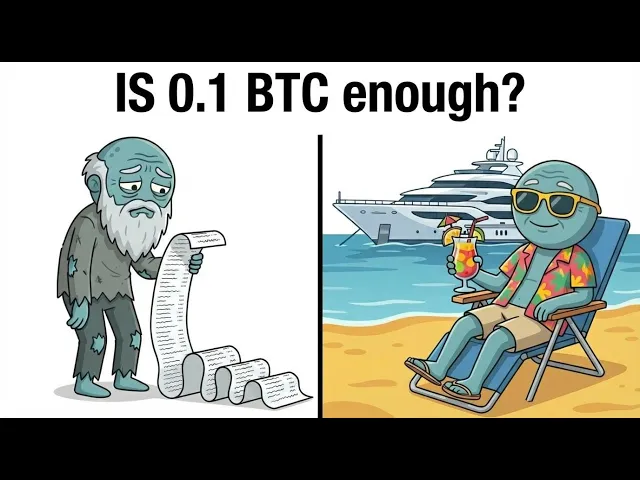
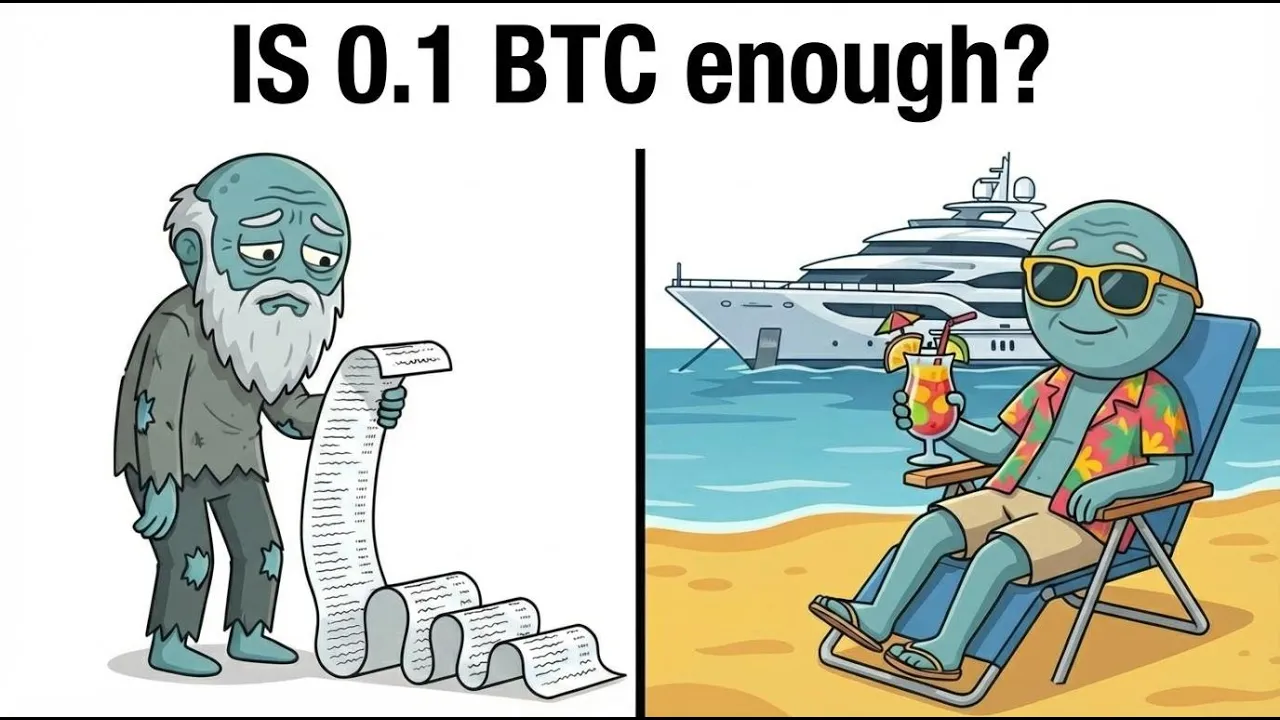
Can a tenth of a Bitcoin really let you retire by 2030? Or is that just the most seductive financial myth of this decade? Over the last few years, a strange idea has taken over crypto conversations.
Not one whole coin, not early retirement millions, just a fraction. A slice so small it feels achievable. The claim is simple.
Hold. 1 Bitcoin long enough and someday you won't need to work anymore. But why that number?
Why not half a coin or two? And why is everyone obsessed with the year 2030? It taps into something deeper than price charts.
Most people watching this are not hedge fund managers. They're engineers, freelancers, teachers, small business owners. People who feel like the old retirement playbook no longer works.
work 40 years, save slowly, hope inflation behaves. Lately, that formula feels shaky, housing keeps climbing, health care is expensive, wages move slowly. So, when someone says a tiny piece of Bitcoin could change everything, it feels like oxygen.
But this video is not about hype. No Lamborghinis, no moon emojis, no guaranteed futures. Instead, we're going to look at scenarios, numbers, history, psychology, what would actually have to happen for 0.
1 Bitcoin to fund a real life in 2030? And more importantly, what could stop it from happening? So, where did this whole.
1 Bitcoin can retire you idea even come from? And why did it spread so fast? It didn't appear out of nowhere.
The story starts with one simple fact. Bitcoin has a hard supply limit. There will only ever be 21 million coins.
That number is baked into the code. No central bank can print more. No emergency meeting can change it.
Then people started doing napkin math. Take the world's population. Divide those 21 million coins across everyone.
Suddenly, even owning a tiny slice starts to look rare. And that's where. 1 Bitcoin becomes psychologically powerful.
It feels small, affordable. But when you frame it against global scarcity, it sounds huge. Social media poured gasoline on that idea.
threads on X, viral YouTube videos, influencers talking about whole coiners and fractional sovereignty, charts showing shrinking exchange balances, headlines about ETFs buying Bitcoin for retirement accounts and pension funds. All of that made the narrative feel institutional, not just internet speculation. Another subtle trick is how humans think about units.
Most people can't imagine buying an entire Bitcoin anymore. The price feels intimidating, but a fraction that feels doable, like buying shares of a company instead of the whole business. So, the 0.
1 story isn't magic. It's built from real supply limits, real adoption trends, and very clever framing. The question is what those ingredients actually add up to by 2030.
What does retirement even mean in 2030? And is it the same dream for everyone watching this? When people say, "I want to retire on Bitcoin," most imagine freedom.
No alarm clocks, no boss. Living off investments while the money works for you. But that word hides a lot of messy details.
First, where you live matters more than almost anything else. Retiring in a small town in southern Europe is very different from retiring in New York or San Francisco. Rent alone can swing your yearly budget by tens of thousands.
Owning a home versus renting changes the math completely. So does whether you have kids, debt, or aging parents. Then there's inflation.
Prices do not stand still. Groceries, insurance, utilities, and taxes tend to creep higher over time. Even if Bitcoin goes up, your future lifestyle might get more expensive, too.
Health care is another giant variable, especially in the United States. Premiums, deductibles, unexpected surgeries. These are not small line items.
They can wreck a plan that looks perfect on a spreadsheet. And here's something people skip. Retiring does not always mean never touching your principal.
Some plans rely on passive income. Others assume you slowly sell assets year after year. Those are very different strategies.
For millennials, retirement often isn't about yachts. It's about optionality, flexibility, working because you want to, not because you're trapped. Before asking if.
1 Bitcoin is enough, you have to define what enough really means. So, how expensive would Bitcoin actually have to become for. 1 of a coin to pay your yearly bills?
And are those numbers even realistic? Let's strip away the memes and do basic math. Imagine your retirement lifestyle costs around $50,000 a year.
If you only own 0. 1 Bitcoin, that means one full coin would need to be worth roughly $500,000 for that slice to cover one year of spending. If you want more cushion or higher living costs, the price requirement climbs even faster.
Now, zoom out. At 500,000 per coin, Bitcoin's total network value would be measured in the low tens of trillions. That sounds wild, but not impossible in a world where global real estate, stocks, and bonds are already far larger.
Still, it would require massive adoption. This is where history matters. Bitcoin moves and cycles, big bull runs, brutal crashes, long boring periods in between.
Each cycle has brought higher highs, but also stomach turning drops. Adoption has followed a curve, too. starting slow then accelerating as institutions, payment apps, and funds step in.
So let's frame it in scenarios. A conservative case assumes slower adoption, tighter regulation, and modest growth. In that world, 0.
1 Bitcoin might be meaningful, but not life-changing. An aggressive case assumes broad global use, ETF inflows, and Bitcoin becoming a serious reserve asset. Then the retirement math starts to look very different.
No guarantees, just ranges. That's what withoutium really means. What could completely wreck the retire on.
1 Bitcoin plan even if the price keeps going up? This is the part most hype videos skip. First, regulation.
Governments change rules. Sometimes slowly, sometimes overnight. New reporting laws, transaction limits, or restrictions on self-custody could make Bitcoin harder or more expensive to use in certain countries.
Then there are taxes, capital gains, wealth taxes, estate rules. A huge price increase does not mean much if a big chunk disappears the moment you sell or move funds. Your retirement number has to be calculated after taxes.
Not before. Technology matters, too. Bitcoin has been incredibly resilient, but no system is immune forever.
Bugs, attacks on infrastructure, or failures at major exchanges can cause chaos even if the protocol itself survives. Competition is another angle. Bitcoin is dominant today, but finance keeps evolving.
New systems, new settlement layers, or governmentbacked digital currencies could limit its role in some scenarios. And then there is custody. Lose your private keys and the coins are gone.
No customer support, no reset button. That risk is invisible until it is catastrophic. Finally, black swans, wars, financial crises, policy shocks, unexpected bans, things nobody models until they happen.
None of this means Bitcoin fails. It means a serious retirement plan has to include friction, uncertainty, and worst case outcomes. Ignoring risk is easy.
Pricing it in is what adults do. If Bitcoin really is the long game, why do so many people quit before the finish line? It usually isn't because the math changed.
It's because humans changed. Bare markets are brutal. Prices fall.
Headlines turn hostile. Your portfolio is down 50% then 60. Friends stop asking about crypto.
Family members start warning you that it was all a mistake. Even people with strong conviction feel that not in their stomach when red candles stack for months. Then there's the temptation to lock in gains.
Maybe your small stack suddenly turns into something meaningful. Enough to pay off debt. Enough for a down payment.
enough to breathe. Selling feels responsible even if the long-term thesis is still alive. Life gets in the way, too.
Job losses, medical bills, moving cities, starting a family. Emergencies do not wait for perfect market cycles. And during every quiet period, new shiny distractions appear.
Hot altcoins, meme tokens doing insane multiples in weeks, friends bragging on group chats. It makes slow, boring Bitcoin holding feel outdated. The truth is, most people do not fail because Bitcoin went to zero.
They fail because volatility, fear, and FOMO slowly grind down their patience. Holding until 2030 is not just a financial challenge. It is a psychological one.
And psychology has liquidated more portfolios than any chart pattern ever has. So if betting everything on 0. 1 Bitcoin is risky, what does a grown-up realistic plan actually look like?
It starts with one simple idea. Bitcoin does not have to be your entire financial identity. For most people, it works better as part of a broader portfolio, something with upside, not the only pillar holding up your future.
Many long-term holders use dollar cost averaging. That just means buying small amounts on a regular schedule instead of trying to time the market. It reduces stress and smooths out wild price swings over years.
Security matters too. Keeping coins in cold storage offline wallets you control lowers the risk of exchange failures or account freezes. It is not flashy, but it is how serious holders think.
Then comes rebalancing. If Bitcoin grows faster than everything else, you might trim a little and move it into safer assets. If it crashes, you decide ahead of time whether you will add or just sit tight.
Rules beat emotions. Flexibility is underrated. Some people plan to live in lower cost countries.
Others downsize housing. Geography can change retirement math more than any price target. Most important income does not have to stop completely.
Side businesses, remote work, dividends, royalties. Those streams reduce pressure to sell at the worst moment. A realistic plan is not allin.
It is layered. Bitcoin as optionality, not desperation. That is how you stay in the game long enough for 2030 to even matter.
So, can 0. 1 Bitcoin actually retire you by 2030? Or is the whole idea just wishful thinking?
The honest answer is this. It depends. In some futures, yes.
If Bitcoin keeps gaining global trust, if institutions keep allocating, if adoption spreads across payments, savings, and reserves, and if living costs stay manageable for you personally, then a small stack could turn into serious freedom. Not yachts and private jets, but choice. The ability to work less, to say no more often, to move where life is cheaper.
That is real retirement for a lot of people. In other futures, no. Bitcoin could grow slowly.
Regulations could tighten. Taxes could bite harder than expected. Inflation could keep climbing faster than asset prices.
Life could throw expensive surprises right when markets are down. In those worlds, 0. 1 Bitcoin might be a nice boost, not a finish line.
That is why the key word is optionality. Bitcoin is not a promise. It is a lever.
It gives you more paths than you would have had otherwise, but it does not guarantee which one you end up on. And that brings us to the next question in this series. What if 2030 is not the real target?
What if the bigger mistake is focusing on a date instead of a strategy?