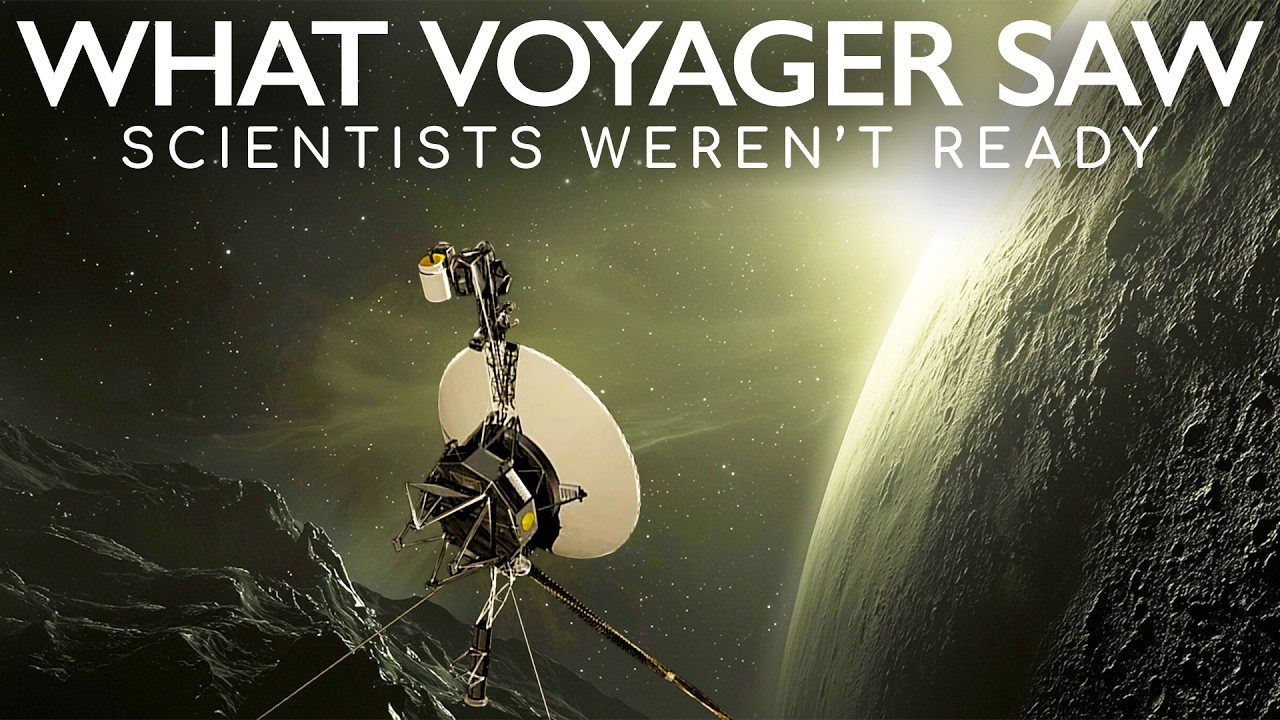
the twin spacecraft Voyager 1 and Voyager 2 have operated in space for 45 years instead of the plan 5 and they're still there transmitting strange signals to earth scientists believe we won't lose contact with the voyagers until 2025 but will they have time to show us anything else is there any chance they're Journey can [Music] continue the Voyager missions were initially launched to reach Jupiter Saturn and the major moons of both planets to photograph them thus thanks to their images scientists were finally able to see the surfaces of the moons around Saturn which had previously
seemed to be just bright dots that was the beginning of a series of discoveries related to one of the moons Enceladus scientists were shocked by the fact that Saturn's moons show geological activity moons are usually covered with craters sort of scars left after collisions these craters do not disappear if a moon is stationary and there's no geological activity on the contrary Enceladus appeared to be smooth like pearls this could mean its forming an atmosphere and one day life could probably originate there today we know that the reason for the smoothness of insolidus Lies elsewhere namely
in cryo volcanism that is the melted ice that covers the satellite ensures the displacement of ice masss and the formation of new ones but in the 70s nobody was aware of this as well as of Jupiter's moon IO before the voyagers it seemed like a tiny ball of rock and ice at a distance of 800 million kilm from the Sun B the legendary probes presented scientists with a different picture there was no ice on iio only raging volcanoes everywhere and the ash plume from the eruption of the largest of them reached a height of 400
km that was the first time active volcanoes had been seen somewhere other than on Earth it turned out that Jupiter's enormous gravity makes the moon's tectonic structures constantly move this results in extreme volcanic activity and magma missions far beyond io's surface the voyagers also showed scientists Jupiter's radiation belts and the neverbe seen planetary Rings they were first spotted by Voyager 1 in 1979 several months later Voyager 2 conducted more extensive Imaging which allowed rough determination of the Ring's structure then it was the turn of Saturn the owner of the most extensive ring system in the
solar system they consist of countless small particles ranging in size from micrometers to meters we know this thanks to NASA's Cassini spacecraft which spent 13 years studying the moon however if the voyagers hadn't captured bizarre interlacing around Saturn scientists would never have sent Cassini the same happened with Saturn's moon Titan the voyagers were the first to notice liquid Seas on Titan and Cassini only confirmed that 40 years later it seemed that after 5 years in Space the Voyager Mission came to an end but luckily it happened otherwise the mission was extended Voyager 2 went to
explore Uranus and Neptune and Voyager 1 headed to the unknown moons of Jupiter but how could they continue the mission if they were only expected to Last 5 Years the twin Voyager probes weigh 773 kg each while newer devices such as the Japanese akatski released in 2010 are at least 200 kg lighter of that total weight each voyage carries 105 kg of scientific instruments these include the Imaging science subsystem or the ISS it consists of two television cameras the first one is wide angle with a low resolution of 200 mm the second camera uses a
narrow angle lens with a higher resolution of 1,500 mm but these Technologies are almost silly compared to what's aboard the James web Space Telescope a camera with several matrices sophisticated prisms and lenses numerous shutters and autonomous mode nevertheless the voyagers made quite a stir even though as the mission moved farther from the Sun the objects in the photos became dimmer the voyagers managed to transmit hundreds of thousands of photos with a storage capacity of only 67 megabytes today you'd hardly be able to make a good Tik Tock video with such a phone memory obviously it
wasn't about the cameras what was it about then power it's totally unlikely each Voyager has three radioisotope thermoelectric generators and the fuel used is plutonium 238 oxide as the isotope of plutonium decays the probe's power decreases as in 2011 it fell by 57% is compared to its launch power the remaining power would be insuff efficient to keep all the subsystems running for so long that's why scientists decided to shut down some of them to save energy this begs the question how did the voyagers manage to get this far from Earth it's all about a carefully
chosen launchtime scientists took advantage of a rare alignment of the outer planets in the late '70s this arrangement of Jupiter Saturn Uranus and Neptune occurs approximately every 170 5 years this allows a spacecraft to follow a particular trajectory and make a four Planet tour for a minimum of propellant to trip time this is the so-called gravity assist when passing each planet the spacecraft uses its gravity to increase its speed and reach its next destination using this technique the flight time to Neptune was reduced from 30 years to 12 Voyager 2 was launched first its trajectory
was developed to fly past Jupiter Saturn Uranus and Neptune Voyager 1 was launched second but on a faster and shorter trajectory it was designed to send the spacecraft closely past Saturn's largest moon Titan at the same time in the '90s Voyager 1 overtook the slower deep space probes Pioneer 10 and Pioneer 11 and became the most distant human-made object from Earth but does this mean we can keep using the voyagers the speed of digital data transmission between the voyagers and Earth is constantly decreasing as the spacecraft travel further from Earth for example when Voyager 2
traveled from Jupiter to Saturn the data transfer rate was haved what can we say about fast data exchange if Voyager 1 is currently at a distance of 185 billion kilom from Earth and Voyager 2 has flown 15 billion km away and they keep moving way at roughly the same speed of over 60,000 kmph however the distance doesn't yet prevent maintaining the connection with the devices the voyagers continue to search for the boundary between the heliosphere the region of our Sun's influence and the interstellar medium and they even send new data Voyager 1 for example managed
to record sounds where there just can't be any sounds it turned out that this noise occurs when the solar wind waves collide with waves coming from other stars in interstellar space this means the Voyager Mission devices help scientists get information about the interstellar medium parameters which just can't be obtained in any other way researchers hope to gain enough info while the voyagers still have fuel however there is a butt Voyager One one seems to have gotten lost in 2022 NASA announced that the readouts from Voyager 1's attitude control system didn't seem to match the spacecraft's
movements scientists assume the probe is confused about its location in space this is how it works the attitude control system sends data about the interstellar medium surrounding the spaceship the signal passes through a giant antenna directed towards our planet but now it only gives Engineers random numbers that don't reflect what's actually happening on board scientists are struggling to understand the nature of the problem if they fail to do it we may lose Voyager 1es sooner than expected the scientist task is Complicated by the fact that the probe is very far away Voyager 1's signals take
20 and 1 half hours to reach Earth and exchanging messages between the space agency and the probe takes 2 days there's another problem back in thousands of employees worked on the Voyager Mission but today there are no more than 20 people working part-time that's too bad because there's still something the voyagers could see when the probes run out of power it doesn't mean they'll get stuck in zero gravity the voyagers use fuel to keep the subsystems running so they'll continue to fly but they'll stop turning the antennas in the right direction and sending signals to
Earth currently the voyagers have moved beyond the influence of the solar wind and after 20,000 years they'll cross the or Cloud a swarm of comets and icy debris orbiting the Sun at a distance of up to 100,000 astronomical units that is 100,000 times the distance from the Sun to the Earth this will be the final destination of the journey through the solar system and although we'll lose contact with the probes by then they'll still be silent ENT Witnesses of space phenomena after 500 million years the voyagers along with the entire solar system will make a
full revolution around the center of the Milky Way you guys know everything in the Galaxy revolves around the center right now it's impossible to predict what will happen on Earth by then but in the past in that amount of time the super continent Pangia formed and collapsed scientists also assume that in G actic orbit the spacecraft will oscillate up and down at the same time Voyager 1 will oscillate more dramatically than his twin according to assumptions Voyager 1 will travel so far above the main dis of the Galaxy that it will see stars at just
half the density as we do from Earth besides the same difference in vertical motion will also shape the differing odds each spacecraft has of survival Yes you heard me right survival the thing is that the Milky Way's vast clouds of Interstellar dust are very dangerous dust will pound into the voyagers at a speed of a few kilm per second even a dust grain only 1,000th of a millimeter across will still leave a small crater these grains will steadily hit the hall which can slowly chip away at the spacecraft skin of course the dust won't change
the trajectory but the gravity of the Milky Way's clouds can easily do it the clouds have so much mass concentrated in one place that they may fling the spacecraft into new orbits sometimes much farther out sometimes even deeper towards the galactic core in this sense Voyager 1 is at a greater risk its vertical oscillations mean the spacecraft will spend more time above and below the galactic plane where the clouds are thickest but despite the potential dangers the voyagers will probably have time to visit us another star Voyager 1 will move to the constellation ucus and
millions of years later the probe will say hi to a red dwarf named gisa 445 in the constellation Camelo parales meanwhile Voyager 2 will reach the constellation Sagittarius and visit a star named Ross 248 it could also be that the voyagers will see stars that haven't been born yet but why should we care whether the voyagers will meet them if we no longer exist by that time we actually should because the probes carried valuable cargo destined for distant civilizations two golden records with a collection of information about humanity and our home planet they contain photos
of Earth sounds of animals and birds and words in various languages it also contains the location of our solar system in relation to Pulsar stars and even instructions on how the record is to be played this seemingly frivolous idea may well be the last proof of our existence because the records were designed to last billions of years in space under the gold plating there's a protective aluminum cover and beneath it there are engraved copper discs for additional protection of the records they were placed on the voyagers so that the Engravings would be hidden if the
records survive they'll last about 5 billion years no more why because after this period there'll be the great Andromeda Milky Way collision and the fate of the voyagers depends on the conditions of this merger will they be able to survive if the devices survive they can live on for trillions of years that's long enough to enter genuinely unexplored Space by that time Stars will exhaust their fuel and the star formation processes in the universe will completely cease the voyagers would drift in a universe that would be absolutely unrecognizable to us populated by black holes and
the remnants of neutron stars [Music]



![The Voyage Beyond the Solar System [4K]](https://img.youtube.com/vi/ZzglosGjrlM/maxresdefault.jpg)
![The Insane Science of Neutron Stars [4K]](https://img.youtube.com/vi/qX6h72IyKSo/maxresdefault.jpg)